
UBO and KYC records are not just paperwork for a UAE company. They are the evidence trail that shows who owns the company, who controls it, how funds move through it, and why the structure exists. For founders, family offices, holding companies and international groups, weak records can slow down bank account opening, trigger repeated document requests, or create avoidable compliance exposure.
In 2026, UAE registrars, free zones, banks and professional service providers expect ownership and control information to be clear, current and consistent. This is especially important for structures involving foreign shareholders, nominee arrangements, layered entities, RAK ICC offshore companies, RAKEZ free zone entities, trusts, foundations or cross-border holding vehicles.
The goal is not to create a large archive that nobody uses. The goal is to maintain a practical, audit-ready file that can answer three questions quickly: who ultimately owns the company, who actually controls it, and what evidence supports that conclusion?
Why UBO and KYC records matter in the UAE
Ultimate Beneficial Owner records identify the natural person or persons who ultimately own or control a UAE entity. KYC records go wider. They support due diligence by explaining the shareholders, directors, managers, business activity, source of funds, source of wealth, transaction profile and risk factors around the company.
The two record sets overlap, but they are not the same. A UBO register may satisfy a statutory filing requirement, while a KYC file is what a bank, registrar, corporate service provider or counterparty may use to assess whether the structure is legitimate and understandable.
This distinction matters because beneficial ownership transparency is a global compliance priority. The Financial Action Task Force has repeatedly emphasized that legal persons can be misused when ownership and control are opaque. UAE authorities have therefore strengthened expectations around UBO identification, AML/CFT controls and record keeping.
| Record type | Main purpose | Typical users | Practical question it answers |
|---|---|---|---|
| UBO register | Identifies ultimate natural-person ownership or control | Registrar, free zone, compliance teams | Who ultimately owns or controls the entity? |
| KYC file | Supports due diligence and risk assessment | Banks, service providers, auditors, counterparties | Is the company’s structure, activity and funding profile credible? |
| Governance records | Evidence decisions and authority | Directors, shareholders, banks, regulators | Who approved what, and under which authority? |
For a deeper explanation of what is visible in the UAE regime, who can access the register and how penalties work, Alldren’s guide to the UAE’s UBO register and penalties for non-compliance is a useful companion to this practical record-keeping framework.
Build one source of truth for ownership and control
The most common UBO and KYC problem is inconsistency. A shareholder percentage appears one way in the trade license file, another way in a bank form, and a third way in an internal ownership chart. A passport has been renewed, but the old copy remains in the bank file. A company has changed its manager, but the KYC pack still shows the previous signatory.
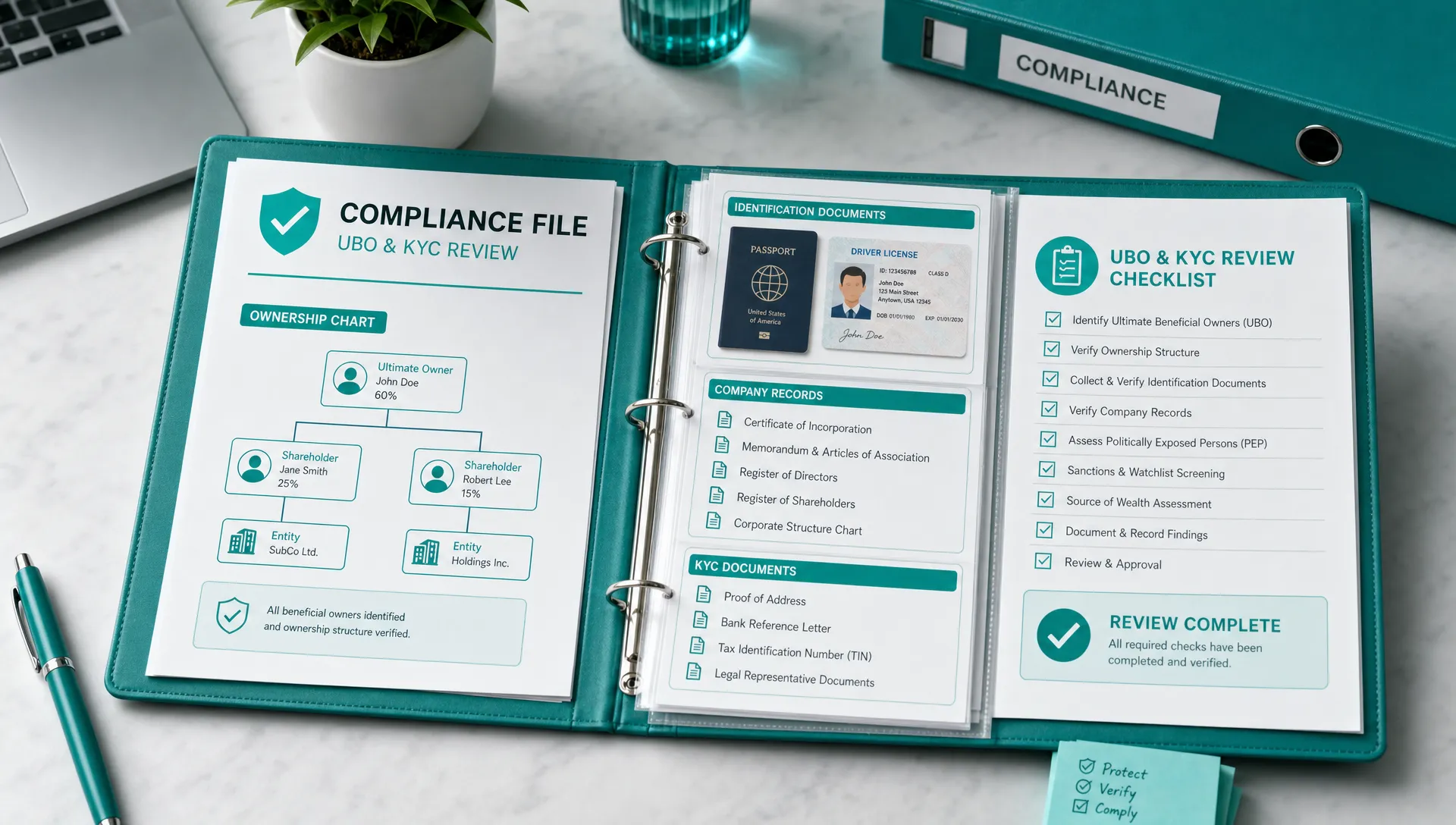
To avoid this, maintain one controlled master file for the company. This file should include the current ownership chart, constitutional documents, licenses, registers, resolutions, UBO details, director and manager details, bank signatory information and supporting KYC evidence.
For UAE business incorporation and ongoing compliance, the ownership chart should show every layer between the UAE company and the ultimate natural persons. If an intermediate shareholder is a foreign company, include its incorporation documents, register of shareholders, register of directors or equivalent evidence. If the chain includes a foundation, trust, nominee shareholder or holding vehicle, document the control logic rather than only the legal title.
A good ownership chart should be simple enough for a bank analyst to understand without a conference call. It should show names, jurisdictions, ownership percentages, voting rights and control rights. If control is exercised through contractual rights, reserved matters, shareholder agreements or appointment rights, those facts should be referenced clearly.
Apply a clear UBO determination method
A UBO is generally a natural person who ultimately owns or controls the company, whether directly or indirectly. Ownership thresholds, voting rights, rights to appoint or remove management, and other means of control may all be relevant. In many UAE contexts, a 25 percent ownership or control threshold is a key reference point, but the analysis should not stop at shareholding percentages.
For straightforward companies, the answer may be obvious. If one individual owns 100 percent of the shares, the UBO record is simple. The challenge appears when ownership is layered, split across family members, held through offshore companies, or managed through nominee or fiduciary arrangements.
Best practice is to write a short UBO determination note for every company, even when the structure looks simple. This note should explain:
- Who the direct shareholders are.
- Who the ultimate natural-person owners are.
- Whether anyone controls the company through voting rights, appointment rights, agreements or other arrangements.
- What documents were reviewed to reach the conclusion.
- Whether any senior managing official has been identified because no individual UBO can be determined.
This note is useful because it records the reasoning at the time. If a bank, free zone, auditor or regulator asks why a person was listed as UBO, the company does not need to reconstruct the analysis months later.
Keep the KYC file bank-ready, not just regulator-ready
Many companies prepare UBO records for filing, then discover that banks ask for much more. A UAE bank may want to understand the commercial purpose of the structure, source of funds, expected counterparties, countries of trade, shareholder background and transaction volumes. This is not unusual. Banks are required to assess AML/CFT risk, not simply collect incorporation documents.
A practical KYC file should contain documents for both the company and the individuals behind it. For individuals, this usually includes passport copies, Emirates ID and UAE visa where applicable, proof of address, contact details, professional background, tax residency information where relevant, and source-of-wealth evidence. For companies, it should include incorporation documents, licenses, constitutional documents, registers, ownership charts, board or shareholder resolutions, lease or office evidence where applicable, and a clear business activity description.
Source-of-funds and source-of-wealth evidence should be treated carefully. A one-line explanation such as “personal savings” is often not enough for a high-value structure. Better evidence may include sale agreements, dividend statements, salary records, audited financial statements, investment portfolio statements, inheritance documents, or historic business ownership records, depending on the facts.
If corporate bank account opening is part of the plan, the KYC file should be assembled before approaching banks, not after the first rejection or delay. Alldren’s guide on how to prepare a bank-ready UAE company file explains how banks typically review ownership, activity and control information.
Use update triggers, not annual panic
UBO and KYC records should not be updated only at license renewal or when a bank asks. The strongest compliance systems use event-based triggers. Whenever a relevant fact changes, the company reviews whether the UBO register, KYC file, bank file, corporate records or registrar filings need to be updated.
The exact filing deadline can depend on the authority, entity type and nature of the change, so companies should confirm the applicable rule for their license or structure. As a practical internal standard, treat any ownership, control, director, manager, signatory or key identity-document change as urgent and review it immediately.
| Trigger event | What to review | Why it matters |
|---|---|---|
| Share transfer or new shareholder | UBO register, ownership chart, shareholder register, bank file | Ownership and control may have changed |
| Passport, Emirates ID or address change | KYC documents, bank records, internal registers | Outdated identity records create avoidable queries |
| New director, manager or signatory | Governance records, authority matrix, bank mandate | Banks and counterparties need current authority evidence |
| New nominee or fiduciary arrangement | UBO analysis, control note, supporting agreements | Legal ownership may differ from effective control |
| New business activity or market | KYC risk profile, license scope, bank transaction profile | Activity must match expected inflows and outflows |
| Change in source of funds | Bank narrative, supporting evidence, transaction forecast | Unexplained funding can delay onboarding or payments |
This approach reduces the risk of a rushed, incomplete update when a bank requests a refreshed KYC pack or a registrar asks for confirmation.
Align names, numbers and narratives across every file
In UAE compliance work, small inconsistencies can create large delays. A middle name omitted from one form, a different transliteration of an Arabic name, a mismatch between the license activity and the bank narrative, or an unexplained holding company in the ownership chain can lead to follow-up questions.
The best practice is to reconcile the file before submission. Check that names match passports and corporate documents, ownership percentages total correctly, dates are consistent, and the company’s business activity is described the same way across incorporation, bank, tax and commercial documents.
This is particularly important for Ras Al Khaimah company formation and structures involving RAK ICC offshore or RAKEZ free zone entities. Offshore and free zone companies can be highly effective when properly structured, but banks and counterparties will still expect a clear commercial rationale, verified UBOs and a coherent document trail.
The same principle applies to tax and accounting posture. KYC records should not contradict corporate tax registration, VAT analysis, bookkeeping records or management accounts. If the company states that it is a holding company, its bank activity should not look like an operating trading company without explanation. If it states that it provides consulting services, contracts, invoices and expected counterparties should support that narrative.
Protect sensitive data with proper access controls
UBO and KYC files contain passports, addresses, tax details, wealth evidence, signatures and corporate control information. Treat them as sensitive records, not general admin documents.
Access should be limited to people who need the information for compliance, governance, banking, tax or legal purposes. Keep a version-controlled folder, avoid circulating personal documents in long email chains, and maintain a record of what has been shared with banks, free zones, service providers and counterparties.
Good data hygiene also means removing duplicates, marking outdated documents as superseded and keeping expiry reminders for passports, Emirates IDs, visas, licenses and key agreements. When a bank asks for the “latest KYC,” the company should know which version is current.
Assign ownership of the compliance process
UBO and KYC records often fail because nobody owns them. The founder assumes the corporate service provider has everything. The accountant assumes the bank has the latest ownership chart. The bank assumes the company will volunteer changes. This creates gaps.
Assign a clear internal owner, even if external advisers support the process. For a small company, this may be the founder or finance lead. For a larger group, it may sit with legal, compliance or corporate governance. The responsible person should maintain the master file, track update triggers, coordinate filings, and ensure that bank and corporate records remain aligned.
For new companies, UBO and KYC setup should be part of the initial compliance architecture, not an afterthought. Alldren’s first-year UAE compliance checklist is a helpful reference for integrating UBO records with licensing, tax, accounting and governance obligations.
Practical UAE UBO and KYC record checklist
A well-maintained file does not need to be complicated. It needs to be complete, current and explainable. At minimum, review whether your company has:
- A current ownership chart showing all layers up to the ultimate natural persons.
- A written UBO determination note explaining ownership and control.
- Up-to-date passports, Emirates IDs and visas where applicable for UBOs, directors, managers and signatories.
- Evidence of source of funds and source of wealth proportionate to the company’s profile.
- Current licenses, constitutional documents, registers and resolutions.
- A clear business activity narrative aligned with the license and expected bank transactions.
- A record of filings, updates and documents shared with authorities, banks and service providers.
- A review calendar for document expiry dates and annual KYC refreshes.
If any of these items are missing, the company may still be operational, but it is not fully bank-ready or audit-ready.
Frequently Asked Questions
How often should UAE UBO and KYC records be updated? They should be reviewed at least annually and whenever there is a material change in ownership, control, directors, managers, signatories, identity documents, business activity or source of funds. Do not wait for a bank or registrar to ask.
Is the UBO always the person who owns the most shares? Not always. Shareholding is important, but control can also arise through voting rights, appointment rights, agreements, nominee arrangements or other means. A company should document both ownership and control.
Do offshore company UAE structures need UBO records? Offshore structures are not outside compliance expectations. RAK ICC offshore companies and other offshore vehicles are commonly asked to provide ownership and control evidence by registrars, banks and counterparties.
What is the difference between KYC and UBO records? UBO records identify the ultimate natural persons who own or control the entity. KYC records are broader and may include identity documents, business rationale, source of wealth, source of funds, expected transactions and risk information.
Can poor UBO records delay UAE bank account opening? Yes. Banks need to understand ownership, control, activity and funding before approving a corporate account. Inconsistent or incomplete UBO and KYC records are a common cause of delays and follow-up requests.
Build your UAE structure on records that can stand up to review
Strong UBO and KYC records are a practical advantage. They make banking smoother, reduce compliance friction, support corporate governance and give founders confidence that their UAE company structure can withstand review.
If you are planning company setup in the UAE, restructuring an existing entity, or maintaining a more complex holding or offshore structure, Alldren provides expert-led corporate services in the UAE, including tailored structuring, compliance management, bank account opening support, governance and ongoing company administration. The right records from day one are easier, and safer, than repairing gaps later.