
Many founders treat incorporation as the finish line: choose a jurisdiction, obtain a license, open a bank account, then deal with compliance later. In the UAE, that order can create avoidable friction. Banks, tax authorities, free zones, mainland departments, immigration systems and counterparties all expect your company story to be consistent from the beginning.
A company that is built with compliance from day one is easier to explain, easier to bank, easier to maintain and easier to scale. That does not mean overcomplicating your structure. It means making each early decision with its future obligations in mind.
For UAE founders, investors and private clients, the goal is simple: build a company that matches the real business, keeps clean records, satisfies regulatory expectations and remains manageable after incorporation.
Compliance from day one is a design decision
Compliance is often misunderstood as an annual renewal task or a file of documents requested by a bank. In reality, compliance starts before the incorporation application is submitted.
Your company’s jurisdiction, legal form, licensed activities, ownership structure, management powers, tax posture, banking profile and recordkeeping process all create obligations. If these elements are not aligned, the company may still be formed, but it can become difficult to operate.
For example, a UAE free zone company licensed for consultancy should be able to explain its actual consulting activity, clients, contracts, invoices and payment flows. A RAK ICC offshore company may be suitable for holding assets or shares, but it is not the same as an operating company with staff, visas and local commercial activity. A RAKEZ free zone entity can be a strong option for many businesses, but it should still match the founder’s operating model, banking needs and tax position.
The important point is not that one structure is always better than another. The point is that the structure must fit the facts.
If you are still comparing mainland, free zone and offshore routes, Alldren’s guide to building a company in the UAE the right way provides a broader foundation for thinking through those choices.
Why early decisions become future compliance issues
A company setup decision made quickly can create years of administrative pressure. This is especially true in the UAE, where regulators and banks place significant emphasis on transparency, beneficial ownership, source of funds, real activity and tax registration.
The most common problems are not always dramatic. They often begin with small mismatches:
- The license activity does not accurately describe the real business.
- The ownership structure is legal but poorly documented.
- The bank application tells a different story from the incorporation file.
- The company starts invoicing before basic bookkeeping is in place.
- The founder assumes a free zone company has no tax obligations.
- The company uses service providers, nominees or signatories without clear governance records.
These issues can lead to delays in bank account opening, repeated KYC questions, poor audit readiness, missed tax registrations, renewal problems or difficulty adding investors later.
In practical terms, compliance from day one means your company should be able to answer three questions at any time: who owns and controls it, what does it actually do, and where is the evidence?
The day-one compliance framework for a UAE company
A strong company setup UAE process should connect commercial planning with compliance planning. Before choosing a jurisdiction or filing incorporation documents, founders should map the company’s real operating profile.
| Day-one decision | Compliance question to ask | Risk if ignored |
|---|---|---|
| Jurisdiction | Will the company operate locally, internationally, online or as a holding vehicle? | Wrong setup for banking, visas or contracts |
| License activity | Does the activity match actual revenue-generating work? | KYC issues, renewal friction or activity restrictions |
| Ownership | Can ultimate beneficial owners be clearly identified and documented? | UBO record gaps and bank concerns |
| Management powers | Who can sign contracts, open accounts and bind the company? | Disputes, weak governance and inconsistent bank mandates |
| Tax posture | Is the company ready for Corporate Tax, VAT monitoring and accounting records? | Late registration, inaccurate filings or poor audit trail |
| Banking profile | Can the company explain source of funds, customers, suppliers and transaction flows? | Bank rejection, delays or account restrictions |
| Ongoing administration | Who tracks renewals, filings, tax dates, visas and corporate records? | Missed deadlines and reactive compliance |
This framework is simple, but it changes the quality of the company. It turns incorporation from a document exercise into a controlled corporate build.
Choose the structure that matches the business, not the cheapest license
Cost matters, especially for early-stage founders. But the lowest initial setup cost is not always the lowest total cost. If the company cannot bank, invoice properly, employ people, hold assets or satisfy tax and governance requirements, the founder may end up restructuring later.
A mainland company may make sense for businesses that need direct UAE market access, government contracts or certain regulated activities. A free zone company may be appropriate for international trade, services, digital businesses, holding activities or specific sector ecosystems. An offshore company UAE structure may be useful for holding, succession or asset ownership, but it is not a substitute for an operating license.
Ras Al Khaimah company formation options illustrate this distinction well. RAKEZ free zone companies and RAK ICC offshore companies are both established UAE structures, yet they serve different purposes. One founder may need a RAKEZ entity for a commercial activity with visas and a UAE bank account. Another may need a RAK ICC vehicle as part of a wider holding structure. The compliance analysis is different in each case.
The right question is not “Which jurisdiction is easiest?” It is “Which jurisdiction makes the business easiest to explain, operate and maintain?”
Build your tax and accounting posture before the first invoice
Tax compliance should not begin at year-end. It should begin when the company is designed.
The UAE Corporate Tax regime applies to financial years starting on or after 1 June 2023, and companies must assess registration, filing and recordkeeping obligations under the framework administered by the UAE Federal Tax Authority. VAT also remains relevant for businesses that meet, or expect to meet, the applicable taxable supply thresholds.
Even if a company has limited activity in its first months, it should still maintain clean financial records. That means keeping incorporation documents, bank statements, invoices, contracts, expense evidence, shareholder funding records and accounting ledgers in an organized way.
A practical day-one accounting posture includes clear answers to these questions:
- What is the company’s financial year?
- Who is responsible for bookkeeping?
- How will shareholder loans or capital injections be recorded?
- When should VAT registration be assessed?
- What information will be needed for Corporate Tax registration and filing?
- Are related-party transactions or intercompany arrangements expected?
The best time to build this system is before transactions become numerous. Once records are messy, reconstruction becomes more expensive and less reliable.
Prepare the company for banking before approaching the bank
Bank account opening is one of the areas where day-one compliance has the most visible impact. UAE banks do not only look at incorporation documents. They evaluate the commercial rationale, ownership profile, source of funds, expected transactions, counterparties and consistency of the overall file.
A strong banking file usually includes a clear business description, ownership documents, manager or director authority, expected account activity, contracts or pipeline evidence where available, source-of-funds information and a coherent explanation of why the UAE company exists.
For a deeper look at this topic, Alldren has a dedicated guide on how to build your company for banking and compliance, including how structure, documentation and business rationale affect the banking process.
The principle is straightforward: the bank should not have to guess what the company does. Your documents, license, website, contracts and founder explanation should all tell the same story.
Put governance in place before decisions become informal
Corporate governance does not need to be heavy or bureaucratic. For many owner-managed companies, it simply means documenting key decisions and ensuring the right people have the right authority.
At a minimum, a company should maintain reliable corporate records, including constitutional documents, shareholder details, beneficial ownership information, director or manager appointments, resolutions, powers of attorney, bank mandates and major commercial approvals.
As the company grows, governance may need to become more formal. This is especially true when there are multiple shareholders, investors, nominee director arrangements, holding companies, intercompany loans, regulated activities or cross-border assets.
Nominee director services, where used, should be approached carefully and transparently. The purpose should never be to hide control or mislead banks or authorities. Proper documentation, clear authority limits and accurate beneficial ownership records are essential.
Good governance protects the company and the people behind it. It reduces disputes, supports banking reviews and creates a clean record for investors, auditors and regulators.
Turn compliance into a calendar, not a crisis
After incorporation, the company enters a cycle of renewals, filings, updates and monitoring. The exact obligations depend on the jurisdiction, activity, tax profile, staff, visas and structure, but the operating principle is the same: assign ownership and track deadlines.
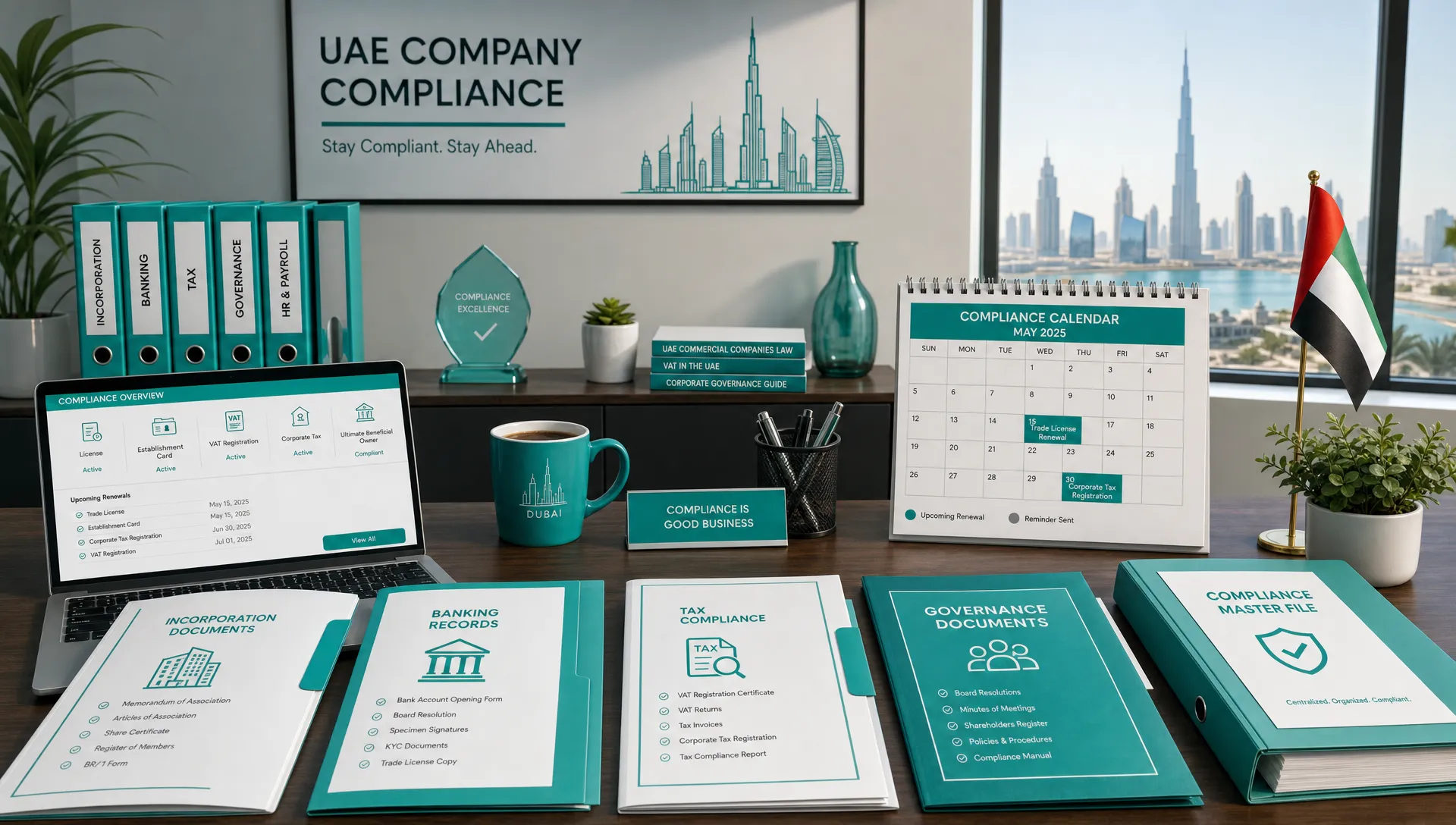
A reliable UAE compliance calendar should cover trade license renewals, lease or flexi-desk renewals where applicable, establishment card and visa dates, UBO and corporate record updates, accounting close processes, Corporate Tax obligations, VAT monitoring or filings, bank KYC reviews and changes to shareholders, managers or business activities.
This does not have to be complex. A simple system is enough if it is maintained consistently. The problem is not that founders cannot manage compliance. The problem is that compliance tasks are often scattered across email inboxes, portals, advisors and memory.
For a practical first-year reference, use a Compliance UAE Checklist for New Companies to make sure the basics are not missed after setup.
Common mistakes to avoid when building a company
Most compliance problems are preventable. The founders who avoid them usually take more time at the planning stage and keep better records from the beginning.
Common mistakes include choosing a license because it is cheap rather than appropriate, using vague activity descriptions, delaying bookkeeping until tax season, assuming bank approval is automatic, failing to document shareholder funding, forgetting to update UBO or manager records, treating nominees as informal arrangements, and ignoring the difference between an operating company and a holding company.
Another major mistake is separating setup advice from ongoing administration. A provider may incorporate the company quickly, but if the structure is hard to bank, tax-register or maintain, the founder inherits the problem.
The better approach is to design incorporation, banking, tax, governance and administration as one connected system.
How expert-led corporate services reduce risk
Professional corporate services UAE support should do more than file forms. It should help founders make decisions that remain defensible after the license is issued.
That includes selecting the right jurisdiction and legal form, aligning licensed activities with the real business, preparing ownership and governance documentation, supporting bank account opening, planning visas where relevant, organizing bookkeeping and tax registration, and maintaining the company after incorporation.
For founders, the value is not only convenience. It is confidence that the company has been built with the right logic, records and compliance posture from the start.
Frequently Asked Questions
What does it mean to build a company with compliance from day one? It means designing the company’s structure, license, ownership, tax posture, banking file and governance records before incorporation, rather than trying to fix gaps after the company is formed.
Does every UAE company need Corporate Tax registration? Most UAE companies should assess Corporate Tax registration and filing obligations early, including free zone companies. Specific treatment depends on the company’s facts, activities and status, so founders should take advice before assuming they are outside the regime.
Is a free zone company always easier to keep compliant? Not always. A free zone company can be efficient and appropriate, but only if the jurisdiction, license activity, banking profile, visa needs and tax position match the real business.
Can a RAK ICC offshore company be compliant? Yes, when used for the right purpose, such as a holding or asset ownership structure, and when ownership, control, records and banking expectations are properly documented. It should not be treated like an operating UAE trading company.
When should bookkeeping start for a new UAE company? Bookkeeping should start with the first transaction, including capital contributions, shareholder loans, incorporation costs, bank fees, invoices and expenses. Early records make tax, banking and governance much easier.
Build the company you can operate with confidence
A compliant company is not created by paperwork alone. It is created by clear decisions, accurate records and a structure that matches reality.
If you are planning UAE business incorporation, Alldren provides expert-led support for company setup, structuring, compliance management, governance, banking support, visas, bookkeeping and tax registration. The aim is to help you build the company properly from day one, so it remains robust after incorporation.
Start with a structure that banks, regulators and your future self can understand. Speak with Alldren about building your UAE company with compliance at the core.