

Opening a corporate bank account in the UAE can feel deceptively simple from the outside: you have a trade license, you have shareholders, you have a business plan, so you should get an account. In practice, banks apply strict onboarding standards and detailed KYC (Know Your Customer) and AML (anti money laundering) checks that can slow things down if your file is incomplete or inconsistent.
This checklist is designed to help you prepare a bank-ready application package, understand what banks are really validating, and avoid the most common rejection triggers for business bank account opening in the UAE.

Why UAE business bank account opening is rigorous
UAE banks are regulated and supervised, and they are expected to apply robust controls for customer onboarding, transaction monitoring, and risk assessment. In other words, your application is not just “documents”, it is a risk case the bank must be able to justify.
Two practical implications:
- Expect enhanced due diligence if the ownership chain is complex, if shareholders reside abroad, if the activity is considered higher risk, or if expected transactions involve multiple jurisdictions.
- Expect consistency checks across your license activity, website, invoices/contracts, source of funds narrative, and the personal profiles of shareholders and directors.
Even though the UAE has strengthened its compliance framework substantially in recent years (including its removal from the FATF “grey list” in early 2024, see FATF February 2024 plenary outcomes), banks continue to apply conservative onboarding standards.
Before you start: align your corporate setup with bank expectations
A bank account is easier to open when the underlying company setup is “bankable”. Before compiling documents, sanity-check the basics.
1) Your licensed activity matches your real operations
Banks compare:
- Trade license activity and any side approvals
- Website and marketing claims
- Contracts, invoices, and counterparties
- Expected transaction flows (countries, currencies, volumes)
If your company will operate differently than the license suggests, fix the structure first. Otherwise, your application can stall in compliance queries.
2) Your ownership and control structure is clear
Banks need to identify the UBO(s) (ultimate beneficial owner(s)) and understand who controls the company. If you have:
- A holding company shareholder
- Multiple layers across jurisdictions
- Trusts, foundations, or nominee arrangements
…plan for extra documentation and extra time.
3) Your “economic substance” story is credible
Banks increasingly look for signs that your company has genuine operations and governance, for example:
- Office address (even flexi desk, where applicable)
- Local phone number and domain email
- Contracts in pipeline or signed
- Relevant experience of shareholders/directors
This is not about “having a big office”, it is about making your business profile understandable and defensible.
Business bank account opening in the UAE: a practical checklist
Use the checklist below to build a complete onboarding file. Requirements vary by bank and by risk profile, but these items cover what most relationship managers and compliance teams ask for.
A) Company documents (core)
Have clear PDF scans (and originals available if requested).
- Trade license (valid)
- Certificate of incorporation/registration
- Memorandum and Articles of Association (MOA/AOA) or equivalent constitutional documents
- Shareholder register (or equivalent)
- Board resolution authorizing account opening and naming authorized signatories (as required)
- Specimen signatures for authorized signatories (as required)
- Office lease/Ejari or free zone lease agreement (as applicable)
B) Owner and management KYC (for each relevant person)
For each shareholder, UBO, director, and authorized signatory (as requested by the bank):
- Passport copy
- UAE Emirates ID (if resident)
- UAE residence visa page (if applicable)
- Proof of address (commonly: utility bill or bank statement, usually recent)
- Personal bank statement(s) (often 3 to 6 months, depending on profile)
- CV or LinkedIn profile and a short background summary (commonly requested for non-trivial profiles)
C) Business profile and supporting evidence
This is where many applications become “slow”, because it is not only documents, it is your business narrative.
- Company profile (what you do, who you serve, where you operate)
- Website, domain email, and any marketing collateral
- Key contracts, signed client agreements, purchase orders, or invoices (where available)
- Supplier list and customer list (sometimes requested)
- Explanation of expected monthly activity (incoming/outgoing volumes, average ticket size, countries, currencies)
- Source of funds and source of wealth explanation (for owners/UBOs, as applicable)
D) Compliance and tax-related disclosures (as applicable)
Banks may ask for disclosures related to international reporting regimes and risk screening.
- FATCA and CRS self-certification forms (common if there are foreign tax residencies)
- Any group structure chart showing all entities and UBOs
- Sanctions/PEP declarations (typically embedded in onboarding forms)
E) Application execution (what to do, in order)
- Shortlist 2 to 4 suitable banks based on your profile (activity, shareholder residency, expected volumes).
- Prepare a single consolidated onboarding pack (clean filenames, consistent data, no missing pages).
- Ensure your company profile and transaction narrative are written clearly, in plain language.
- Submit through the bank’s relationship manager or an approved introduction route.
- Respond quickly to compliance queries, and keep answers consistent with your original narrative.
Document checklist by entity type (quick reference)
This table helps you confirm you have the “usual suspects”. Banks can still ask for more depending on the risk rating.
| Entity type | Documents banks commonly expect (in addition to KYC IDs) | Notes |
|---|---|---|
| UAE mainland company | Trade license, MOA/AOA, shareholding documents, lease/Ejari | Some banks focus heavily on office/operations proof. |
| UAE free zone company | Trade license, incorporation certificate, constitutional docs, lease agreement | Free zone format varies, confirm the exact “company docs set” issued by your zone. |
| UAE branch | Parent company documents, branch registration, authorization of signatories | Expect deeper due diligence on the parent and group structure. |
Choosing the right bank: what to evaluate (beyond fees)
In the UAE, “best bank” depends on your risk profile and operating model. A high-volume trading company, a consultancy, and a holding company can receive very different onboarding treatment.
Key evaluation criteria to discuss before submitting a full application:
| What to evaluate | What to ask the bank | Why it matters |
|---|---|---|
| Risk appetite for your activity | “Do you onboard companies doing X with cross-border payments to Y?” | Misalignment here is a top cause of slow or failed onboarding. |
| Shareholder/UBO residency | “Do you require a UAE resident signatory or UBO visit?” | Some profiles trigger mandatory in-person verification. |
| Minimum balance requirements | “What is the minimum monthly average balance and penalties?” | Helps avoid unexpected monthly fees. |
| Supported currencies and transfers | “AED only, or multi-currency? SWIFT capabilities? Cut-off times?” | Impacts international trade and cash management. |
| Online banking and approvals | “How are maker-checker workflows handled?” | Important for governance and internal controls. |
| Account purpose fit | “Operating account, escrow-like needs, holding company account?” | The wrong account framing can trigger compliance concerns. |
Tip: If your business model involves international clients and suppliers, be ready to explain why the UAE account is operationally required (billing, settlement, local presence), not just “convenience”.
Common reasons applications get delayed or rejected (and how to prevent them)
Banks rarely reject with a single blunt reason. More often, an application “dies in back-and-forth” until it is closed. These are recurring triggers.
Inconsistencies across documents and narrative
Examples:
- License says “consultancy” but website markets “trading”
- Expected monthly turnover stated in the form does not match the business plan
- Ownership percentages differ across MOA, registry, and structure chart
Prevention: build one master fact sheet (company name, license number, address, UBOs, percentages, signatories, expected volumes) and keep everything aligned.
Insufficient proof of business activity
New companies often have limited history. That is normal, but banks still want evidence that the activity is real.
Prevention: provide what you have (pipeline contracts, proposals, signed agreements, supplier correspondence), and clearly state what is “signed” versus “planned”.
Unclear source of funds or source of wealth
If capital is coming from abroad, if shareholders have diverse income sources, or if the structure includes holdings, banks may require a clearer explanation.
Prevention: prepare a short written explanation and supporting documents (for example, salary certificates, dividends evidence, sale of business documents, audited financials for parent companies, as applicable).
Higher-risk geographies or counterparties
Cross-border flows involving sanctioned jurisdictions, high-risk countries, or high-risk sectors can increase onboarding friction.
Prevention: disclose expected countries transparently and prepare a compliance-friendly explanation of counterparties and trade flows.
Lack of responsiveness after submission
Compliance teams often work with deadlines. Slow replies can push an application out of the queue.
Prevention: assign one person to coordinate replies, and respond within 24 to 48 hours where possible.
Timeline: how long does UAE business bank account opening take?
There is no single “standard” timeline, because it depends on bank workload, your risk rating, and how complete your file is. But you can plan realistically:
- Preparation time (you control this): often a few days to 2 weeks, depending on how quickly you can gather KYC and business proof.
- Bank review time: often a few weeks for straightforward cases, longer for complex ownership, international profiles, or higher-risk activities.
Two practical ways to reduce delays:
- Submit a clean file the first time (single PDF pack or well-organized folder, readable scans, consistent names).
- Provide a clear transaction narrative upfront (what you sell, to whom, from where, typical invoice amounts, expected monthly totals).
Practical “bank-ready” packaging tips
Small details can cause large delays. These are simple, high-impact improvements:
- Use the exact legal name as on the license, including punctuation and abbreviations.
- Keep documents readable, in color, with all corners visible.
- Avoid screenshots for proofs when a PDF statement is available.
- Ensure proof of address documents are recent (banks often prefer recent issuance).
- Use a professional domain email that matches your website and company name.
When expert support makes a difference
If your case includes a multi-layer structure, multiple nationalities, a regulated activity, or meaningful cross-border flows, it often helps to have an experienced team shape the narrative and pre-check the file before submission.
Alldren supports clients with UAE corporate services, including business bank account opening support, company structuring, compliance, and ongoing corporate governance. If you want a second set of eyes on your onboarding pack (especially the structure chart, UBO narrative, and transaction flow explanation), you can explore Alldren’s approach at alldren.com.
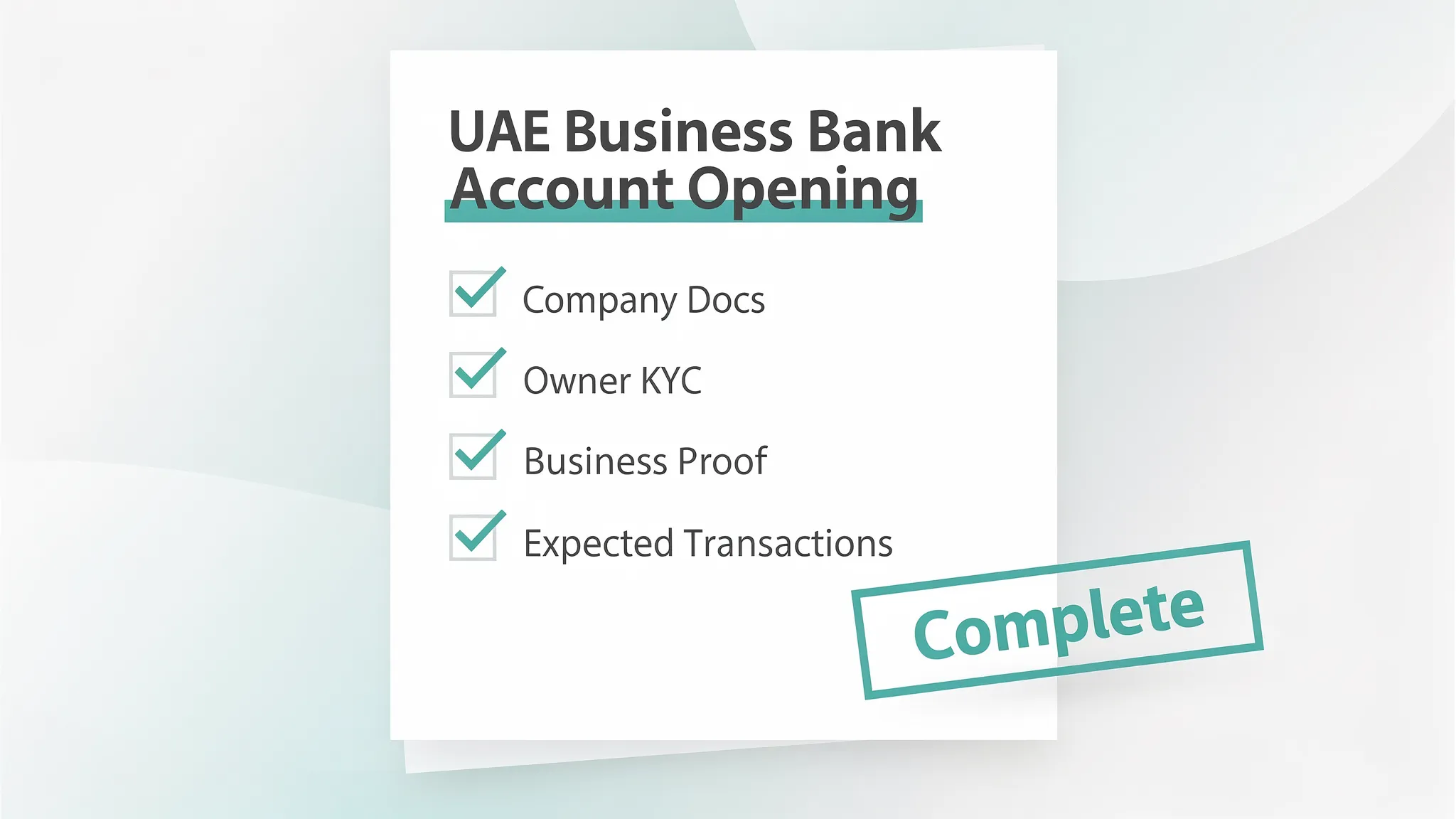
Final pre-submission check
Before you hit submit, make sure you can answer these clearly in one page:
- What does the company do, and is that aligned with the license?
- Who are the UBOs, and how does the ownership chain work?
- Where will money come from, and where will it go (countries, counterparties, monthly totals)?
- What evidence shows the business is active or actively launching?
If those answers are consistent with your documents, you will dramatically improve your odds of a smooth, faster business bank account opening in the UAE.


