

Setting up in a UAE free zone can be one of the fastest and most predictable ways to launch a business in the Emirates, but only if you treat it like a structured project. The “free zone” part is not just marketing, it affects your licensing, where you can trade, what office requirements apply, your visa quotas, and the compliance you must maintain after incorporation.
This guide walks you through company formation in UAE free zone step by step, with the key decisions, documents, and common pitfalls to watch for.
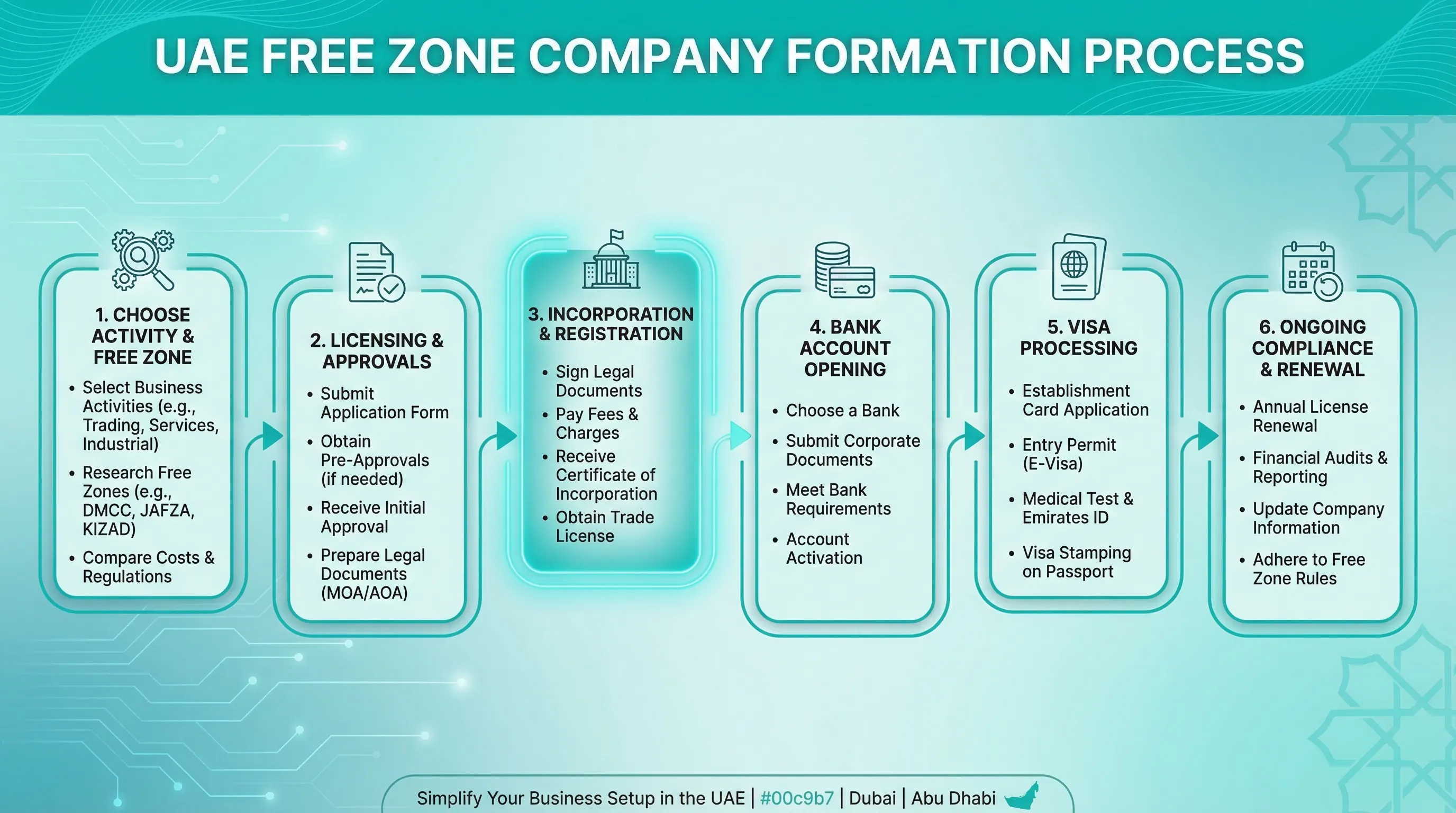
What “UAE free zone company” means (in practical terms)
A free zone company is a legal entity incorporated within one of the UAE’s designated free zones, each with its own authority, rulebook, and licensing catalog. Free zones are popular for international trading, services, tech, consulting, holding structures, and many regulated or semi regulated activities that benefit from a clear, packaged setup process.
A few practical realities to keep in mind:
- Your license is activity specific. You are approved to do what your license states, not “anything business-related.”
- Office and facility rules vary by free zone. Some require physical space, others allow flexi-desk or shared offices depending on activity.
- Visa eligibility is linked to your package. Visa quotas often depend on leased space, activity, and the free zone’s rules.
- You still have ongoing compliance. Incorporation is the beginning, not the finish line.
If you are evaluating whether free zone is right for your goals (versus mainland or an offshore structure), you may want an advisor to stress test your plan before you commit to a jurisdiction and license category.
Step 1: Define your business activity and operating model
Start by writing a one-paragraph “operating model” that answers:
- What will you sell, to whom, and where are your customers located?
- Will you invoice UAE clients, international clients, or both?
- Will you need employees in the UAE in the first 3 to 12 months?
- Do you need a warehouse, desk, clinic, lab, studio, or is remote fine?
This step drives everything else: license type, free zone choice, office requirements, and (in some cases) additional regulator approvals.
Step 2: Choose the right free zone (not just the cheapest)
Different free zones are optimized for different sectors, facilities, and visa models. “Best free zone” is usually the one that fits your activity, banking profile, and compliance tolerance.
Here is a decision checklist you can use when comparing options:
| Decision factor | Why it matters | What to confirm with the free zone |
|---|---|---|
| Activity availability | Not every free zone lists every activity | Exact activity name, permitted scope, and any restrictions |
| Facility requirement | Impacts cost, visas, and operational feasibility | Flexi-desk vs office, warehouse options, minimum lease term |
| Visa framework | Determines how fast you can onboard staff and founders | Initial visa eligibility, quota rules, and upgrade path |
| Reputation with banks | Impacts the difficulty of opening accounts | Typical bank expectations for that zone and activity |
| External approvals | Some activities need extra NOCs or regulator approval | Whether you need approvals from UAE authorities or industry regulators |
| Time to license | Impacts go-live planning and contracts | Typical end-to-end timeline for your profile |
Tip: if you plan to open a corporate bank account soon after licensing, make “bankability” part of your free zone selection, not an afterthought.
Step 3: Select the legal structure and shareholder plan
Most free zones offer variations of:
- A new free zone entity (often an FZE/FZCO style structure, terminology varies)
- A branch of an existing local or foreign company
The right choice depends on how you want to manage liability, reporting, ownership chain, and future expansion.
Also decide early:
- Who the shareholders will be (individuals, a holding company, or both)
- Who will act as manager/director
- Whether you need nominee arrangements (only if justified, and always with proper legal and compliance guidance)
If you are building a multi-entity structure (for example, holding company plus operating company), it is worth designing it upfront rather than “patching” it later.
Step 4: Prepare your KYC and incorporation documents
Free zones run KYC checks and require incorporation paperwork. Requirements vary, but the following is a typical baseline.
| Document type | Common examples | Notes |
|---|---|---|
| Identity | Passport copy, photo, entry stamp (if applicable) | Validity and clarity matter, mismatched names cause delays |
| Proof of address | Utility bill, bank statement | Often must be recent, format rules vary |
| Profile evidence | CV, company profile, website, client contracts (if available) | Helps with compliance review and later bank onboarding |
| Corporate docs (if shareholder is a company) | Certificate of incorporation, register of shareholders, board resolution | May require attestation/legalization depending on jurisdiction |
| UBO information | Ultimate beneficial owner details | Required for transparency and compliance |
For official context on beneficial ownership expectations, see the UAE Ministry of Economy’s resources on UBO compliance: UAE Ministry of Economy.
Step 5: Reserve a trade name and submit the application
Most free zones include trade name reservation (or approval) in the early stages.
Common reasons trade names get rejected:
- Similarity to existing names
- Restricted words (for example, regulated terms such as “bank,” “insurance,” “government,” or certain professional titles)
- Name not aligned with the licensed activity
Once the name is approved, you submit the incorporation application with your activity selection and supporting documents.
Step 6: Choose your office solution (and align it with visas)
Even when a flexi-desk is available, make sure it matches your reality:
- If you plan to hire quickly, confirm whether your package can scale visas without relocating.
- If you need client meetings, consider whether the free zone facility supports it.
- If your activity requires a physical setup (health, education, certain industrial activities), confirm fit-out and inspection rules early.
This is also the moment to align your “paper setup” with substance expectations. Banking and compliance teams often want to see consistency between activity, office, staffing plan, and expected transaction profile.
Step 7: Sign incorporation documents and pay the fees
After approvals, you will typically sign incorporation documents (often electronically) and pay the relevant government and free zone fees.
Because fee schedules and packages change frequently by free zone and activity, avoid building your business plan around old figures. Instead, request a written quote that clearly separates:
- Government and authority fees
- License and registration fees
- Facility and lease costs
- Visa-related charges
- Third-party costs (if any)
If you value predictability, work with a provider that commits to transparent, upfront pricing so you are not surprised mid-process.
Step 8: Receive your trade license and incorporation documents
Once completed, you typically receive:
- Trade license
- Certificate of incorporation (or equivalent)
- Share certificate(s)
- Memorandum and Articles (or free zone equivalent constitutional documents)
- Lease or facility agreement
From this point, your company exists legally, but you are not “fully operational” until banking, visas, and tax registrations (where required) are addressed.
Step 9: Start bank account opening (plan for compliance questions)
Bank account opening in the UAE is often the stage that requires the most planning. Banks must comply with stringent AML and KYC obligations, so you should be prepared to explain:
- Nature of business and revenue model
- Expected monthly inflows/outflows and counterparties
- Source of funds and source of wealth (for founders/shareholders)
- Contracts, invoices, pipeline evidence, and website presence
- Corporate structure and UBO clarity
What improves success rates is consistency: your license activity, business story, and documentation should align.
If you want official background on AML expectations in the UAE, start with the UAE Government’s portal: UAE Government AML overview.
Step 10: Process residency visas (if needed)
Visa steps vary by free zone, but generally include:
- Establishment card / immigration file for the company
- Entry permit (if outside the UAE)
- Medical test and Emirates ID biometrics
- Visa stamping or issuance process (subject to current procedures)
Treat visas as part of operations planning, not just paperwork. Your timeline to hire, onboard founders, rent housing, and open certain services can depend on visa completion.
Step 11: Register for tax where applicable and set up bookkeeping
In recent years, tax and reporting have become a core part of UAE operating readiness. Two common areas to review are:
- VAT (if you meet the registration requirements)
- Corporate tax (and any relevant registrations, filings, and documentation expectations)
Always validate your obligations based on your facts, activity, revenue, and where you conduct business.
Helpful starting points:
- UAE Federal Tax Authority for VAT and corporate tax guidance and updates
Bookkeeping is not just “for later.” Clean accounting and documentation can support banking, audits, corporate governance, and tax filings.
Step 12: Set your ongoing compliance cadence (the part many founders forget)
Free zone companies commonly have recurring obligations such as:
- License renewal
- Lease renewal
- Immigration card renewals (if applicable)
- Maintaining UBO and company records
- Economic substance and reporting considerations (depending on activities and rules)
- Corporate governance (resolutions, signatory updates, document control)
Build a simple internal calendar, or outsource it to a corporate services partner, so compliance does not become a last-minute scramble.
Here is an example operating cadence you can adapt:
| Compliance area | Typical frequency | What “good” looks like |
|---|---|---|
| License and establishment renewals | Annual | Renewed early, documents consistent, no operational disruption |
| Accounting and records | Monthly/quarterly | Transactions categorized, invoices stored, reconciliations up to date |
| Tax reviews | Ongoing + filing deadlines | Thresholds monitored, registrations handled when triggered |
| Corporate governance | As needed | Decisions documented, signatories current, records accessible |
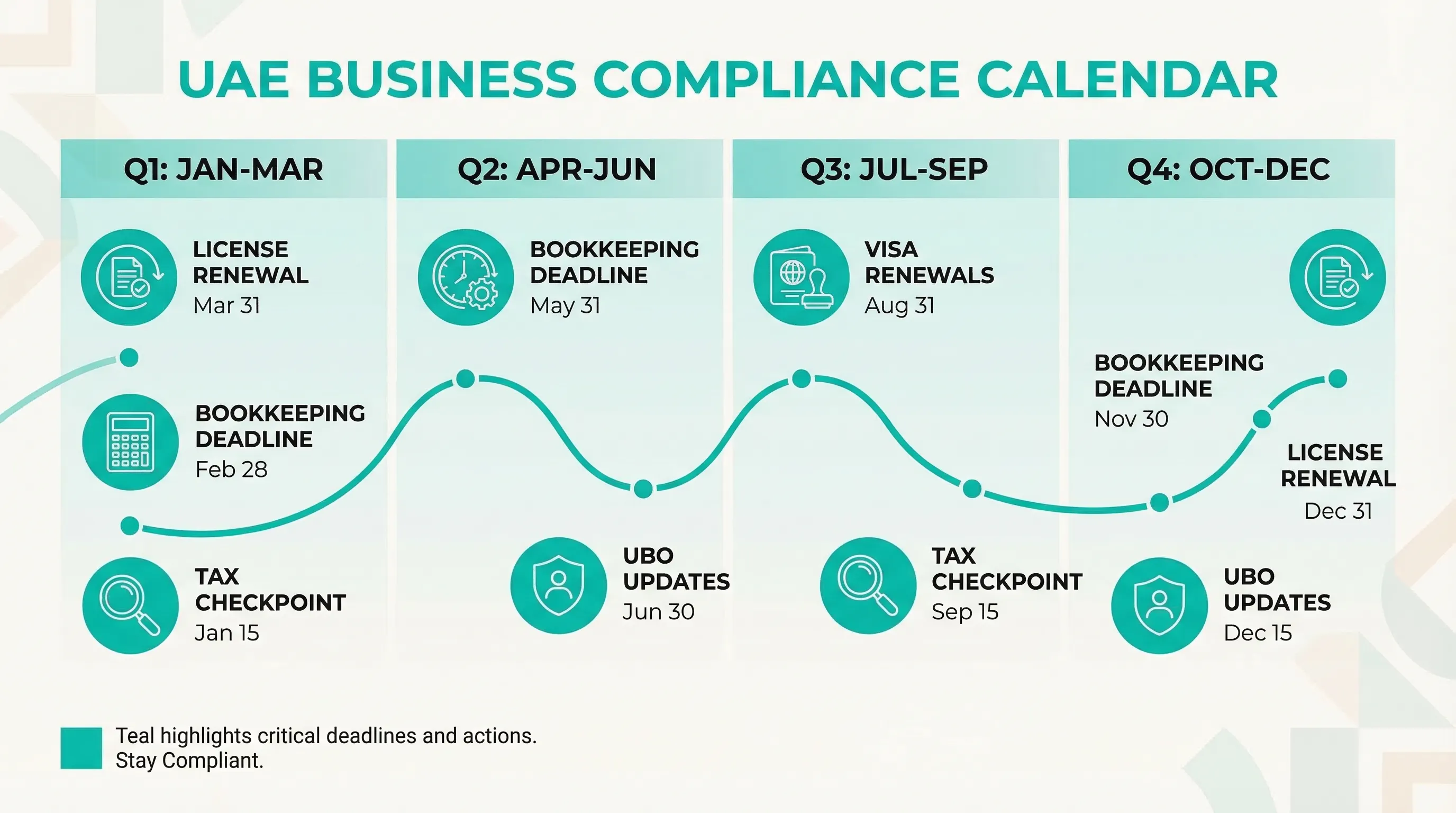
Common mistakes in UAE free zone formation (and how to avoid them)
Most issues are preventable if you address them early.
Picking a free zone before confirming the activity scope
Two activities that sound similar can have different permitted scopes, and that can affect banking, invoicing, and contract eligibility.
Underestimating bank onboarding
Many founders treat banking like a formality. In reality, your account opening outcome depends on preparation, clarity, and how well your profile matches the bank’s risk appetite.
Buying the smallest office package without a hiring plan
If you will need visas soon, choose a setup that scales cleanly, or confirm the upgrade path and costs in writing.
Waiting to “do accounting later”
Delayed bookkeeping creates blind spots, and it can complicate tax compliance, audits, investor due diligence, and even bank reviews.
When to bring in an expert
If your situation includes any of the following, professional structuring advice is usually worth it:
- A holding structure with multiple shareholders or jurisdictions
- Plans to operate across free zone and mainland markets
- Regulated or sensitive activities
- A need for nominee services (which must be handled carefully and compliantly)
- Higher expected transaction volumes, multiple currencies, or complex payment flows
Alldren positions itself as an expert-led, transparent corporate services partner for UAE company setup and ongoing management, with direct access to senior experts. If you want help designing a robust structure, handling compliance, and keeping the process predictable, you can start at Alldren.
Frequently Asked Questions
How long does company formation in a UAE free zone take? Timelines vary by free zone, activity, and how quickly documents are provided. Many straightforward cases can move in days to a few weeks, while regulated activities or complex shareholder structures can take longer.
Do I need a physical office to set up a free zone company? Not always. Some free zones offer flexi-desk or shared office options, while others require leased space depending on your activity and visa needs. Confirm the facility requirement before committing.
Can a UAE free zone company do business in the UAE mainland? It depends on your activity, licensing permissions, and how you deliver goods or services. Some models require additional arrangements or approvals. Get clarity early so your contracts and invoicing match your legal setup.
What documents are usually required for a free zone company setup? Commonly: passport copies, proof of address, a brief business description, and UBO details. If a corporate shareholder is involved, corporate documents and board resolutions are typically required.
Is VAT or corporate tax registration required for a free zone company? It depends on your specific facts and whether you meet registration requirements. Use the UAE Federal Tax Authority as the official starting point and seek professional advice for your scenario.
Get your UAE free zone setup right the first time
A free zone setup can be fast, but the best outcomes come from designing the structure, licensing, banking plan, and compliance calendar as one coherent system.
If you want a senior-led team to guide the process end to end (from structuring and incorporation to compliance and ongoing support), explore Alldren and request a clear, upfront plan for your company formation.


