

A company license in the UAE is more than a “permission to trade.” It determines where you can operate, which activities you can perform, what renewals you must complete each year, and often what banks and counterparties will expect during onboarding. Getting it right from day one, and renewing it cleanly, saves time, money, and regulatory stress.
What a “company license” in the UAE actually includes
In practice, people use “company license” to describe a bundle of registrations and documents. The exact set varies by jurisdiction (mainland vs free zone vs offshore), but you will commonly deal with:
- Trade license (the license itself): issued by the relevant authority (for example, a free zone authority, or a mainland economic department).
- Approved business activities: the activities printed on the license, which drive what you are legally allowed to do.
- Establishment / immigration file (for visa-enabled setups): often needed to sponsor employees and shareholders.
- Lease / occupancy proof (where required): many renewals are tied to a valid lease or facility agreement.
- Corporate compliance filings (depending on your profile): items like UBO, ESR, AML obligations, VAT and corporate tax registrations.
If you treat renewal as “just pay a fee,” you can get caught by missing supporting requirements, especially when banking, visas, or tax registrations are involved.
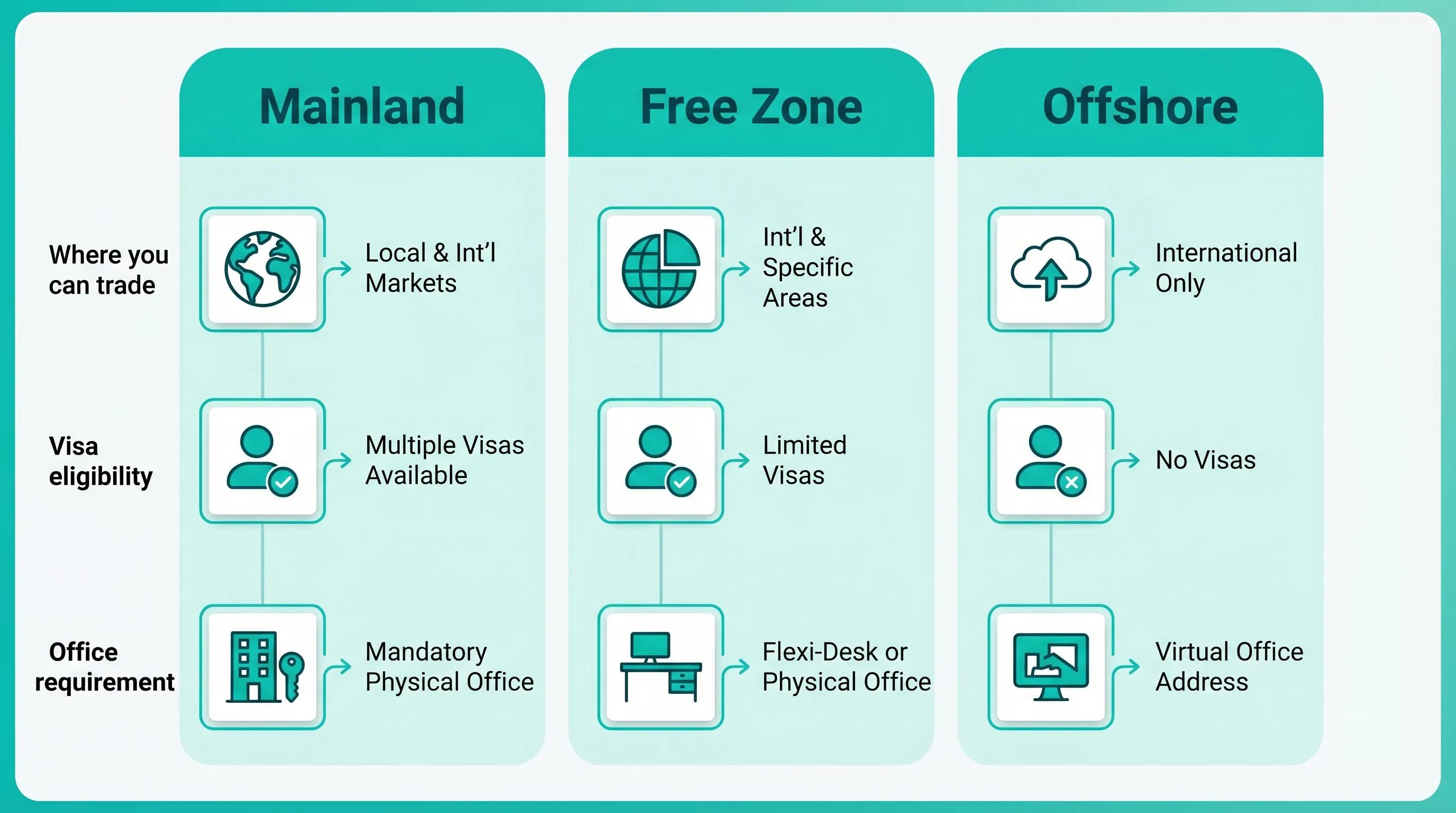
Company license UAE: the 3 main types (mainland, free zone, offshore)
Most structuring decisions start with jurisdiction. License names can look similar across authorities, but the operating model is different.
| License jurisdiction | Best for | Where you can do business | Typical physical presence | Notes to know upfront |
|---|---|---|---|---|
| Mainland | Serving UAE onshore customers (B2B/B2C), regulated activities, local contracting | UAE onshore, and often internationally | Often requires a lease/tenancy proof depending on emirate and activity | Licensing authority is the emirate’s economic department (Dubai’s authority is DET) |
| Free zone | International trade/services, e-commerce, regional HQ functions, sector clusters | Commonly outside the UAE, and within the free zone. Onshore sales may require specific arrangements | Flexi-desk/office/warehouse options vary by free zone | Each free zone has its own rulebook, activity list, and renewal requirements |
| Offshore | Holding structures, owning assets, shareholder SPVs (not for onshore trading) | Generally no onshore trading in the UAE | Usually no office requirement | Often used for holding shares or assets, subject to the relevant authority’s rules |
A helpful way to validate your direction is to map your revenue: where are your customers located, where will contracts be performed, and will you need staff visas? Those three points usually narrow the correct jurisdiction quickly.
Mainland company license (onshore)
A mainland company license is generally the right fit when you need to sell services or goods directly into the UAE market, sign local contracts, or operate at client sites across the UAE.
Key points to understand:
- Authority: licensing is handled by the relevant emirate. In Dubai, this is the Department of Economy and Tourism (DET). (See Dubai DET for official information.)
- Activity precision matters: mainland licensing is activity-driven. The wrong activity selection can block bank account opening, visa issuance, or approvals.
- Additional approvals: some activities require external regulator approvals (for example, health, education, financial services, transport). These approvals can also affect renewal.
Free zone company license
Free zones are popular for international-facing businesses because they can offer streamlined processes, cluster-specific ecosystems, and visa packages tied to facility types.
Important realities:
- Your free zone authority is your regulator for licensing and renewals.
- Scope of business: many free zone companies can invoice globally and within the free zone, while onshore UAE business may need a mainland arrangement or specific permissions. Always validate the rule set of your chosen free zone rather than relying on generalizations.
- Banking and compliance: free zone entities still go through UAE banking compliance checks, and many still fall under UAE tax and reporting regimes depending on activities and registrations.
Offshore company registration
Offshore structures are typically used for holding and ownership rather than operating a business “in the market.” If you plan to issue invoices for active trade, hire staff in the UAE, or rent premises for operations, an offshore vehicle is usually not the correct licensing route.
Offshore can be appropriate for:
- Holding shares in subsidiaries
- Holding assets (subject to applicable rules)
- Certain investment and SPV use cases
Because “offshore” is sometimes used loosely, confirm the practical constraints (especially around local trading and substance expectations) before committing.
License categories in the UAE (commercial, professional, industrial, and more)
Within each jurisdiction, the category of license often reflects the nature of activity. Common categories include:
- Commercial: trading activities (buying/selling goods) and many general business activities.
- Professional: service-based activities (consulting, marketing, IT services, design, etc.).
- Industrial: manufacturing, production, and industrial processing.
- Tourism / hospitality (where applicable): activities tied to travel and tourism, often requiring additional approvals.
The naming and subcategories differ by authority, so treat the category as a starting point, then align it to the exact activity code(s).
Why activity selection is where most problems start
Your activity list is not just administrative. It impacts:
- What you can put on invoices and contracts
- Whether you need pre-approvals from regulators
- Whether your bank flags you as higher risk (leading to extra due diligence)
- What you can advertise without compliance risk
- Renewal feasibility if the authority checks supporting documents
If your business model might evolve, it is usually better to select a set of activities that truthfully covers your near-term roadmap, rather than under-scoping and requiring constant amendments.
Company license renewal in the UAE (what usually happens, and what to prepare)
Renewal is often annual, but the workflow differs by jurisdiction and activity. In 2026, the main reason renewals fail or get delayed is not “payment,” it is missing supporting requirements such as lease validity, approvals, or compliance filings.
A practical renewal timeline
A simple approach most companies can follow:
- 60 to 45 days before expiry: confirm lease validity (if required), confirm any external approvals are valid, and check if any amendments are needed (activities, partners, manager).
- 30 days before expiry: prepare renewal documents and start any authority approvals that are known to take time.
- Before expiry: complete renewal and settle any outstanding penalties.
Exact grace periods and penalties vary by authority, so avoid relying on a “standard” buffer.
Typical renewal requirements checklist (varies by authority)
Below is a general checklist you can use to spot gaps early. Your authority may ask for all or only some items.
| Renewal item | Why it matters | Common pitfall |
|---|---|---|
| Valid lease / facility agreement | Many authorities require proof of premises for license validity | Lease expired, mismatch in entity name, missing registration (for example, tenancy registration where applicable) |
| External approvals (if regulated) | Some activities require regulator approval to remain active | Approval expired or renewed under a different activity scope |
| Corporate documents (updated where required) | Ensures the legal record matches reality | Partner/manager changes not updated before renewal |
| Immigration establishment card / files (if visas) | Visas and work permits depend on an active establishment record | Renewing the trade license but missing immigration file renewals where required |
| Compliance filings (as applicable) | Ongoing compliance is increasingly interconnected | UBO/ESR/AML obligations overlooked until the authority blocks a service |
Tax registrations you should not ignore when planning renewal
License renewal is separate from tax, but in real life they become connected because banks, auditors, counterparties, and sometimes authorities may ask for evidence that you are correctly set up.
- VAT: administered by the Federal Tax Authority. Official portal: UAE Federal Tax Authority.
- Corporate tax: the UAE introduced federal corporate tax (with a standard rate of 9% for taxable income above the relevant threshold, subject to the law). Official guidance: UAE Ministry of Finance corporate tax.
Whether you must register depends on your facts (activities, revenue thresholds where applicable, and legal obligations). The key is to treat tax setup as part of your annual compliance calendar, not something you “fix later.”
Common company license UAE mistakes (and how to avoid them)
These are the issues that most often create renewal delays, fines, or operational blocks.
1) Choosing a license type that does not match where you actually do business
A common example is setting up in a free zone for convenience, then immediately trying to serve onshore UAE clients without the right structure. This can create contracting limitations and complicate invoicing and banking narratives.
How to avoid it: document your “where revenue happens” model (UAE onshore vs free zone vs export) before you pick a jurisdiction.
2) Under-scoping or mis-scoping activities
If the activities on the license do not match what you do, you may face:
- Delays in bank account opening (enhanced due diligence or rejection)
- Issues with payment processors
- Renewal questions if approvals do not align
How to avoid it: map your services/products to the authority’s activity list, and include realistic near-term extensions (without adding activities you do not intend to perform).
3) Missing external approvals (or assuming they are “one-time”)
Some approvals must be obtained before licensing, and some must remain valid at renewal. Companies often discover this only when a renewal is blocked.
How to avoid it: maintain a register of approvals with expiry dates and responsible owners.
4) Letting the lease or facility agreement lapse
Even when your business is largely remote, many licensing regimes still require a valid registered address or facility agreement.
How to avoid it: align lease expiry so it does not end right before license expiry, and ensure entity names match across documents.
5) Treating renewal as an accounting task only
Renewal can touch legal, compliance, immigration, and tax. If the renewal is handled in a silo, issues surface late.
How to avoid it: assign one owner for “company compliance” who collects inputs from finance, operations, and HR.
6) Forgetting visas and establishment files (for visa-enabled companies)
A renewed trade license does not automatically mean your immigration-related files are in perfect order.
How to avoid it: keep a single calendar that tracks license expiry, establishment card or immigration file dates, and visa expiries.
7) Inconsistent corporate records (partners, manager, signatories)
Banks and authorities expect consistency across:
- Trade license
- MOA or equivalent constitutional documents
- Board resolutions (where applicable)
- Bank signatory lists
How to avoid it: complete amendments as soon as changes occur, not at renewal time.
8) Weak compliance narratives for banking
Even when your licensing is correct, banks may ask about the business model, counterparties, source of funds, and expected transaction flows.
How to avoid it: maintain a lightweight “banking pack” (company profile, contracts or pipeline evidence, invoices, and clear ownership documentation) and ensure it matches the licensed activities.
A simple “stay compliant all year” system
Most renewal pain comes from missing information, not complex law. A basic system is often enough:
- One compliance calendar: license expiry, lease expiry, approvals, visas, tax filing milestones.
- One source of truth for documents: the latest license, constitutional documents, shareholder IDs, proof of address, and key resolutions.
- Quarterly internal check: confirm you are still operating within licensed activities, and record any changes needed.
If your company is growing, or if you have regulated activities, it is worth getting professional oversight so issues are caught early.
Frequently Asked Questions
What is the difference between a mainland and free zone company license in the UAE? Mainland licenses are designed for operating onshore in the UAE market under the relevant emirate authority (for example, Dubai DET). Free zone licenses are issued by a free zone authority and typically suit international or free zone based operations, with specific rules for onshore activity.
How often do I need to renew a company license in the UAE? Many UAE trade licenses are renewed annually, but the exact renewal cycle and requirements depend on the issuing authority, your activities, and whether additional approvals or premises requirements apply.
Can I renew my company license if my office lease has expired? Often no, if your licensing authority requires a valid lease or facility agreement as part of renewal. This is a common cause of delays, so align lease renewals ahead of license expiry.
What are the most common mistakes that delay UAE company license renewals? Misaligned activities, missing external approvals, expired lease or facility agreements, inconsistent corporate records (manager/partners), and forgetting immigration-related files for visa-enabled companies.
Does corporate tax or VAT affect company license renewal? They are separate systems, but they affect overall compliance and can impact banking and counterparties. Ensure your VAT and corporate tax position is correct based on official guidance from the Federal Tax Authority and the Ministry of Finance.
Need help choosing or renewing the right UAE company license?
If you want your UAE structure to be compliant, renewal-ready, and aligned with how your business actually operates, it helps to have senior guidance early. Alldren provides expert-led, transparent support for company setup and structuring, ongoing compliance management, and related needs like bank account opening support, bookkeeping and tax registration, and UAE residency visa processing.
Explore options at Alldren and speak with an expert about the licensing route that fits your activities and growth plan.


