

Starting a business in the UAE is famously business-friendly, but “company registration” can still feel complex once you hit the real decisions: mainland vs free zone, licensing, visas, banking, tax registrations, and ongoing compliance.
This guide breaks UAE company registration into simple, practical steps so you can choose the right structure, avoid common delays, and understand what happens after the trade license is issued.
What “company registration” means in the UAE
In the UAE, company registration is not one single form. It is a sequence of approvals and documents that typically results in:
- A trade name reservation
- An initial approval (in principle)
- A legal entity documented (for many setups, a Memorandum of Association)
- A trade license issued by a mainland department or a free zone authority
- The ability to proceed with immigration, visas, and corporate banking
Depending on your activities and jurisdiction, the order and required documents can vary.
Step 1: Choose where to register (mainland vs free zone vs offshore)
Your first decision is jurisdiction. It drives what you can do, where you can operate, what approvals you need, and how visas, office requirements, and banking will work.
Mainland company
A mainland company is licensed by the relevant Emirate’s economic department (for example, Dubai’s Department of Economy and Tourism). It is typically the right fit if you want to:
- Trade directly with the UAE market (B2C or B2B)
- Work across the UAE without being limited to a specific free zone ecosystem
- Bid on certain government or semi-government opportunities (requirements vary)
Free zone company
A free zone company is licensed by a specific free zone authority. This is often a strong option if you:
- Serve international clients, export, or operate regionally
- Prefer packaged setup processes (many free zones streamline onboarding)
- Want a structure aligned with a defined industry cluster (media, logistics, tech, etc.)
Free zone rules differ, so always confirm what “doing business in the UAE” means for your exact activity and sales model.
Offshore entity (commonly used for holding)
“Offshore” in UAE conversations usually refers to entities formed for holding or international structuring rather than operating a UAE onshore business. The permitted activities and substance expectations can differ significantly.
Because offshore use cases are sensitive to tax, banking, and cross-border rules, get specialist advice before choosing this route.
Quick comparison table
| Option | Who it suits best | Typical limitation to watch | Common next step after license |
|---|---|---|---|
| Mainland | UAE-facing trading and services | More external approvals can apply depending on activity | Immigration file, visas, corporate bank account |
| Free zone | International or export-led companies, startups wanting a packaged process | Operating “outside” the free zone may require additional arrangements | Visas through free zone authority, banking |
| Offshore | Holding structures and specific international planning | Often not intended for onshore operations | Banking and compliance planning |
Step 2: Pick the right activity (this controls approvals)
In the UAE, your licensed activity is not a marketing label. It is a regulated classification that can trigger:
- Extra documents (qualifications, NOCs, professional memberships)
- Additional authority approvals (sector regulators)
- Different office or facility requirements
A common cause of delays is choosing an activity that does not match how you will invoice clients, hire staff, or market services.
If you are unsure, define your model in plain terms first:
- What will you sell (service, goods, subscription, consulting)?
- Where are clients located (UAE, GCC, global)?
- How will you deliver (in-person, online, on-site)?
- Will you need visas and how many within the first year?
Then map that to the correct activity and license type.
Step 3: Decide your legal structure and shareholders
Company registration requires selecting a legal form (for example, an LLC-type structure, depending on jurisdiction) and confirming:
- Shareholders (individuals and or corporates)
- Share capital approach (requirements vary by authority)
- Managers and signatories
- Whether you need nominee arrangements (only if appropriate and compliant)
If a corporate shareholder is involved, expect additional documents, legalization requirements, and more banking scrutiny.
Step 4: Reserve a trade name and get initial approval
Most UAE registrations begin with:
- Trade name reservation (with naming rules and restricted words)
- Initial approval (a green light to proceed, not the final license)
Naming rules differ by authority. If you are building a brand, consider reserving a few options early so you do not lose momentum.
For official government context, the UAE’s portal is a useful starting point: u.ae (Official Portal of the UAE Government).
Step 5: Secure an address or facility arrangement
Many setups require a registered address and a lease or facility agreement. The exact requirement depends on jurisdiction and activity.
Treat this step as more than a formality:
- Your office address can affect visa quotas and operational credibility.
- Banks often ask for proof of address and may verify substance.
Step 6: Prepare, sign, and submit incorporation documents
Your submission typically includes a set of KYC documents and incorporation paperwork.
Common document checklist (varies by case)
| Document type | Often required for | Notes |
|---|---|---|
| Passport copy | Shareholders, managers | Ensure validity and clear scan |
| Photo | Shareholders, managers | Usually passport-style |
| Proof of address | Shareholders (sometimes) | Utility bill or bank statement, per authority rules |
| Entry stamp or visa page | Individuals already in UAE | Depends on immigration status |
| Corporate documents | Corporate shareholders | May require notarization and legalization |
| Business description | Many bank and compliance steps | Helps later with banking and AML queries |
You may also need signed constitutional documents (for example, an MOA) and manager appointment resolutions, depending on your structure.
Step 7: Receive the trade license
Once your application is approved and fees are paid, the authority issues the trade license. This is the milestone most founders are waiting for, but it is not the finish line.
At this point, your company can usually begin progressing:
- Immigration establishment file
- Residency visas (if needed)
- Corporate bank account opening
- Accounting and tax registrations where applicable
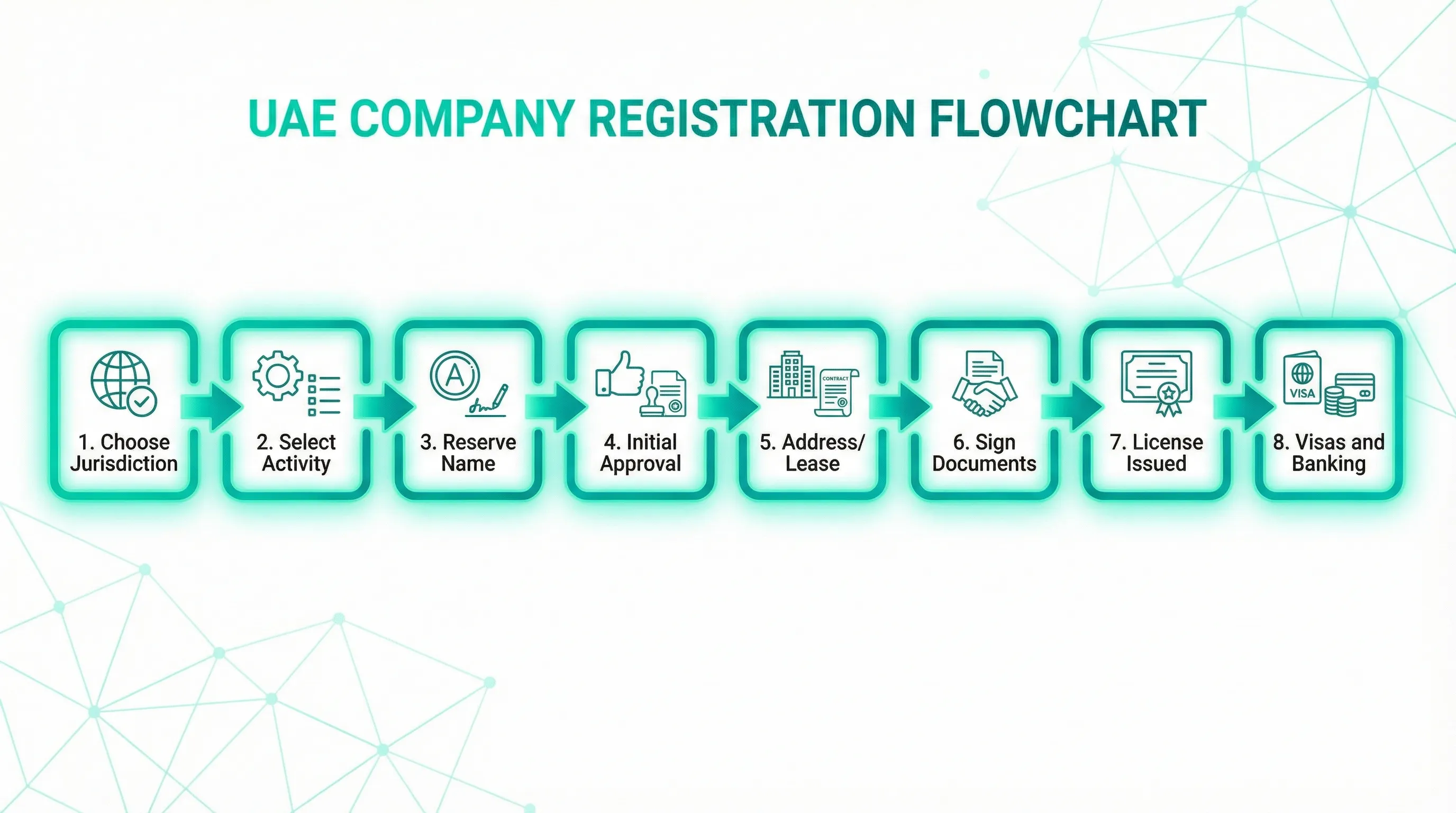
Step 8: Set up immigration, visas, and Emirates ID (if needed)
If you need to live in the UAE or hire staff locally, you will likely open an immigration file and process:
- Entry permit (if applicable)
- Medical test (process depends on Emirate)
- Biometrics and Emirates ID
- Residency visa stamping or issuance
Rules and processes can change, so always check the official authority for the latest steps. A reliable starting point is the ICP portal: Federal Authority for Identity, Citizenship, Customs & Port Security (ICP).
Step 9: Open a corporate bank account (plan for this early)
Banking is often the step that takes longer than founders expect. UAE banks typically perform detailed due diligence, especially for:
- New companies without contracts yet
- Certain nationalities or higher-risk sectors
- Complex shareholder structures
- Businesses with significant international flows
To improve your odds, prepare a clear “banking pack”:
- Business plan or model summary
- Expected transaction volumes and counterparties
- Source of funds documentation
- Signed contracts or invoices if available
- Website and professional email domain (often helpful)
Avoid rushing into the wrong structure just to “get a license fast” if it creates friction later with banking.
Step 10: Register for tax where applicable (and set up bookkeeping)
The UAE has introduced and evolved several compliance regimes in recent years. What you need depends on your activities, revenue, and footprint.
Two practical principles:
- Do not wait until the first tax deadline to set up bookkeeping. Clean records make banking, audits, and tax registrations far easier.
- Confirm your registration triggers with a qualified advisor, because thresholds and obligations depend on your facts.
For official VAT guidance, refer to the Federal Tax Authority: UAE Federal Tax Authority (FTA).
Ongoing compliance most founders forget to plan for
Company registration is the beginning of compliance, not the end. Depending on your setup, you may need ongoing support with:
- License renewals and establishment card renewals
- Immigration file maintenance and employee onboarding
- Corporate governance (resolutions, signatory updates)
- Bookkeeping, VAT filings (if registered), and corporate tax considerations
- Ultimate Beneficial Owner (UBO) records and related filings (as applicable)
If you plan to scale, build a simple compliance calendar early.
Common UAE company registration mistakes (and how to avoid them)
Choosing a jurisdiction before confirming your sales model
If you will sell into the UAE market, your operational model matters. Confirm how you will contract, invoice, and deliver services before committing.
Picking the wrong activity to “make it easier”
An activity mismatch can cause issues later with regulators, invoicing, and even bank account opening. Align the license to reality.
Underestimating banking timelines
Treat corporate bank account opening as a parallel project, not an afterthought.
Skipping bookkeeping until you are “bigger”
Messy records are expensive to fix and can create compliance risk. Set up a basic accounting process from day one.

When it makes sense to get expert help
You can register a company yourself in some cases, but expert support is valuable when:
- You have a complex shareholder structure (multiple shareholders or corporate shareholders)
- Your activity is regulated or requires external approvals
- You need visas quickly and want the process coordinated end to end
- You want to avoid rework that can happen from choosing the wrong jurisdiction or activity
- You want clarity on compliance obligations from the start
A good advisor should explain trade-offs in plain language, provide transparent pricing, and tell you what they do not know yet until they review your exact facts.
Frequently Asked Questions
How long does company registration in the UAE take? The timeline depends on jurisdiction, activity, and how quickly documents are provided. Straightforward cases can move quickly, while regulated activities, corporate shareholders, and banking can extend timelines.
Do I need to live in the UAE to register a company? Not always. Some structures allow registration without UAE residency, but if you want residency, you will typically need to complete the visa and Emirates ID process.
Is free zone or mainland better for company registration? Neither is universally better. Mainland often suits UAE domestic trading, while free zones can be efficient for international or export-led models. The best choice depends on how and where you will do business.
Can you open a corporate bank account immediately after getting the trade license? You can usually start the process right after licensing, but approval depends on bank due diligence. Preparing contracts, a business summary, and source-of-funds documentation helps.
Do I need VAT registration right away? Not necessarily. VAT registration depends on your taxable supplies and whether you meet the applicable threshold rules. Confirm your position with a qualified advisor and official FTA guidance.
Get UAE company registration done right, the first time
If you want a clear, compliant setup without guesswork, Alldren provides expert-led, transparent corporate services for UAE company registration, structuring, and ongoing compliance. You get direct access to senior experts who can help you choose the right jurisdiction, align your activity with your real business model, and coordinate next steps like visas, banking support, and bookkeeping or tax registrations.
Explore your options at Alldren.


