

Setting up a business in the UAE is refreshingly structured once you understand the sequence and who regulates what. The challenge is that “UAE company registration” can mean several different routes (mainland, free zone, financial free zone), each with its own paperwork, approvals, and compliance expectations.
This step-by-step guide walks you through the company registration process in UAE from planning through post-licensing compliance, with practical checkpoints to help you avoid delays.
Before you start: understand the 3 main setup routes
Most founders choose between:
- Mainland (onshore): Licensed by the economic department of the emirate (for example, Dubai, Abu Dhabi, Sharjah). Often best if you want maximum ability to trade directly within the UAE market and work with a wide range of local counterparties.
- Free zone: Licensed by a specific free zone authority (for example, DMCC, IFZA, RAKEZ). Popular for 100% foreign ownership options, packaged office solutions, and streamlined onboarding.
- Financial free zones: DIFC (Dubai) and ADGM (Abu Dhabi). These have their own regulators and company registrars, often used for regulated financial activity, holding structures, and businesses that benefit from common-law style frameworks.
There are also “offshore” registries used mainly for holding and asset ownership in certain contexts, but they are not a fit for operating businesses that need staff visas and local premises.
If you want the official government starting point for doing business, see the UAE Government Portal (u.ae).
Step 1: Define your business activity and license type
In the UAE, your business activity is not a marketing description, it is a regulatory selection that drives:
- Which authority issues the license
- Whether you need external approvals (health, education, food, media, fintech, etc.)
- What you can invoice for, and what your contracts should reference
- In some cases, your office requirements and staffing expectations
Common license types include:
- Commercial (trading)
- Professional (services)
- Industrial (manufacturing/production)
Practical tip: If your business model is broad, choose activities that cover your revenue streams without overloading the application with unrelated activities. Over-selection can trigger extra questions and approvals.
Step 2: Choose the right jurisdiction (mainland vs free zone) and legal form
This is where most long-term outcomes are determined: tax, banking experience, compliance workload, visas, and your ability to contract with different customer types.
Mainland vs free zone: quick comparison
| Decision factor | Mainland | Free zone | Financial free zone (DIFC/ADGM) |
|---|---|---|---|
| Where you can operate | Broad UAE market access (subject to activity rules) | Primarily within the free zone and international markets (UAE onshore access depends on structure and requirements) | Often used for holding, investment, and regulated or governance-heavy structures |
| Office options | Varies by emirate and activity | Often packaged (flexi desk to full offices) | Typically office-focused, with higher governance expectations |
| Compliance style | Emirate economic department + federal requirements | Free zone authority + federal requirements | Registrar + (often) additional regulatory expectations |
| Typical fit | Restaurants, retail, contracting, broad local trading/services | Consulting, tech, trading, regional HQ models, e-commerce | Funds, financial services, holding companies, complex governance |
Pick a legal form that matches your ownership and risk profile
Depending on jurisdiction and activity, you may be looking at:
- LLC (common for operating businesses)
- Sole establishment (often services, with specific liability considerations)
- Branch of a foreign company
- Free zone company (for example, FZ-LLC or FZE depending on the authority)
Your legal form affects signing authority, shareholder liability, corporate documents required, and sometimes banking requirements.
Step 3: Reserve your trade name and obtain initial approval
Most registrations start with trade name reservation and an initial approval (or equivalent) confirming the authority has no objection to the setup in principle.
Expect rules around:
- Prohibited or restricted words (often government-related, regulated terms, or certain descriptors)
- Name similarity checks
- Format rules (for example, requiring the legal form suffix)
Practical tip: Prepare 2 to 3 alternatives. Name rejections are common and can slow timelines if you only submit one option.
Step 4: Prepare KYC and incorporation documents
Every authority and every bank will ask for some form of KYC (Know Your Customer). If you prepare this properly upfront, you reduce back-and-forth later.
Typical document checklist (varies by case)
| Applicant type | Commonly requested documents |
|---|---|
| Individual shareholder(s) | Passport copy, photo, entry stamp/visa page if applicable, proof of address, CV or profile, sometimes a bank reference |
| Corporate shareholder | Certificate of incorporation, register of directors/shareholders, memorandum/articles (or equivalent), board resolution approving the UAE setup, UBO details, good standing certificate (sometimes) |
| Branch of foreign company | Parent company documents + board resolution to open branch + appointment of manager + parent’s audited financials (sometimes) |
Authorities can request additional items depending on nationality, activity, and whether the structure involves multiple layers.
Practical tip: If your shareholder is a company, start early. Corporate paperwork legalization and attestations, when needed, often become the longest lead-time item.
Step 5: Secure a business address (and meet office requirements)
In many cases, you need a lease or office solution before the license can be issued.
- Free zones may offer flexi desks or serviced offices as part of a package.
- Mainland setups often require a physical lease registered under the emirate’s system (requirements vary by emirate and activity).
Your office choice can affect:
- How many visas you can obtain
- Inspection requirements
- Banking credibility (some banks scrutinize “virtual” footprints)
Step 6: Obtain external approvals (only if your activity is regulated)
Some activities require clearance from additional regulators. Examples include:
- Healthcare and clinics
- Education and training institutes
- Food and beverage operations
- Media and advertising in certain categories
- Financial services and certain fintech models
Practical tip: Confirm external approval requirements before you sign a lease or finalize a name. Regulators may have naming rules, facility standards, or qualification requirements for managers.
Step 7: Submit the application, pay fees, and receive your license
Once the authority is satisfied with:
- Activity selection
- Shareholder and manager KYC
- Office solution
- External approvals (if applicable)
You proceed to final submission and payment. Outputs typically include:
- Trade license
- Certificate of incorporation/registration (wording varies)
- Memorandum/Articles or equivalent constitutional documents
- Share certificates (for many free zones)
This is the moment your company exists as a registered legal entity, but you are not finished yet. Most operational capabilities (banking, visas, tax registrations) come next.
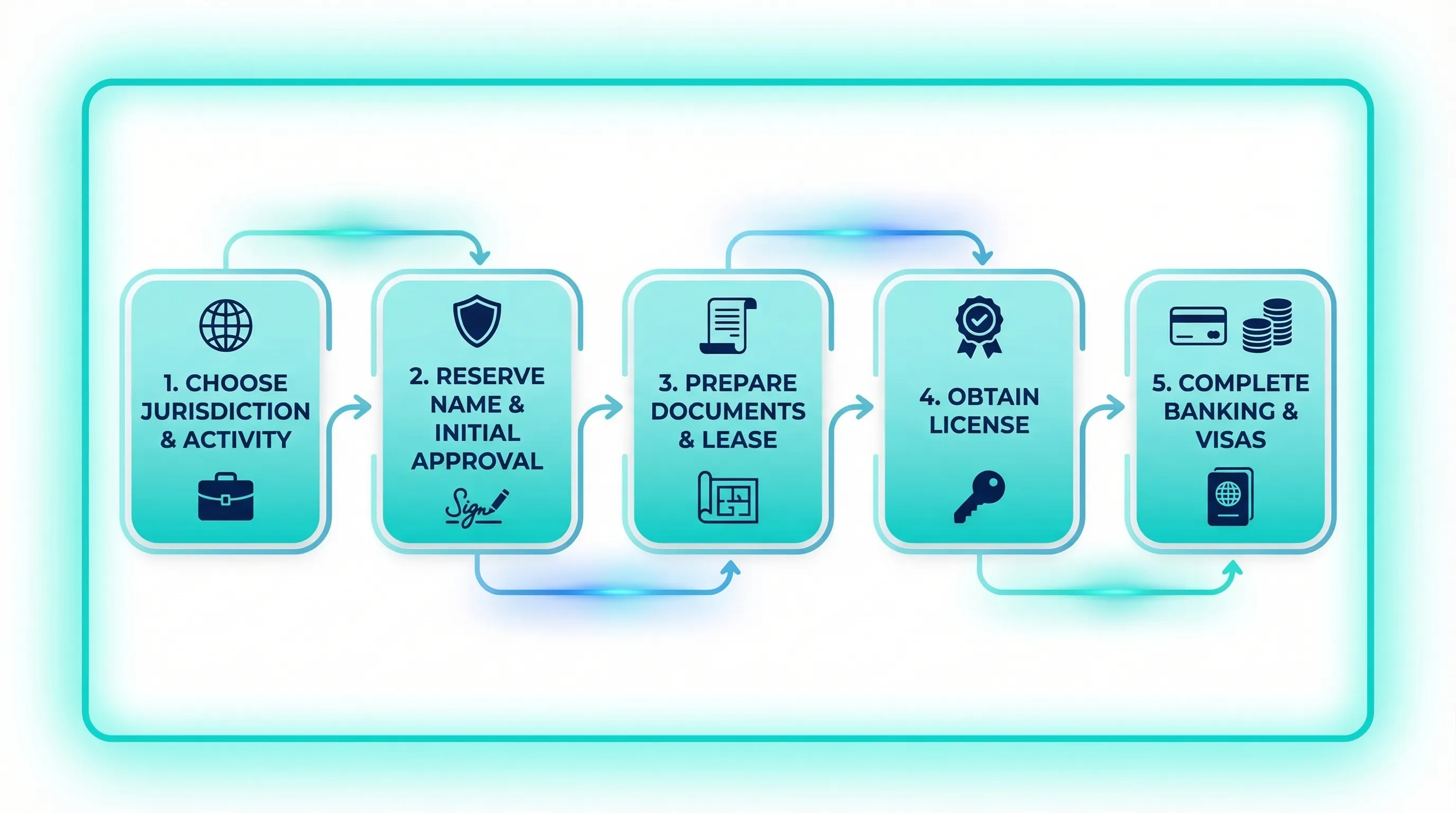
Step 8: Set up immigration file and process UAE residency visas (if needed)
If you will hire staff or sponsor yourself, you typically need an establishment or immigration file (terminology varies by jurisdiction). Then visas are processed in stages.
While details differ, the process often includes:
- Entry status or entry permit (if applicable)
- Medical testing and biometrics
- Emirates ID application
- Visa stamping or e-visa issuance process depending on the current rules
Because visa quotas can be tied to office type and size, align your office decision with your hiring plan.
Step 9: Open a corporate bank account
Corporate bank account opening in the UAE can be smooth or slow depending on your profile, activity, and documentation readiness.
Banks commonly assess:
- Business model clarity and expected transaction flows
- Source of funds and source of wealth (for shareholders)
- Contracts or pipeline evidence (in some cases)
- Substance signals (office, website, local phone number, experienced management)
- Compliance risk based on geography and activity
Practical tip: Prepare a short, consistent “banking pack” (company overview, ownership chart, invoices/contracts if available, expected monthly inflows/outflows, key counterparties, and shareholder background). Consistency matters, mismatched explanations are a common reason for delays.
Step 10: Complete tax and ongoing compliance setup
Registration is only the start. To stay compliant, you need to set up an operating rhythm.
Corporate Tax and VAT considerations
The UAE has a federal Corporate Tax regime, and some businesses must also register for VAT depending on taxable supplies and thresholds.
- For authoritative guidance, use the UAE Federal Tax Authority (FTA) resources.
- Corporate Tax and VAT obligations depend on your facts (activity, revenue, group structure, place of management, and more). If you are unsure, take professional advice before your first invoices.
Governance and annual renewals
Most companies must handle:
- License renewal
- Immigration and visa renewals (if applicable)
- Accounting and bookkeeping
- Audited financial statements (required in some jurisdictions and for certain entities)
- Ultimate Beneficial Owner (UBO) and other registers or filings depending on your setup
Practical tip: Build compliance into your calendar from day one. Late renewals can lead to penalties, blocked immigration services, and bank friction.
Typical timeline: what to expect (and what can slow you down)
Timelines vary widely by jurisdiction and how prepared you are. In practice:
- Straightforward free zone setups can be relatively fast once documents are ready.
- Mainland setups can be quick too, but external approvals, lease readiness, and activity-specific requirements can add time.
- Corporate shareholder structures and regulated activities are the most likely to extend timelines.
Common causes of delay include document legalization needs, unclear activity selection, missing proof of address, name rejections, and back-and-forth during bank compliance.
Common pitfalls in the company registration process in UAE
Choosing a jurisdiction for “cost” instead of operational fit
A cheaper setup can become expensive later if it blocks your ability to invoice certain clients, hire at the pace you need, or open a suitable bank account.
Misalignment between activity, contracts, and invoicing
If your license activities do not match what you sell, you may face banking queries, client procurement issues, and compliance risk.
Underestimating banking and compliance
Founders often treat bank account opening and tax registration as afterthoughts. In reality, they are core to operating smoothly.
Overcomplicated ownership structures too early
Complex multi-layer ownership can be valid, but it increases KYC requirements with authorities and banks. Complexity should match a clear business reason.
When it makes sense to use a corporate services partner
If any of the following apply, professional guidance usually pays for itself in saved time and reduced risk:
- You are unsure whether mainland or a specific free zone is best for your activity
- You need help structuring shareholder arrangements, governance, or nominee solutions
- You need bank account opening support with a compliant narrative and document pack
- You want an ongoing compliance partner for renewals, bookkeeping, and tax registrations

Frequently Asked Questions
How much does it cost to register a company in the UAE? Costs depend on jurisdiction (mainland vs free zone), activity, visa needs, office requirements, and whether external approvals or corporate shareholder documentation is involved. It is best to request a written quotation aligned to your exact setup.
Can I register a UAE company remotely? Often yes for parts of the process, especially document submission and initial approvals. However, banking and visa steps may require in-person presence depending on the bank and immigration stage.
Do I need a physical office to register a company in the UAE? Many setups require an address solution, but the form varies. Some free zones offer flexi desks or serviced offices, while certain mainland activities may require specific premises.
What documents do I need for company registration in the UAE? Typically passports, proof of address, and basic profiles for shareholders and managers. If a shareholder is a company, you will likely need incorporation documents and board resolutions, and sometimes attestations.
How long does the company registration process in UAE take? It ranges from relatively fast for straightforward cases to longer for regulated activities, corporate shareholders, or situations requiring document legalization and extensive bank compliance.
What are the key obligations after my UAE license is issued? Common obligations include license renewal, bookkeeping, tax registrations where applicable, and maintaining governance records. Some jurisdictions require audited accounts.
Get expert-led help with your UAE company setup
If you want a setup that is built to last, not just a fast license, Alldren provides expert-led, transparent corporate services for establishing and managing companies in the UAE. That includes tailored structuring, company registration support, compliance management, bank account opening support, residency visa processing, and bookkeeping and tax registration assistance.
Explore how Alldren can support your registration and long-term operations at Alldren.


