

Running a UAE company is not only about getting the trade license issued. The real work starts after incorporation, when you have to keep your corporate records clean, decisions properly approved, and filings aligned with your regulator, bank, and tax authorities.
That is where company secretarial support comes in.
In the UAE, “company secretarial” is best understood as the practical, ongoing discipline of corporate governance and compliance administration. It helps ensure your company stays in good standing, avoids preventable penalties and delays, and can prove its substance and decision-making when it matters (banking, tax, audits, investor due diligence, disputes).
What “company secretarial” means in the UAE (and what it is not)
In some countries, appointing a formal “Company Secretary” is a legal requirement for many company types. In the UAE, the terminology varies by jurisdiction (mainland, free zone, DIFC, ADGM), and a formal officer appointment is not always mandatory. However, the underlying obligations absolutely exist: every company must be able to evidence its corporate decisions and maintain statutory records.
So in practice, company secretarial in the UAE covers the administration behind corporate governance:
- Maintaining statutory registers and key corporate documents
- Drafting and storing resolutions and minutes
- Managing changes (shareholders, directors/managers, signatories, address)
- Coordinating annual and event-driven filings with the relevant authority
- Supporting compliance workflows tied to banking, immigration, and tax
It is also important to clarify what company secretarial is not. It is not the same as bookkeeping, audit, or legal representation in court, though it often interfaces with each.
The core building blocks: records and registers you must keep
A well-run UAE company can quickly produce a complete, consistent “company file” that matches what is on government portals and what your bank has on record. That file typically includes:
Constitutional and licensing documents
These establish what the company is allowed to do and how it is governed.
- Trade license and any annexes
- Certificate of incorporation/registration
- Memorandum and Articles (or equivalent constitutional documents)
- Share certificates (where applicable)
- Lease/ejari or flexi-desk agreement (depending on the jurisdiction)
Why it matters: banks and counterparties frequently request these, and inconsistencies between documents and portals are a common reason for onboarding delays.
Statutory registers (ownership and control)
Even when you are not explicitly asked for “a register,” you need an internal source of truth.
Common registers and logs include:
- Register of shareholders (or members)
- Register of directors/managers (and their appointment/termination dates)
- Register of authorized signatories and powers of attorney
- UBO information and supporting documentation (where applicable)
The UAE has a UBO framework that requires many entities to identify and maintain beneficial ownership information, with rules and exemptions depending on the entity type. For background and updates, see the UAE Ministry of Economy’s UBO resources: Ultimate Beneficial Owner (UBO).
A clean document trail (not just PDFs in a folder)
Company secretarial is also about traceability. When a decision happens, you want to be able to answer:
- Who approved it?
- On what date?
- Under what authority (articles, shareholder approval, board/manager authority)?
- Where is the signed resolution?
- Was the change filed with the correct authority and reflected on the license/portal?
This becomes critical for:
- Bank account opening and periodic KYC refresh
- Investor or buyer due diligence
- Corporate tax and VAT position support
- Disputes between shareholders
Governance deliverables: resolutions, minutes, and decision hygiene
A major portion of company secretarial work is making sure decisions are properly approved and recorded.
Typical decisions that should be documented
Depending on your jurisdiction and your constitutional documents, you may need shareholder resolutions, board resolutions, manager resolutions, or a combination.
Common examples include:
- Appointing or removing a manager/director
- Opening or changing a bank account and signatories
- Issuing or transferring shares
- Changing business activities (or adding activities)
- Amending the MOA/AOA
- Changing registered address
- Approving audited financial statements (where required)
- Appointing auditors (where required)
Why “templates” are not enough
Using templates without tailoring can create technical non-compliance. For instance, a resolution that assumes a “board of directors” exists can be wrong for a manager-managed entity, or the approving body may differ in your free zone rules.
Good company secretarial practice ensures:
- The correct approving authority is used
- Quorum and voting requirements are respected
- Signatures match what the authority and bank expect
- Supporting documents are attached and stored consistently
Filings, renewals, and event-driven changes (the operational heart of the function)
In the UAE, compliance is not typically a single “annual return” for all entities. Requirements depend heavily on where you are incorporated.
License renewal and regulator relationships
Most UAE companies must renew their license periodically (often annually). While renewal sounds straightforward, it can be blocked by issues such as:
- Missing lease updates
- Missing establishment card renewal (for immigration file, if relevant)
- Outstanding authority requirements (for example, audit submission in some jurisdictions)
- Unupdated company details (manager, shareholders, contact info)
Company secretarial support helps keep a renewal-ready posture year-round rather than scrambling at the deadline.
Handling corporate changes correctly
Many compliance failures happen when companies make real-world changes but do not update the legal and regulatory record.
Examples:
- You change signatories with the bank, but the authority portal still shows old signatories.
- You agree a share transfer, but the share register and share certificates are not updated, or the authority filing is delayed.
- You appoint a new manager, but immigration or banking still relies on the previous person.
In well-managed companies, secretarial processes coordinate the change across:
- The corporate record (registers, resolutions)
- The relevant authority portal and license
- The bank’s KYC and mandate
- Any dependent files (immigration establishment card, tax registrations)
Tax and compliance coordination that commonly sits alongside secretarial
Company secretarial work often touches tax and compliance, even when a separate specialist executes the filings.
Corporate tax and VAT touchpoints
With UAE Corporate Tax now a core compliance area for many businesses, governance and record-keeping matter more. Your tax position relies on accurate financials, but also on correct entity data and decision documentation.
- UAE Corporate Tax overview and guidance: Federal Tax Authority
VAT may also apply depending on your activities and thresholds. Even where VAT is not applicable, banks and counterparties may request evidence of tax registration status.
Economic substance and reporting regimes (context matters)
Some companies still operate with “legacy” compliance expectations from previous years (for example, where counterparties or banks ask how substance is demonstrated). Regulations and applicability have evolved over time, so company secretarial teams often help you keep an audit-ready narrative: what your company does, where decisions are made, and which documents support that.
When in doubt, rely on current guidance from your regulator and the Ministry of Finance or Federal Tax Authority.
AML, UBO, and KYC readiness
Even if your company is not a regulated financial institution, you will experience AML and KYC expectations through banks, payment providers, and sometimes free zones. Secretarial support helps you respond quickly with consistent, signed, up-to-date documents.
How requirements differ by jurisdiction (mainland, free zones, DIFC/ADGM, offshore)
“UAE company” is not one uniform compliance environment. A practical company secretarial approach starts with mapping the rulebook that applies to you.
Mainland (DED-licensed entities)
Mainland companies interact with the Department of Economy and Tourism (or equivalent emirate authority), and may have additional layers depending on their activity (regulated activities, special approvals).
Company secretarial focus is often:
- Keeping the MOA and manager/partner details aligned with the license
- Managing notarisation/legalisation steps when required
- Coordinating changes that impact immigration files and banking
Free zone companies
Free zones vary widely. Some require audited financial statements; others do not. Some have stricter office/lease requirements, others offer flexi-desks. Renewal workflows also differ.
Secretarial support typically covers:
- Free zone portal filings and document updates
- Renewal readiness (lease, immigration, compliance requirements)
- Tracking zone-specific submissions (where required)
DIFC and ADGM (financial free zones)
DIFC and ADGM have their own company registrars and corporate law frameworks. They are often more “company-law” driven in administration style, and businesses in these jurisdictions commonly benefit from structured corporate governance support.
Reference registrars:
- DIFC Registrar of Companies
- ADGM Registration Authority
Offshore entities
Offshore structures can be useful for specific purposes, but their compliance administration still matters, especially for banking and ownership transparency expectations. Secretarial support here often emphasizes document quality, ownership registers, and change control.
What a “good” company secretarial setup looks like in practice
A useful way to evaluate company secretarial support is to look at outcomes: can you operate smoothly, and can you prove what you did?
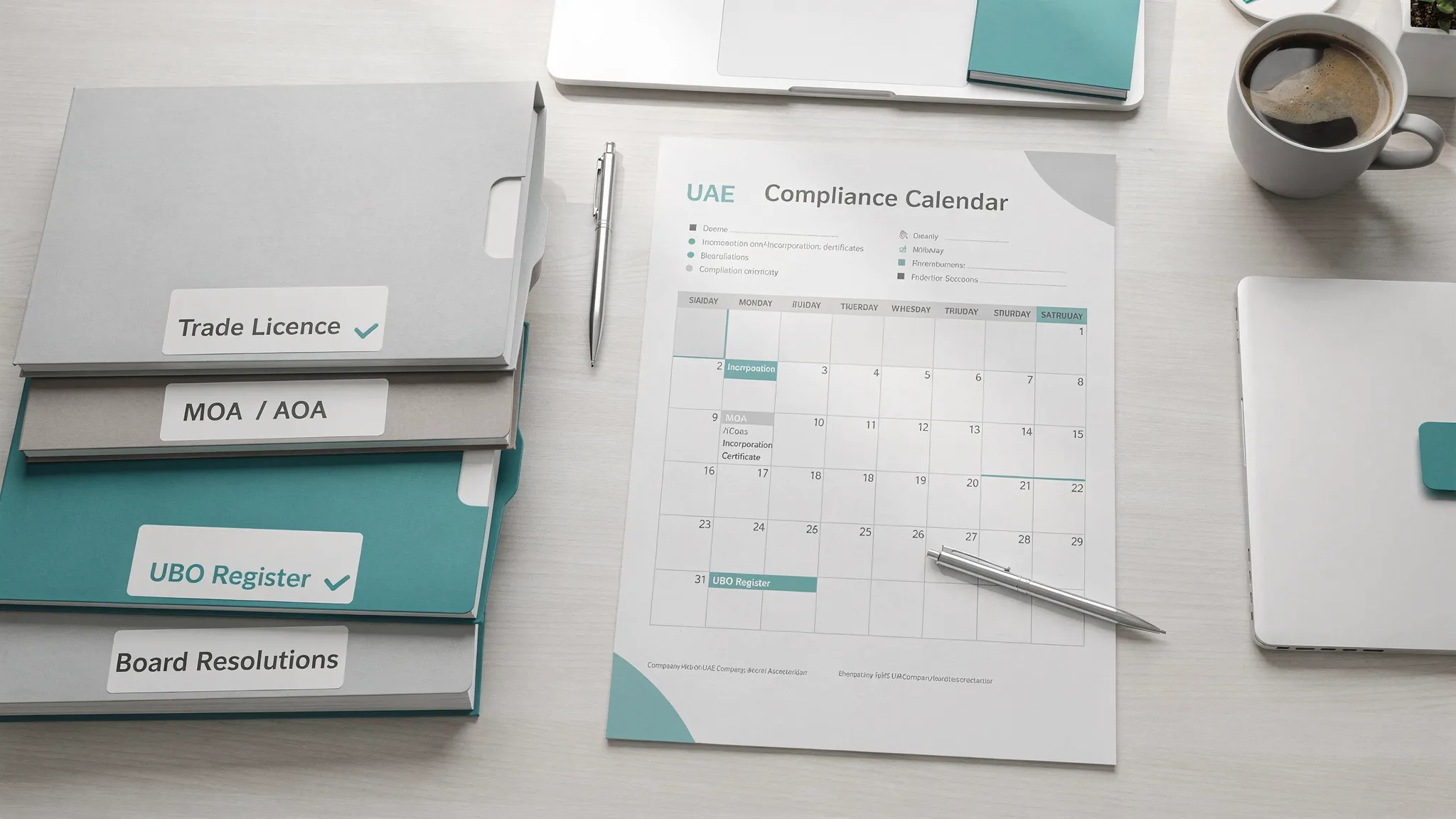
A compliance calendar with owners and lead times
You want a simple calendar that identifies:
- Renewal windows (license, lease, establishment card where applicable)
- Expected internal decision dates (for example, approving financial statements)
- Time needed for notarisation, legalisation, or authority processing
A single source of truth for corporate data
At minimum, keep a controlled record of:
- Legal name, license number, registered address
- Shareholding and UBO data
- Directors/managers, signatories, and appointment dates
- Copies of passports/Emirates IDs (as appropriate and securely stored)
Document standards that banks and investors accept
High-quality secretarial output typically means:
- Clear resolution formatting with correct entity details
- Signature blocks that match signatory authority
- Consistent naming and version control
- A retrieval process that does not depend on one person’s inbox

What company secretarial typically covers (and when)
The table below summarizes common company secretarial deliverables and triggers. Exact requirements vary by jurisdiction and activity, but this gives a practical baseline.
| Area | What company secretarial delivers | Typical trigger | Why it matters |
|---|---|---|---|
| Statutory records | Registers of shareholders, managers/directors, signatories, key documents | Ongoing, updated after changes | Proof of ownership/control and governance history |
| Resolutions and minutes | Drafting, signature coordination, storage | Bank account, share transfer, manager change, major decisions | Decisions are valid, enforceable, and auditable |
| Authority updates | Preparing and coordinating filings for changes | Any corporate change (name, address, activities, partners) | Keeps license/portal accurate, prevents renewal blocks |
| Renewal readiness | Compliance calendar, document checks, renewal coordination | Renewal windows (often annual) | Avoids lapses, fines, operational downtime |
| Banking support | Bank-ready corporate packs, KYC refresh support | New bank account, periodic reviews | Reduces delays and rejection risk |
| Tax and reporting coordination | Ensuring entity data consistency, governance evidence | Corporate tax/VAT registrations, audits (where applicable) | Supports defensible compliance and smoother filings |
Choosing a UAE company secretarial provider: what to ask before you sign
Because “company secretarial” can mean anything from basic admin to full governance oversight, clarity at the start matters.
Key questions to ask:
- Scope: Which entity types and jurisdictions do you cover (mainland, specific free zones, DIFC/ADGM)?
- Responsibility matrix: Who drafts resolutions, who files, who tracks deadlines, who stores records?
- Quality control: Are documents reviewed by senior experts before submission?
- Transparency: Is pricing upfront, and what is considered out of scope (for example, complex restructures, notarisation costs, government fees)?
- Access: Will you have direct access to decision-capable professionals, or only a ticketing layer?
Where Alldren fits
If you want company secretarial done properly in the UAE, you typically need two things: technical accuracy (so filings and governance align with your jurisdiction’s rules) and operational discipline (so renewals and changes happen on time, every time).
Alldren provides expert-led, transparent corporate services for establishing and managing UAE companies, including ongoing compliance management and corporate governance services. If you are building a structure, planning changes (new shareholders, new signatories, new activities), or simply want your company to stay renewal-ready without last-minute stress, you can explore their approach at Alldren.
A strong company secretarial function is not “paperwork.” It is the infrastructure that keeps your UAE company bankable, compliant, and ready for growth.


