

Outsourcing corporate services in the UAE is less about “saving admin time” and more about reducing regulatory risk while staying fast. Between different authorities (mainland vs free zones), strict KYC expectations from banks, and evolving tax and compliance rules, many operational tasks are best handled by specialists so founders and executives can focus on revenue, product, and customers.
Below is a practical guide to what you should typically outsource in the UAE, what you should keep close, and how to choose providers without losing control.
Why outsourcing matters more in the UAE than in many markets
Most companies outsource something, but the UAE has a few characteristics that make smart outsourcing a competitive advantage:
- Multi-jurisdiction setup: obligations and processes differ across mainland and each free zone (licensing, office requirements, permissible activities, reporting).
- High-stakes compliance: missed renewals, incorrect filings, or poorly documented governance can create issues with licensing, banking, visas, and future exits.
- Bank onboarding is documentation-heavy: even legitimate businesses can face delays if the corporate file, UBO info, and proofs of activity are not packaged correctly.
- A fast operating tempo: many firms are in growth mode (regional HQs, cross-border trade, fundraising). Outsourcing routine obligations frees leadership attention.
The goal is not to outsource everything, it is to outsource what is specialized, time-consuming, and failure-sensitive.
Corporate services in the UAE you should usually outsource
These are the functions where outsourcing is commonly the most efficient and safest option, especially for SMEs, holding structures, and international founders.
1) Company formation, structuring, and licensing administration
Formation is not just paperwork. Decisions made at incorporation affect banking, tax profile, hiring ability, and even investor readiness.
Commonly outsourced scope includes:
- Selecting jurisdiction and license activity alignment (mainland vs free zone)
- Drafting and processing incorporation documents
- Coordinating lease or office requirements where applicable
- Handling license issuance, renewals, amendments, and authority liaison
This is the “set the foundation correctly” work. If you plan to scale, open multiple entities, or run cross-border operations, structured guidance matters.
2) Ongoing compliance management (calendar, filings, evidence)
In the UAE, compliance is often a system, not a one-time task. You want a provider who runs a clear compliance calendar and keeps evidence ready for banks, auditors, and authorities.
Typical outsourced items include:
- Maintaining statutory records and company documents
- Tracking renewals, submissions, and deadlines across authorities
- Supporting Ultimate Beneficial Owner (UBO) record readiness and updates (see the UAE Ministry of Economy’s UBO information for context: Ministry of Economy)
- Entity-level compliance hygiene that supports bank reviews and counterparties
Even if your jurisdiction does not require formal audits, many businesses still need clean records for banking and commercial credibility.
3) Corporate governance and corporate secretarial work
Good governance is a quiet enabler. It makes it easier to add shareholders, change directors, pass resolutions, and demonstrate control and substance.
Often outsourced:
- Board and shareholder resolutions (templates, drafting, proper approvals)
- Share transfers, amendments, and updates with the registrar
- Maintaining registers (members, directors, UBO information where required)
The main risk here is not difficulty, it is inconsistency. A missing resolution today becomes a painful due diligence issue later.
4) Bookkeeping, VAT, and corporate tax registration and filings
Tax and accounting are high-consequence areas to outsource, provided you still keep internal oversight on cash and decision-making.
Common outsourced scope:
- Bookkeeping and monthly management reporting (as agreed)
- VAT registration and returns where applicable (reference: UAE Federal Tax Authority)
- Corporate tax registration, compliance preparation, and returns (where applicable)
- Support for audits if your free zone or stakeholders require them
A practical rule: outsource preparation and process, keep approval and accountability internal.
5) Visa processing and PRO-style government liaison
For most companies, residency visas and work permits become an operational bottleneck unless handled by specialists.
Common outsourced scope:
- Entry permits, status changes, medicals, Emirates ID coordination
- Establishment card and immigration file management
- Employee visa processing workflows and renewals
Because requirements vary across authorities and change over time, outsourcing reduces delays and prevents paperwork loops.
6) Bank account opening support and KYC packaging
Many founders underestimate the work required for bank onboarding. Outsourcing support does not guarantee approval, but it typically improves readiness and reduces back-and-forth.
Often outsourced:
- Preparing corporate documents and KYC packs
- Mapping business activity to supporting evidence (contracts, invoices, counterparties)
- Coordinating meetings and responding to bank requests
Keep in mind: banks evaluate the total story (activity, geography, transaction profile), not just documents.
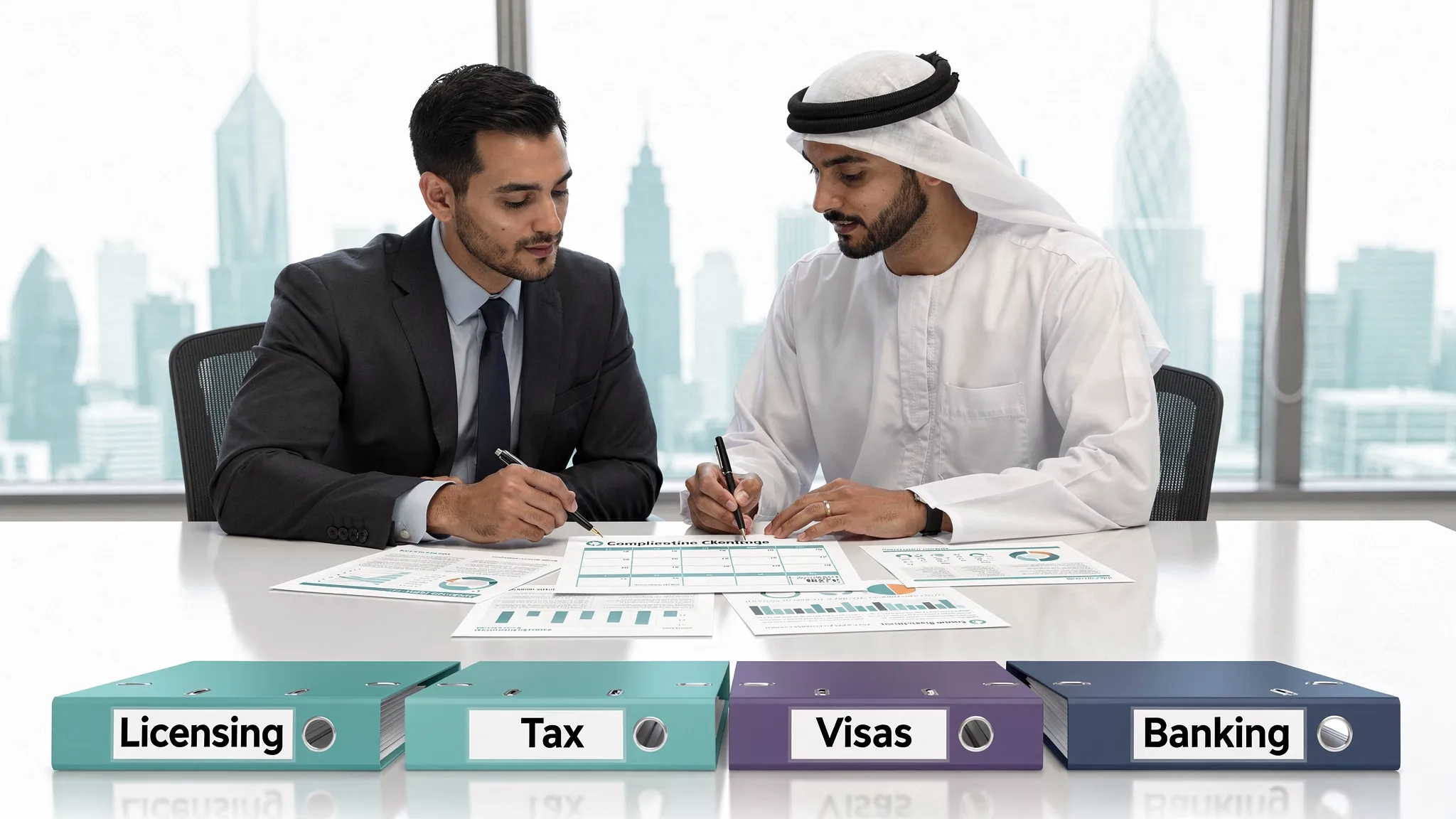
A decision framework: what to outsource vs keep in-house
Use this simple test for each function:
- Is it regulated or deadline-driven? If yes, outsource the operational execution.
- Does it require specialized UAE knowledge or authority relationships? If yes, outsource.
- Is the work repetitive and process-based? If yes, outsource or standardize.
- Is it core to differentiation or involves sensitive strategic judgment? Keep internal leadership control.
The most successful operating model is often hybrid: specialists run the machine, leadership steers it.
Outsource-by-default vs keep-close (quick comparison)
| Function | Outsource-by-default? | Keep close internally? | Why it matters |
|---|---|---|---|
| Licensing, renewals, authority liaison | Yes | Approvals only | Missed steps can disrupt operations and visas |
| Bookkeeping and tax filings | Yes | Controls and sign-off | Errors create penalties and future diligence risk |
| Corporate governance paperwork | Yes | Key decisions and oversight | Clean records protect fundraising and exits |
| Visas and immigration processing | Yes | Hiring decisions | Delays affect onboarding and continuity |
| Banking onboarding support | Yes | Transaction narrative and approvals | Strong documentation reduces friction |
| Contract negotiation and risk posture | Often | Yes | Commercial terms affect profit and liability |
| Strategy, pricing, product, key clients | No | Yes | Core differentiation and leadership accountability |
Corporate services you can outsource, but choose partners carefully
Some areas are commonly outsourced, but quality and coordination matter more because they influence strategy, risk, or reputation.
Legal drafting and contract management
Routine templates can be outsourced. High-value negotiations and disputes should involve qualified legal counsel and internal decision-makers.
A good approach is:
- Outsource first drafts and document control
- Keep commercial positions, risk acceptance, and final approvals internal
Fractional CFO, FP&A, and financial controls
Many UAE SMEs benefit from a fractional CFO model, especially if the business is scaling, raising capital, or managing multi-entity structures.
Outsource the financial model building, reporting discipline, and process design, but keep signing authority and treasury policy under leadership control.
IT operations and cybersecurity
Managed IT can be efficient, but governance should remain internal. You can outsource monitoring and incident response readiness, while leadership defines policies, access rules, and vendor risk requirements.
Recruitment for business-critical roles
Hiring is an area where outsourcing can add major leverage, particularly for senior and highly specialized roles (GTM leadership, sales management, executive management). If you need an international pipeline and structured search, working with a specialist like an international executive search recruitment agency can be a better fit than generalist hiring channels.
The key is alignment: define role scorecards, success metrics, and decision rights so external recruiters amplify your strategy rather than steer it.
How to choose the right corporate services provider in the UAE
UAE corporate services look similar on paper, but operational quality varies widely. Evaluate providers like you would a critical vendor.
Look for clarity of scope and senior accountability
You want to know:
- Who is responsible for delivery and advice (and how senior they are)
- What is included vs excluded (especially for compliance and government processes)
- How handoffs work across setup, visas, accounting, and governance
Firms that emphasize direct access to senior experts and transparent, upfront pricing make it easier to avoid surprise costs and “black box” processes.
Require a compliance calendar and evidence-ready documentation
Ask the provider to show how they manage:
- License renewals and reminders
- Tax deadlines (VAT and corporate tax where applicable)
- Governance actions and document retention
- Change management (new shareholders, new activities, new signatories)
Your best-case outcome is simple: at any point, you can produce a clean corporate pack for banks, investors, landlords, or authorities.
Confirm data handling and operational controls
Corporate services involve passports, Emirates IDs, financial records, and banking documentation. Ensure there is a clear approach to:
- Secure document storage and access control
- Defined communication channels and authorization rules
- A single “source of truth” for current documents
Avoid fragmented outsourcing when your structure is complex
If you are running multiple entities, adding shareholders, or operating across borders, fragmented vendors can create gaps (each party assumes another handled it).
Many businesses prefer a single lead partner for structuring and governance, with specialist partners plugged in where needed.
If you are looking for an expert-led partner for UAE company setup, structuring, and ongoing compliance management, you can explore Alldren’s corporate services and assess fit based on how your operating model and risk profile look.
A practical outsourcing blueprint for the first 12 months
Rather than outsourcing reactively, design your first-year operating rhythm.
Phase 1: Launch readiness (incorporation to first transactions)
Focus on getting the corporate foundation and proof-of-activity readiness right:
- Entity setup and licensing finalized
- Bank onboarding documentation packaged
- Visa and immigration file opened (if hiring or relocating)
- Accounting system and chart of accounts set up, with invoice and expense processes agreed
Phase 2: Operational cadence (month 2 to month 12)
This is where outsourcing pays off most. Your provider should run recurring tasks predictably:
- Monthly bookkeeping and management reporting (as agreed)
- VAT processes if applicable, including evidence collection discipline
- Payroll administration if relevant
- Governance housekeeping (resolutions, registers, signatory updates)
Phase 3: Annual and event-based obligations
Plan for “events,” not just dates:
- License renewals and office adjustments
- Corporate tax year-end preparation and filing requirements
- Shareholder or director changes
- New activity additions or new locations
A well-run outsourced model makes these events procedural rather than disruptive.
The biggest outsourcing mistake: giving up control instead of delegating execution
Outsourcing works when you delegate execution and retain decision rights.
A good governance pattern is:
- Your team defines: strategy, risk tolerance, approval thresholds, signing authorities
- Your provider executes: filings, document preparation, renewals, process management
- Both align on: a compliance calendar, document repository, and escalation rules
That is how corporate services in the UAE become an operating advantage, not an administrative burden.


