

The UAE remains one of the most attractive places in the world to launch, relocate, or scale a company, but “easy” does not mean “automatic.” The same factors that make the market compelling (fast licensing, multiple jurisdictions, international banking, tax incentives) also create complexity: the rules differ by emirate, by regulator, and by business activity.
This guide breaks down what “doing business UAE” really involves in 2026: the key rules you must plan for, the risks that can derail otherwise solid businesses, and the advantages that keep founders and groups choosing Dubai, Abu Dhabi, and other emirates.
Why the UAE is a global business hub
The UAE’s value proposition is not just a headline tax rate. It is a combination of location, infrastructure, regulation, and market access that works well for international founders and holding structures.
Core advantages for founders and international groups
Strategic geography and connectivity. The UAE sits in a time zone that supports same-day business across Europe, Africa, and Asia, supported by world-class air and sea logistics.
Modern infrastructure and pro-business services. Digital government portals, strong telecoms, and mature professional services make it easier to operate than many peers in the region.
No federal personal income tax on salaries. This remains a practical advantage for talent and founders (always consider your own home-country tax residency rules).
A competitive corporate tax framework. The UAE’s federal corporate tax regime, introduced for financial years starting on or after 1 June 2023, created clarity for international groups and treaty partners while keeping the standard rate competitive (see UAE Ministry of Finance corporate tax overview).
Free zones designed for international business. Many free zones offer streamlined set-up, sector-specific ecosystems (tech, media, finance, logistics), and potential tax benefits if you meet the conditions.
Stable currency. The UAE dirham’s peg to the US dollar can simplify planning for globally priced contracts.
Mainland vs free zone (and why the choice changes your compliance)
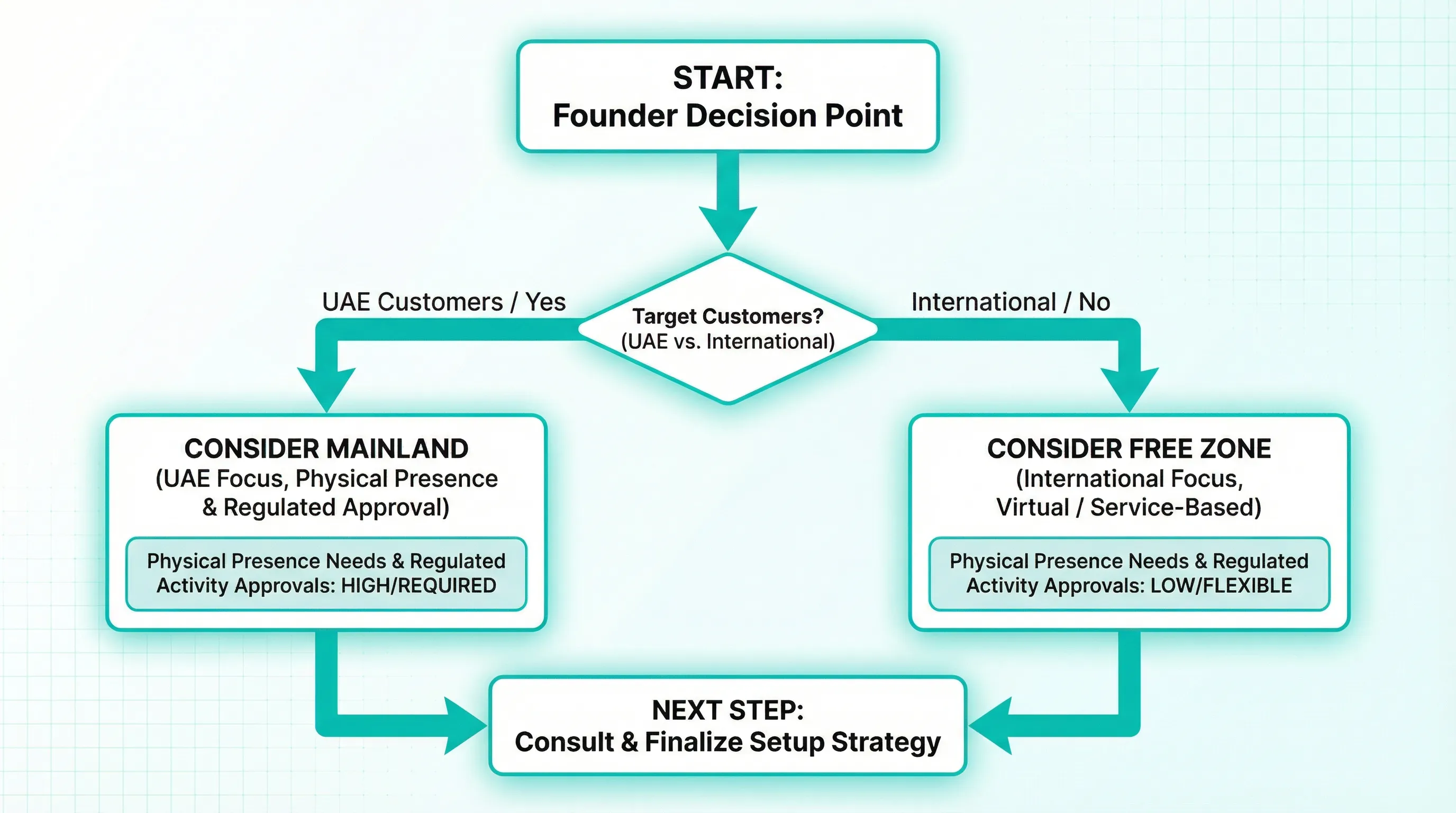
One of the biggest structuring decisions is where your license sits. The UAE is not a single licensing system, it is a federation with multiple regulators.
In practice, most operating businesses choose either:
- Mainland (onshore, Department of Economic Development or equivalent in each emirate)
- Free zone (a separate authority and regulatory framework)
“Offshore” entities also exist in some jurisdictions, but they are typically used for holding purposes and generally are not designed for conducting business with the UAE local market.
Here is a practical comparison to anchor your decision.
| Topic | Mainland company | Free zone company |
|---|---|---|
| Where you can trade | Generally can trade in the UAE market and internationally (subject to activity licensing) | Often best for international trade and operating within the free zone; mainland access may require a branch, distributor, or additional permissions depending on the model |
| Regulator | Emirate-level economic department and other relevant ministries | Free zone authority (rules differ by free zone) |
| Office requirements | Vary by activity and emirate, may require physical office/lease | Often flexible options exist, but requirements vary widely |
| Tax considerations | Subject to UAE corporate tax rules | Can qualify for free zone tax benefits if conditions are met, including compliance and “qualifying income” rules (see Ministry of Finance guidance) |
| Perception and counterparties | Often preferred for businesses serving UAE customers and government-related procurement | Often preferred for regional HQ, international contracting, and sector clusters |
The key point: your jurisdiction choice affects licensing, visas, office requirements, banking, and tax outcomes. It should be driven by your operating reality (customers, contracts, hiring plan, and where value is created), not by one isolated benefit.
Key rules you must understand before you start
1) Business activity, licensing, and approvals
In the UAE, your license is tied to approved activities, and the activity description is not just administrative. It impacts:
- Whether you need external approvals (for example, regulated professional services)
- Whether you can invoice certain services
- Whether your bank will accept your business profile
- Whether you can sponsor specific visa types
A common pitfall is selecting an activity that is “close enough” to get the company incorporated quickly, then discovering later that contracts, invoicing, or banking compliance becomes difficult.
2) Ownership and local participation (sector-specific)
Reforms have expanded foreign ownership options across many activities. That said, some sectors remain restricted or require special conditions. Always confirm requirements for your specific activity, emirate, and regulator rather than assuming a one-size-fits-all rule.
3) Corporate tax (and what it means operationally)
The UAE corporate tax regime is now a core part of doing business UAE properly. Even if your effective tax is low, your compliance obligations are real.
Key concepts to plan for:
Standard corporate tax rate. The UAE applies corporate tax rules at the federal level (details and updates are published by the UAE Ministry of Finance).
Small Business Relief (where applicable). The UAE has provided relief for eligible small businesses under specified conditions and timeframes. If you think you may qualify, confirm the latest eligibility requirements and elections in Federal Tax Authority guidance.
Free zone taxation (qualifying vs non-qualifying income). Free zones are not “tax free by default.” To benefit, businesses must generally meet the conditions to be treated as a qualifying free zone person and must manage income streams correctly.
Transfer pricing and related-party transactions. If you have a group structure, intercompany services, royalties, cost sharing, or centralized management, expect documentation and pricing scrutiny consistent with international standards.
Practical takeaway: tax is now linked to substance, documentation, and governance, not just incorporation.
4) VAT (5%) and indirect tax basics
The UAE has a mature VAT system with well-defined registration thresholds, invoicing rules, and filing obligations. If your taxable supplies exceed the mandatory registration threshold, you must register and comply.
For current thresholds and rules, use the UAE Federal Tax Authority VAT portal.
VAT becomes operationally important because it affects:
- Your pricing and contract wording (VAT inclusive vs exclusive)
- Cash flow (timing of VAT collection and remittance)
- Recordkeeping and audit readiness
5) UBO (Ultimate Beneficial Owner) and corporate transparency
UAE entities are generally required to maintain beneficial ownership information and keep corporate registers up to date, with obligations often tied to the licensing authority and underlying federal rules.
If your structure involves holding companies, trusts, family offices, or nominee arrangements, you should treat UBO compliance as a design constraint from day one, not as a form to complete later.
For official context, see the UAE Ministry of Economy’s information on beneficial owner regulations.
6) Banking and KYC (the rule that affects everyone)
Bank account opening in the UAE is often the longest pole in the timeline for new companies, particularly for:
- International founders without UAE residence
- Businesses in higher-risk industries (crypto-related services, certain trading models, payment flows)
- Companies with complex ownership chains
Banks will typically assess the “why UAE” story, expected transaction flows, counterparties, source of funds, and the founder’s experience. If your licensing activity, website, contracts, and invoices do not align, delays are common.
7) Visas, immigration, and employment compliance
Many founders combine company setup with residency visas. Visas are not only a lifestyle benefit, they also influence practical operations like banking, leasing, and hiring.
If you plan to hire, you must also plan for employment compliance such as work permits and wage protection rules (depending on the jurisdiction and employee category). Requirements can differ between mainland and free zones.
8) Data protection and sector rules
The UAE has a federal personal data protection framework, and certain sectors (finance, health, education) may have additional requirements or regulator expectations.
If you handle sensitive personal data or operate a platform business, include data governance in your initial setup checklist rather than deferring it until you scale.
The main risks of doing business in the UAE (and how to reduce them)
The UAE is a high-opportunity environment, but the risks are often compliance and execution related rather than market related.
Risk 1: Choosing a structure that does not match your real operating model
This is the most frequent and expensive mistake. A structure optimized for one goal (for example, speed or a perceived tax benefit) can later conflict with:
- How you sell (B2B vs B2C, UAE customers vs international)
- Where you perform the work (in-country staff vs remote delivery)
- What your bank expects to see
Mitigation: start with a clear map of your customer locations, contracting entity, delivery model, and hiring plan, then choose jurisdiction and license around that.
Risk 2: Banking delays that stall the business after incorporation
It is common to obtain a trade license quickly, then wait weeks or months for full banking access.
Mitigation: prepare a bank-ready pack early: concise business plan, contracts or pipelines, invoices/pro forma templates, owner CVs, source-of-funds evidence, and a consistent web presence that matches the licensed activity.
Risk 3: Corporate tax and VAT compliance gaps
The “new normal” is that companies need bookkeeping, documentation, and filings that stand up to audit.
Mitigation: implement accounting from the start, even before revenue, and define who is responsible for: invoicing rules, VAT logic, corporate tax data capture, and year-end documentation.
Risk 4: UBO, governance, and documentation issues
Problems typically show up at the worst time, during bank reviews, due diligence, M&A, or when applying for regulated services.
Mitigation: maintain clean cap tables, shareholder registers, resolutions, and UBO documentation, and keep them updated whenever ownership or control changes.
Risk 5: “Substance” mismatch (especially for international groups)
Even though the UAE Economic Substance Regulations were repealed for financial years starting in 2023, substance still matters for tax, banking, and commercial credibility. If your UAE company claims to be a regional HQ but has no decision-makers, no contracts executed locally, and no operating footprint, you invite questions.
Mitigation: align your substance (people, premises, management decisions, and documentation) with what the company claims to do and where value is created.
A practical roadmap for setting up and operating compliantly
A successful UAE launch is usually less about “forming a company” and more about building an operating system that can pass bank scrutiny and scale without compliance fire drills.
The table below shows a typical sequence and what to prepare at each stage.
| Stage | What you decide or prepare | Why it matters |
|---|---|---|
| Structuring | Jurisdiction (mainland vs free zone), ownership chain, activity scope | Determines licensing, visas, tax treatment, and bankability |
| Incorporation | Name, constitutional documents, initial approvals | Creates the legal entity and defines governance |
| Operating footprint | Office/lease (if required), signatories, management roles | Supports substance, visas, and banking credibility |
| Banking prep | Business profile, contracts/pipeline evidence, compliance documents | Reduces KYC friction and timelines |
| Tax and accounting | VAT assessment, corporate tax readiness, bookkeeping process | Prevents penalties and makes reporting realistic |
| Ongoing compliance | Renewals, filings, UBO updates, governance | Keeps the company in good standing and bankable |
What “good” looks like: a UAE compliance baseline
If you want a simple benchmark, compliant companies usually have these elements in place early:
- A license activity that precisely matches contracts and invoicing
- A documented ownership and UBO file that is current
- A real operating narrative (who sells, who delivers, where decisions are made)
- Bookkeeping that supports VAT and corporate tax reporting
- Governance hygiene (resolutions, signatory control, documented management decisions)
This baseline is what makes expansions, audits, and due diligence routine rather than disruptive.
When to bring in experts (and what to delegate)
Founders often try to handle UAE setup alone, then later bring in advisors when they hit a bank rejection or a compliance deadline. It is usually cheaper and faster to structure correctly from the start.
Expert help is most valuable when:
- Your ownership structure is multi-layered (holdco, family office, multi-country group)
- You need both UAE market access and international contracting
- You expect regulated counterparties (banks, payment providers, government-linked entities)
- You want a free zone tax position that must be defensible
- You need visas, bookkeeping, and tax registration coordinated with setup
Alldren provides expert-led corporate services for establishing and managing UAE companies, with support across structuring, compliance management, governance, banking support, visas, and ongoing administration. If you want the setup to be designed around how you actually operate (not just how fast you can incorporate), you can explore Alldren’s corporate services.

The bottom line
Doing business UAE offers real advantages: global connectivity, a business-friendly environment, and a modern tax framework that can work well for both founders and international groups. The tradeoff is that success depends on getting the details right, especially your licensing scope, jurisdiction choice, banking readiness, and ongoing tax and transparency compliance.
If you treat UAE setup as a long-term operating system rather than a one-time registration, you dramatically reduce risk and increase your ability to scale confidently.


