

Choosing between a mainland, Free Zone UAE, or offshore company is one of the most consequential decisions you will make when entering the UAE. It impacts where you can trade, how you hire and sponsor visas, what your banking file needs to look like, and how much ongoing compliance you will carry.
This guide breaks down the practical differences (not brochure promises), highlights where each option fits best, and gives you a clear framework to decide.
Mainland vs Free Zone vs Offshore in the UAE, the simple definitions
Before comparing benefits, align on what each structure actually means.
- Mainland company: A UAE company licensed by the economic department of an emirate (for example, Dubai’s Department of Economy and Tourism, Abu Dhabi’s ADDED). Mainland companies can generally trade directly across the UAE market, subject to licensing and regulatory approvals.
- Free zone company: A UAE company incorporated in a specific free zone authority (DMCC, IFZA, JAFZA, ADGM, DIFC, and many more). A Free Zone UAE company is primarily designed for activities within the free zone and for doing business internationally, with controlled pathways to serve the mainland.
- Offshore company: A company incorporated in an offshore jurisdiction (often used as a holding or asset ownership vehicle). Offshore companies are typically not designed to conduct operating trade within the UAE market and generally do not provide UAE residency visas.
The “best” choice is the one that matches your business model, customer location, activity, and substance (people, premises, and operations).
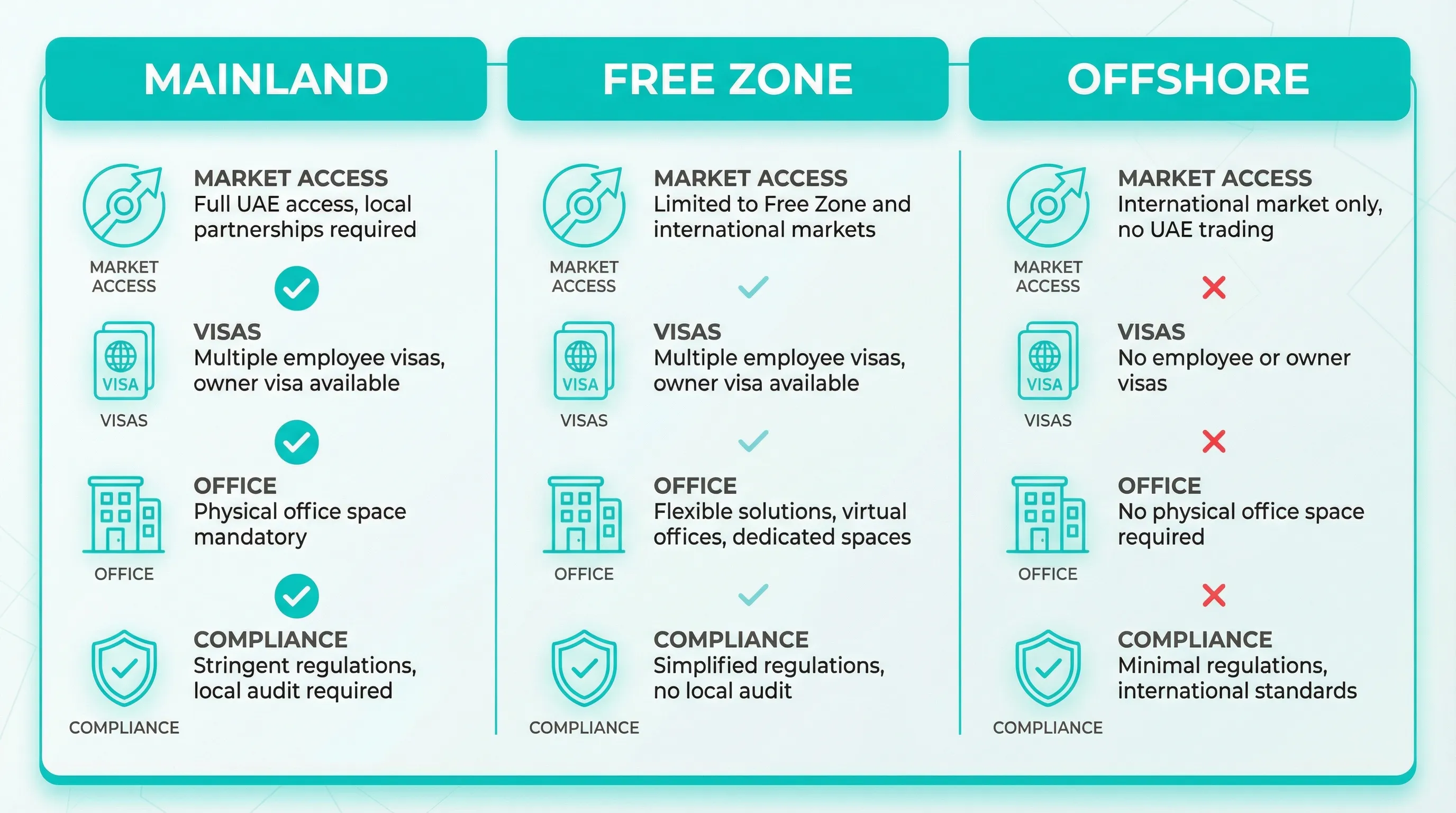
Mainland company in the UAE
A mainland setup is usually the most straightforward path if you intend to sell directly to UAE customers (B2C or B2B), sign local contracts without intermediaries, open branches, or build a team that works across the UAE.
Typical advantages
- Direct access to the UAE market: You can invoice and contract locally without needing a free zone to mainland mechanism.
- Operational flexibility: Suitable for businesses that need to work at client sites, open physical locations, or operate across multiple emirates (subject to licensing).
- Often preferred for certain tenders and regulated activities: Government, semi-government, and regulated sectors may have specific requirements.
Typical tradeoffs
- Office and lease requirements: Many activities require a compliant office/lease arrangement (requirements vary by emirate and activity).
- More external approvals for some activities: Certain regulated activities can require additional ministry or authority approvals.
- Perception that mainland requires a local partner: This used to be a primary driver, but foreign ownership rules have evolved significantly. The UAE has expanded foreign ownership eligibility for many activities, though some strategic sectors can still have restrictions. For official context, see the UAE Ministry of Economy resources.
When mainland is usually the best fit
Mainland tends to be a strong choice if you:
- Sell to customers located in the UAE and want simple invoicing and contracting.
- Need a shop, clinic, restaurant, warehouse, or other onshore footprint.
- Need to deploy staff frequently across the UAE (site work, field teams, service delivery).
Free Zone UAE company
A Free Zone UAE company can be an excellent solution when your business is international, digital, export-oriented, or when you want a structured ecosystem (industry clusters, community, and processes designed for foreign founders).
There are two realities to keep in mind:
- Free zones vary widely (cost, permitted activities, office options, audit expectations, visa quotas, banking comfort).
- “Free zone” does not automatically mean “you can trade anywhere in the UAE without constraints.” Access to the mainland is possible, but the route matters.
Typical advantages
- Streamlined incorporation experience: Many free zones are optimized for fast setup and founder-friendly administration.
- International business fit: Useful for companies contracting abroad, operating online, or running regional HQ functions.
- Ecosystem benefits: Certain free zones are built around sectors (media, commodities, logistics, financial services), which can be valuable for credibility and networking.
Typical tradeoffs
- Mainland trade limitations: Direct local trading rules depend on your activity and the free zone. Often, selling “into” the mainland requires a specific arrangement (for example, a mainland distributor, a branch, or other compliant pathway).
- Substance and compliance still matter: Banking, corporate tax positioning, and ongoing compliance can require real operational substance, not just a license.
- Annual renewals and authority requirements: These vary, and some free zones have more rigorous expectations (especially those under financial regulators).
When a Free Zone UAE setup is usually the best fit
Free zones are commonly chosen when you:
- Serve international clients and do not need day-to-day local UAE contracting.
- Run a digital services business, consultancy, trading (import/export), or regional coordination hub.
- Want a clear visa route for founders and key staff, aligned to an office solution offered by the free zone.
Offshore company (and what it is really for)
An offshore company is most often used as a holding vehicle, not an operating business on the ground. People choose offshore structures for asset holding, shareholder structuring, and sometimes as part of multi-entity group design.
Typical advantages
- Useful for holding shares or assets: Often considered when separating ownership from operations.
- Potentially lighter operational footprint: Depending on the jurisdiction and activity, offshore entities are typically not designed for staffing and premises in the UAE.
Typical tradeoffs
- Usually not an operating license: It is generally not the right vehicle if you plan to invoice UAE customers for day-to-day services or trade locally.
- No standard visa pathway: Offshore companies typically do not sponsor UAE residency visas like mainland and free zone entities.
- Banking can be more challenging: Banks may ask for clear economic rationale, source of funds, and substance, especially if the structure looks “paper-only.”
When offshore is usually the best fit
Offshore is often considered when you:
- Need a holding entity for shares in other companies.
- Want ring-fencing between operating risk and asset ownership (subject to professional advice).
- Are building a group and want a clean ownership layer above operations.
Quick comparison table: Mainland vs Free Zone UAE vs Offshore
The table below summarizes the decision points most founders care about.
| Factor | Mainland | Free Zone UAE | Offshore |
|---|---|---|---|
| Primary purpose | Operate and sell in the UAE market | International business, sector ecosystems, controlled mainland access | Holding and structuring (typically not operating) |
| Selling to UAE customers | Usually simplest | Possible, but often needs a compliant pathway depending on activity and free zone | Generally not intended |
| Residency visas | Commonly available | Commonly available | Typically not available |
| Office requirements | Often required (varies by activity/emirate) | Usually tied to free zone packages (varies widely) | Typically not designed for UAE premises |
| Banking posture | Strong when substance is clear | Strong when substance is clear, free zone choice matters | Can be harder without clear rationale and substance |
| Compliance intensity | Medium to high (activity dependent) | Medium to high (authority dependent) | Varies, but do not assume “no compliance” |
Taxes and compliance in 2026: what actually changes the choice
Tax and compliance should not be the only reason you choose a jurisdiction, but they should be modeled early because they affect ongoing cost and risk.
UAE Corporate Tax
The UAE introduced federal corporate tax, and it applies across mainland and free zones, with specific rules for free zone entities.
Key high-level points to be aware of:
- A federal corporate tax regime applies to UAE businesses, with rules administered by the Federal Tax Authority.
- Free zone entities may qualify for preferential treatment on qualifying income, subject to conditions and ongoing compliance obligations.
You should always validate your specific position with the law and current guidance. Start with the Federal Tax Authority corporate tax pages.
VAT
VAT is a separate analysis from corporate tax. VAT registration depends on your taxable supplies and thresholds, not whether you are mainland or free zone.
For official VAT guidance, see the Federal Tax Authority VAT resources.
Economic substance, UBO, and AML expectations
Even if your license setup is quick, ongoing compliance is not optional. Most businesses should expect to deal with:
- UBO disclosures (ultimate beneficial owner)
- Accounting records and financial reporting appropriate to the entity and regulator expectations
- Real substance if you are presenting yourself as an operating company to banks, counterparties, or tax authorities
If you are building a structure with multiple entities (for example, free zone operating company plus an offshore holding company), consistency across documents, flows of funds, and governance is critical.
Banking: the factor that surprises most founders
Many founders choose a jurisdiction based on setup marketing, then get stuck at the bank.
In 2026, UAE bank onboarding is best understood as a risk assessment. Regardless of mainland or Free Zone UAE incorporation, expect the bank to request:
- Clear business activity description aligned with your license
- Contracts, invoices, and/or pipeline evidence
- Source of funds and source of wealth explanations for shareholders
- UBO details and corporate documents
- Proof of address, office solution, and sometimes proof of local economic tie
A practical rule: if your structure looks like it exists only “on paper,” banking friction increases.
Visas and hiring: what differs across the three
If residency is a key objective, jurisdiction choice matters.
- Mainland: Commonly supports investor/partner and employment visas, with requirements tied to your license and office situation.
- Free Zone UAE: Commonly supports investor and employment visas, with quotas and processes defined by the free zone authority and the office package.
- Offshore: Typically does not provide a standard route to UAE residency visas.
If your plan includes moving a team to the UAE within 3 to 12 months, model visas, office needs, and renewals early, not after incorporation.
A practical decision framework (use this before you pick a jurisdiction)
Use these questions to reach the right answer faster.
1) Where are your customers and where will you deliver the service?
- If you will sell and deliver in the UAE daily, mainland is often simplest.
- If you will sell internationally and only maintain a UAE base, a Free Zone UAE entity can be a strong fit.
2) What is your exact activity, and is it licensable where you want to register?
Licensing is not just a label. “Consulting,” “trading,” “marketing,” “software,” and “management” can have different scopes and regulator expectations. The right structure is the one that matches your real operations.
3) Do you need visas, and for how many people?
- Founder-only residency needs can be solved in multiple ways.
- Hiring plans can push you toward jurisdictions with better visa processing, clearer quotas, and suitable office options.
4) Will you need to invoice the mainland directly?
If “yes,” clarify upfront how your free zone choice enables compliant mainland access, or consider mainland from day one.
5) What does your banking story look like?
Banks want coherence: activity, geography of clients, expected volumes, and documented source of funds. Pick a setup that supports a credible operating narrative.
6) Are you building for investment, a group structure, or an exit?
If you expect new shareholders, regional expansion, or a holding structure, design the corporate architecture early rather than bolting it on later.
Common pitfalls to avoid
These are the mistakes that most often create re-setup costs.
- Choosing the cheapest license without checking mainland access needs.
- Picking an activity that does not match reality, then struggling with banking and compliance.
- Assuming offshore is a shortcut to operating.
- Ignoring ongoing compliance, especially bookkeeping, tax registration obligations (where applicable), and governance.
Where Alldren fits in your decision
Alldren provides expert-led, transparent corporate services for establishing and managing companies in the UAE, with support that goes beyond incorporation.
If you are deciding between mainland, Free Zone UAE, and offshore, Alldren can help you:
- Choose a structure that matches your business model, licensing reality, and growth plans
- Set up the company and corporate governance correctly from day one
- Handle ongoing compliance management and operational support
- Support bank account opening, residency visas, and tax registration and bookkeeping needs (where applicable)
If you want to avoid re-incorporation later, it is worth treating structuring as an engineering problem, not a paperwork task. You can explore Alldren’s approach at alldren.com.


