
Cross-border growth is exciting when viewed through a commercial lens: new customers, new partners, new revenue, and new markets. But behind every successful expansion is a less visible operating layer that determines whether growth is durable or fragile. Entity structure, banking, governance, tax registration, compliance calendars, signing authority, visas, and recordkeeping can all accelerate expansion when handled well, or slow it down when treated as an afterthought.
That is where global corporate services become strategically important. They are not just administrative support for incorporation paperwork. Done properly, they create the legal, financial, and compliance framework that allows a company to enter new markets, manage risk, and keep operating as it grows across borders.
For founders, CFOs, family offices, and international advisory teams, the question is not simply “Can we set up a company abroad?” A better question is: “Can we build a structure that banks, regulators, investors, tax advisers, and future counterparties can understand and rely on?”
Cross-border growth is an operating challenge, not just a sales challenge
A company can validate demand in a new market long before it is ready to operate there. It may receive distributor interest, hire remote contractors, sign a first customer, or explore regional partnerships. At that point, the expansion starts to create practical questions.
Who signs the local contract? Which entity invoices the customer? Where should revenue be booked? Does the company need a local license? Can it open a bank account? Who is responsible for regulatory filings? How are directors appointed and documented? What happens if a bank asks for proof of ownership or source of funds?
These questions are not minor details. They shape the company’s risk profile and its ability to scale. A weak structure can create delays, rejected bank applications, tax uncertainty, licensing problems, or governance gaps that become expensive to fix later.
Global corporate services help companies turn expansion from an improvised sequence of decisions into a coordinated operating model. This matters especially when a business is using a hub jurisdiction, such as the UAE, to support regional or international activity.
What global corporate services actually include
The term can mean different things depending on the provider, but in a cross-border context, global corporate services usually cover a mix of structuring, implementation, compliance, and ongoing administration.
| Area of support | How it helps cross-border growth | Common business question |
|---|---|---|
| Entity setup and structuring | Creates the legal vehicle for trading, holding assets, hiring, or investing | Should we use a mainland, free zone, offshore, branch, or subsidiary structure? |
| Governance and secretarial support | Keeps ownership, director authority, resolutions, and registers properly documented | Can we prove who controls the company and who can sign? |
| Banking readiness | Prepares documentation and structure for financial institution review | Will a bank understand our business model and ownership chain? |
| Tax and bookkeeping coordination | Supports registration, accounting records, and filing readiness | Are our accounts and tax obligations aligned with the structure? |
| Visa and residency support | Enables founders, managers, or employees to establish practical presence | Who needs residency or local authorization to operate effectively? |
| Ongoing compliance management | Tracks renewals, filings, changes, and regulatory obligations | Are we staying compliant after incorporation? |
If you are evaluating what this looks like in a UAE context, Alldren’s guide to what corporate services in the UAE actually cover provides a more detailed breakdown of the service areas involved.
1. Choosing the right structure for the growth plan
A common mistake in international expansion is choosing the quickest entity to form rather than the most suitable entity to operate. Speed matters, but structure matters more.
A business expanding across borders may need a trading company, a regional headquarters, an intellectual property holding entity, an investment vehicle, a joint venture company, or a special purpose vehicle. Each serves a different purpose. The right answer depends on commercial goals, ownership, substance, banking needs, licensing requirements, and future exit plans.
For example, a company entering the Gulf region may consider the UAE for regional management, contracting, invoicing, hiring, or holding functions. But the specific setup should match the business model. A consulting firm, e-commerce operator, fund manager, family office, SaaS company, and asset-holding structure will not necessarily need the same corporate architecture.
Global corporate services support this decision by mapping practical requirements before the entity is formed. This includes understanding where customers are located, which contracts will be signed, what activities need to be licensed, who the beneficial owners are, which banks may be approached, and what tax advisers need to review.
The best outcome is not a company that merely exists on paper. It is a company that can operate, bank, contract, renew, maintain records, and withstand due diligence.
2. Reducing compliance risk across jurisdictions
Cross-border growth increases compliance exposure. A company operating in one jurisdiction may only need to monitor one set of filings, one tax authority, one licensing body, and one banking relationship. Once it expands internationally, the number of obligations multiplies.
Common compliance requirements can include company license renewals, changes in directors or shareholders, beneficial ownership filings, tax registrations, accounting records, immigration documentation, board approvals, and bank KYC updates. None of these should be handled reactively.
Regulators around the world are also increasing expectations around transparency. The Financial Action Task Force has emphasized beneficial ownership transparency as a core part of preventing misuse of corporate structures. For legitimate businesses, this means ownership chains, control rights, and source of funds should be clear and well documented.
Global corporate services help by creating compliance systems that keep the company organized after formation. This includes tracking deadlines, maintaining statutory records, updating registers, preparing resolutions, and coordinating with accountants, tax advisers, and banks when information changes.
For a growing business, this reduces the risk of unpleasant surprises. For investors, banks, and counterparties, it signals that the company is managed professionally.
3. Making banking easier by making the structure understandable
Bank account opening is often one of the biggest bottlenecks in cross-border expansion. Many founders assume that once a company is incorporated, banking will follow automatically. In reality, banks assess the full risk profile of the business.
They may review the ownership structure, beneficial owners, director profiles, source of wealth, source of funds, expected transaction flows, countries of operation, customer types, contracts, invoices, websites, business plans, and tax residency position. If the structure is unclear or documentation is inconsistent, the process can stall.
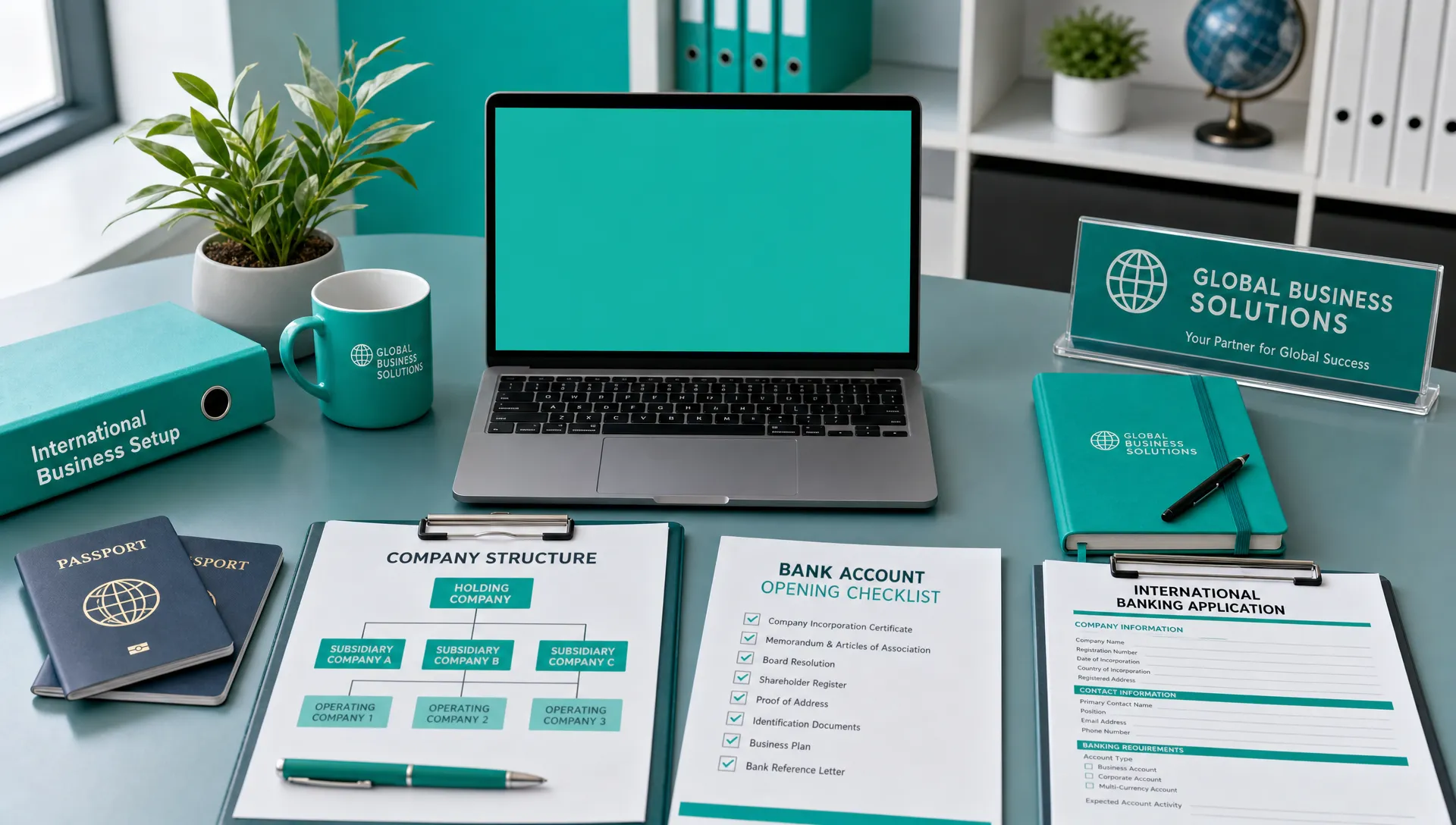
Global corporate services support banking readiness by ensuring the company’s documents tell a coherent story. A bank should be able to understand what the company does, who owns it, who controls it, why it was established, where its revenue comes from, and why it needs the account.
This is especially important for internationally active companies with holding structures, foreign shareholders, nominee arrangements, or multiple operating entities. The more complex the group, the more important it is to present clean documentation and consistent explanations.
4. Strengthening governance as the business scales
Governance is often overlooked in early-stage expansion because it feels formal compared with sales, hiring, and customer delivery. But cross-border growth quickly creates situations where governance becomes essential.
A company may need board approvals for opening bank accounts, appointing managers, issuing shares, changing signatories, entering major contracts, approving intercompany arrangements, or applying for licenses. If these decisions are not documented properly, future due diligence can become difficult.
Good governance also protects founders and shareholders. It clarifies who has authority, how decisions are made, which records are maintained, and how changes are approved. This matters for banks, investors, auditors, buyers, and regulators.
Corporate services providers typically support governance through company registers, minutes, resolutions, director and shareholder changes, power of attorney coordination, document retention, and renewal monitoring. These may sound administrative, but they are the evidence trail that supports the company’s legitimacy.
For cross-border groups, governance also helps avoid internal confusion. When there are multiple entities in different countries, clear documentation prevents uncertainty over which entity owns assets, which entity contracts with customers, and who has authority to act.
5. Coordinating tax, bookkeeping, and financial records
Global corporate services do not replace specialist tax advice, especially for multinational groups. However, they play a critical coordination role. A structure that is not supported by accurate bookkeeping and tax registration can create risk, even if it was well designed at the outset.
International tax rules are increasingly focused on substance, transfer pricing, profit allocation, and transparency. The OECD’s Base Erosion and Profit Shifting project has influenced how tax authorities view cross-border structures, particularly where profits and activities appear misaligned.
For companies using the UAE as part of a regional or global structure, tax and accounting coordination is now a core operating requirement. UAE corporate tax, VAT where applicable, bookkeeping, invoices, management accounts, and supporting records all need to align with the company’s activities and structure.
Global corporate services help ensure that the operational records match the legal reality. This can include coordinating bookkeeping, tax registration, financial reporting support, and document collection so that advisers have the information they need.
The goal is simple: the structure should be commercially logical, properly recorded, and defensible if reviewed by a bank, auditor, investor, or authority.
6. Supporting mobility, presence, and practical operations
Cross-border growth is not only about entities and filings. People matter too. Founders, executives, managers, and key employees may need residency visas, work authorization, local identification, or the ability to sign documents and attend bank meetings.
In many cases, a company’s practical ability to operate depends on whether the right people can establish presence in the jurisdiction. This is particularly relevant when a business wants to build a regional base, relocate management, hire locally, or demonstrate that decisions are not being made entirely elsewhere.
Corporate services can support the administrative side of this process, including UAE residency visa processing where relevant. This does not remove the need to assess tax residency, immigration rules, or employment obligations, but it helps align the company’s legal setup with the real people running it.
7. Creating a stable platform for future expansion
The first cross-border entity is rarely the last. Once a business succeeds in one new market, it may expand into adjacent territories, add shareholders, raise capital, acquire assets, form joint ventures, or restructure for operational efficiency.
A properly managed corporate platform makes those future steps easier. Documents are available. Ownership is clear. Accounting records are organized. Compliance deadlines are tracked. Banks have up-to-date information. Directors and shareholders can approve changes efficiently.
A weak platform does the opposite. Each new transaction requires cleanup. Bank reviews take longer. Investors ask for missing records. Advisers find inconsistencies. Renewal deadlines create emergencies. The company grows, but its administrative foundation lags behind.
This is why global corporate services are not only useful at incorporation. Their value increases over time as the business becomes more complex.
When offshore or holding structures may be relevant
Some cross-border businesses require more than one entity. A group may need a holding company, an asset ownership vehicle, a special purpose vehicle, or a structure designed for succession, investment, or ring-fencing risk.
These arrangements can be legitimate and useful, but only when they have a clear commercial purpose and are managed properly. Offshore and holding structures should be evaluated in the context of banking, tax advice, substance, reporting obligations, and the jurisdictions involved.
If you are considering this route, Alldren’s article on when offshore corporate services make sense explains common use cases and the governance considerations that come with them.
What to look for in a global corporate services partner
Choosing the right provider matters because corporate services sit close to your company’s legal and financial foundations. A low-cost setup provider may be enough for a simple local company, but cross-border growth usually requires broader judgment.
Look for a partner that can discuss your objectives before recommending a structure. They should understand banking expectations, compliance requirements, governance documentation, and the difference between forming a company quickly and forming one that is fit for purpose.
Strong providers are transparent about scope, pricing, timelines, and responsibilities. They also know when to involve external tax, legal, or regulatory specialists rather than pretending one provider can answer every question in every jurisdiction.
A useful evaluation process should cover:
- Whether the provider asks about your commercial model before recommending an entity
- Whether they explain licensing, ownership, banking, and compliance implications clearly
- Whether pricing is transparent and distinguishes setup from ongoing support
- Whether they can coordinate governance, tax registration, bookkeeping, and renewals
- Whether senior experts are accessible when structural decisions need judgment
For a deeper provider selection framework, see Alldren’s guide on how to choose a global corporate service provider.
How the UAE fits into cross-border growth strategies
The UAE is often considered by international businesses because of its role as a regional commercial hub, its range of mainland and free zone options, its international connectivity, and its developed banking and professional services environment. But these advantages only translate into value when the structure is designed around the company’s actual activities.
A UAE company used for regional operations, consulting, trading, investment holding, or management services may require different licensing, documentation, banking preparation, and tax coordination. The key is to avoid treating the UAE entity as a standalone formality. It should fit into the wider corporate group and support real commercial objectives.
For businesses and private clients, this is where expert-led corporate structuring becomes important. The aim is not complexity for its own sake. The aim is clarity: a structure that supports cross-border growth while remaining practical to manage.
Frequently Asked Questions
What are global corporate services? Global corporate services are professional services that help companies establish, manage, and maintain corporate structures across jurisdictions. They typically include company setup, governance, compliance management, banking support, tax registration coordination, bookkeeping support, and ongoing administration.
Why are global corporate services important for cross-border growth? They help companies expand with a structure that can operate legally, open bank accounts, meet compliance obligations, document governance decisions, and support future transactions. Without this foundation, international growth can be slowed by regulatory, banking, or administrative issues.
Do global corporate services replace legal or tax advice? No. They often work alongside legal and tax advisers. A strong corporate services partner helps implement and maintain the structure, coordinate documentation, and ensure the company’s records support the advice received.
When should a business engage a corporate services provider? Ideally, before forming an entity or signing major cross-border contracts. Early input helps align the structure with licensing, banking, tax, governance, and operational needs before decisions become costly to reverse.
Can global corporate services help with UAE company setup? Yes, where the provider has UAE expertise. Support may include company setup and structuring, compliance management, bank account opening support, UAE residency visa processing, bookkeeping, tax registration, and corporate governance services.
Build cross-border growth on a stronger corporate foundation
International expansion works best when the corporate structure is designed with the same care as the commercial strategy. The right foundation can make banking smoother, compliance more predictable, governance clearer, and future growth easier to manage.
Alldren provides expert-led, transparent corporate services for establishing and managing UAE companies, including tailored structuring, compliance support, governance, bank account opening support, residency visa processing, bookkeeping, tax registration, and ongoing administration. If you are planning cross-border growth through the UAE or reviewing an existing structure, speak with Alldren to build a setup that is robust, compliant, and fit for purpose.