
A clear source-of-funds file helps a UAE bank understand more than how much money you have. It explains where the money came from, who owns it and how it will reach your company’s account. A statement showing a healthy balance may support the application, but it does not necessarily explain the economic origin of that balance.
The practical goal is to create a short, documented trail that a reviewer can follow without reconstructing your finances. Start with the funding explanation, support it with evidence and reconcile every material transfer along the way.
Separate source of funds from source of wealth
Source of funds concerns the origin of the specific money involved in an account or transaction. Examples include salary savings, proceeds from a property sale, a dividend or a loan.
Source of wealth concerns how someone accumulated their overall wealth over time. That might involve a business career, investment portfolio, inheritance or several asset sales.
The two can overlap. A founder funding a UAE company from accumulated savings may need to explain both their employment history and the bank transactions supporting the proposed contribution. The depth of evidence depends on the bank’s assessment and the circumstances.
The FATF Recommendations establish international standards for customer due diligence and ongoing monitoring. They are not a universal document checklist for every UAE application.
Keep this file focused on funding evidence. Incorporation documents, ownership records and business plans belong in the broader application, as explained in our guide to preparing a bank-ready UAE company file.
Build a source-of-funds file around a one-page explanation
Write the funding note first
A useful funding note should let the reviewer understand the transaction before opening the supporting documents. Describe the facts in plain language rather than relying on labels such as “personal funds” or “business income.”
Include the funding amount and currency, the person or entity providing it, the economic origin and the account from which it will be sent. Explain whether the company will receive an equity contribution, shareholder loan, customer payment or another type of receipt.
A concise opening could read:
The company expects to receive USD 80,000 as a shareholder loan from its sole shareholder. The funds are held in the shareholder’s personal account and derive from the sale of a personally owned property. The enclosed sale, settlement and banking records show the proceeds received and the funds available for the proposed transfer.
Use wording that reflects the actual transaction. Do not describe a loan as revenue or a proposed transfer as completed. The relevant agreement and company approvals should support the chosen treatment.
Give every supporting document a reference
A source-of-funds file is easier to review when the explanation points directly to the evidence. Use a simple index with consistent filenames, for example:
- A01, Funding note: The summary of the amount, origin, provider and intended transfer.
- B01, Origin evidence: The employment record, sale agreement, dividend resolution or other document explaining how the money arose.
- C01, Receipt evidence: The statement or settlement record showing that the proceeds were received.
- D01, Transfer trail: Statements and payment confirmations connecting any intermediate accounts.
- E01, Funding arrangement: The shareholder loan agreement, contribution documentation or other applicable record.
- F01, Reconciliation: A short schedule explaining deductions, currency conversion and any differences between amounts.
These are suggested organizational categories, not bank-mandated folder names. A straightforward salary-funded contribution may require fewer documents than a transfer involving several companies or asset sales.
Trace the money from its economic origin
Follow the chain, not just the last transfer
The last account to send the money is not necessarily its economic source. If a founder transfers money from a brokerage account to a personal account and then to the UAE company, the personal account explains one step, not the whole origin.
Build the chain in chronological order:
Economic origin → receipt of proceeds → intermediate movements → proposed or completed company funding.
For each material step, show the account holder, date, amount, currency and relevant transaction reference. Where an account number appears differently across documents, explain the masking or formatting difference rather than leaving the reviewer to infer it.
Documents should establish both the underlying event and the movement of money. A signed property contract does not, by itself, prove that the seller received the proceeds. Equally, a bank credit does not necessarily establish what was sold or who owned it.
If the company account is not yet open, stop the documented chain at the current holding account. Identify the final transfer as planned and add its confirmation after it occurs.
Match the evidence to the funding source
The following examples show how different sources can be documented. Actual requirements vary by bank and transaction.
| Funding source | Evidence explaining the origin | Evidence connecting it to available funds |
|---|---|---|
| Employment savings | Employment records, payslips and relevant tax records where applicable | Statements showing salary credits and accumulation of savings |
| Dividends | Dividend resolution or declaration, ownership evidence and relevant company financial records | Payment record and statement showing receipt by the shareholder |
| Property or business sale | Sale agreement, evidence of ownership and settlement records | Statement showing the net proceeds and any later transfers |
| Loan funding | Loan agreement, lender identity and evidence supporting the lender’s funding capacity and funds origin | Disbursement confirmation and receiving-account statement |
| Trading receipts | Customer contracts, invoices and relevant delivery or service records | Statements matching customer payments to the commercial records |
| Inheritance | Applicable estate, probate or distribution documentation | Records showing payment from the estate or authorized administrator |
| Investment proceeds | Broker statements, holding records and sale or redemption confirmations | Settlement record, withdrawal confirmation and bank receipt |
A shareholder loan agreement explains why money is being provided to the company. It does not, on its own, explain how the shareholder obtained that money.
For business-generated funds, distinguish turnover from money available to distribute or lend. Gross customer receipts may still be needed for supplier payments, tax liabilities or other obligations. Company accounts and the relevant authorization help explain the amount being transferred.
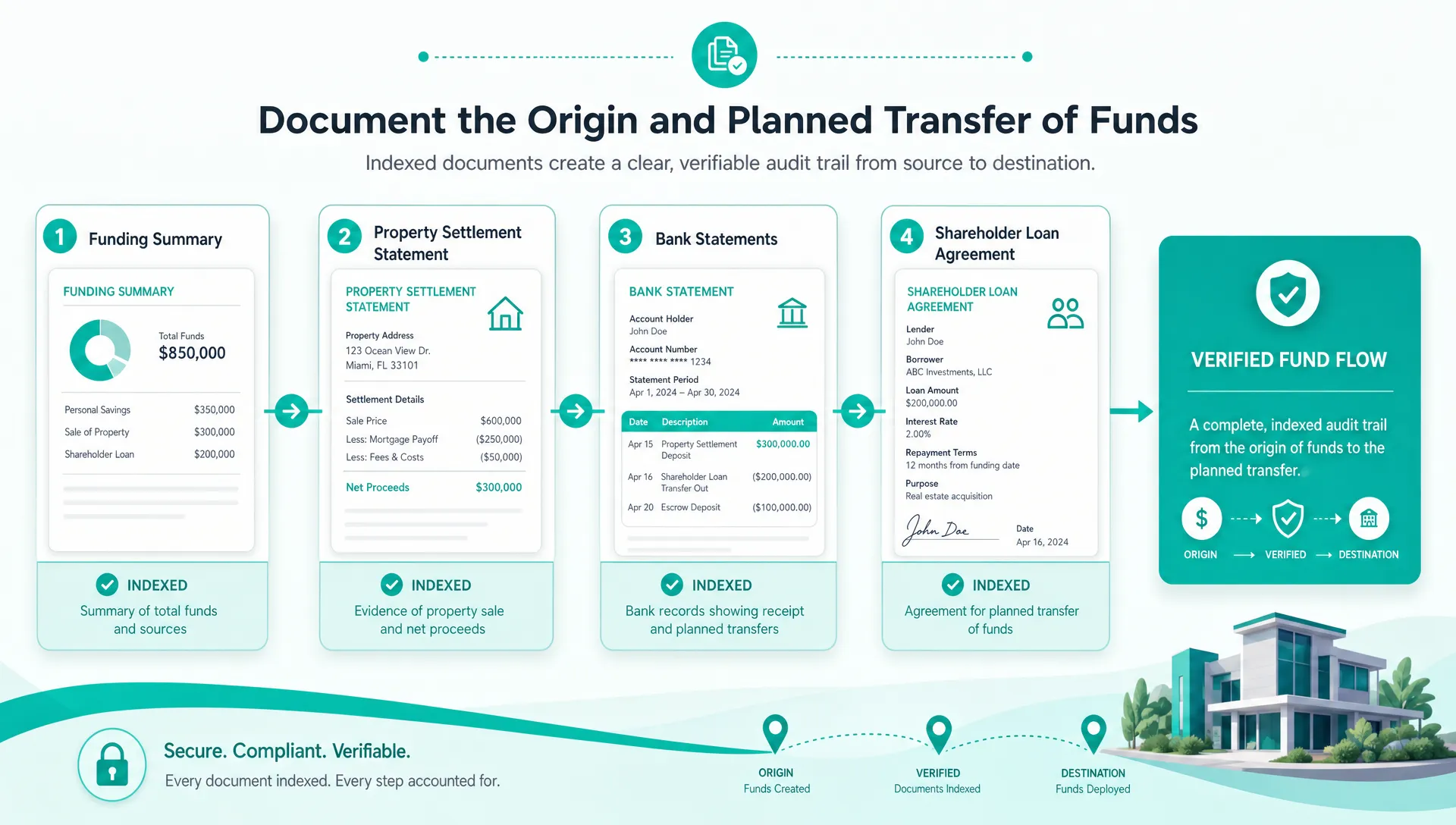
Worked example: property proceeds funding a new UAE company
Assume a founder plans to lend USD 80,000 to a newly established UAE company. The money comes from a property sale, with all amounts in this simplified example denominated in USD.
The property sells for USD 250,000. Settlement records show a USD 90,000 mortgage repayment and USD 10,000 in selling costs, leaving USD 150,000 paid to the founder’s personal account.
The source-of-funds file should connect those figures explicitly:
| Stage | Amount | Supporting record |
|---|---|---|
| Gross sale price | USD 250,000 | Sale agreement |
| Mortgage repayment | USD 90,000 | Settlement statement and repayment record |
| Selling costs | USD 10,000 | Settlement statement and fee records |
| Net proceeds received | USD 150,000 | Settlement statement and personal bank statement |
| Proposed shareholder loan | USD 80,000 | Loan documentation and funding note |
The funding note should explain that USD 80,000 will be drawn from the USD 150,000 received. If later transactions reduced the balance, include sufficient account history to demonstrate that the proposed funding remains available.
Before the corporate account opens, no company receipt can exist. Label that evidence as pending rather than presenting a transfer instruction as proof of payment. Once funded, add the transfer confirmation and corporate account statement, together with any fee or exchange-rate reconciliation.
This approach connects the asset sale, net proceeds and proposed company funding without implying that the entire sale price was available to transfer.
Reconcile amounts, currencies and document dates
A strong source-of-funds file does not require every figure to be identical. It requires differences to be understandable and supported.
Common differences include mortgage repayments, brokerage charges, transfer fees, withholding deductions and currency conversion. Show the original amount, each relevant deduction and the amount received. Use actual transaction records rather than a current exchange rate to explain a historical conversion.
Check dates as carefully as amounts. An agreement date, settlement date, bank value date and posting date can differ legitimately. A brief note can explain the sequence without suggesting an inconsistency.
For older savings, there may be no single transaction equal to the planned contribution. Explain the accumulation period and provide representative income evidence alongside sufficient account history to support the explanation. Ask the bank what period it needs before assembling years of statements.
When several sources are combined, separate them in the reconciliation. For example, identify how much comes from salary savings and how much from an investment sale. A single line labeled “personal savings” can conceal the very information the bank needs.
Address complications before submitting the file
Third-party payments and joint accounts
Funds arriving from someone other than the stated shareholder, customer or lender need an explanation. Identify the sender, their relationship to the company and the legal or commercial reason for the payment.
A spouse’s account, parent company account or related business account should not be presented as interchangeable with the founder’s own account. The bank may need evidence of ownership, authority and the underlying arrangement, as well as the origin of the funds.
For a joint account, show who holds it and explain whose funds are being contributed. If ownership or entitlement is unclear, resolve the documentation before initiating the transfer.
Avoid routing money through extra accounts merely to make the final payment appear simpler. Unnecessary movements can make the evidence harder to follow.
Cash, digital assets and incomplete records
A cash deposit proves that cash entered an account. It usually provides much less information about how that cash was earned. Support the underlying activity with records appropriate to the circumstances, and expect the bank to assess whether that evidence is sufficient.
For proceeds from digital assets, relevant records may include platform statements, acquisition history, transaction records, wallet ownership evidence and fiat withdrawal confirmations. A transaction hash alone does not establish the holder’s identity or the lawful economic origin of the assets. Bank acceptance and evidence requirements vary.
If a document is unavailable, identify the gap openly and ask what alternative evidence the bank will consider. A replacement statement or independently issued settlement record can be more useful than a lengthy explanation unsupported by records.
Keep the submission consistent and secure
Before sending the file, compare its funding note with the account application, ownership information and expected transaction profile. The provider, amount, purpose and countries involved should tell the same story across the documents.
For example, an application forecasting only domestic customer receipts should not leave a substantial overseas shareholder loan unexplained. Initial funding and future operating receipts are different flows, and both should be described accurately.
Our guide to the documents banks request for corporate account opening explains the wider documentation context. The source-of-funds file should complement that pack, not replace identity or company records.
Keep the original documents, a dated submission copy and a record of subsequent explanations. If something changes, issue a clearly identified revision rather than circulating several conflicting summaries.
Use the bank’s designated submission channel. Do not remove names, transaction details or account information needed for verification without first agreeing on acceptable redactions. Confirm whether translations, certifications or particular document formats are required.
Maintain the trail after the account opens
The file remains useful after onboarding. Banks may ask about later transactions during ongoing monitoring, particularly when activity differs from the profile originally provided.
Update the records when there is a new funding source, shareholder, lender or material change in payment routes. Keep loan agreements, approvals and transfer evidence connected to the corresponding bookkeeping entries.
Consistency matters beyond banking. A receipt described to the bank as a shareholder loan should not be recorded casually as sales revenue. Where the legal, accounting or tax treatment is uncertain, resolve it with the appropriate adviser.
A well-maintained source-of-funds file preserves the original explanation and makes later questions easier to answer. It does not guarantee account approval or prevent further due diligence.
Frequently asked questions
How many months of bank statements should I include? There is no single period suitable for every case. Provide the period requested by the bank and enough history to support the funding explanation. Recent sale proceeds and savings accumulated over several years require different evidence.
Can I prepare the file before the UAE company account opens? Yes. Document the origin, receipt and current location of the funds, then explain the proposed funding arrangement. Add the final transfer and receiving-account evidence once the account is open and funded.
Is a bank statement enough to prove source of funds? It may support part of the explanation, but a balance alone does not establish economic origin. Pair relevant transactions with employment, sale, dividend, loan or commercial records as appropriate.
Can I combine several funding sources in one file? Yes. Separate each source in the summary and reconciliation, with document references for its evidence trail. Then explain how the amounts combine into the proposed company funding.
Discuss your funding structure before applying
Alldren provides bank account opening support alongside company structuring, bookkeeping and ongoing compliance services. If your funding involves several owners, entities or jurisdictions, discuss your arrangements with Alldren before submitting the application. The aim is a documented explanation that matches the company’s structure and actual transactions, not a promise of bank approval.