
Audit readiness is not a last-minute exercise before an auditor, bank, investor, or free zone authority asks questions. In the UAE, it is a practical operating discipline: clean records, explainable transactions, current corporate registers, and tax evidence that can be produced without panic.
That matters more than ever. Corporate Tax, VAT, economic substance expectations in banking, free zone renewal processes, and ownership transparency rules have raised the standard for UAE companies. Even if your entity is not required to complete a statutory audit every year, it should still be able to withstand review.
The goal is simple: if someone asks, “Can you prove what happened, who approved it, and how it was reported?” your company should be able to answer quickly.
What “audit-ready” means for a UAE company
Being audit-ready does not always mean your UAE company must have signed audited financial statements every year. The requirement depends on factors such as your legal form, jurisdiction, free zone rules, revenue, tax status, bank expectations, investor requirements, and whether the company is claiming a specific tax treatment.
It does mean your company has a reliable audit trail. That audit trail should connect your commercial activity, accounting records, bank movements, tax filings, contracts, invoices, corporate approvals, and ownership records.
This applies whether you operate through a mainland company, a RAKEZ free zone entity, a RAK ICC offshore structure, or another UAE vehicle. The details differ, but the standard is similar: your records should be complete, consistent, and easy to explain.
| Area | What “audit-ready” looks like | Typical review risk |
|---|---|---|
| Accounting | Transactions are recorded with supporting documents and reconciled bank accounts | Missing invoices, unexplained payments, personal expenses in company accounts |
| Tax | Corporate Tax and VAT positions are supported by calculations, filings, and records | Late registration, incorrect classification, unsupported deductions |
| Governance | Decisions, ownership, directors, and authorities are properly documented | Outdated UBO records, missing resolutions, unclear signatory authority |
| Banking | KYC file, source of funds, counterparties, and business model are coherent | Account freezes, requests for clarification, delayed renewals |
| Licensing | Actual activity matches the trade license and commercial documents | Activity mismatch, renewal delays, regulatory questions |
If your company is newly incorporated, audit readiness should start immediately rather than at year-end. A first-year entity can use a structured UAE compliance checklist for new companies to avoid creating gaps that later become expensive to fix.
Start with clean financial records
The foundation of audit readiness is basic accounting discipline. Auditors, banks, tax advisers, investors, and regulators all start from the same question: do the numbers make sense?
A UAE company should maintain accounting records that show income, expenses, assets, liabilities, shareholder funding, loans, related-party transactions, and bank balances. Those records should not exist only as a year-end spreadsheet. They should be updated throughout the year, ideally monthly.
At a minimum, keep the following records organized and accessible:
- Sales invoices, credit notes, customer contracts, and proof of delivery or performance.
- Supplier invoices, receipts, purchase orders, and payment confirmations.
- Bank statements, bank reconciliation files, and explanations for unusual movements.
- Loan agreements, shareholder funding records, dividend approvals, and intercompany balances.
- Payroll, visa-related employment records, end-of-service calculations, and staff reimbursements.
- Fixed asset registers, depreciation schedules, lease agreements, and insurance records.
The strongest audit files do not only show what was paid. They show why it was paid, who approved it, how it relates to the licensed activity, and how it was treated for tax.
A simple rule helps: every bank transaction should be traceable to a commercial document, a tax record, or a corporate approval. If it cannot be explained six months later, it is not audit-ready.
Separate business money from personal money
One of the fastest ways to weaken a UAE company’s audit position is to mix business and personal spending. This creates problems for accounting, tax deductibility, banking reviews, and shareholder disputes.
Founder-funded businesses often blur the line early on. A shareholder pays a supplier personally, uses the company card for travel, or transfers funds without a written loan or capital contribution record. These actions may be manageable if documented correctly, but they become risky when left unexplained.
If a shareholder injects money, record whether it is share capital, a shareholder loan, or another form of funding. If the company reimburses expenses, keep receipts and approval records. If the company pays a director or connected person, document the commercial basis for the payment.
This is especially important for groups with overseas shareholders, nominee arrangements, family offices, holding companies, or multiple related entities. The more complex the structure, the more important the paper trail.
Keep Corporate Tax and VAT evidence ready
UAE Corporate Tax changed the record-keeping standard for many businesses. The Federal Tax Authority explains that taxable persons must keep records and documents to support their Corporate Tax position, and Corporate Tax records generally need to be retained for seven years after the end of the relevant tax period. You can review the FTA’s official overview on its Corporate Tax information page.
For VAT, taxable businesses must also keep records that support returns, tax invoices, input tax recovery, zero-rating, exemptions, and adjustments. In many cases, VAT records should be retained for at least five years, with longer periods applying to certain asset categories.
Audit readiness for tax is not just about filing on time. It means being able to justify the numbers in the filing. For Corporate Tax, that includes revenue recognition, deductible expenses, related-party balances, exempt income, tax losses, and transfer pricing where relevant.
Ministerial Decision No. 82 of 2023 also requires certain UAE taxable persons to prepare and maintain audited financial statements, including taxable persons with revenue exceeding AED 50 million and Qualifying Free Zone Persons. Separately, some licensing authorities, free zones, banks, and investors may ask for audited financials even where the tax rules do not.
A practical tax file should include the filed returns, working papers, trial balance, financial statements, tax registration details, correspondence with the FTA, VAT calculations where applicable, and management’s reasoning for material tax positions.
Maintain a corporate governance file
Financial records explain the numbers. Governance records explain authority.
A company may have clean accounts but still fail an audit-readiness review if it cannot prove who owns it, who controls it, who approved key decisions, and who is authorized to act. This is where company secretarial discipline becomes essential.
Your corporate governance file should include incorporation documents, memorandum and articles, license copies, share registers, director and manager records, UBO information, board or shareholder resolutions, powers of attorney, specimen signatures, and major approvals.
For changes, timing matters. A new shareholder, director, manager, signatory, business activity, address, or bank mandate should be reflected in the company records promptly. Backfilling resolutions at year-end is far weaker than maintaining a live corporate file.
If your structure involves nominee director services or layered ownership, keep the scope, authority, and control arrangements documented clearly. Banks, counterparties, and regulators increasingly expect transparency around beneficial ownership and decision-making authority.
For a deeper operational view, Alldren’s company secretarial duties checklist outlines the types of records and approvals UAE entities should keep under control.
Align your license, activity, contracts, and bank flows
Audit readiness is not only an accounting issue. It is also a consistency issue.
Your UAE company’s trade license should match what the business actually does. Your contracts should match the licensed activity. Your invoices should match the contracts. Your bank transactions should match the invoices. Your website, pitch deck, and customer communications should not describe a business model that is materially different from the company’s approved activity.
This alignment matters for free zone renewals, bank KYC reviews, tax analysis, investor due diligence, and counterparty onboarding. It is particularly important where a company has multiple activities, cross-border customers, consulting income, intellectual property income, holding-company functions, or related-party transactions.
For a RAKEZ free zone company, this may involve checking that the activity on the license properly supports the revenue being booked. For a RAK ICC offshore company, it may involve ensuring the company’s role as a holding, investment, or structuring vehicle is reflected consistently in bank records, agreements, and board approvals.
When the story is consistent, reviews are faster. When the story changes from document to document, even a compliant company can face delays.
Prepare for bank and investor reviews as audit events
Many founders think “audit” only means an annual review by an audit firm. In practice, UAE companies are often tested through bank reviews, payment questions, investor due diligence, free zone requests, and tax inquiries.
Banks may ask for updated trade licenses, ownership charts, UBO details, financial statements, major invoices, customer contracts, source-of-funds evidence, and explanations for high-value transactions. If the company file is weak, routine KYC can become disruptive.
A bank-ready file and an audit-ready file overlap heavily. Both require coherent ownership records, clear business activity, financial evidence, and transaction support. If banking is a priority, the guide on preparing a bank-ready UAE company file is a useful companion to this audit-readiness framework.
Investors and acquirers ask similar questions, but usually with more depth. They want to see whether revenue is real, liabilities are complete, tax exposures are understood, and the company has authority to enter into its contracts. Good audit readiness can therefore improve deal speed and credibility.
Build a monthly, quarterly, and annual rhythm
The easiest way to stay audit-ready is to avoid treating compliance as an annual clean-up project. A simple rhythm is usually enough for most UAE companies.
| Cadence | What to do | Why it helps |
|---|---|---|
| Monthly | Reconcile bank accounts, upload invoices and receipts, review receivables and payables, classify expenses | Prevents missing documents and makes errors easier to correct |
| Quarterly | Review VAT status, tax provisions, related-party balances, payroll records, and license activity alignment | Keeps tax and licensing risks visible before deadlines |
| Annually | Close financial statements, prepare audit schedules, update corporate registers, review UBO and signatory records | Creates a clean year-end file for auditors, banks, tax, and renewals |
This rhythm should be owned by someone. In a small company, that may be the founder with external bookkeeping support. In a larger structure, it may be a finance manager, company secretary, or corporate services provider. What matters is that responsibilities are assigned and deadlines are visible.
Create an audit pack before anyone asks for it
An audit pack is a central folder that gathers the evidence your company is most likely to need. It does not replace proper accounting, but it makes every review easier.
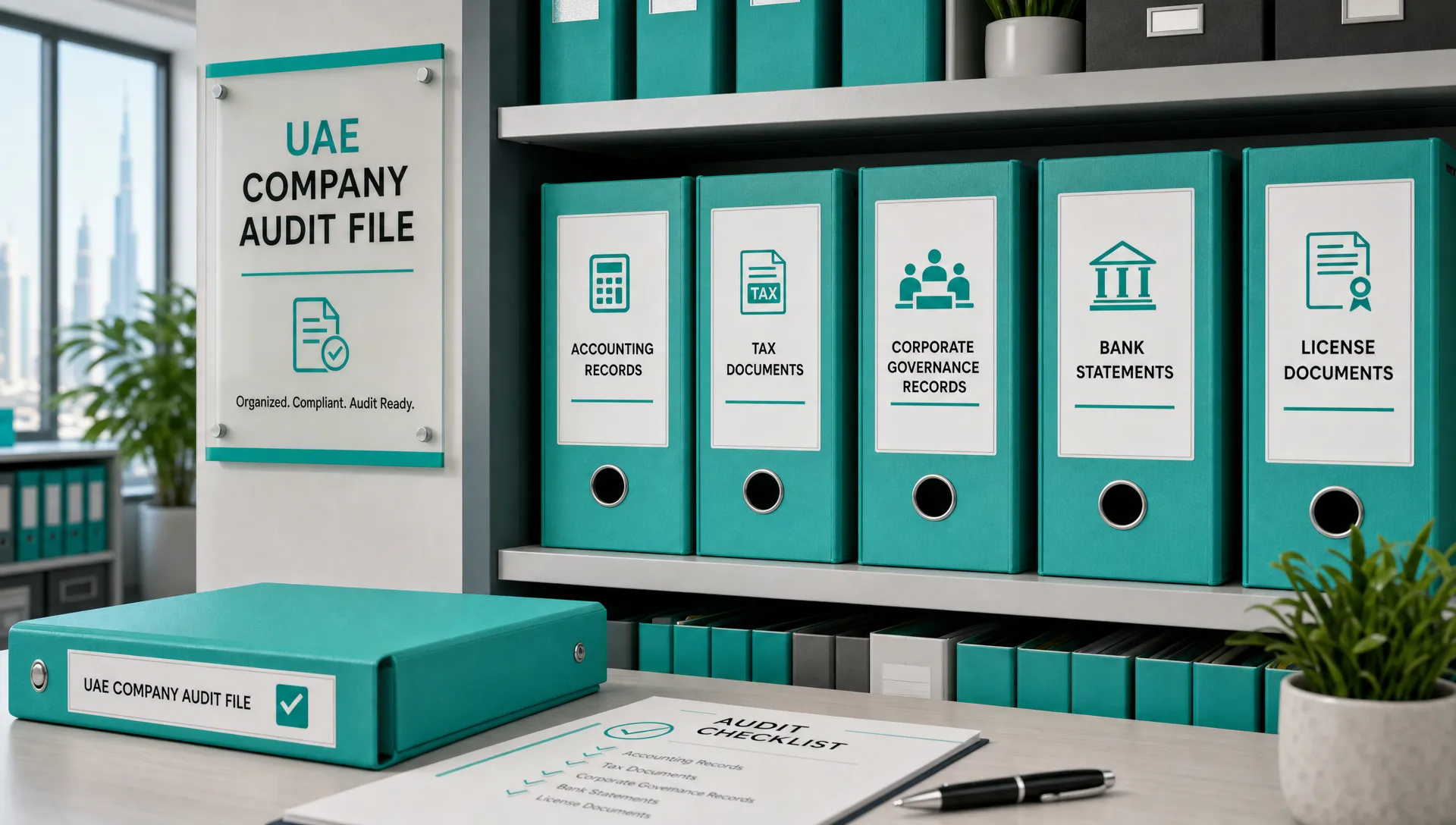
A strong UAE company audit pack usually includes financial statements, trial balance, general ledger, bank statements, bank reconciliations, accounts receivable and payable reports, fixed asset register, major contracts, tax filings, license documents, incorporation documents, UBO records, shareholder and director registers, resolutions, powers of attorney, and key correspondence with authorities or banks.
The pack should be version-controlled and updated at least annually. For companies with active banking reviews, frequent investor reporting, or regulated counterparties, quarterly updates may be more appropriate.
Avoid the temptation to store everything in email inboxes or messaging apps. Use a controlled folder structure, consistent file names, and restricted access for sensitive documents. Audit readiness depends not only on having documents, but also on being able to retrieve the correct version quickly.
Common audit-readiness weaknesses in UAE companies
Most audit issues are not caused by one dramatic mistake. They are caused by small gaps repeated over time.
A missing supplier invoice is manageable. A year of supplier payments with no supporting invoices is a problem. One undocumented shareholder transfer can be explained. Multiple undocumented transfers may raise tax, governance, and source-of-funds questions.
Common weak spots include outdated UBO information, missing board resolutions, unsupported management fees, personal expenses in company accounts, incomplete VAT records, inconsistent license activity descriptions, no written related-party agreements, expired powers of attorney, missing bank statements, and failure to document shareholder loans.
Another frequent issue is waiting until the auditor starts fieldwork to prepare schedules. By then, staff have changed, memories have faded, documents are harder to find, and corrections may require more work.
The better approach is to assume that every material transaction will eventually need to be explained. If you would not be comfortable showing the support to an auditor, bank, tax adviser, or investor, fix the record now.
Know when your company needs more than basic bookkeeping
Basic bookkeeping may be enough for a simple early-stage company with low transaction volume and no VAT registration. But as soon as the company adds employees, cross-border contracts, multiple shareholders, related-party transactions, VAT, financing, or free zone tax considerations, audit readiness becomes more technical.
You should consider expert support if your company may need audited financial statements, expects revenue near relevant tax or audit thresholds, wants to claim a free zone tax benefit, has related-party or connected-person transactions, operates across jurisdictions, uses nominee or holding structures, or is preparing for banking, investment, or sale due diligence.
Good advisers do not only fix issues after they appear. They help design the company’s reporting, governance, and compliance systems so the evidence exists before it is requested.
Frequently Asked Questions
Does every UAE company need an annual audit? Not every UAE company is required to complete a statutory audit every year. The answer depends on the company’s jurisdiction, free zone rules, legal form, tax status, revenue, bank requirements, and investor or contractual obligations. However, every company should keep records that can support an audit or review if required.
How long should a UAE company keep accounting and tax records? For UAE Corporate Tax, taxable persons should generally retain supporting records for seven years after the relevant tax period. VAT records are generally retained for at least five years, with longer periods for certain asset categories. Corporate governance records should be maintained carefully throughout the life of the company.
What is the difference between bookkeeping and being audit-ready? Bookkeeping records transactions. Audit readiness goes further by ensuring transactions are supported by evidence, reconciled to bank movements, aligned with tax filings, approved through proper governance, and consistent with the company’s licensed activity and ownership records.
Can audit readiness help with UAE bank account reviews? Yes. Banks often ask for many of the same documents an auditor or investor would request, including ownership records, financial statements, invoices, contracts, source-of-funds evidence, and explanations for major transactions. A clean audit file can make KYC reviews smoother.
When should a new UAE company start preparing for audit readiness? From the first transaction. The first year is when many long-term compliance habits are created. Setting up proper accounting, tax, governance, and document storage early is much easier than reconstructing records at renewal, tax filing, banking review, or audit time.
Keep your UAE company ready before the questions arrive
Audit readiness is ultimately about control. A well-managed UAE company can explain its ownership, activity, money flows, tax position, and decisions without scrambling for missing evidence.
Alldren provides expert-led, transparent corporate services for establishing and managing UAE companies, including structuring, compliance management, governance support, bank account opening support, bookkeeping, tax registration, visa processing, and ongoing corporate administration.
If you want your UAE company to be built and managed with audit readiness in mind, Alldren can help you put the right structure, records, and compliance rhythm in place from the start.