

UAE banks are fast when your file is clean, consistent, and easy to approve. They are slow when there are gaps in ownership information, unclear business activity, or mismatched documents. If your goal is to open a company bank account in UAE faster, the biggest lever you control is preparation: aligning your company structure, licensing, and KYC pack with what banks must collect under strict AML and sanctions-screening rules.
This guide walks through what actually speeds up approvals in 2026, what commonly causes delays, and the practical steps to reduce back-and-forth.
Why corporate bank accounts take time in the UAE
Most delays are not “bank bureaucracy,” they are compliance checks. UAE banks must verify who owns and controls the company, understand what the business does, and ensure funds are not linked to illicit activity. That means they typically assess:
- UBO (Ultimate Beneficial Owner) clarity: who ultimately owns or controls the company.
- Source of funds and source of wealth: how the business is funded and where owners’ wealth comes from.
- Business activity and transaction logic: expected customers, countries, invoice sizes, payment rails, and counterparties.
- Sanctions and adverse media screening: individuals and entities connected to the company.
You can read more about the regulator’s role via the Central Bank of the UAE.
What determines how fast your account is approved
“Fast” is relative because each bank has internal risk models and queues. In practice, approvals move quickest when your profile is straightforward and well documented.
1) Your company’s licensing and activity selection
Banks compare your trade license activity to your narrative and expected cash flows.
Common speed killers:
- Choosing a broad “trading” activity but describing a services model.
- Claiming international clients but providing no contracts or invoices.
- High-risk activities (or activities that banks treat as higher risk) without supporting evidence.
2) Ownership structure and number of layers
The more complex the structure, the more documents the bank needs. A simple structure (individual shareholders, clear UBO, clear management) usually moves faster than layered holding companies across multiple jurisdictions.
3) Residency and signatory availability
Many banks still prefer at least one UAE-resident signatory and often require an in-person meeting. Some will accept alternative arrangements, but you should plan for physical presence unless you have confirmation in writing.
4) Business proof and commercial footprint
Banks often look for evidence the business is real and operating, such as:
- Website and corporate email domain
- Signed contracts or proposals
- Recent invoices (even if small)
- Supplier/customer lists
- Office lease or flexi-desk where relevant
A company can be newly incorporated and still open an account, but you typically need a credible operating story and documentation to match.
Before you apply: the “speed pack” you should assemble
If you want fewer follow-up emails and fewer re-submissions, prepare a single coherent package that answers the bank’s questions upfront.
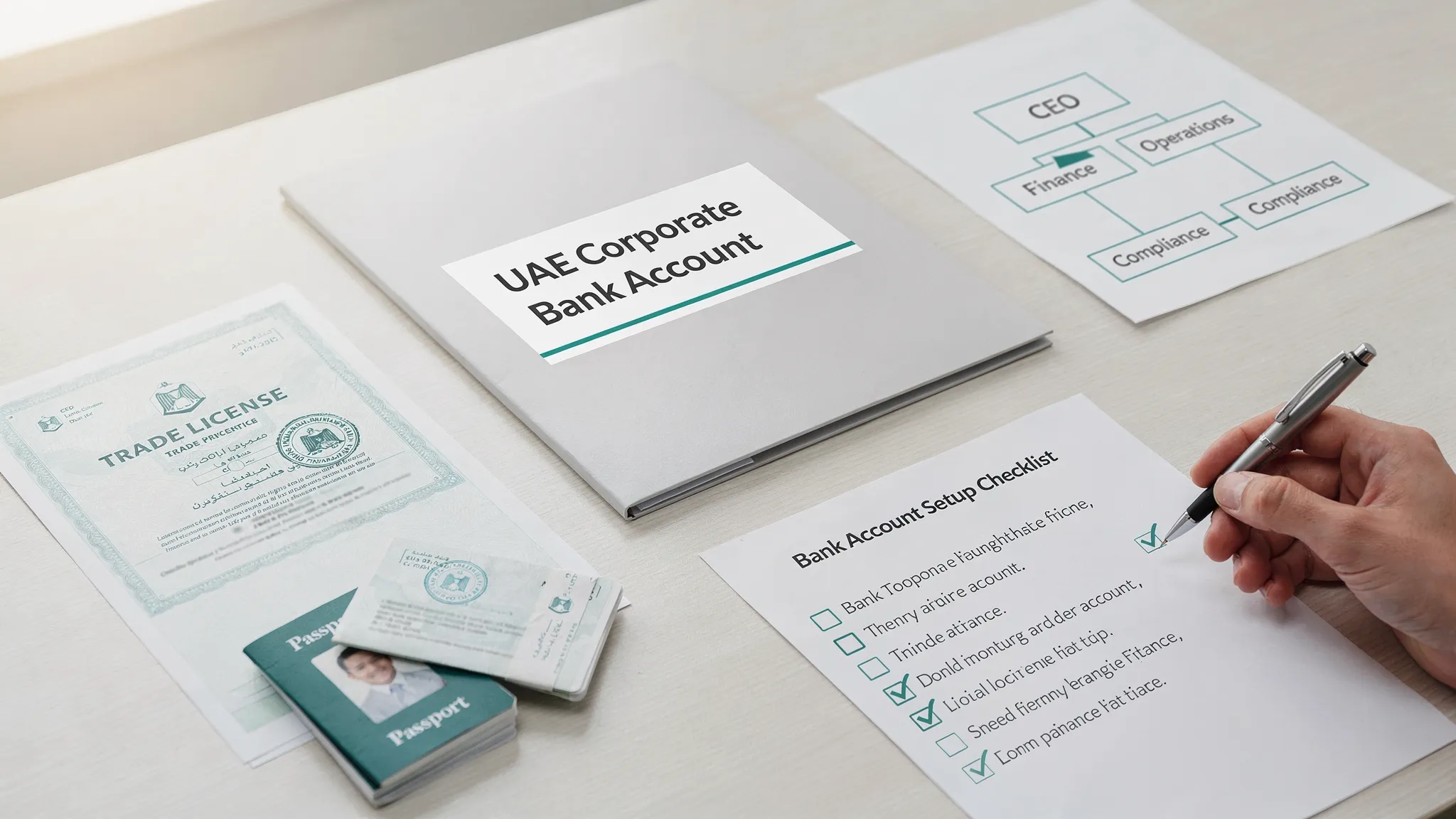
Core documents most banks request
Exact requirements vary, but the following are commonly requested for UAE corporate accounts.
| Document | Typically required for | Tips to avoid delays |
|---|---|---|
| Trade license | All companies | Make sure activity description matches your business narrative and website. |
| Memorandum/Articles (MOA/AOA) or equivalent constitutional docs | All companies | Provide the latest signed versions, consistent shareholder names and passport details. |
| Certificate of incorporation and any amendments | Many companies | Include amendments, not just the original certificate. |
| Shareholder and UBO details | All companies | Provide a simple ownership chart showing percentages and control. |
| Passports for shareholders and signatories | All companies | Use clear color scans, ensure expiry dates are valid. |
| UAE visa and Emirates ID (if applicable) | Often requested | If not available yet, ask what alternatives the bank accepts. |
| Proof of address (owners/signatories) | Common | Ensure it is recent and matches names exactly. |
| Board resolution authorizing account opening and signatories | Common | Use bank-friendly wording, confirm signing authority rules. |
| Business profile and expected activity (countries, volumes) | Common | Provide realistic monthly inflows/outflows and top counterparties. |
| Contracts, invoices, pipeline evidence | Common | Even 2–3 samples can reduce “prove your business” back-and-forth. |
| Source of funds/wealth supporting docs | Common | Keep it simple and credible (salary slips, sale of business, audited statements where applicable). |
Practical tip: Use one naming convention for the company everywhere, including the trade license, invoices, website footer, and email signatures.
Step-by-step: how to open a UAE company bank account faster
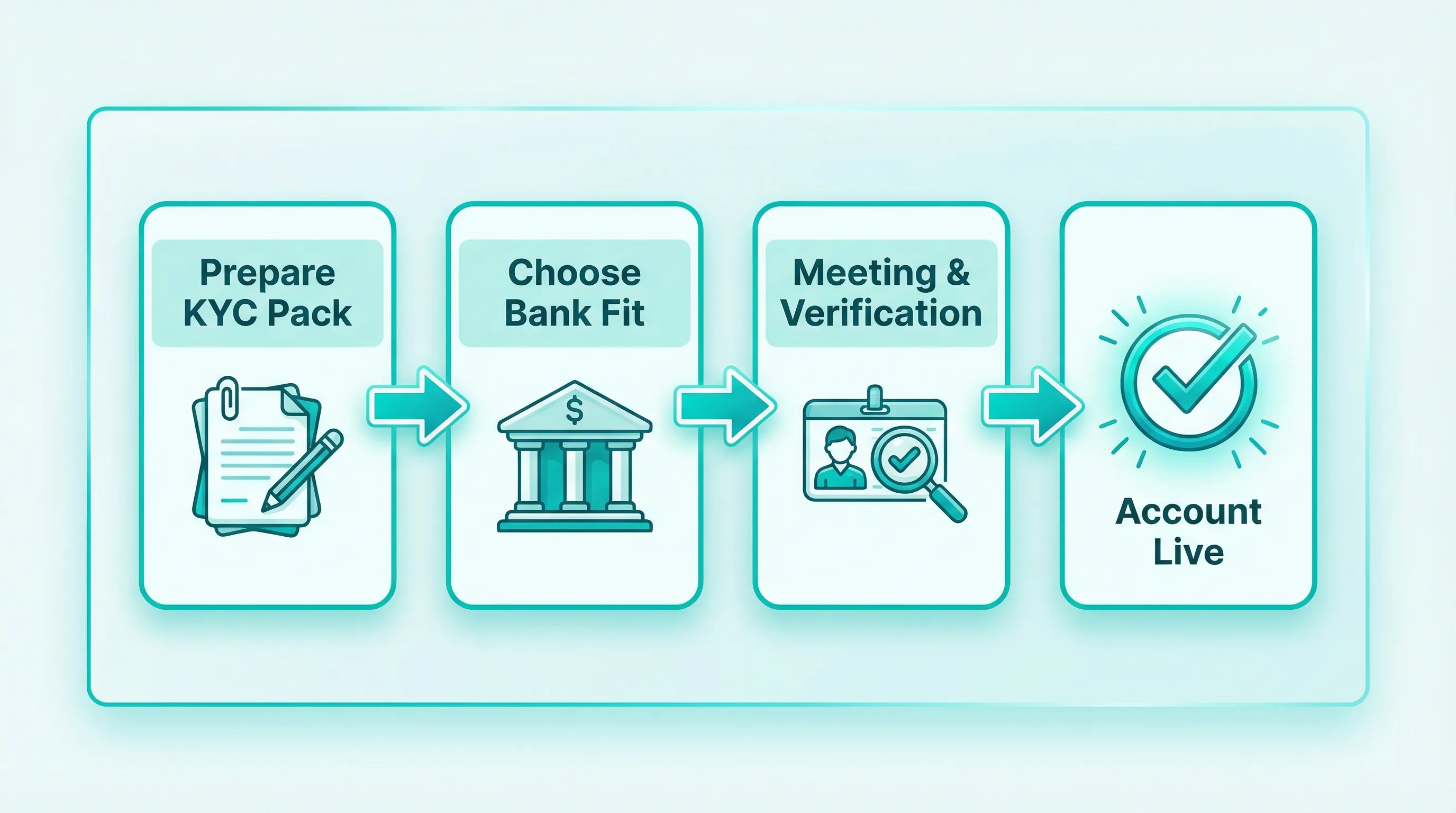
1) Pick the right bank target list for your profile
Not every bank is equally suitable for every business model. Speed increases when you apply to banks that already bank companies like yours.
Consider your reality:
- Are you primarily local UAE B2B, or cross-border?
- Do you need multi-currency collections?
- Will you receive payments from high-risk geographies?
- Are you in consulting/services, trading, tech, real estate, or another category?
Well-known UAE banks that offer corporate banking include Emirates NBD, FAB, ADCB, Mashreq, and RAKBANK. Each has different onboarding appetites at any given time, and those appetites can change.
2) Align your company structure with bankability (before incorporation, if possible)
If you are still setting up the company, decisions made at incorporation can materially affect banking speed later.
Examples of decisions that can reduce friction:
- Keeping ownership straightforward where commercially possible
- Assigning a clear manager/signatory with a stable profile
- Avoiding unnecessary shareholder layers
- Ensuring the licensed activity matches what you will actually do in the first 6–12 months
This is where specialist structuring advice often saves weeks, not because it “forces” a bank to approve, but because the file becomes easier to understand and defend internally.
3) Write a one-page business profile the compliance team can approve
A good business profile is not marketing copy. It is an underwriting note.
Include:
- What you sell and to whom
- Where customers are located
- Expected average invoice size
- Expected monthly incoming and outgoing volume
- Payment channels (bank transfer, cards, platforms)
- Top 5 counterparties (or types of counterparties if too early)
If your narrative is coherent, the account officer spends less time chasing clarifications.
4) Prepare an ownership chart that makes UBO review effortless
Provide a simple chart showing:
- Shareholders and percentages
- Any intermediate entities
- The final UBO(s)
- Who controls management and signing
If you have corporate shareholders, be ready to provide their incorporation documents and registers as requested.
For official context on UBO concepts and compliance direction, see the UAE Ministry of Economy’s information resources, including the Ministry of Economy portal.
5) Avoid the most common “avoidable” rejection triggers
The following patterns often lead to long holds or a decline:
- Business activity suggests higher risk without strong proof (for example, unusually high volumes for a brand-new entity)
- Inconsistent information across documents (company name variants, address mismatches, different job titles)
- No credible source of funds story
- Vague transaction purpose (“general trading worldwide” without specifics)
- Counterparties in jurisdictions that increase compliance friction
Not all of these are disqualifiers, but they increase review depth, which increases time.
6) Book the meeting early and ensure all signatories can attend
If the bank requires in-person verification, availability becomes a bottleneck. Schedule early and bring originals where required.
Also confirm operational details in advance:
- Who must be physically present
- Whether wet signatures are required
- Whether documents need stamping (company stamp policies vary)
7) Expect follow-up questions and answer in one clean response
A common speed mistake is replying to bank queries piecemeal across multiple emails. Instead:
- Answer every question in one message
- Attach all requested documents at once
- Refer to attachments with clear filenames
This reduces internal “reset” cycles where the file goes back to the bottom of a queue.
Typical timelines (and how to think about them)
Timelines vary widely by bank, profile, and seasonality. Rather than relying on a single promised number, plan around two realities:
- The bank’s clock starts when the file is complete.
- Your clock starts now, with how quickly you can produce consistent documents and attend verification.
A practical way to move faster is to treat onboarding like a mini audit: anticipate the next question and include the answer before it is asked.
Free zone vs mainland: does it affect banking speed?
It can, depending on the bank and your activity.
- Mainland companies may benefit when the business is clearly UAE-operational (local contracts, local customers, local office).
- Free zone companies are common and widely banked, but some banks will scrutinize substance and cross-border flows more closely.
Neither is universally “faster.” The fastest path is usually the structure that best matches how you will actually operate.
A practical decision table to speed up bank selection
Use this as a starting point when deciding which direction to pursue.
| Your situation | What tends to get approved faster | What to prepare upfront |
|---|---|---|
| New consultancy or professional services firm | Clear contracts, simple ownership, realistic volumes | Signed proposals, client pipeline, founder CV and credentials, simple fee model |
| Trading/import-export | Strong supplier and buyer documentation | Pro forma invoices, supplier agreements, logistics details, expected shipping routes |
| Tech/SaaS with international clients | Clear payment flows and pricing | Subscription terms, sample invoices, payment processor statements (if any), customer geography breakdown |
| Holding company / investment vehicle | Enhanced source of wealth review | Evidence of wealth, audited statements, investment rationale, clear beneficiary control |
What to do if you need banking urgently
If timelines are tight (payroll, first invoices, visa steps), the most effective approach is usually:
- Apply with a complete package to a bank that regularly onboards your profile
- Run a parallel plan (for example, a second bank application) if advised and appropriate
- Avoid “spray and pray” submissions with inconsistent data, which can create reputational friction
Important: do not try to “game” KYC. Missing or misleading information is one of the quickest ways to slow the process or end it.
After the account is opened: keep it open and usable
Opening is only step one. Many account issues happen in the first 90 days when actual transactions do not match the onboarding story.
To reduce friction:
- Keep invoices and contracts organized in case the bank asks
- Avoid sudden spikes in volume without a clear explanation
- Update the bank if shareholders, signatories, or activities change
If your company also needs tax registrations or ongoing compliance support, align finance operations early so banking activity and compliance filings remain consistent.
How Alldren helps you open a UAE corporate bank account with less friction
Alldren supports UAE company setup and ongoing corporate services, including bank account opening support, structuring, and compliance guidance. The practical value is coordination: ensuring your corporate structure, licensing, and documentation are aligned before you approach banks, so you reduce avoidable loops.
Because bank onboarding decisions are always discretionary, no provider can ethically guarantee approval or a specific timeline. What you can do is present a bank-ready file and a coherent operating story.
If you want expert help packaging your application and coordinating the process end to end, you can reach Alldren at alldren.com.
Frequently Asked Questions
How long does it take to open a company bank account in the UAE? Timelines vary by bank and risk profile. The most consistent way to shorten timelines is to submit a complete, consistent KYC pack and attend verification promptly.
Can I open a UAE corporate bank account without being a UAE resident? Sometimes, depending on the bank and the company profile, but many banks prefer at least one UAE-resident signatory or in-person verification. Confirm requirements before applying.
What documents do banks ask for most often? Typically a trade license, incorporation documents, shareholder and UBO information, passports for shareholders and signatories, proof of address, a board resolution, and business proof like contracts or invoices.
Why do banks ask for source of funds and source of wealth? These are standard AML controls. Banks need to understand how the business is funded and how the owners acquired their wealth to assess risk and meet regulatory obligations.
Will my free zone company face more difficulty than a mainland company? Not necessarily. Both are widely banked. What matters most is whether your licensed activity, ownership, and expected transaction flows are clear and well supported.
CTA: Get a bank-ready setup and application pack
If you are setting up a UAE company or restructuring an existing one, banking should not be an afterthought. A bank-ready structure and a clean compliance pack are often the difference between a smooth approval and weeks of follow-ups.
Explore Alldren’s corporate services and bank account opening support at Alldren.


