

Choosing an offshore UAE company can be a smart move, but only for the right objectives. In practice, “offshore” in the UAE typically refers to company types designed for international holding and cross-border activities, not for operating a day-to-day business inside the Emirates.
If you are comparing offshore vs free zone vs mainland, the key is to start with your intended use case (asset holding, international trading, UAE operations, residency visas, banking), then work backwards into the structure that is compliant and bankable.
What “offshore UAE” usually means (and what it does not)
An offshore company in the UAE is generally a UAE-incorporated entity set up in a jurisdiction intended for non-UAE business activities. Two commonly referenced offshore registries are:
- JAFZA Offshore (Jebel Ali Free Zone Authority offshore companies)
- RAK ICC (Ras Al Khaimah International Corporate Centre)
Exact rules vary by registry and by your fact pattern, but offshore companies are commonly used for holding assets or conducting business outside the UAE.
What offshore is usually not designed for:
- Running a shop, consultancy, or services business physically in the UAE
- Hiring staff locally and leasing an operating office as a normal “onshore” business
- Getting UAE residence visas based on the offshore company (in most cases, offshore entities do not provide visa eligibility)
If your goal is to operate in the UAE market, a mainland or free zone company is usually the appropriate starting point.
When an offshore company makes sense
1) You need a holding company (shares, subsidiaries, group structuring)
Offshore entities are frequently used as holding companies to own:
- Shares in operating businesses (inside or outside the UAE, depending on rules and licensing)
- Subsidiaries across different jurisdictions
- Assets that you want owned by a corporate vehicle rather than personally
This can be useful for group structuring, succession planning, or ring-fencing risk between activities.
2) You want a special purpose vehicle (SPV) for a specific asset
If your objective is to hold a defined asset in a clean, standalone structure (for example, a single investment), an offshore company may be considered as a type of SPV.
Important: asset-holding feasibility is highly dependent on the asset type (for example, real estate), the emirate, the registrar’s rules, and third-party requirements (developers, land departments, banks). Always verify eligibility before incorporating.
3) Your business is international, and you do not need UAE premises or visas
If you are doing cross-border business where:
- Clients and suppliers are outside the UAE
- The work is performed outside the UAE
- You do not need local UAE staff, office premises, or a UAE trade license to sell locally
Then offshore can be a simpler corporate wrapper than a full operating setup.
4) You want a UAE incorporation option for governance and administration
Some owners prefer UAE incorporation for practical governance reasons (clear shareholder registers, corporate continuity, ability to change shareholders, defined constitutional documents), even if the business activities are conducted abroad.
Be careful not to confuse this with “no compliance.” Offshore companies still face KYC/AML checks, UBO disclosure, and ongoing obligations.
When offshore usually does not make sense
1) You plan to sell goods or services inside the UAE
If you need to invoice UAE customers for local activities, sign local contracts for onshore work, or maintain a physical presence, offshore is typically the wrong tool.
In these scenarios, you usually want:
- Mainland if you need broad access to the UAE market and local contracting
- Free zone if your activity fits and you can operate under free zone rules (and handle mainland access appropriately)
2) You want UAE residence visas for founders or employees
In most cases, visa eligibility is linked to operating setups (often free zone or mainland) rather than offshore entities.
3) You expect frictionless banking without a strong profile
Bank account opening is often the make-or-break issue. Offshore companies can be bankable, but banks will typically scrutinize:
- Where management is located
- Source of funds and source of wealth
- Contracts, counterparties, and invoice trails
- Real economic rationale for choosing offshore
If you need robust day-to-day banking (multiple currencies, frequent inbound and outbound payments, payment gateways), you may be better served with a structure that aligns more naturally with operating substance.
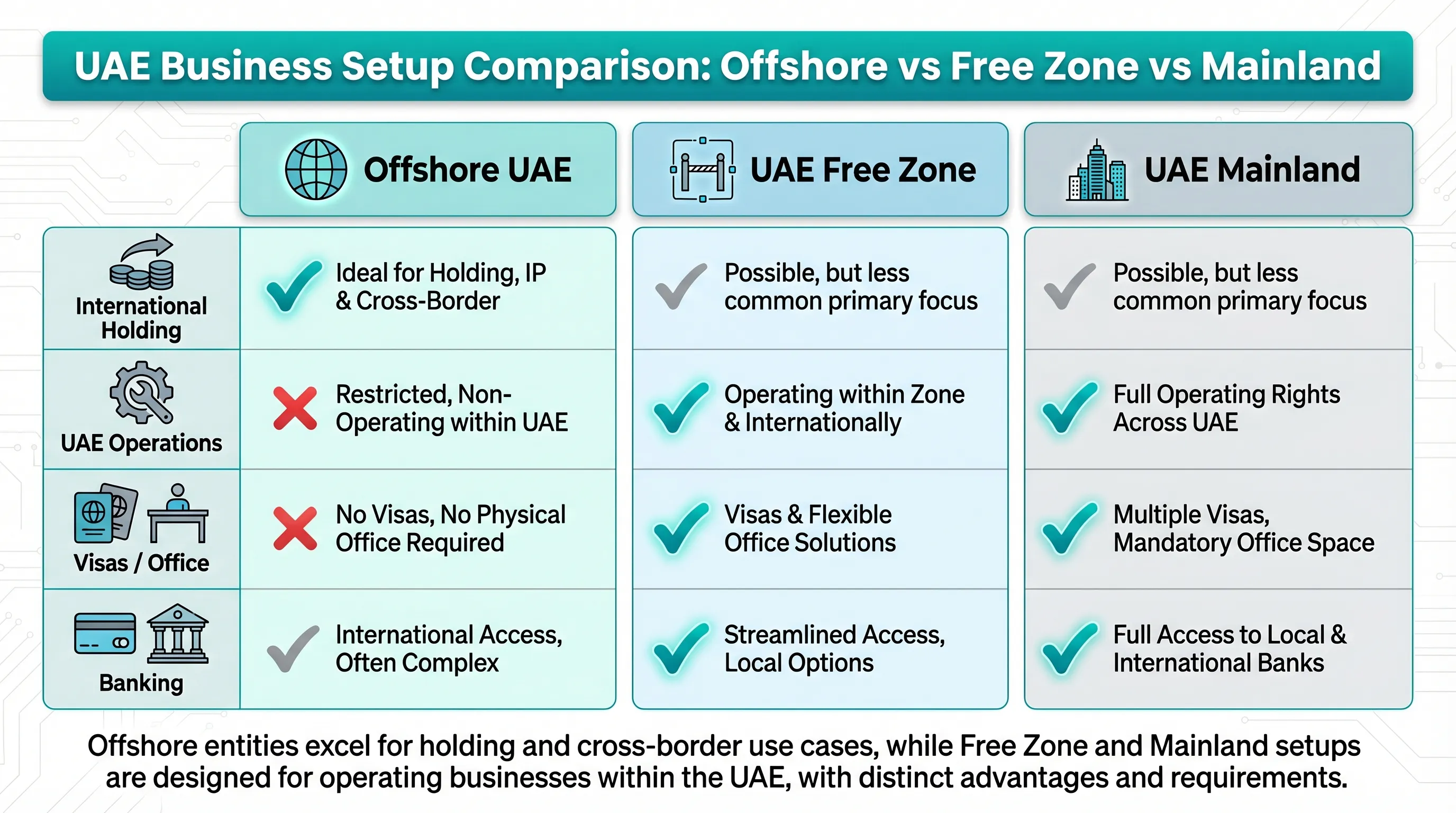
Offshore vs free zone vs mainland (practical comparison)
| Topic | Offshore UAE company | UAE Free Zone company | UAE Mainland company |
|---|---|---|---|
| Best for | Holding, SPVs, international activities | Operating businesses with a free zone license | Operating businesses across the UAE market |
| Can trade inside UAE | Typically not (by design) | Limited, often via distributor or mainland arrangement depending on activity | Yes |
| Office requirement | Usually minimal, registrar-specific | Often flexi-desk or office options | Office/tenancy usually required |
| UAE visas | Usually not available | Commonly available | Commonly available |
| Banking difficulty | Often higher scrutiny | Varies, often more straightforward than offshore | Varies |
| Ongoing compliance | KYC/UBO plus registrar rules | License renewals, compliance, sometimes audit | License renewals, compliance, broader onshore obligations |
This is a high-level view. The correct structure depends on your activity, counterparties, residency, and risk tolerance.
5 realities to consider before choosing offshore UAE
1) Transparency and UBO disclosure are standard
“Offshore” does not mean anonymous. Expect to provide UBO information and pass AML checks.
The UAE has strengthened its AML framework and corporate transparency expectations over recent years. Banks and corporate service providers will ask for documentation and may ask follow-up questions.
A useful reference point is the UAE government’s corporate tax and compliance landscape via the Ministry of Finance and the Federal Tax Authority.
2) Corporate tax: incorporation in the UAE can still create obligations
The UAE introduced federal corporate tax effective for financial years starting on or after 1 June 2023. Whether tax is ultimately payable depends on the facts (income, taxable status, exemptions, and applicable rules), but you should assume that registration, filing, and governance may be required, not just for “operating” companies.
For official guidance, review the UAE Ministry of Finance Corporate Tax page and the Federal Tax Authority.
If your offshore entity has no activity and no income, the tax outcome can differ from a company with active trading. Plan this upfront, not after incorporation.
3) Banking and payments: substance and story matter
Offshore companies are often evaluated by banks as “higher due diligence” customers, especially if:
- Beneficial owners are from multiple jurisdictions
- Transactions involve higher-risk corridors
- The business model is hard to evidence with contracts and invoices
If banking is critical, your structure should be built to be explainable, documentable, and consistent with the reality of where decisions are made and where operations happen.
4) “No office” can be a benefit, but it can also be a weakness
The simplicity of offshore is attractive, but the same simplicity can raise questions:
- Where is the company really managed?
- Where are records maintained?
- How are directors making decisions?
Good governance (board resolutions, documented decision-making, clear activity descriptions) helps reduce friction with banks and counterparties.
5) Ongoing compliance is not optional
Even if an offshore company has limited activity, you should expect ongoing obligations such as:
- Registrar renewals
- Maintaining statutory registers
- Keeping accounting records (requirements vary)
- Supporting KYC refresh requests from banks and service providers
A “set it and forget it” approach is one of the most common causes of later banking or compliance problems.
A quick decision framework (is offshore UAE right for you?)
Offshore is most likely to fit when your answers look like this:
- Primary purpose: holding assets or shares, or facilitating international activities
- UAE operations: none (no local selling, no local staff)
- Residency visas needed: no
- Banking needs: manageable with strong documentation and a clear transaction profile
- Time horizon: medium to long term, with willingness to maintain compliance
If you instead need UAE market access, visas, or an operating footprint, start by evaluating free zone or mainland.
How Alldren can help (without guesswork)
Offshore UAE structuring works best when it is designed around your real operating model and future needs (banking, governance, tax registration, and ongoing compliance).
Alldren supports clients with UAE company setup and structuring, ongoing compliance management, corporate governance, and bank account opening support, with a focus on transparent, upfront pricing and direct access to senior experts.
If you are deciding between offshore, free zone, and mainland, you can explore options at Alldren and align the structure with what banks, regulators, and counterparties will actually expect.
Frequently Asked Questions
What is an offshore company in the UAE? An offshore company in the UAE is typically a UAE-incorporated entity intended for holding assets or conducting business outside the UAE, with restrictions on local UAE operations depending on the registry and rules.
Can an offshore UAE company do business in the UAE? Generally, offshore companies are not meant to conduct onshore business in the UAE. If you need to sell locally or operate onshore, a mainland or free zone structure is usually more suitable.
Can I get a UAE residence visa through an offshore company? In most cases, offshore entities do not provide visa eligibility. Visa pathways are more commonly linked to mainland or free zone companies.
Is it easy to open a bank account for an offshore UAE company? It can be more challenging than for operating companies, because banks often apply enhanced due diligence. A clear business rationale, clean documentation, and a coherent transaction profile are essential.
Does UAE corporate tax apply to offshore companies? UAE corporate tax rules can create obligations for UAE-incorporated entities. Whether tax is payable depends on the facts and applicable rules, so it is important to assess this during structuring.
CTA: Get the structure right before you incorporate
If you are considering offshore UAE because it sounds simpler, pause and validate the full picture: what you will use the company for, whether it can open the right bank account, and what ongoing compliance will look like.
For an expert-led, transparent assessment of whether offshore makes sense (or whether a free zone or mainland setup is the better fit), visit Alldren and discuss your intended use case with a senior specialist.


