

If you are searching for RAK Free Zone company setup, you are likely trying to answer three practical questions: what will it really cost, how long will it take, and what steps actually move the process forward (without losing weeks to preventable banking and compliance delays).
This guide is built for that decision stage. It focuses on the setup workflow, realistic cost drivers, and a timeline you can plan around in 2026.
What “RAK Free Zone” typically means in practice
Most founders using the phrase “RAK Free Zone” are referring to setting up an operating company in Ras Al Khaimah under a free zone authority, commonly RAKEZ (Ras Al Khaimah Economic Zone).
A RAK free zone entity is generally used when you want:
- A UAE trade license (to invoice as a company)
- Eligibility to sponsor UAE residence visas (subject to package and facility)
- A structure that can be made “bankable” if built with proper substance and documentation
If your goal is only holding assets or signing non-UAE contracts without operations, an offshore vehicle (such as RAK ICC) may be more appropriate, but that is a different setup pathway with different limitations.
RAK Free Zone company setup costs: what you pay for (and what changes the number)
There is no single “the cost” because free zone pricing depends heavily on licensing, facility, visas, and how complex your ownership and banking profile is.
The most useful way to budget is to break costs into components.
The core cost components
| Cost component | What it covers | What most affects the cost |
|---|---|---|
| Registration and license | Incorporation, trade license issuance, authority fees | Activity type, number of activities, legal form (FZ-LLC vs branch) |
| Facility / premises | Flexi desk, office, warehouse, industrial space (as applicable) | Bank expectations, visa quota needs, whether you need a dedicated space |
| Visas and immigration | Establishment card, entry permit, medical, Emirates ID, visa stamping | Number of visas, whether dependents are included, processing speed |
| Corporate services support | Structuring, document drafting, filings, liaison, compliance coordination | Complexity (multi-UBO, corporate shareholders, regulated activities) |
| Banking readiness | KYC pack, business profile, supporting contracts/invoices, bank coordination | Nationalities, source of funds, activity risk, address/substance strength |
| Accounting and tax setup | Bookkeeping framework, TRN registrations if needed, compliance calendar | Revenue model, VAT exposure, corporate tax posture, audit needs |
The cost drivers founders underestimate in 2026
1) The “address reality” for corporate banking
In 2026, many banks have tightened how they assess a company’s physical nexus. If you rely on a generic shared address with no credible operational story, bank onboarding can become the most expensive part of the project in time, not just money. Even if your free zone license is issued quickly, delays in banking can stall operations.
Alldren has written separately about banking address scrutiny and why a flexi desk is sometimes not enough for corporate banking outcomes, but the planning implication is simple: choose your facility with banking in mind, not only license price.
2) Ownership complexity (and documentation quality)
Costs increase when the shareholders are corporate entities, when ownership chains cross multiple jurisdictions, or when UBO identification requires additional proofs. This is not just administrative, it affects bank KYB and ongoing compliance.
3) Visa count and sequencing
Visas are not a side task. If you need UAE residency quickly (for personal relocation, leasing, or banking), the setup should be designed around a visa timeline from day one.
A realistic budgeting approach
Instead of looking for a single headline number, ask your provider for a two-scenario budget:
- Lean operating scenario: minimum viable facility and 0 to 1 visa, optimized for low fixed costs
- Bankable operating scenario: facility and documentation aligned to Tier-1 banking expectations, often with at least one UAE-resident manager (where appropriate)
This avoids the common trap of paying twice, first for the cheapest setup, then again to “upgrade” substance and documents after a bank rejection.
RAK Free Zone company setup steps (the process that actually works)
A smooth setup is less about the order on a brochure and more about running the right workstreams in parallel.
Step 1: Define the operating model (before you select a package)
Your free zone license should match what you will actually do in contracts, invoices, and bank narratives.
At minimum, lock down:
- Revenue model (services, trading, e-commerce, consulting, etc.)
- Customer location (UAE vs non-UAE)
- Whether you will hold inventory, hire, or lease premises
- Visa needs for founders and staff
This step prevents mismatches that later trigger bank queries like “activity is inconsistent with transactions” or “insufficient evidence of operations.”
Step 2: Choose jurisdiction setup details (legal form, activities, and naming)
Typical choices include:
- Free Zone LLC (FZ-LLC): common for new operating companies
- Branch: sometimes used for an existing foreign company expanding into the UAE
Then come activities and trade name. Name reservation and activity selection can become a hidden timeline risk if you iterate too late.
Step 3: Build your compliance-ready shareholder and UBO file
Even before the license is issued, you should prepare a clean file that works for both the free zone authority and bank KYB.
Common document categories include:
- Shareholder and manager IDs and proof of address
- CV or profile (often useful for banking)
- Ownership chart (especially where there is a corporate shareholder)
- Source of funds and source of wealth narrative (for banking)
Avoid “patchwork PDFs.” Banks reward coherent packs.
Step 4: Select facility based on operational and banking needs
Your facility choice is not just rent, it is part of your compliance posture.
Ask:
- Do you need a dedicated lease or a specific facility type to satisfy bank expectations?
- Does your visa plan require a certain facility size or category?
- Do you need meeting space for counterparties or auditors?
If you are planning for serious counterparties (enterprise clients, marketplaces, payment providers), a stronger premises story can reduce onboarding friction across multiple platforms.
Step 5: Incorporation and license issuance
Once the authority has accepted the application and KYC, you receive the incorporation documents and trade license.
At this stage, you should also start building your “operational readiness” stack:
- Company stamp (if required operationally)
- Invoice template aligned with your license details
- Basic contract templates consistent with activity
Step 6: Immigration and visas (if needed)
Visa processing is its own workflow and often includes:
- Establishment/immigration file
- Entry permit
- Medical and biometrics
- Emirates ID
- Visa stamping
If your banking strategy depends on the founder or manager being UAE-resident, treat visa processing as a critical path item.
Step 7: Corporate bank account opening (start early)
A key 2026 reality is that license issuance is not the finish line.
Banks typically want:
- A clear business model description
- Contracts, invoices, or pipeline evidence
- Expected counterparties and countries
- Source of funds evidence
- A credible UAE presence (where appropriate)
For official context on the UAE’s financial crime compliance direction, you can review the UAE Central Bank publications and notices.
Step 8: Tax registrations and bookkeeping posture
Even if you expect a low tax burden, you still need correct registration and records.
- Corporate Tax: Corporate tax rules apply across the UAE, including free zones, with different outcomes depending on how the business qualifies and operates. The Federal Tax Authority (FTA) is the reference point for filings and registrations. See the FTA site for official resources.
- VAT: VAT registration depends on thresholds and the nature of supplies. Again, FTA guidance is the official source.
Also, 2026 compliance expectations around documentation and e-invoicing readiness are increasing across the market. Your bookkeeping process should be “audit-defensible,” not improvised.
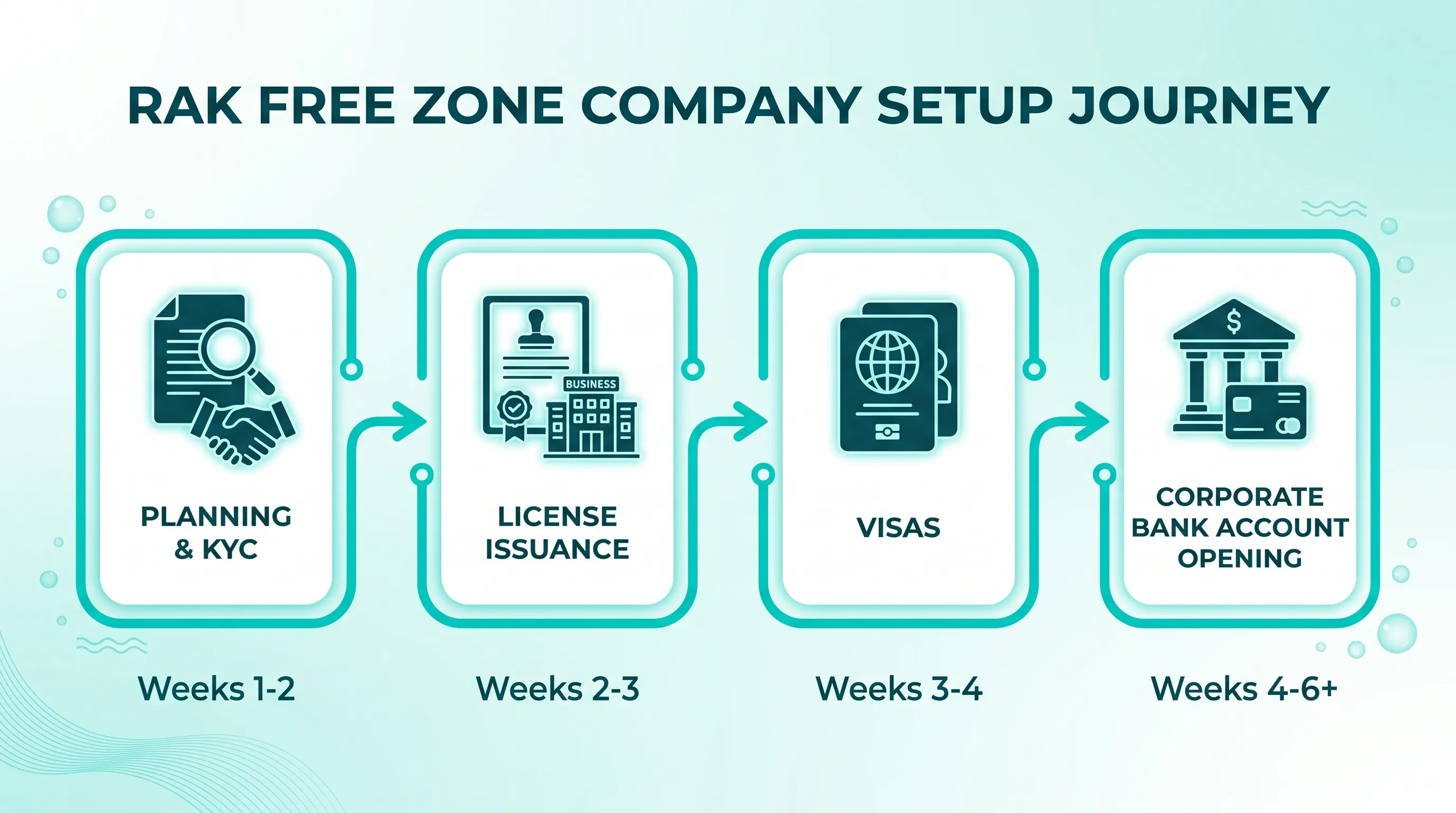
RAK Free Zone company setup timeline: what’s fast, what’s slow
Timelines vary by authority workload, ownership complexity, and how prepared you are. But the pattern is consistent: the license can be fast, banking often takes longer.
Typical timeline by phase (planning-level ranges)
| Phase | What happens | Typical planning range |
|---|---|---|
| Pre-application planning | Activity selection, structure, KYC file prep, name shortlist | 2 to 7 days |
| Incorporation and licensing | Application, approvals, issuance of license and company documents | 5 to 15 business days |
| Immigration and visa (if required) | Entry permit to Emirates ID and stamping | 2 to 6 weeks |
| Corporate banking | Bank selection, KYB submission, compliance questions, activation | 4 to 10+ weeks |
These are not guarantees. They are practical planning ranges that reflect typical bottlenecks.
What delays RAK Free Zone company setup the most
Bank onboarding delays often come from:
- Inconsistent activity vs actual business model
- Thin substance signals (weak premises story, no local operational nexus)
- Unclear UBO chain or missing corporate documents
- Inadequate source of funds evidence
- Rushed responses to bank questions (piecemeal documents)
Authority delays often come from:
- Trade name rejections
- Activity classification issues
- KYC document format problems (expired documents, mismatched names)
A practical 30 to 60 day launch plan (what to do in parallel)
To keep momentum, run these tracks in parallel as soon as you start:
- Track A (license): finalize activity, name, KYC, facility selection
- Track B (banking): prepare a bank-ready pack, draft a one-page business profile, collect evidence of pipeline (contracts, proposals, invoices)
- Track C (tax and finance): choose bookkeeping ownership, set up invoice and recordkeeping standards, map VAT exposure
- Track D (visa): prepare personal documents and plan travel windows for medical and biometrics
The main advantage is time: you avoid waiting for the license to begin work that banks and immigration will ask for anyway.
When RAK Free Zone is the right choice (and when it is not)
RAK free zone setups are commonly a strong fit when you want a cost-effective UAE base with visa access and a scalable operating footprint.
It may not be the right choice if:
- You need to trade directly in the UAE mainland without using the appropriate pathways
- Your activity is regulated and needs a specific regulator or jurisdiction
- You only need a holding or SPV vehicle with no operations (where an offshore structure may be cleaner)
Choosing the wrong jurisdiction usually costs more than choosing the right one, because you pay in re-incorporation, bank re-onboarding, contract amendments, and timeline drag.
Frequently Asked Questions
How much does a RAK Free Zone company setup cost? The cost depends on license type, facility (flexi desk vs office/warehouse), number of visas, and how complex your ownership and banking profile is. Budget by components, not a single headline figure.
How long does RAK Free Zone company setup take? Many straightforward cases can reach license issuance within 5 to 15 business days after documents are ready. Visas commonly add 2 to 6 weeks, and corporate bank account opening often takes 4 to 10+ weeks depending on the profile and preparedness.
Can I open a UAE bank account with a RAK Free Zone company? Yes, but approval is not automatic. Banks assess UBO clarity, source of funds, activity risk, contracts and invoices, and the credibility of premises and operational substance.
Do I need an office for a RAK Free Zone company? You will need an approved facility solution through the free zone. Whether a flexi desk is sufficient depends on your visa needs and, often, your banking strategy.
Do RAK Free Zone companies need to register for Corporate Tax and VAT? Corporate tax and VAT obligations depend on your facts and thresholds. Corporate tax applies across the UAE, and VAT registration is threshold-based. The Federal Tax Authority is the official reference for rules and registrations.
Set up your RAK Free Zone company with an expert-led, bank-ready plan
If you want a RAK Free Zone company setup that is not only incorporated quickly, but also structured to pass banking onboarding and remain compliant as you scale, Alldren can help.
Alldren provides expert-led, transparent corporate services for UAE company setup and ongoing management, including structuring, compliance management, corporate governance support, bank account opening support, residency visa processing, and bookkeeping and tax registration coordination.
Explore Alldren’s approach at alldren.com or review related guidance like RAK Free Zone companies: costs, activities, and renewals to deepen your planning before you start.


