

If you’re considering an offshore company in the UAE, RAK ICC (Ras Al Khaimah International Corporate Centre) is one of the most recognized options for international holding and structuring. It can be a fit for investors who want a UAE-incorporated entity for asset holding, shareholding, IP ownership, or international business conducted outside the UAE, with a relatively streamlined formation process.
This guide covers the essentials: what RAK ICC is designed for, how setup typically works, what drives costs (without guesswork on exact prices), and the compliance basics you should plan for in 2026.
What is RAK ICC (and what it’s typically used for)
RAK ICC is a corporate registry in Ras Al Khaimah that enables the incorporation of “international” companies often referred to as offshore companies (commonly structured as an IBC-style vehicle). In practical terms, most founders look at RAK ICC for one or more of these use cases:
- Holding company for shares in operating businesses (in the UAE or abroad)
- Asset holding (for example, investments, intellectual property, or certain eligible real estate structures depending on the asset and local rules)
- International trading / contracting where business is conducted and invoiced outside the UAE
- Family wealth structuring and succession planning (often paired with wills, trusts, or other instruments depending on the family’s needs)
Key limitation to understand early
An offshore company is generally not the same as a free zone or mainland company. In most cases, an offshore structure:
- Is not designed to conduct business with the UAE market locally
- Does not issue UAE residence visas
- Will not lease office space in the way an operating business typically needs
If your goal is to trade inside the UAE, hire staff locally, or obtain investor/employee visas, you usually evaluate a mainland or free zone setup instead (or a combined structure, depending on the situation).
RAK ICC vs free zone vs mainland (quick decision framing)
The right structure depends on what you need the company to do. Here is a practical comparison to orient your decision.
| Topic | RAK ICC (offshore-style) | UAE Free Zone | UAE Mainland |
|---|---|---|---|
| Best for | Holding, structuring, international activities | Operating business with a licensing framework | Operating business in the UAE market |
| UAE market trading | Typically not the purpose | Possible with rules/partners depending on activity | Yes |
| Visas | Typically not | Yes (subject to package/eligibility) | Yes |
| Physical office | Usually not required like an operating entity | Often via flexi desk/office options | Often requires office/tenancy |
| Banking | Possible, but KYC can be rigorous | Possible, often requires substance/KYC | Possible, often requires substance/KYC |
| Ongoing compliance | Annual renewal + regulatory filings as applicable | Renewal + licensing + potential audits/filings | Renewal + broader regulatory touchpoints |
If you’re unsure, the safest approach is to start from your operating reality: where customers are, where contracts are performed, where management sits, and what banks will expect to see.
Offshore setup process with RAK ICC (step by step)
While the exact workflow varies by registered agent and shareholder profile, most RAK ICC incorporations follow a consistent pattern.
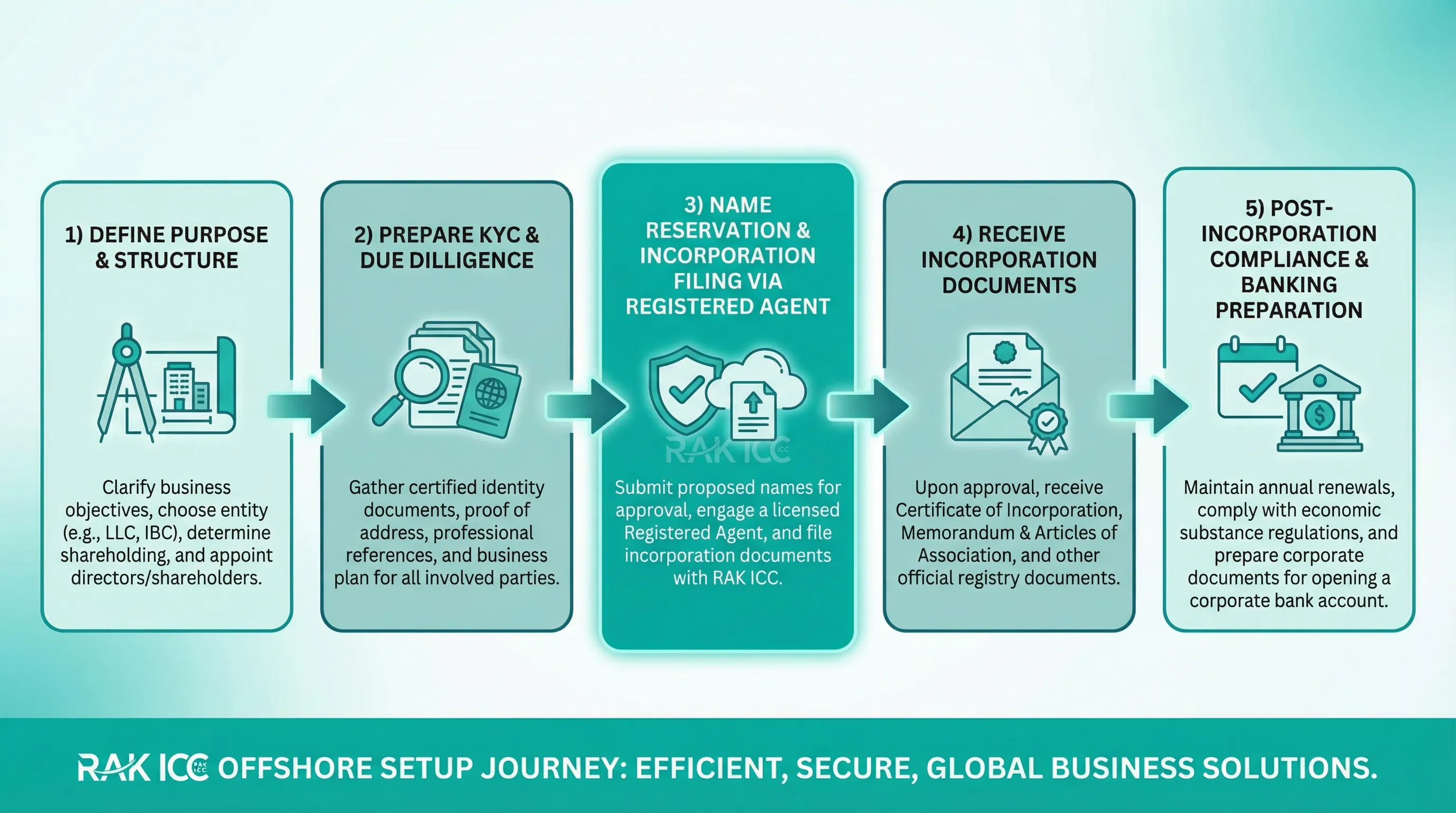
1) Define the structure before you incorporate
Before you file anything, clarify:
- Shareholders (individuals, corporate shareholders, or a mix)
- Directors and who will actually control decisions
- Planned activities (holding, investing, contracting, etc.)
- Where counterparties are located and where contracts are performed
- Whether you need substance (people, premises, decision-making) for banking or tax reasons
This is where many founders lose time later. If your bank or counterparties need clarity on ownership, source of funds, or commercial rationale, it’s best to design around that from day one.
2) Prepare KYC and due diligence (expect this to be thorough)
Like other reputable jurisdictions, RAK ICC incorporations are completed via a registered agent, and the agent will collect due diligence. While requirements vary, it’s common to provide:
- Passport copies and proof of address
- CV or professional background
- A description of the business purpose
- Source of funds and source of wealth evidence (especially for banking readiness)
- Corporate documents if a company is a shareholder
This is standard global compliance practice and aligns with UAE AML expectations.
3) Name reservation and incorporation filing
Your registered agent typically handles:
- Name checks and reservation
- Incorporation application and supporting documents
- Issuance of constitutional documents and registers
4) Post-incorporation essentials
After incorporation, most owners will focus on:
- Corporate governance basics (appointments, registers, resolutions)
- Banking strategy (UAE bank vs international bank, and what substance and documents are needed)
- Ongoing compliance setup (renewal dates, UBO updates, accounting records)
RAK ICC costs: what you actually pay for (and what drives the total)
Searchers often want a single number for “RAK ICC cost.” In practice, the total depends on your structure, risk profile, and banking needs. Rather than quoting unreliable ranges, here is the cost model you can use to estimate accurately.
Common cost components
| Cost component | What it covers | What makes it higher or lower |
|---|---|---|
| Incorporation and registry fees | Government and registry charges to form the company | Company type, documentation complexity |
| Registered agent fees | Mandatory agent services, filings, liaison with registry | Service level, turnaround, due diligence workload |
| Annual renewal | Keeping the company in good standing each year | Same variables as above |
| UBO/AML administration | Maintaining required registers and updates | Ownership complexity, changes during the year |
| Accounting support (if needed) | Bookkeeping and financial records organization | Volume of transactions, reporting needs |
| Banking support (optional) | Preparing the file, compliance narrative, introductions where possible | Nationalities, business model, substance, documentation readiness |
The biggest “hidden” cost is usually time and rework
For many founders, the main expense is not the registry fee. It’s the cost of delays caused by:
- Unclear ownership chain (especially with corporate shareholders)
- Weak source-of-funds documentation
- A business model that banks struggle to underwrite
- Mismatch between the company’s purpose and the account activity
If banking is critical, plan for it upfront. An offshore company can be incorporated quickly, but opening and maintaining a suitable bank account depends on KYC comfort and credible commercial rationale.
Compliance basics you should plan for (2026-ready)
“Offshore” does not mean “no compliance.” In 2026, offshore structures are expected to meet transparency, recordkeeping, and (where applicable) tax and substance-related rules.
1) Maintain accurate company records and governance
At a minimum, plan to keep:
- Registers of shareholders and directors
- Up-to-date resolutions for major decisions (banking, investments, share transfers)
- Supporting contracts and invoices if the company is active
Also maintain accounting records in an organized way. UAE regulations generally expect companies to retain accounting records for a period of years (commonly referenced as at least five), and banks may request financials even when not legally audited.
2) UBO (Ultimate Beneficial Owner) transparency
UAE rules require most entities to maintain beneficial owner information and keep it current when changes occur. A commonly cited reference is UAE Cabinet Resolution No. 58 of 2020 on beneficial owner procedures.
Even when certain information is not publicly displayed, it still must be available and accurate for regulatory and banking compliance.
Helpful reference: UAE Ministry of Economy information on AML and related compliance.
3) Economic Substance Regulations (ESR) analysis
The UAE Economic Substance Regulations require entities that conduct specific “relevant activities” to meet substance tests and reporting obligations. Whether an offshore company is in scope depends on what it actually does.
What to do in practice:
- Map the company’s activities to the ESR “relevant activities” list
- If potentially in scope, plan for decision-making, premises, people, and evidence
- If not in scope, you may still need to file a notification depending on the current regulatory expectations and your agent’s guidance
Because ESR determinations are fact-specific, treat this as a compliance review item, not a checkbox.
4) Corporate Tax considerations
The UAE introduced a federal Corporate Tax regime effective for financial years starting on or after 1 June 2023. Whether and how it applies to an offshore company depends on residence, income, and other factors.
A safe, non-assumptive way to approach this:
- Assume you may have registration and filing obligations depending on your facts
- Confirm whether the company is a UAE “resident person” for Corporate Tax purposes
- Determine whether there is taxable income (many holding companies have minimal taxable income, but it depends)
Reference: UAE Ministry of Finance Corporate Tax.
5) VAT is usually activity-driven
VAT registration typically depends on making taxable supplies in the UAE and meeting thresholds and conditions. Many offshore holding structures have no UAE VAT footprint, but you should confirm based on what the company will invoice and where the place of supply sits.
6) Banking compliance is ongoing, not one-time
Banks periodically refresh KYC. Expect requests such as:
- Updated proof of address and passport
- Recent contracts/invoices (if active)
- Explanation of incoming and outgoing transfers
- Audited or management accounts for certain profiles
If the company’s activity drifts away from what was described at onboarding, account friction can follow.
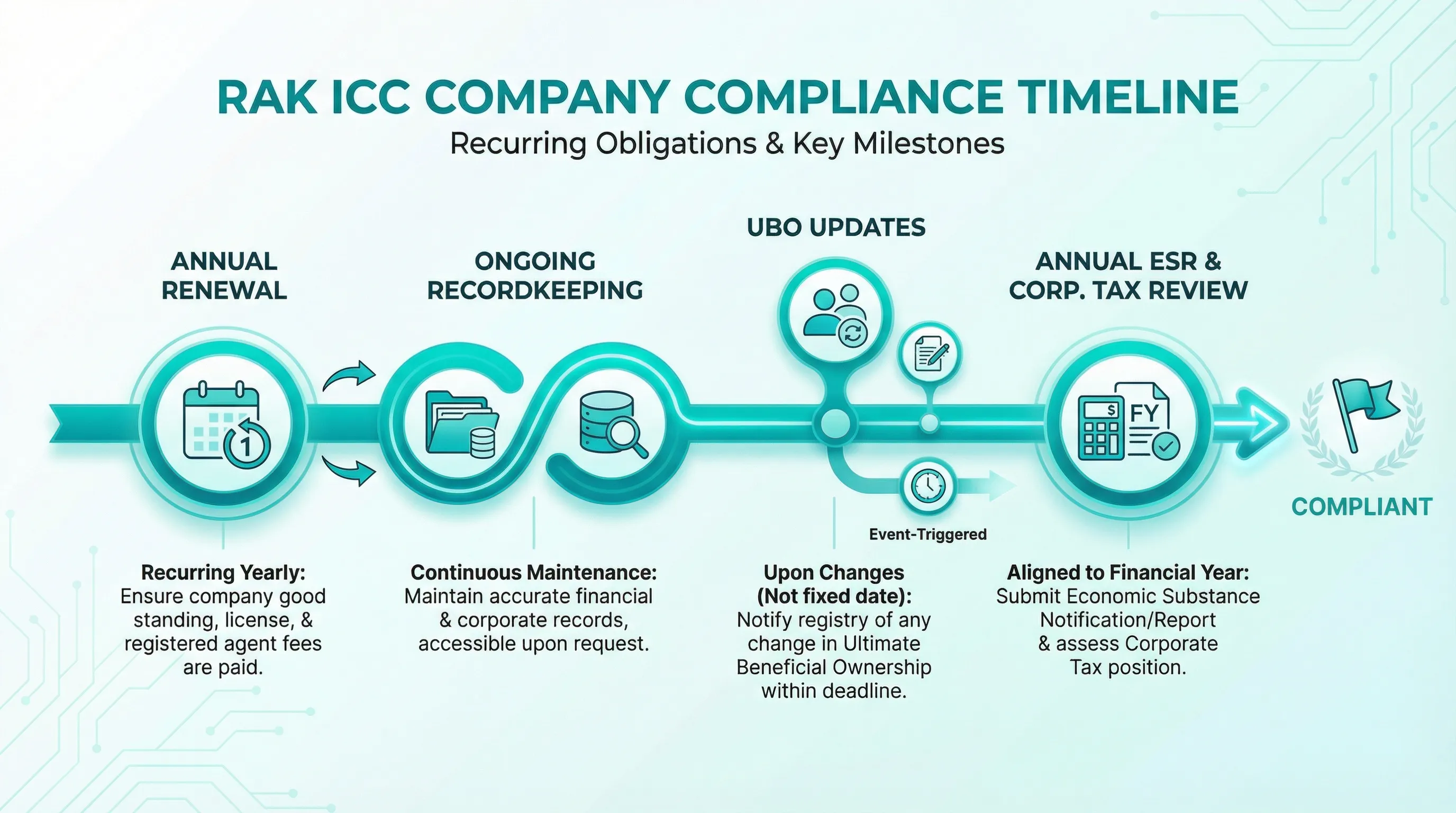
A simple compliance calendar to follow
| Item | Typical timing | Why it matters |
|---|---|---|
| Annual renewal | Every year (on renewal date) | Keeps the company in good standing |
| UBO/register updates | Whenever changes occur | Required regulatory accuracy |
| Accounting records upkeep | Ongoing (monthly/quarterly) | Supports tax, banking, governance |
| ESR review (if applicable) | Annual (aligned to financial year) | Avoid penalties for missed obligations |
| Corporate Tax assessment | Annual (aligned to financial year) | Determines registration, filing, tax due |
Common pitfalls (and how to avoid them)
Treating RAK ICC as a “cheap company” rather than a purpose-built tool
If the goal is operating in the UAE, RAK ICC is often the wrong fit. The fix is simple: choose the structure that matches your operating reality (mainland or free zone), or use RAK ICC strictly as a holding layer.
Underestimating banking readiness
Formation is only one part of the journey. A strong banking file usually includes:
- Clear ownership and control narrative
- Legitimate commercial rationale for the jurisdiction
- Clean documentation for source of funds and expected transactions
Not aligning tax residence, management, and substance
In 2026, cross-border structures are evaluated based on where management decisions occur, where directors are, and where value is created. Good structuring documents reality rather than trying to fight it.
When RAK ICC can be a great fit
RAK ICC can be particularly effective when:
- You need a holding vehicle above one or more operating companies
- You want clean separation between operating risk and owned assets
- You need a UAE-incorporated entity for international contracting outside the UAE
- You value a jurisdiction with mature compliance expectations and professional administration
Getting RAK ICC right with expert-led structuring
If you want your RAK ICC company to be more than a certificate, the key is designing it around compliance and banking from the start: ownership chain, governance, recordkeeping, and a defensible tax and substance position.
Alldren provides expert-led, transparent corporate services for establishing and managing UAE companies, including structuring, compliance management, governance support, bank account opening support, and ongoing administration. If you’d like help evaluating whether RAK ICC fits your objectives, you can start at Alldren and speak with a senior expert to map the cleanest structure for your use case.


