

Choosing where to incorporate in the UAE is not just a pricing decision. The emirate and the specific authority you pick will shape your licensing scope, regulatory expectations, office and visa requirements, and even how smoothly your banking and counterpart onboarding goes.
This guide compares Ras Al Khaimah Economic Zone options (commonly explored through RAK’s economic zones and free zone authorities) with the typical setup paths in Dubai, Abu Dhabi, Sharjah, and other northern emirates, so you can shortlist the jurisdiction that matches your operating reality.
What actually changes when you choose a different emirate?
From a founder’s perspective, most “emirate comparisons” boil down to a few practical variables:
- Regulator and legal framework: Some jurisdictions are standard UAE civil law environments, while financial free zones like ADGM and DIFC operate with their own commercial legal frameworks and courts.
- Business model fit: Trading, services, manufacturing, logistics, and regulated activities often map better to specific ecosystems.
- Facility requirements: Flexi-desk vs dedicated office, warehousing, industrial plots, and whether physical presence is routinely checked.
- Visa needs: Quotas vary by package, facility type, and authority.
- Banking and compliance: Documentation standards are broadly similar across the UAE, but your perceived risk profile can change based on activity, substance, and jurisdiction.
- Ongoing costs and admin: Renewals, compliance filings, and support for amendments, visas, and corporate governance.
One important clarification: “best” is rarely universal. A software consultancy with international clients, a regional trading company, and a manufacturing business will optimize for different things.
Ras Al Khaimah Economic Zone, the positioning in one paragraph
Ras Al Khaimah is often chosen by startups, SMEs, and international groups that want a cost-aware setup with practical facilities, straightforward administration, and proximity to logistics and industrial infrastructure. In the market, RAK is commonly compared with Dubai and Abu Dhabi for brand signaling, and with Sharjah and the northern emirates for operational cost and industrial options.
If your priorities are “set up efficiently, stay compliant, keep overhead predictable,” Ras Al Khaimah Economic Zone routes are frequently on the shortlist.
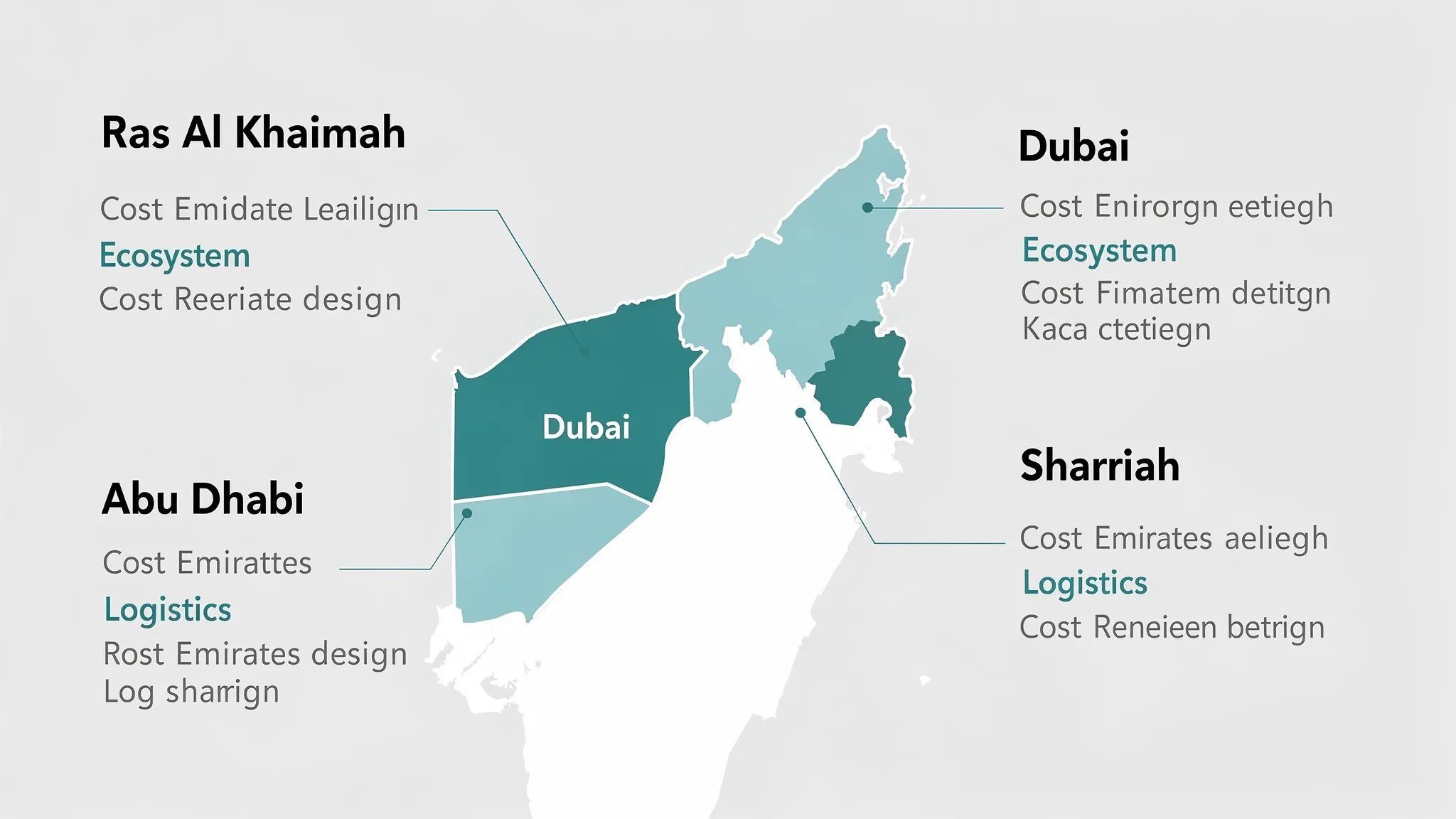
Side-by-side comparison: Ras Al Khaimah vs other emirates (practical factors)
The table below reflects typical decision criteria. Exact outcomes depend on the specific authority, license activity, facility type, and your compliance profile.
| Decision factor | Ras Al Khaimah Economic Zone (typical) | Dubai (typical free zones) | Abu Dhabi (typical free zones) | Sharjah and other northern emirates (typical) |
|---|---|---|---|---|
| Total cost sensitivity | Often perceived as value-oriented for setup and renewals | Often higher, especially in premium zones | Can be premium for certain ecosystems | Often competitive, especially for industrial and trading |
| Business ecosystem | Strong SME base, growing industrial and logistics footprint | Very broad, strong services, trade, tech, regional HQs | Strong institutional ecosystem, energy, industry, and finance | Strong manufacturing and trading in select zones |
| Brand signaling | Solid, practical, can be “lean and operational” signaling | Strong global recognition, common for international counterparties | Strong for institutional and certain regulated contexts | Practical, industry-focused in the right zones |
| Facilities | Commonly attractive for warehouse and industrial options (where relevant) | Wide variety, but premium facilities can raise cost | Strong industrial clusters and planned developments | Often strong for industrial and warehousing |
| Visa planning | Flexible in many packages, but varies by authority and facility | Wide range, but cost and quotas depend heavily on zone and office | Wide range, often tied closely to lease and activity | Often competitive, varies by authority |
| Time-to-launch | Often efficient if documentation is ready | Can be fast, but premium zones may have more steps | Can be fast, complexity increases with regulated use cases | Often efficient for standard activities |
| Banking experience | Can work well with clean docs and substance, jurisdiction alone is not a guarantee | Strong familiarity, but scrutiny remains high for some activities | Strong, especially for well-structured groups | Similar, depends on activity and documentation |
| Regulated financial activities | Usually not the go-to for regulated finance | DIFC is a major hub for regulated finance | ADGM is a major hub for regulated finance | Not typically the first choice |
Deep dive: Ras Al Khaimah Economic Zone vs Dubai
Dubai is the UAE’s default comparison point because it has unmatched density of international businesses, service providers, and global counterpart familiarity. But those strengths can come with higher total cost of ownership.
Ras Al Khaimah tends to win when:
- You prioritize predictable overhead and efficient renewals.
- You need practical facilities (for example, light industrial or warehousing, depending on the chosen authority and package).
- You want a UAE base but do not need the “Dubai address premium” for your sales motion.
Dubai tends to win when:
- Your pipeline is relationship-driven and a Dubai presence materially improves conversion.
- You want proximity to major corporate HQs, events, and certain specialized talent clusters.
- You are targeting ecosystems tied to specific zones (for example, finance and professional services in DIFC, or certain trade/logistics clusters).
A useful rule: if customers and partners ask “Are you in Dubai?” early in the sales process, pay attention. If they never ask, you may be paying for signaling you do not use.
Deep dive: Ras Al Khaimah Economic Zone vs Abu Dhabi
Abu Dhabi’s setup options are often selected for institutional adjacency (government-linked ecosystems, energy, large industry) and for global legal familiarity in the ADGM environment.
Ras Al Khaimah tends to win when:
- You want a lean, operational UAE entity that can scale later.
- Your business is not dependent on being in a specific institutional ecosystem.
Abu Dhabi tends to win when:
- You benefit from proximity to Abu Dhabi’s institutional landscape or industrial megaprojects.
- You have a group structure that fits a financial free zone environment (for example, certain holding or investment-related structures, subject to proper advice).
If you are considering ADGM or any regulated activity, plan early. The licensing and compliance journey can be more involved than a standard commercial license.
Deep dive: Ras Al Khaimah Economic Zone vs Sharjah and other northern emirates
Sharjah and other northern emirates are frequently competitive for founders who want a functional setup with strong trading or industrial logic.
Ras Al Khaimah tends to win when:
- You want a balanced mix of cost control, practical administration, and a growing RAK industrial and logistics footprint.
- Your operational plan aligns well with RAK’s facilities and long-term overhead expectations.
Sharjah and other northern emirates tend to win when:
- Your activity matches a specific zone’s strengths (often industrial, manufacturing, or certain trading profiles).
- Your suppliers, workforce, or facilities are already concentrated in those emirates.
In reality, the best choice here is often very specific to your facility needs, visa plan, and whether you require warehousing, yards, or industrial units.
A corporate tax note (because it affects every emirate)
Corporate tax in the UAE is federal, so the headline tax framework does not change by emirate.
- The UAE has a federal corporate tax regime administered by the Federal Tax Authority.
- Free zone entities may benefit from corporate tax relief on qualifying income if they meet the conditions set by the law and related decisions.
For primary sources, see the UAE Ministry of Finance corporate tax overview and the Federal Tax Authority.
The practical takeaway for this comparison: choose the emirate for operational fit first, then structure properly for compliance and tax positioning.
How to choose the right emirate: match jurisdiction to your operating model
Here are common profiles and what typically matters most.
1) International services business (consulting, software, marketing)
You generally optimize for banking readiness, credible contracts, and low admin friction.
Ras Al Khaimah Economic Zone routes can be a strong fit if your revenue is international and you do not need a premium address for sales.
2) Trading and import-export
You optimize for warehousing, logistics access, and clear documentation for payments and shipments.
Dubai can be compelling for certain trade corridors and counterpart familiarity, but RAK and Sharjah can be very competitive if your cost base and facilities matter.
3) Manufacturing, industrial, and logistics
You optimize for industrial units, land options, utilities, and long-term facility economics.
This is where RAK, Sharjah, and Abu Dhabi industrial ecosystems often come into the conversation earlier than a premium Dubai services-oriented setup.
4) Holding structures and investment-led groups
You optimize for governance, legal certainty, substance planning, and banking comfort.
In these cases, Abu Dhabi (ADGM) or Dubai (DIFC) may be relevant depending on the structure and purpose, but they are not automatically “better.” They are tools for specific outcomes.
Common mistakes when comparing emirates
Over-optimizing for setup price
Setup cost matters, but it is rarely the biggest risk. Founders run into bigger issues with:
- Mismatched license activity (your invoices do not align with your license)
- Weak substance (no credible operations, staff, or contracts)
- Poor document hygiene for banking and onboarding
Ignoring ongoing compliance and governance
Even small companies need basic corporate housekeeping. Depending on your activity, this can include bookkeeping, VAT registration (where applicable), and maintaining clear ownership and signatory records.
Assuming a jurisdiction guarantees bank account opening
No emirate can “guarantee” banking. Banks assess risk based on your activity, counterparties, source of funds, transaction geography, and documentation. A good jurisdiction choice helps, but clean compliance materials help more.
A simple shortlist checklist
If you want a fast way to narrow down Ras Al Khaimah Economic Zone vs other emirates, answer these:
- Do you need a Dubai or Abu Dhabi address to win deals, or is that a “nice to have”?
- Will you need warehousing or industrial space within 6 to 12 months?
- How many visas do you realistically need in year 1?
- Are your customers local UAE, GCC, global, or a mix?
- Do you anticipate regulated activity now or later?
If you can answer those, you can usually reduce the market to two viable options and then compare total cost and compliance workload.
Frequently Asked Questions
Is Ras Al Khaimah Economic Zone the same as Dubai free zones? It is comparable in the sense that it offers structured business setup routes under a dedicated authority, but each emirate and authority has its own packages, facility rules, and processes.
Is corporate tax different in Ras Al Khaimah vs Dubai or Abu Dhabi? No. Corporate tax is federal in the UAE. However, free zone corporate tax treatment depends on meeting specific conditions for qualifying income, not on the emirate alone.
Can a company registered in Ras Al Khaimah do business across the UAE? It depends on your license type and how you plan to sell (for example, cross-border services, distributors, local contracts). Many businesses can serve UAE clients, but direct onshore contracting rules vary by setup. Get advice for your exact activity.
Is banking easier in Dubai than Ras Al Khaimah? Not necessarily. Banks focus on the quality of your compliance file, your business model, and transaction risk. Jurisdiction is only one input.
Which is cheaper, Ras Al Khaimah or Dubai? In many cases, Ras Al Khaimah is perceived as more cost-effective, especially for SMEs and operational setups. But total cost depends on your facility needs, visas, and renewals, not just the initial license fee.
Get a tailored comparison for your exact activity
If you are deciding between Ras Al Khaimah Economic Zone vs other emirates, the fastest way to avoid an expensive mismatch is to map your activity, visa plan, facility needs, and banking story to the right jurisdiction before you submit anything.
Alldren provides expert-led, transparent support for UAE company setup, structuring, compliance, visas, and bank account opening assistance, with direct access to senior experts. If you want a clear recommendation between RAK, Dubai, Abu Dhabi, Sharjah, or another option, start here: Alldren.


