

Choosing the right UAE vehicle is less about picking the most popular jurisdiction and more about matching the structure to what you actually need to do. A Ras Al Khaimah offshore company (commonly set up through RAK ICC) can be an efficient option for international holding and cross-border arrangements, but it is not designed for running a customer-facing business inside the UAE.
This guide explains what a Ras Al Khaimah offshore company is, what it is typically used for, what the setup process looks like, and the practical compliance and banking considerations you should plan for.
What is a Ras Al Khaimah offshore company?
In the UAE context, “offshore” generally refers to a company incorporated in the UAE that is primarily used for international purposes rather than operating a business onshore in the UAE market.
Ras Al Khaimah’s offshore registry is widely associated with RAK International Corporate Centre (RAK ICC), which maintains a corporate registry and works through registered agents for incorporations and ongoing administration. You can review official information directly via the RAK ICC website.
At a high level, a Ras Al Khaimah offshore company is often used as a:
- Holding company (shares in subsidiaries, investments)
- Special purpose vehicle (SPV) for a transaction
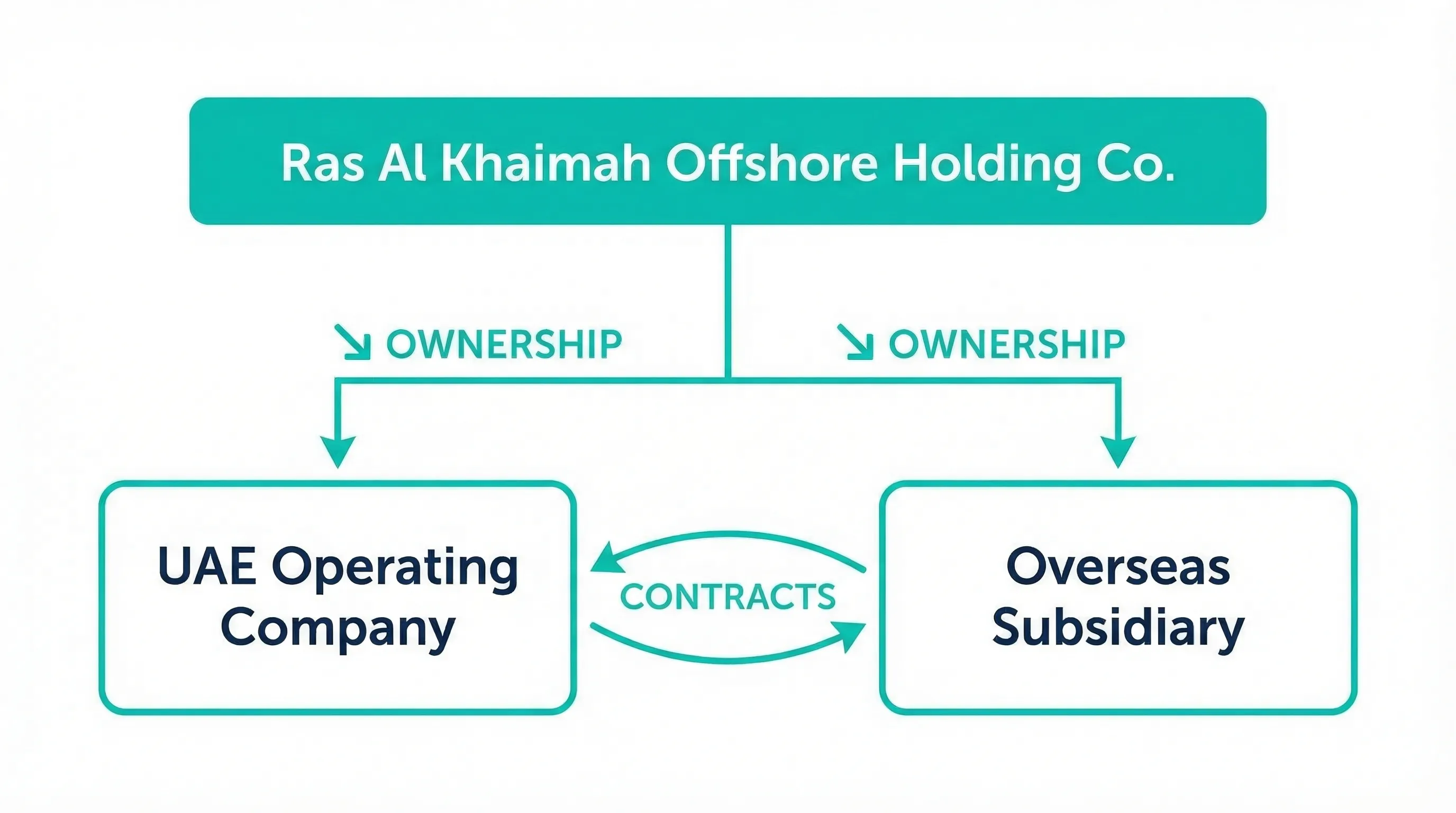
- Ownership and governance wrapper for assets and contracts
It is typically not used as an operating company for UAE local trading, hiring staff, or issuing UAE residence visas.
Common uses of a Ras Al Khaimah offshore company (and why people choose it)
A Ras Al Khaimah offshore company is most compelling when the “job to be done” is own, hold, or control rather than “sell and operate locally.”
1) Holding shares in other companies
A frequent use case is holding equity in:
- International subsidiaries
- UAE free zone or mainland entities (subject to structuring and regulatory constraints)
- Joint ventures and investment SPVs
The offshore company becomes the shareholder, which can simplify ownership transitions (for example, selling the shares of the holding company rather than transferring individual assets).
2) Asset holding and ring-fencing risk
Offshore entities are often used to segregate assets from operational risk. Examples include:
- Holding intellectual property (IP) that is licensed to operating companies
- Holding contractual rights, receivables, or investment portfolios
Important: asset holding does not remove compliance obligations. You still need proper documentation, governance, and alignment with tax and regulatory requirements.
3) International trade and contracting (non-UAE market)
Some founders use an offshore company to sign international contracts, invoice foreign customers, or hold supplier agreements, especially where a UAE onshore commercial presence is not required.
In practice, this must be evaluated carefully against banking requirements and tax residence considerations. “Offshore” does not automatically mean “easy banking.”
4) Family ownership, succession, and governance planning
For private clients, an offshore company can serve as a governance wrapper that clarifies:
- Who owns what
- Who controls decisions (directors, signatories)
- How ownership transfers happen
Depending on complexity, you may also consider whether a foundation or trust-style arrangement is more suitable. That decision is fact-specific.
Use-case fit at a glance
| Use case | Why a Ras Al Khaimah offshore company can fit | Typical watch-outs |
|---|---|---|
| Holding shares (subsidiaries, JV stakes) | Clean ownership layer, easier transfer of control | Proper corporate governance and documentary trail needed |
| IP holding and licensing | Centralizes IP ownership and licensing agreements | Tax, substance, and transfer pricing considerations may apply |
| International contracting | UAE incorporation with international-facing structure | Banking and proof of business activity can be demanding |
| Family governance | Clear ownership and control rules | Needs careful drafting of shareholder and board documentation |
When a Ras Al Khaimah offshore company is usually the wrong tool
You will typically want a different UAE structure if you need:
- UAE residence visas for owners or staff
- A physical office lease as part of licensing requirements
- To trade directly in the UAE market (selling to UAE customers onshore)
- To participate in certain regulated activities or local tenders
In those cases, a UAE mainland company or a free zone company is often more appropriate.
Ras Al Khaimah offshore company setup: what the process typically looks like
While exact steps vary by facts (shareholders, nationality mix, activities, banking plan, and risk profile), most setups follow a similar path.
Step 1: Confirm the structuring logic
Before incorporation, clarify:
- Who will be the shareholder(s)
- Who will be the director(s)
- Who needs signing authority (and where)
- Whether nominee director services are required (only if justified and compliant)
- How this company will be used (holding, contracting, SPV)
This is where many problems are prevented early, especially if you plan to open a bank account or connect the entity to other group companies.
Step 2: Prepare KYC and due diligence
Expect a compliance-first onboarding process. While requirements vary by case, it is common to provide:
- Passport copies and proof of address for shareholders and directors
- A CV or profile describing professional background
- Source of funds and source of wealth information (where applicable)
- A clear business rationale and expected transaction profile
If there is a corporate shareholder, you may also need corporate documents and ownership chain disclosures up to the ultimate beneficial owner.
Step 3: Incorporation via a registered agent
RAK ICC incorporations are handled through registered agents. The agent typically coordinates:
- Name reservation
- Constitutional documents
- Registration and issuance of incorporation documents
Timeline depends heavily on how quickly KYC is completed and whether there are complexity flags (multi-layer ownership, certain nationalities, higher-risk activities).
Step 4: Post-incorporation essentials (often overlooked)
After formation, plan for operational readiness:
- Corporate records and resolutions (board, shareholder)
- Beneficial ownership documentation and registers as applicable
- Banking strategy (UAE or international)
- Accounting and tax position analysis
If you are setting up the company for a transaction, document the commercial rationale early. Banks and counterparties often ask for it later.
Compliance, governance, and ongoing maintenance
A Ras Al Khaimah offshore company is not a “set and forget” solution. Ongoing obligations typically include maintaining corporate records and meeting renewal and reporting expectations.
Key areas to plan for:
Corporate governance hygiene
Good governance is not bureaucracy for its own sake. It is what keeps your structure defensible with banks, auditors, counterparties, and regulators.
Common governance actions include:
- Keeping an up-to-date register of shareholders and directors
- Recording material decisions via written resolutions
- Maintaining clear signatory controls and approval limits
Beneficial ownership and AML expectations
UAE entities are subject to evolving compliance expectations around transparency and anti-money laundering controls. Even where filings are handled by service providers, you remain responsible for the accuracy of information.
Tax considerations (UAE corporate tax and international tax)
The UAE has implemented federal corporate tax, and whether it applies to your offshore company depends on your facts, including tax residence and the nature of income. Do not assume an offshore company is automatically outside scope.
Start with the official guidance and then apply it to your structure with an advisor. A good reference point is the UAE Federal Tax Authority for corporate tax updates and guidance.
Banking: the practical reality you should plan for
Bank account opening is often the most underestimated part of an offshore setup.
What banks typically look for:
- A clear, legitimate business purpose for the entity
- Transparent ownership (UBO) and simple structures where possible
- A coherent transaction profile (currencies, counterparties, geographies)
- Supporting contracts, invoices, or pipeline evidence
Two practical tips:
- Align your corporate documents with the real operating model (who signs, how decisions are made, what the company does).
- Prepare a concise “banking pack” early (structure chart, business narrative, expected volumes, counterparties, and supporting agreements).
Alldren supports bank account opening as part of broader structuring and compliance work, but no reputable firm should promise guaranteed approvals because final decisions sit with the bank.
Ras Al Khaimah offshore vs free zone vs mainland (how to choose)
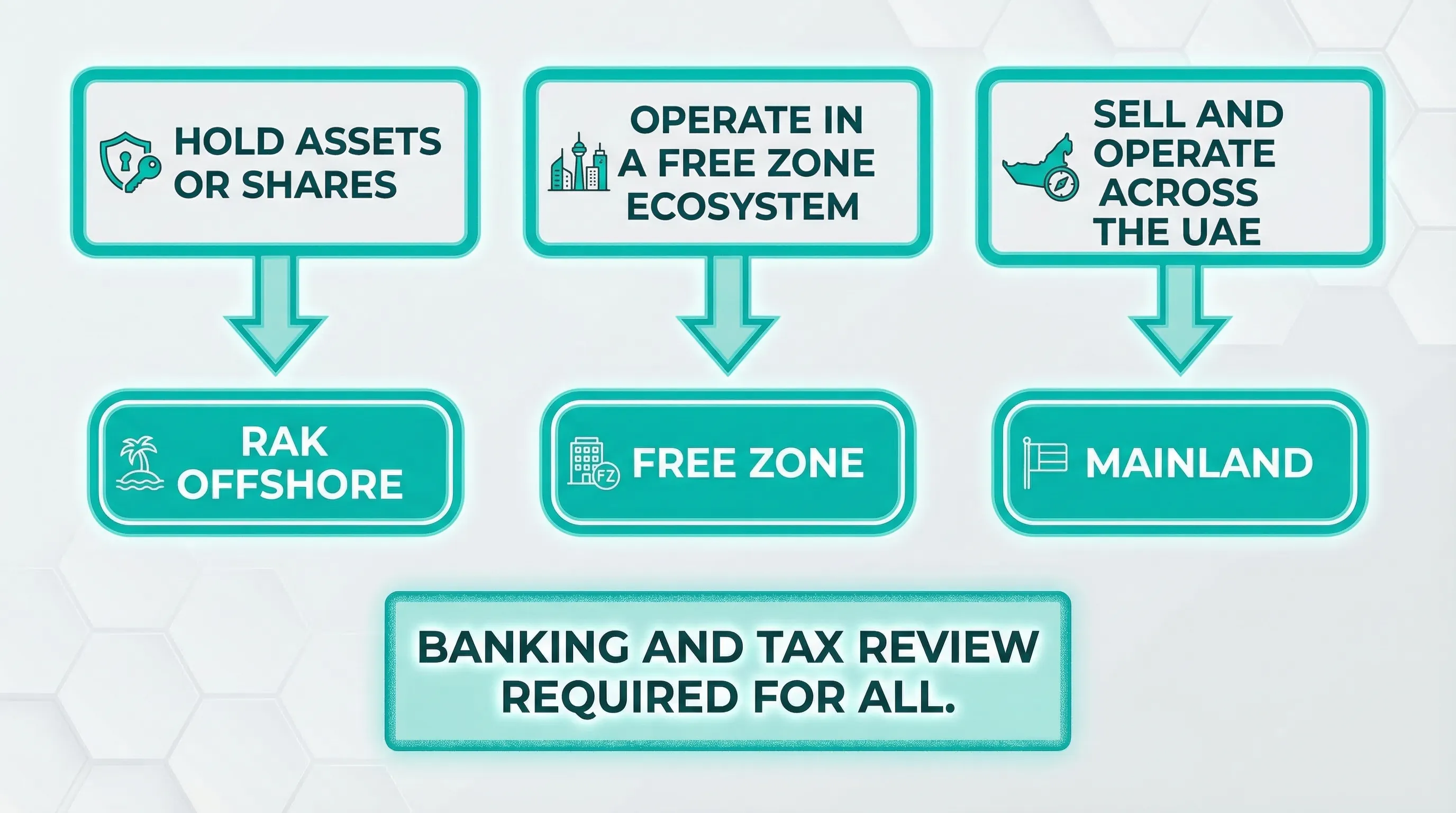
The right comparison is not “which is best,” but “which fits the job.”
| Factor | Ras Al Khaimah offshore company | UAE free zone company | UAE mainland company |
|---|---|---|---|
| Best for | Holding, SPV, international contracting | Operating a business with licensing in a zone | Operating in the UAE market and contracting locally |
| UAE visas | Typically not designed for visas | Usually available (subject to zone rules) | Available (subject to rules) |
| UAE onshore trading | Generally not the goal | Often limited, may require distributor or mainland route | Designed for onshore trading |
| Office/substance | Often minimal | Varies by free zone and package | Typically requires premises arrangements |
| Banking | Possible but can be documentation-heavy | Often more straightforward than offshore, still case-by-case | Often more straightforward than offshore, still case-by-case |
If your primary need is to run an operating business, hire staff, and build a UAE presence, start your analysis with mainland or free zone options. If your primary need is a holding or transaction vehicle, an offshore company can be a strong contender.
A practical decision checklist
A Ras Al Khaimah offshore company tends to make sense when most of the following are true:
- You need a holding layer for shares, assets, or contracts
- Your customers and suppliers are primarily outside the UAE
- You do not need UAE visas from this entity
- You are prepared to maintain proper governance and documentation
- You have a realistic banking plan and supporting evidence
If you are unsure, the fastest way to get clarity is usually a structuring call that maps your objectives to the right vehicle, then pressure-tests banking and tax implications before you incorporate.
Frequently Asked Questions
What is a Ras Al Khaimah offshore company used for? A Ras Al Khaimah offshore company is commonly used as a holding company, SPV, or international contracting entity, especially when you do not need UAE visas or onshore trading.
Can a Ras Al Khaimah offshore company do business in the UAE? Offshore companies are generally not designed for operating an onshore business in the UAE market. If you need to sell locally, a mainland or suitable free zone structure is usually more appropriate.
Can I open a UAE bank account with a Ras Al Khaimah offshore company? It may be possible, but approval depends on the bank and your case. Expect enhanced due diligence, and be ready with clear documentation, ownership transparency, and a credible business profile.
Does a Ras Al Khaimah offshore company need to register for UAE corporate tax? Corporate tax outcomes depend on facts such as tax residence, income type, and activities. Review the latest guidance and get professional advice to determine obligations.
How long does it take to set up a Ras Al Khaimah offshore company? Timelines vary based on KYC completion and complexity. Straightforward cases can be incorporated relatively quickly once all documents are in order, but banking and compliance prep can take longer.
Set up the right Ras Al Khaimah offshore structure with Alldren
If you are considering a Ras Al Khaimah offshore company for holding, cross-border contracting, or a transaction SPV, the quality of the structure and documentation matters as much as the incorporation itself.
Alldren provides expert-led, transparent support across UAE company setup, structuring, compliance management, governance, and bank account opening assistance. To build a robust structure that holds up under banking and regulatory scrutiny, start with a focused scoping discussion at Alldren.


