

Starting a UAE business in 2026 is still one of the most compelling moves for international founders, but it is no longer “set up a license and you’re done.” Corporate tax is now a standard part of operating, banks have tightened onboarding, and the UAE’s compliance expectations have become more systematic.
This guide walks you through the decisions that matter most in 2026, with a practical focus on setup, tax, and banking, so you can build a UAE business that is operationally smooth and regulator-ready.
What’s different in 2026 (and why it matters)
A few changes are shaping how new UAE companies should be structured and run:
- Corporate tax is business-as-usual. Most companies must consider registration, taxable income, and documentation from day one, even if they expect to be in a 0% position initially. The UAE Ministry of Finance maintains the official corporate tax guidance and updates (UAE Ministry of Finance).
- Banking onboarding is more evidence-driven. Expect deeper “source of funds” and “source of wealth” questions, especially for foreign-owned entities.
- Digital tax operations are moving forward. The UAE has communicated an e-invoicing direction and roadmap, and 2026 is widely referenced as an implementation window. Even if your sector is phased in later, you should choose accounting processes that can adapt (UAE Ministry of Finance).
The implication is simple: in 2026, the fastest setup is the one that will also pass compliance checks without rework.
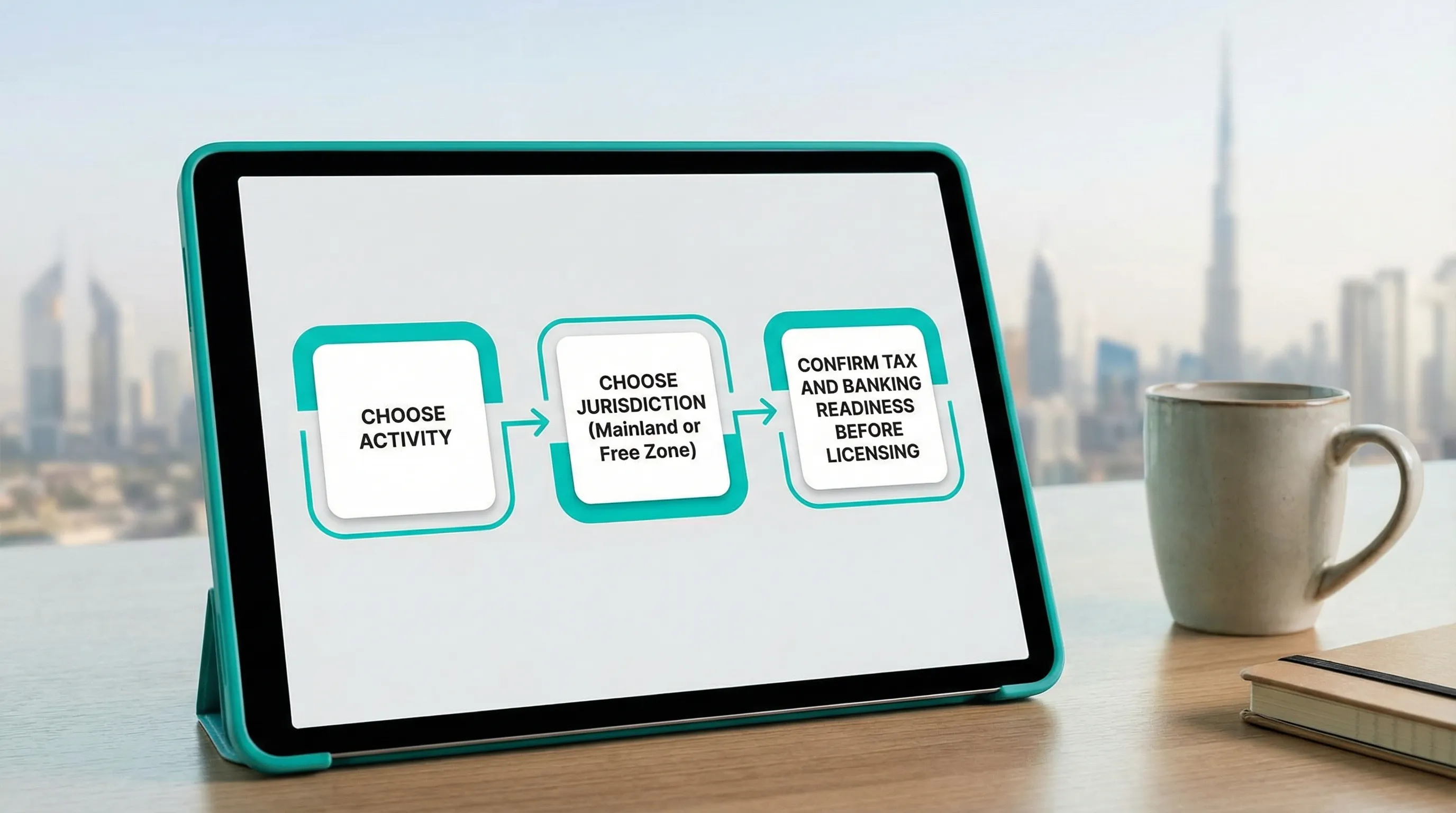
Step 1: Choose the right place to register (mainland vs free zone)
The “best” UAE setup depends on what you sell, where your customers are, and how you will invoice and bank.
In most cases, you will choose between:
- Mainland (onshore) licensing through the relevant emirate’s Department of Economic Development (DED).
- Free zone licensing through a specific free zone authority.
Here is a practical comparison to frame the decision:
| Decision factor | Mainland company | Free zone company |
|---|---|---|
| Selling directly in the UAE market | Generally straightforward | Often requires a distributor/agent arrangement or a mainland branch/structure depending on the activity |
| Office/lease requirements | Varies by emirate and activity | Often offers flexible packages, but requirements vary by free zone |
| Corporate tax position | Subject to UAE corporate tax rules | Potential access to 0% on qualifying income if conditions for “Qualifying Free Zone Person” are met |
| Perception for banking | Strong, especially with local contracts | Also common, but banks may ask more about the business model and local substance |
| Best fit | Local trading, services delivered in UAE, regulated activities | International trading, digital services, holding/IP models, regional HQ setups (case-by-case) |
Two important notes for 2026:
- Your activity and revenue flow should drive the choice. A misaligned jurisdiction can create downstream friction with VAT, corporate tax treatment, or bank onboarding.
- Free zone 0% is not automatic. It depends on meeting conditions and having “qualifying income” under corporate tax rules (always validate the latest position with professional advice and the official guidance).
Step 2: Pick a legal form that matches ownership, liability, and banking reality
Most foreign founders use structures such as:
- Limited Liability Company (LLC) style entities (mainland or free zone variants)
- Branch of a foreign company (usually when the operating history and contracts are already established)
From an execution standpoint in 2026:
- If you are opening your first UAE bank account, banks typically prefer a structure with a clear operating story, identifiable counterparties, and documentation that shows commercial purpose.
- If you expect multiple shareholders, outside investors, or a group structure, plan for corporate governance and signing authority early to avoid repeated amendments.
Step 3: Build your tax baseline from day one (corporate tax and VAT)
UAE corporate tax: what most new businesses need to know
The UAE corporate tax regime is now the core tax framework for companies.
Key concepts most founders should model early:
- Corporate tax rate and thresholds: The UAE introduced a standard corporate tax rate of 9% on taxable income above a threshold (commonly referenced as AED 375,000), with 0% below that threshold for many businesses (subject to rules and eligibility).
- Free zone treatment: Many free zone entities may access 0% on qualifying income if they meet the “Qualifying Free Zone Person” conditions and comply with requirements, with 9% potentially applying to non-qualifying income.
- Documentation matters: Even if you expect a 0% outcome, you still need defensible records (financial statements, invoices, contracts, and in some cases transfer pricing-style support).
Always use the latest official guidance as the starting point, because definitions and clarifications evolve (UAE Ministry of Finance corporate tax).
VAT: registration triggers you should not ignore
VAT remains a major compliance area, particularly for trading and service companies with UAE-based customers.
Practical 2026 reminders:
- Mandatory VAT registration generally applies when taxable supplies exceed the legal threshold (commonly AED 375,000 in a 12-month period). Voluntary registration may be available at a lower threshold (commonly AED 187,500). Confirm the current thresholds and rules with the regulator (Federal Tax Authority VAT).
- VAT is not just a filing task. It affects how you price, contract, invoice, and collect documentation (especially for zero-rated or exempt treatments).
Bookkeeping and tax operations: treat it as infrastructure
If you want banking and tax to go smoothly, your bookkeeping cannot be an afterthought.
In practice, strong early setups include:
- A consistent invoicing process (with clear customer details, descriptions, and payment terms)
- A clean separation between personal and company transactions
- A document trail for supplier contracts, shipping documents (if applicable), and proof of service delivery
With e-invoicing direction emerging, this “clean data” approach also reduces future migration pain if your business must adopt e-invoicing requirements.
Step 4: Execute the setup process without rework
The exact sequence varies by jurisdiction and activity, but most UAE company formations follow a similar arc:
- Define business activity and jurisdiction
- Reserve trade name and obtain initial approvals
- Prepare incorporation documents (shareholders, UBO information, resolutions)
- Secure office/lease or flexi-desk arrangements if required
- Obtain the license and establishment file
- Set up immigration and visas if needed
- Activate tax registrations when applicable (VAT, corporate tax registrations and filings as required)
Where founders lose time in 2026 is usually not the license itself. It is the “second layer” tasks: bank account opening, compliance documentation, and tax-ready accounting.
Step 5: Banking in 2026, how to improve approval odds
Opening a UAE bank account is often the most unpredictable part of starting a UAE business. Banks must meet strict AML and KYC obligations, and they will assess the risk profile of your activity, geography, and counterparties.
What banks typically want to understand
Most onboarding processes try to answer:
- Who ultimately owns the company (UBO clarity)
- What the company will do in the UAE (real economic purpose)
- Who will pay you and who you will pay (counterparty clarity)
- Where funds come from (source of funds and sometimes source of wealth)
- Whether transactions match the stated business model after opening
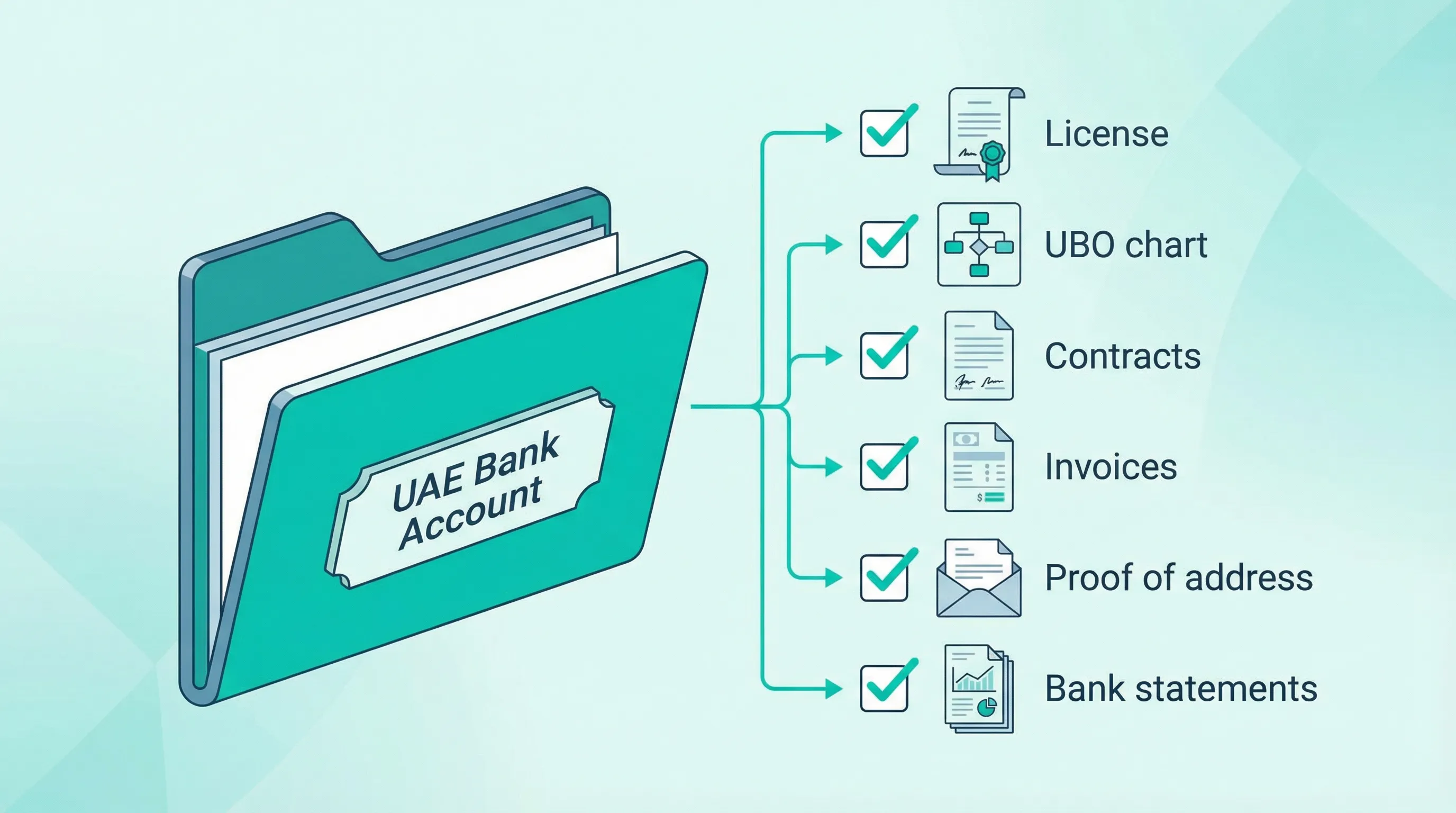
Documents to prepare before you apply
Exact requirements vary by bank, but delays usually come from missing evidence rather than missing forms.
Commonly requested items include:
- Company incorporation documents and license
- Shareholder and signatory passport copies and proof of address
- UBO declaration and ownership chart (especially for groups)
- Business plan or commercial narrative (what you sell, to whom, and how)
- Contracts, invoices, purchase orders, or pipeline evidence
- Bank statements (personal and or corporate, depending on your profile)
- Proof of address for the business (lease or facility agreement if applicable)
Practical banking tips that work in 2026
- Apply with a bank-matching strategy. Different banks have different risk appetites for certain activities, geographies, and early-stage revenue profiles.
- Avoid “generic” explanations. If your activity is “consulting,” clarify the niche, typical deal size, contract length, and where clients are located.
- Keep the first 90 days consistent. Banks may monitor whether incoming and outgoing payments align with what you stated during onboarding.
If your business model is complex (group structures, multiple jurisdictions, regulated sectors, crypto-adjacent flows), get professional support before you apply to avoid repeated rejections that can slow down the entire launch.
Timelines in 2026: what to expect (realistically)
Timelines vary widely by free zone, emirate, and activity, but a realistic planning view is:
- License and incorporation: can be quick for straightforward cases, but may extend if approvals, office requirements, or shareholder documentation is complex.
- Visas: depend on entry status, medical and biometrics scheduling, and employer establishment steps.
- Bank account opening: often the longest pole, especially for new entities without local contracts.
The best way to shorten timelines is to align setup, tax readiness, and banking documentation from the start, rather than treating them as separate projects.
Common mistakes founders make (and how to avoid them)
- Choosing a jurisdiction before validating the revenue flow. Start with where customers are, where the work is delivered, and how money moves.
- Assuming free zone means “no tax.” Corporate tax analysis still applies, and conditions matter.
- Underestimating compliance operations. Bookkeeping, invoicing, and document retention are foundational in 2026.
- Applying to banks too early with no evidence. If you have no contracts yet, prepare a strong narrative and supporting proof (pipeline, prior track record, website, references) or time the application strategically.
Frequently Asked Questions
Is the UAE still a good place to start a business in 2026? Yes, but it rewards founders who plan for corporate tax, VAT (if applicable), and banking compliance from the start. The UAE is attractive, but it is no longer “paper-only.”
Should I choose a free zone or mainland for my UAE business? Choose based on your target customers and operating model. Mainland can be simpler for direct UAE market activity, while free zones can suit international models and may offer specific tax treatment, subject to rules.
Do I need to register for corporate tax as a new company? Many businesses will have corporate tax obligations and may need to register and file based on their situation. Use current official guidance and get professional advice for your specific structure.
When do I need to register for VAT in the UAE? VAT registration generally becomes mandatory once taxable supplies exceed the legal threshold (commonly AED 375,000 in a 12-month period). Check the latest rules on the Federal Tax Authority website.
Why do UAE bank accounts take so long to open? Banks conduct extensive KYC and AML checks and want evidence that the business is genuine, coherent, and matches the expected transaction profile. Missing documents or unclear business narratives are common causes of delay.
Can I start the company before I have a lease or office? It depends on the jurisdiction and license type. Some setups allow flexible facilities, others require a lease. Confirm requirements early because it can affect both licensing and banking.
Need a setup that is built for tax and banking in 2026?
Alldren helps founders and businesses establish and manage UAE companies with expert-led structuring, compliance support, and transparent execution, including help with company setup, ongoing compliance, tax registration support, visa processing, and bank account opening support.
If you want to avoid rework and build a UAE business that is set up to operate cleanly from day one, explore Alldren’s approach at alldren.com.


