

Structuring a business in the UAE is rarely just a “pick a license and start trading” exercise. The decisions you make in week one (jurisdiction, legal form, shareholders, tax position, governance, and banking readiness) shape everything that follows: cost, speed to launch, compliance risk, and how easily you can scale or exit.
This guide walks through the key steps to build a UAE company structure that is operationally practical and defensible under scrutiny (banks, regulators, auditors, and counterparties).
What “business structure” means in the UAE
A UAE structure is the combined design of:
- Legal setup: entity type (LLC, free zone company, branch), ownership, constitutional documents.
- Regulatory footprint: licensing authority, permitted activities, office or facility requirements.
- Tax profile: UAE Corporate Tax, VAT registration needs, transfer pricing posture (where relevant).
- Governance and compliance: UBO filings, renewals, substance, accounting, audit, resolutions.
- Operational execution: banking, payments, contracts, hiring, and residency visas.
The “best” structure is the one that matches your actual business model and the reality of where decisions are made, where people work, and where revenue is generated.

Step 1: Define your objectives (before you compare jurisdictions)
Start with a short, written brief. This prevents choosing a setup that looks cheap or fast but later blocks banking, contracts, or tax efficiency.
Clarify:
- What you will do (activities, customers, where services are delivered, where goods move).
- Where you need to operate (UAE only, cross-border, physical retail, e-commerce, on-site services).
- Who will own and control the company (individuals, a holding company, investors, family office).
- Whether you need UAE residency visas (and for how many people).
- Your near-term plan (hire, warehouse, regulated activities, fundraising, tendering, government clients).
If you expect bank scrutiny (most companies do), also note the expected transaction volumes, main corridors (countries), and source of funds.
Step 2: Choose the right jurisdiction (mainland vs free zone vs offshore)
In practice, this is often the most consequential structuring decision. Each option can be correct depending on what you need to do and where.
Mainland (onshore)
A mainland company is licensed by the relevant Emirate’s Department of Economy and Tourism (or equivalent). It is typically preferred when you need broad access to the UAE market, local contracting, or certain activity categories.
Free zone
A free zone company is licensed by a free zone authority. Free zones are popular for international service businesses, trading models with controlled logistics, and founders who want packaged setup processes. Some free zones have strong ecosystems (specific industries, facilities, or regulator alignment).
Offshore (often used for holding)
Offshore entities are generally used for holding assets or shares (depending on the regime) rather than conducting day-to-day operations in the UAE market. They are not a universal fit for operating businesses, especially if you need visas, office space, or local invoicing.
Here is a high-level comparison to frame the decision (details vary by authority and activity):
| Decision factor | Mainland | Free zone | Offshore (typical use case) |
|---|---|---|---|
| Primary purpose | Operating in the UAE market | Operating within free zone rules, often cross-border | Holding structures, asset ownership |
| Visas | Commonly available (requirements vary) | Commonly available (package-dependent) | Usually not designed for visas |
| Office/facility | Often required depending on activity | Often required (flexi-desk to warehouse) | Usually not an operating footprint |
| Perception for local contracting | Often straightforward | Can be fine, may depend on counterparty requirements | Often unsuitable |
| Complexity of ongoing compliance | Moderate to high depending on activity | Moderate (varies widely by free zone) | Varies, but typically narrower scope |
For official context on UAE business setup and licensing frameworks, see the UAE Ministry of Economy.
Step 3: Select the legal form (and get ownership and control right)
Once jurisdiction is chosen, you select an entity type. Common examples include:
- LLC (mainland): common for operating businesses.
- Free zone company (variously named, for example FZE or FZCO): common for free zone incorporation.
- Branch: an extension of a foreign company, sometimes used for market entry where a parent entity wants direct presence.
Structuring considerations that matter in real life:
Shareholder and group structure
If you plan to bring investors, build a regional group, or separate liabilities, consider whether you need:
- A holding company to own the operating entity.
- Separate entities for risk segregation (for example, contracting vs IP ownership).
- A structure that supports dividends, exits, and share transfers without constant rework.
Governance and signing authority
Banks and counterparties care about who can bind the company. Set clear rules for:
- Authorized signatories and limits.
- Board or shareholder resolutions.
- Contracting authority across subsidiaries (if any).
This is not about paperwork for its own sake, it is about preventing operational bottlenecks and reducing disputes later.
Step 4: Align activities, licensing, and premises (don’t “over- or under-license”)
In the UAE, your license activities are not a marketing description. They are a regulated scope.
Common pitfalls:
- Choosing an activity that is “close enough,” then discovering it blocks banking or contract enforceability.
- Selecting multiple activities that trigger additional approvals, higher compliance, or facility requirements.
- Underestimating premises rules (desk, office, warehouse, shopfront) tied to the activity.
Before you file, validate:
- Which authority can issue the activity.
- Whether the activity is regulated (extra approvals).
- Whether you need specific premises or third-party certifications.
If you are unsure, it is usually cheaper to validate the activity mapping upfront than to amend licenses after you have bank onboarding and contracts in motion.
Step 5: Design your tax and accounting posture (Corporate Tax and VAT)
Since Corporate Tax is now a core part of UAE planning, your structure should be defensible from day one.
UAE Corporate Tax (headline points)
The UAE Corporate Tax regime is administered by the Federal Tax Authority. As a general framework, a 9% rate applies on taxable income above AED 375,000 (subject to conditions and updates in law and guidance).
Free zone businesses may access 0% on qualifying income if they meet the relevant requirements for being a qualifying free zone person and comply with substance and other conditions. Because this area depends heavily on facts, it is important to structure operations in line with how the business actually earns revenue.
You can review official updates and guidance via the Federal Tax Authority.
VAT and indirect tax reality
If you will exceed the VAT registration threshold, you need VAT-ready invoicing, bookkeeping, and document retention. Even if you are below the threshold, some businesses register voluntarily to align with counterparties or reclaim input VAT (where applicable).
Transfer pricing and related-party discipline
If you have a group structure (or plan to), build related-party agreements early (management services, IP licensing, cost sharing). Waiting until after revenue starts is a common way to create messy, backdated documentation.
A simple planning table can help founders and finance teams align early:
| Topic | Decide early | Why it matters |
|---|---|---|
| Corporate Tax profile | Mainland vs free zone treatment, expected income type | Avoid restructuring after contracts are signed |
| VAT readiness | Registration needs, invoice format, place of supply logic | Prevent penalties and customer disputes |
| Accounting standards and audit | Who keeps books, frequency, whether audit is required | Banks and investors often request financials |
| Related-party model | Intercompany agreements and pricing approach | Defensible tax position and cleaner reporting |
Important: This article is general information, not tax advice. Always confirm the latest position based on your facts and the current FTA guidance.
Step 6: Build a “bankable” structure (this is where many setups fail)
A company can be legally formed and still be practically unusable if it cannot open and maintain a bank account.
Banks typically assess:
- Shareholder identity and source of funds.
- Where customers and suppliers are located.
- Expected transaction volumes and activity narrative.
- Substance signals (office, staff, contracts, website, invoices).
To improve readiness, prepare a clean onboarding pack (even before you apply):
- Corporate documents (license, constitutional docs, registers as applicable).
- Shareholder passport/ID and proof of address.
- A short business profile (what you do, who you sell to, why the UAE).
- Sample contracts or proposals and a basic financial forecast.
If your structure includes multiple entities, be ready to explain the purpose of each one in plain language.
Step 7: Plan visas and immigration as part of structure (not afterthought)
If founders or staff need UAE residency, incorporate visa planning into the initial setup:
- The jurisdiction and package may influence how many visas are available.
- Some roles or activities may require specific supporting documents.
- Lease or facility arrangements can impact visa eligibility.
Visa processing is often manageable when planned, and painful when left until after the company has signed client deadlines.
Step 8: Set up governance and compliance so renewals are routine
A sustainable UAE structure is one you can operate and renew without surprises.
Build a recurring compliance calendar that includes:
- License renewal dates.
- Establishment card and immigration-related renewals (where applicable).
- Corporate Tax and VAT filing obligations (as applicable).
- UBO and corporate register updates when changes occur.
- Bookkeeping cadence and audit timelines (if required by your authority, bank, or stakeholders).
Governance is also part of credibility. Many counterparties (and banks) will ask for signed resolutions, beneficial ownership clarity, and consistent documentation.
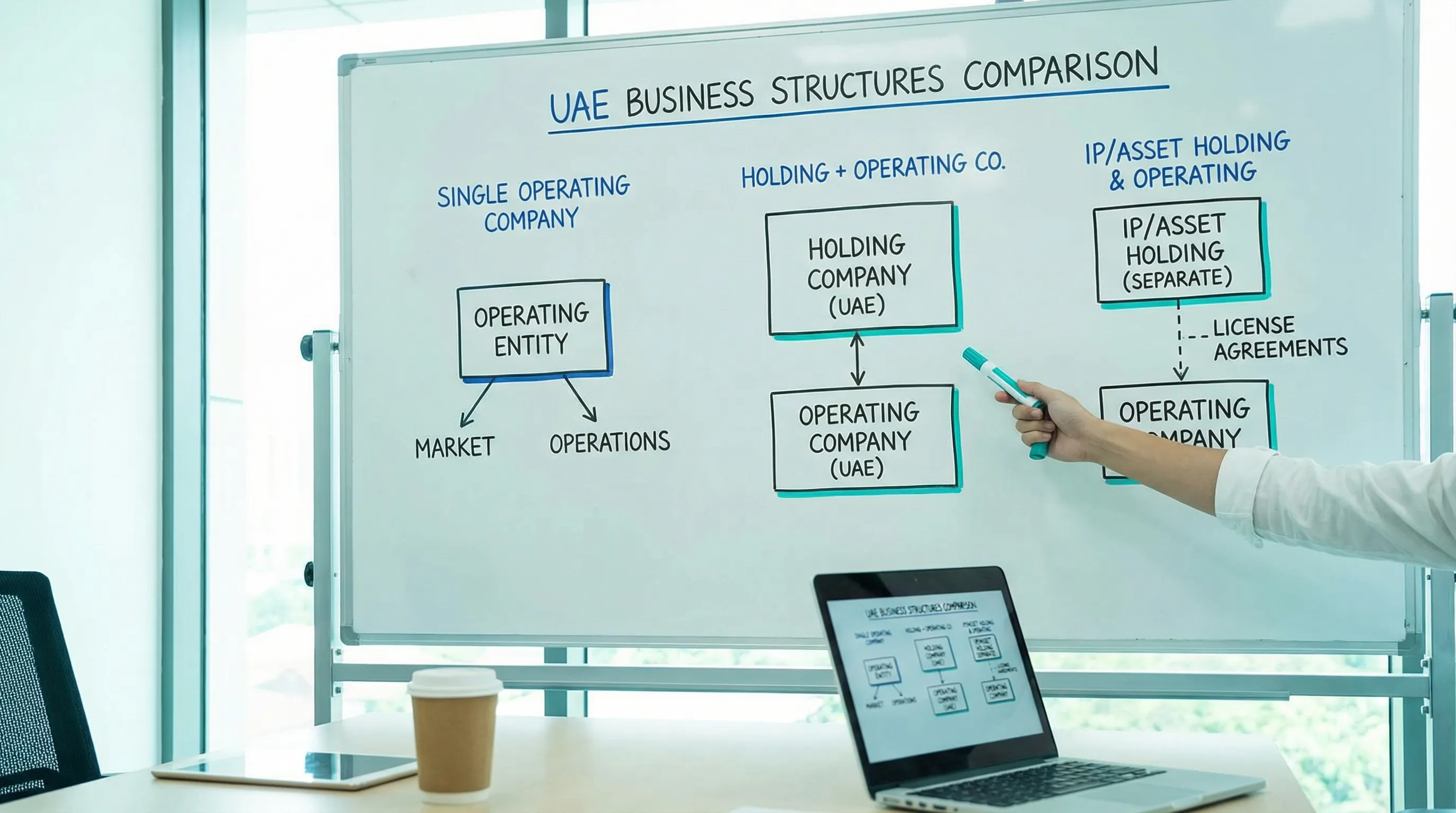
Common structuring patterns (and when they fit)
These are not “one size fits all,” but they reflect how many UAE businesses choose to organize risk, operations, and growth.
Operating company only
Best when you have a straightforward model (single line of business, one team, limited cross-border complexity).
Holding company plus operating company
Often used when you want cleaner ownership, future fundraising flexibility, or risk segregation.
Separate contracting and asset ownership
Sometimes used when a business has valuable IP, trademarks, or equipment, and wants to ring-fence assets from operating risk. This requires careful tax and commercial alignment to avoid artificial arrangements.
If you are considering multi-entity structures, make sure the operational reality supports it (people, decision-making, and contracts), not just the diagram.
Mistakes to avoid when structuring a business in the UAE
The most expensive mistakes are usually not the setup fees, they are the downstream constraints.
Picking the cheapest jurisdiction without validating operations
A structure that cannot legally deliver services where your clients are, or cannot meet banking expectations, costs more to fix than to do properly at the start.
Misaligned activity selection
If the license activity does not match your contracts and invoices, you may face bank friction, contract delays, or amendment cycles.
Overcomplicating the group too early
Multi-entity structures can be powerful, but they create real compliance overhead (accounting, filings, renewals, intercompany documentation). Complexity should be earned by business needs.
Ignoring tax substance and documentation
Corporate Tax era planning is not just about rates. It is about maintaining a position that is consistent with how the business truly operates.
When to bring in an expert
You should strongly consider expert help if any of these are true:
- You have multiple shareholders or an investor roadmap.
- You need regulated activities, government work, or complex contracting.
- You expect cross-border revenue or multiple entities.
- You want free zone tax positioning and need clarity on qualifying income conditions.
- You want to set up once and avoid rework for banking, visas, and compliance.
Alldren positions itself as an expert-led, transparent partner for UAE company setup, structuring, compliance, and ongoing corporate support. If you want senior input early (before forms are filed), that’s typically where the biggest savings and risk reduction happen.
Frequently Asked Questions
What is the best structure for a small business in the UAE? The best structure depends on where you will operate (UAE market vs primarily cross-border), the activities you need on the license, whether you need visas, and your banking and tax requirements.
Is a free zone company always better for tax? Not always. Tax outcomes depend on facts, income type, and meeting the relevant conditions. You should choose a structure that fits your operations first, then optimize within the rules.
Can I change my UAE company structure later? Often yes, but changes can trigger amendments to licenses, constitutional documents, banking files, visas, and tax registrations. It is usually cheaper and faster to design the structure carefully at the beginning.
What documents do banks typically ask for when opening a UAE business account? Commonly: incorporation and license documents, UBO/shareholder documents, proof of address, a business profile, and supporting commercial evidence (contracts, invoices, forecasts). Requirements vary by bank and risk profile.
Do I need bookkeeping from day one? Practically, yes. Even before formal filings are due, clean books support banking, VAT readiness (if applicable), and Corporate Tax compliance.
Need help structuring your UAE business with clarity and compliance?
If you want to avoid guesswork and build a structure that works for licensing, banking, visas, and ongoing compliance, consider speaking with Alldren. They provide expert-led, transparent support for structuring a business in the UAE, company formation, and ongoing governance.
Explore options at Alldren and request an initial discussion to map the right structure for your specific business model.


