
A UAE company is not fully “ready” on the day the license or incorporation certificate is issued. Formation gives you the legal shell. The first 90 days determine whether that shell becomes a bankable, compliant, operational business or a structure that quietly accumulates risk.
This period is especially important in the UAE because several workstreams move in parallel: corporate tax registration, banking, immigration, bookkeeping, licensing alignment, governance records, and in some cases free zone or offshore-specific obligations. Founders who treat these tasks as admin often lose time later when a bank asks for missing documents, a renewal exposes outdated records, or a tax registration deadline is missed.
The goal of the first 90 days after UAE company formation is simple: move from “incorporated” to “operationally controlled.” That means the company can receive and send money, issue contracts and invoices correctly, support visas if required, maintain proper records, and demonstrate who owns and controls it.
The 90-day principle: build evidence, not just paperwork
After company setup UAE founders often focus on the most visible milestones: license issued, bank account opened, visa stamped, first invoice sent. Those matter, but banks, regulators, and counterparties are increasingly interested in the evidence behind the company.
Can you explain what the company does, who owns it, where revenue will come from, and how transactions will flow? Can you show signed contracts, a real office or establishment arrangement, a clean ownership chart, and accounting records that match your bank activity?
The first 90 days should create that evidence deliberately. A well-run UAE company is not just compliant because documents exist. It is compliant because documents, transactions, governance decisions, tax registrations, and commercial activity all tell the same story.
| Period | Primary objective | Key outcomes |
|---|---|---|
| Days 1 to 30 | Stabilize the structure | Confirm license scope, organize corporate documents, begin bank readiness, set governance records, start tax assessment |
| Days 31 to 60 | Make the company operational | Progress banking, implement bookkeeping, prepare invoices and contracts, start visa or establishment work if needed |
| Days 61 to 90 | Lock the compliance rhythm | Complete tax registration where required, review VAT exposure, create a compliance calendar, prepare for renewals and reporting |
Days 1 to 30: confirm what was actually formed
The first month is about clarity. A UAE business incorporation can produce different kinds of entities, and each has different operational limits. A mainland company, a RAKEZ free zone company, a Dubai free zone company, and a RAK ICC offshore company should not be managed in the same way.
Start by reviewing the formation file as a whole, not just the trade license. The file should usually include the license or incorporation certificate, constitutional documents, shareholder or board resolutions, share certificates where applicable, lease or flexi-desk documents, registry extracts, and identification documents for shareholders, directors, managers, and ultimate beneficial owners.
Then check whether the license activity matches the business you are about to conduct. This sounds basic, but it is one of the most common sources of future problems. If the company was licensed for consultancy but begins trading goods, operating a marketplace, providing regulated financial activity, or signing contracts outside its permitted scope, the issue may surface during banking, renewal, tax review, or counterparty onboarding.
If you are not sure whether an activity fits, resolve it before invoicing. It is usually easier to amend a license or clarify the structure early than to explain inconsistent activity later.
Set up governance before the first transaction
Governance is not only for large companies. Even a small founder-owned UAE company needs a clear internal record of who can sign, who can approve payments, who owns shares, and who controls the company.
In the first month, create a governance pack that includes an ownership chart, UBO details, registers of shareholders and directors where relevant, authorized signatory records, powers of attorney if used, and initial board or shareholder resolutions. If there are nominee director services, third-party managers, or professional signatories involved, their authority should be documented precisely.
This is also the right time to define decision rules. Who can sign commercial contracts? Who can instruct the bank? What requires shareholder approval? How are related-party transactions approved? These decisions may feel formal, but they prevent disputes and help the company look coherent during bank or investor diligence.
For a broader control framework, Alldren’s compliance UAE checklist for new companies is a useful companion to this first-month review.
Start corporate tax registration planning immediately
Corporate tax is now a core part of UAE company administration. As of 2026, most new UAE juridical persons incorporated after 1 March 2024 are expected to apply for corporate tax registration within three months of incorporation, subject to the rules applicable to their status. The UAE’s Federal Tax Authority corporate tax guidance should be treated as the primary reference, and professional advice is important where the structure is complex.
Do not wait until revenue begins. Corporate tax registration is about the existence and tax status of the entity, not only whether the company has already generated profit.
During the first 30 days, identify the company’s expected tax profile. A mainland operating business, a free zone company seeking Qualifying Free Zone Person treatment, and an offshore company UAE structure used for holding assets may have very different analysis points. Free zone companies should pay particular attention to substance, qualifying income, audited financial statements, transfer pricing, and whether mainland or non-qualifying activities could affect the tax position.
The practical work is straightforward but important: decide the financial year, appoint bookkeeping responsibility, collect incorporation documents for FTA registration, and ensure all shareholders and managers have consistent identification records.
Days 31 to 60: make the company bankable
The second month is when many founders feel the real friction. The company exists, but it cannot fully operate until banking is in place. UAE banks typically review more than incorporation documents. They want to understand the business model, source of funds, expected counterparties, ownership, management experience, and transaction pattern.
A strong KYC story should answer five questions clearly: what the company does, who controls it, where revenue will come from, which jurisdictions are involved, and why the UAE is the right base. If the company is part of a group, the bank may also ask for parent company documents, financial statements, and a group structure chart.
Banking is also where weak formation decisions become visible. A license with vague activities, a shareholder structure that has not been properly explained, or a business plan that does not match expected transactions can slow the process.
Typical bank-readiness documents include a corporate profile, UBO chart, passports and Emirates IDs where applicable, proof of address, source of funds or source of wealth evidence, contracts or letters of intent, invoices from previous businesses where relevant, website or pitch materials, office documents, and expected monthly transaction estimates.
For a deeper banking preparation guide, review Alldren’s article on bank account opening requirements for a new UAE company before approaching banks.
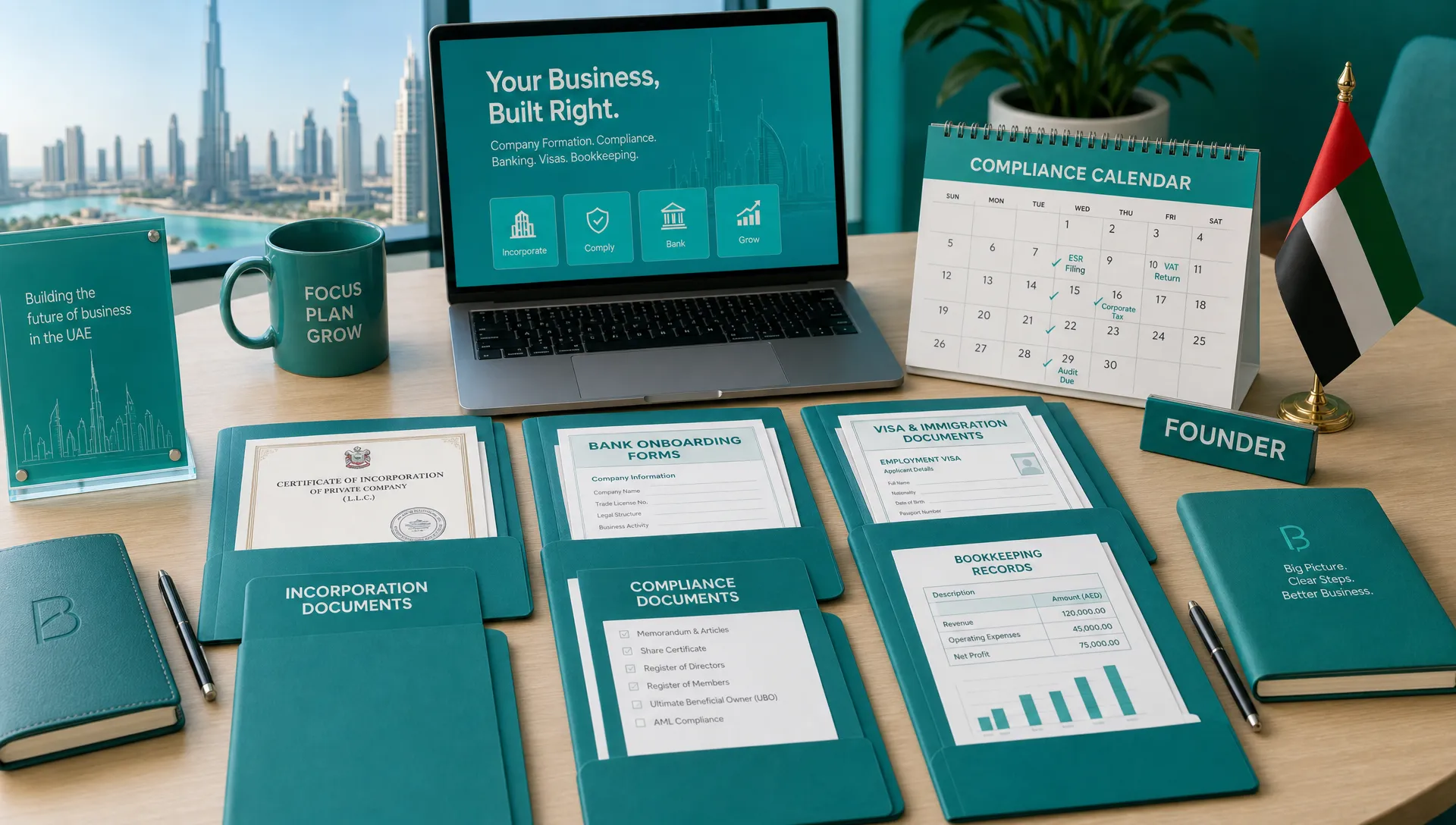
Build bookkeeping from the first dirham
Bookkeeping should not start at year-end. It should start when the first expense is paid, even if the bank account is not open yet. Early costs such as incorporation fees, office costs, visa expenses, advisory fees, travel, software subscriptions, and government charges should be recorded properly.
If a shareholder pays expenses personally before the corporate account is active, record those amounts as shareholder loans, capital contributions, or reimbursable expenses based on professional advice and the company’s documents. Do not leave them as informal payments.
The first 60 days are also the time to set invoice and expense rules. The company should have a chart of accounts, invoice numbering, document storage, approval limits, and monthly reconciliation procedures. If VAT registration becomes necessary later, clean early records will make the process significantly easier.
The Federal Tax Authority’s VAT guidance sets out the UAE VAT framework. In general terms, mandatory VAT registration applies when taxable supplies and imports exceed the statutory threshold, while voluntary registration may be available above the lower voluntary threshold. Because thresholds and treatment depend on the facts, monitor revenue from the beginning rather than waiting for a surprise crossing.
Progress visas, establishment cards, and people operations
If the company was formed partly to support UAE residency, the first 60 days should include an immigration roadmap. Depending on the jurisdiction and package, this may involve an establishment card, entry permit, status change, medical test, Emirates ID biometrics, visa stamping or residency completion, and dependent visa planning.
For companies hiring staff, people operations should also be structured early. Employment contracts, job titles, salary payments, visa quotas, insurance obligations, and workplace policies should match the company’s license and jurisdiction. Mainland companies and many free zones have specific systems and procedures for employment administration, so avoid assuming that a process used in one authority works the same way in another.
This is also where founders should separate personal relocation planning from company compliance. A residence visa may help with banking and local presence, but it does not replace corporate tax registration, accounting, governance, or proper licensing.
Days 61 to 90: create the compliance operating system
By the third month, the company should be moving from setup mode into management mode. This is the point to create a compliance calendar that tracks every recurring obligation and renewal dependency.
Your calendar should include license renewal dates, lease or flexi-desk renewal dates, corporate tax registration and filing milestones, VAT monitoring dates, accounting close dates, visa and Emirates ID expiries, insurance renewals, board or shareholder review dates, and bank KYC refresh requests.
Do not treat the calendar as a reminder list only. Each date should have an owner, required documents, and a preparation window. UAE company renewals can be delayed by expired leases, unresolved immigration issues, unpaid penalties, outdated UBO records, or incomplete accounting. The best renewal process begins months before expiry, not in the week the license expires.
The third month is also a good time to conduct a commercial reality check. Are the first contracts aligned with the license? Are invoices being issued by the correct entity? Are customers paying into the correct bank account? Are related-party charges documented? Are directors approving material decisions? If not, fix the pattern while the company is still young.
Different structures, different 90-day priorities
Not every UAE company needs the same post-formation plan. The right priorities depend on jurisdiction, activity, ownership, and purpose.
| Structure type | First 90-day focus | Common risk to avoid |
|---|---|---|
| Mainland company | Banking, tax registration, employment setup, local operating permissions, contracts | Trading outside the licensed activity or delaying labor and immigration setup |
| Free zone company | Bank readiness, office or flexi-desk compliance, visa allocation, free zone rules, tax position | Assuming free zone status automatically solves mainland trading or corporate tax questions |
| RAKEZ free zone company | License scope, facility package, immigration eligibility, bank KYC, renewal dependencies | Treating a flexible setup as permission for every activity or jurisdiction |
| RAK ICC offshore company | Asset holding purpose, governance records, banking narrative, UBO documentation | Using an offshore company as if it were a UAE operating license with visa rights |
A RAK ICC offshore structure can be useful for holding, investment, succession, and international structuring purposes, but it is not the same as an onshore or free zone operating company. A RAKEZ free zone company can be a strong operating vehicle, but it still needs proper activity selection, banking support, tax review, and renewal management.
The main lesson is that formation documents should match the company’s real-world use. If the use changes, the structure may need to change too.
Common mistakes in the first 90 days
Most post-formation problems are preventable. The risky part is that they often look harmless at the time.
- Waiting for revenue before thinking about corporate tax registration.
- Opening discussions with banks before preparing a clear KYC narrative.
- Signing contracts that do not match the licensed business activity.
- Paying company expenses personally without recording them properly.
- Forgetting to maintain UBO, shareholder, director, and signatory records.
- Assuming an offshore company can operate like a free zone company.
- Treating visa processing as separate from company compliance.
- Leaving bookkeeping until the first tax filing deadline.
The first 90 days are also when founders should be honest about capacity. If the company has cross-border shareholders, regulated activities, nominee arrangements, intercompany transactions, or significant banking needs, the cost of expert support is usually lower than the cost of correcting mistakes later.
What “good” looks like by day 90
By day 90, a well-managed UAE company should have a complete corporate file, a clear ownership and control record, a banking file in progress or completed, tax registration completed or properly scheduled according to applicable rules, bookkeeping live, invoice and expense controls in place, and a compliance calendar for the rest of the year.
It should also have a coherent commercial narrative. If a bank, auditor, tax advisor, regulator, or investor asks what the company does and how it operates, the documents and transactions should support the answer.
This is the difference between company formation and corporate engineering. Formation creates the entity. The first 90 days create the operating structure around it.
Frequently Asked Questions
Do I need to register for UAE corporate tax if my company has no revenue yet? In many cases, yes. For most new UAE juridical persons, corporate tax registration is linked to incorporation status and applicable FTA deadlines, not only revenue. Check the current FTA rules and obtain advice for your structure.
Can I open a UAE corporate bank account immediately after incorporation? You can usually begin the process soon after incorporation, but approval depends on the bank’s KYC review. A clear business model, UBO documentation, source of funds evidence, contracts, and activity alignment can improve the process.
Is a free zone company allowed to trade in the UAE mainland? Not automatically. Free zone companies must review their license, free zone rules, distribution model, and any mainland permissions required. The answer depends on activity, jurisdiction, and how business is conducted.
What is the biggest mistake after UAE company formation? The biggest mistake is treating incorporation as the end of the process. Banking, tax registration, governance, accounting, visas, and compliance calendars should be built in the first 90 days.
Does a RAK ICC offshore company provide UAE residency visas? A RAK ICC offshore company is generally used for international structuring, holding, and asset ownership purposes. It should not be treated like a free zone operating company with standard visa eligibility.
Turn formation into a working corporate structure
The first 90 days after UAE company formation set the tone for everything that follows. If the structure is documented, bankable, tax-aware, and operationally controlled, the company is easier to manage, renew, finance, and scale.
Alldren supports founders, investors, and private clients with UAE company setup, compliance management, corporate governance, bank account opening support, residency visa processing, bookkeeping coordination, tax registration support, and ongoing administration. If you want your UAE company to be built as a robust operating structure rather than a stack of documents, speak with Alldren about the next step.