

Choosing the right corporate entity in the UAE is not just paperwork. It directly affects whether you can legally do your activity, how you invoice customers, what compliance you must maintain, whether you can sponsor visas, and how easy it is to open a bank account.
Below is a practical, plain-English guide to the types of corporate entities in the UAE, how they differ, and when each one typically makes sense.
What “corporate entity” means in the UAE
A corporate entity is the legal wrapper around your business. In the UAE, the wrapper you choose is tightly linked to:
- Jurisdiction: mainland (onshore), free zone, or offshore
- Licensing authority: for example, a mainland Department of Economy and Tourism (DET/DED), a specific free zone authority, or an offshore registry
- Permitted activities: what you can do legally under that license
- Operational scope: whether you can trade directly in the UAE market, internationally, or both
Because the UAE is a federation, the rules can also differ by emirate and by special jurisdictions (for example, financial free zones).
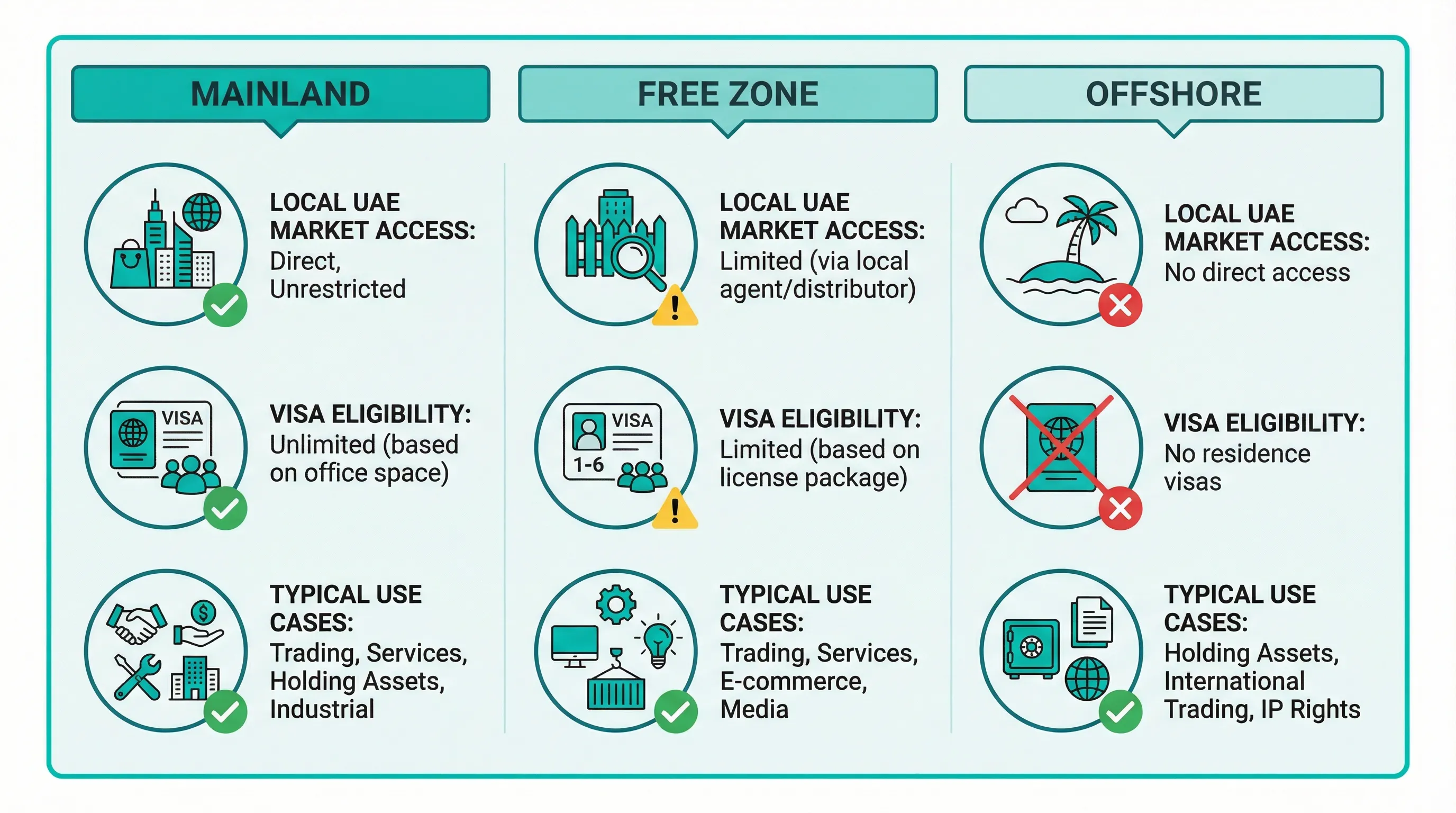
The 3 main buckets: mainland, free zone, and offshore
Most founders can narrow the choice quickly by first deciding where they need to operate.
| Bucket | Best for | Can you do business directly in the UAE market? | Typical visa eligibility | Common setup outcome |
|---|---|---|---|---|
| Mainland (onshore) | Serving UAE customers, physical offices/shops, broad activity access | Yes | Yes | LLC, sole establishment, branch |
| Free zone | International trade, e-commerce, regional HQ, specific clusters (media, tech, logistics) | Often limited (depends on model) | Yes | FZE/FZCO, free zone branch |
| Offshore | Holding assets, international structuring, owning shares/property (subject to rules) | No (not for local trading) | Usually no | Offshore company |
Mainland (onshore) corporate entities in the UAE
Mainland entities are registered with the relevant emirate authority (often referred to as DED/DET depending on the emirate). They are the most flexible option if you need to contract directly with UAE clients, rent retail space, or hire locally at scale.
Limited Liability Company (LLC)
A mainland LLC is one of the most common structures for small and mid-sized businesses.
Why founders choose it
- Fits many commercial and professional activities (subject to licensing)
- Clear separation between the company and owners (liability is generally limited)
- Familiar structure for banks, suppliers, and corporate customers
Key considerations
An LLC still depends heavily on:
- The licensed activity (what you are allowed to do)
- Local approvals for regulated sectors (healthcare, education, financial services, etc.)
- Practical requirements like office leasing, compliance, and renewals
Sole Establishment (for individuals)
A sole establishment is typically used when a single individual wants to operate a business under their own name or a trade name.
When it can fit
- Individual professional services and small operations, depending on activity and licensing
Watch-outs
- It can involve more direct personal exposure than a company with limited liability, depending on the exact legal form and obligations
- Not always ideal for businesses seeking outside investment or multiple owners
Civil Company (commonly used for certain professions)
A civil company is often associated with professional practices (subject to the rules of the emirate and the competent regulators).
Common use cases
- Certain professional service firms where licensing and qualifications matter
Because these setups can be sensitive to the exact activity and regulator expectations, it is worth confirming eligibility before you commit to this route.
Branch of a Foreign Company
A foreign branch lets an existing non-UAE company register a presence in the UAE.
Why it’s used
- The parent company wants to operate in the UAE without creating a new subsidiary
- A brand needs direct contracting and invoicing in the UAE (subject to licensing)
Typical implications
- The branch is tied to the parent company’s identity and documentation
- Approvals and documentation can be heavier than for a fresh LLC
Representative Office
A representative office is generally designed for marketing, liaison, and relationship-building, not for revenue-generating trading in the same way a full commercial license would allow.
It can be useful for companies that want a UAE footprint before committing to full operations.
Free zone corporate entities in the UAE
Free zones are special jurisdictions designed to attract foreign investment. They are popular for international business, digital services, and sector clusters.
The trade-off is that operating directly in the UAE mainland market may require additional structuring (for example, a mainland license, a distributor model, or specific permissions), depending on what you sell and where your customers are.
Free Zone Establishment (FZE)
An FZE is usually a free zone company with a single shareholder.
Good fit for
- Solo founders and single holding owners
- Service businesses exporting work internationally
- Regional HQ functions
Free Zone Company (FZCO / FZ-LLC)
A multi-shareholder free zone entity is often called FZCO or FZ-LLC depending on the free zone.
Good fit for
- Multiple founders
- Groups that want shareholder agreements and clearer governance
Branch of a Free Zone or Foreign Company
Many free zones allow a branch setup. This can be attractive if you want a presence inside a specific ecosystem (for example, a logistics zone, media zone, or innovation hub) without creating a separate subsidiary.
Free zones and regulated activities
Free zones vary widely. Some are designed for niche sectors and may be better aligned for regulated activities.
For example, if you are setting up a healthcare-adjacent or therapy-related service, you will typically need the correct activity plus external approvals. Looking at real, established operators can help you understand how specialized service businesses position themselves, for instance a Dubai-based speech and language therapy center will operate within a licensing and compliance framework suitable for clinical services.
Offshore companies in the UAE
An offshore company is generally intended for holding and international structuring rather than operating a business inside the UAE.
Common uses
- Holding shares in other companies
- Asset holding and certain ownership structures (always confirm eligibility for the specific asset and emirate)
- International trading and contracting outside the UAE
Typical limitations
- Not designed for issuing invoices to UAE mainland customers as an operating business
- Often not used to sponsor UAE residency visas
- Banking and substance expectations can be stricter in practice, depending on the bank and the profile
Joint Stock Companies (JSC): public and private
For larger businesses, especially those that may raise significant capital, the UAE offers joint stock company forms.
Private Joint Stock Company (PrJSC)
A private joint stock company can be relevant when you need a more institutional structure than an LLC, often for larger projects or groups.
Public Joint Stock Company (PJSC)
A public joint stock company is typically used for businesses that may list shares and raise capital from the public, and it comes with heavier governance and regulatory expectations.
For most SMEs and first-time founders, an LLC (mainland or free zone) is usually the starting point, but it is helpful to know these options exist as you scale.
Quick comparison: which entity is usually chosen for which goal?
Here is a practical lens that matches common goals to typical entity choices. This is not legal advice, but it reflects how founders often shortlist.
| Your goal | Common shortlist | Why it’s often chosen | What to verify early |
|---|---|---|---|
| Sell services to UAE clients, sign local contracts | Mainland LLC | Broad market access | Activity, office requirements, approvals |
| Import, export, or sell internationally with a UAE base | Free zone FZE/FZCO | Trade-friendly ecosystems, visa options | Mainland sales pathway, warehouse needs |
| Hold assets or shares, simplify international ownership | Offshore company | Holding and structuring | Banking feasibility, asset eligibility |
| Enter UAE market under a global parent brand | Branch | No new subsidiary required | Parent documentation, scope of activities |
| Professional practice (depending on profession) | Civil company or mainland professional setup | Aligns with regulated professional models | Qualification, regulator approvals |
Compliance and governance: the part many founders underestimate
Your entity choice affects your ongoing obligations. In the UAE, founders should plan for compliance from day one, not as an afterthought.
Common recurring areas include:
- License renewals and keeping activities aligned with actual operations
- Corporate governance requirements (resolutions, authorized signatories, recordkeeping)
- Accounting and bookkeeping, plus tax registrations where applicable
- Bank account opening readiness (documentation, business model clarity, transaction logic)
- Economic substance and beneficial ownership expectations (requirements depend on the business and jurisdiction)
This is often where “cheap setup” becomes expensive later, when a mismatch triggers re-licensing, banking friction, or delayed operations.
A simple way to decide: 6 questions to answer first
Before selecting a structure, get crisp answers to these:
- Will you invoice UAE mainland customers directly?
- Is your activity regulated (health, education, finance, legal, engineering, etc.)?
- Do you need residency visas, and if yes, how many in the first year?
- Will you need a physical location (shop, clinic, warehouse), or is remote acceptable?
- Who are the shareholders, and will you add investors later?
- What is your banking plan (currencies, expected volumes, countries involved)?
If you answer these clearly, the “right” entity type usually becomes obvious, and the remaining work is choosing the best-fit jurisdiction and licensing path.
Frequently Asked Questions
What are the main types of corporate entities in the UAE? The main buckets are mainland (onshore) entities, free zone entities, and offshore companies. Within those, common forms include LLCs, free zone companies (FZE/FZCO), and branches.
Is a free zone company allowed to do business in the UAE mainland? It depends on the activity and operating model. Many free zone companies primarily serve international customers, and mainland sales can require additional structuring or permissions.
What is the difference between a branch and a subsidiary in the UAE? A branch is an extension of the parent company, while a subsidiary is a separate legal entity (for example, an LLC) owned by shareholders.
Which UAE entity is best for a small services business? Often a mainland LLC or a free zone company, depending on where your customers are and whether you need to contract directly in the mainland.
Are offshore companies suitable for getting UAE residency visas? Usually not. Offshore companies are primarily used for holding and international structuring rather than operating businesses with visa quotas.
Do regulated businesses need special approvals regardless of entity type? Yes. In sectors like healthcare, education, and financial services, the entity type is only part of the process. You also need the correct activity and external regulator approvals.
Get the structure right before you register anything
If you are choosing between a mainland LLC, a free zone entity, or an offshore company, the best next step is to map your activity, customers, and compliance obligations into a structure that will still work 12 to 24 months from now.
Alldren provides expert-led, transparent corporate services for establishing and managing UAE companies, including company setup and structuring, compliance management, corporate governance, bank account opening support, visa processing, and bookkeeping and tax registration. If you want to avoid costly rework later, you can start with a structuring-first conversation at Alldren.


