
A loss in your financial statements does not automatically become a loss you can deduct from future profits. UAE corporate tax losses must be calculated under tax rules, supported by records and tracked across tax periods. Ownership changes, relief elections and transfers between related companies can affect whether those losses remain available.
For finance teams and business owners, the practical priority is maintaining a defensible loss register, not simply carrying forward last year’s accounting deficit. This guide explains what to record, how the relief works and which events deserve a review before your next corporate tax return.
What counts as a UAE corporate tax loss?
A tax loss arises when the corporate tax computation produces negative taxable income. The starting point is generally the accounting result, adjusted under the UAE Corporate Tax Law.
Those adjustments can include non-deductible expenditure, exempt income, unrealized gains or losses affected by an election and related-party pricing adjustments. Consequently, the accounting loss and tax loss can differ substantially.
For example, a company might report an accounting loss of AED 200,000. If it has AED 250,000 of non-deductible expenses and no other adjustments, its tax computation produces positive taxable income of AED 50,000. There is no tax loss to carry forward, despite the accounting deficit.
Maintain a reconciliation from the financial statements to the tax result. A retained-earnings balance or management accounts report is not a substitute for that calculation.
The governing provisions are Articles 37 to 39 of Federal Decree-Law No. 47 of 2022, as amended. The Federal Tax Authority’s legislation library provides the official legislation underpinning loss relief, transfers and ownership conditions.
Losses that cannot enter the relief pool
Article 37 excludes losses incurred before corporate tax commenced, losses incurred before a person became a Taxable Person and losses from assets or activities whose income is exempt or otherwise outside the corporate tax computation.
For a longstanding business, this means accumulated accounting losses from earlier years cannot simply be imported into its first corporate tax return.
Track the origin of each loss by tax period and activity. Where your accounts combine taxable and exempt activities, document the allocation of income and expenditure before calculating the amount eligible for relief.
How the 75% loss-relief limit works
Under the general rules, UAE corporate tax losses can be carried forward and deducted from taxable income in subsequent tax periods. The deduction is normally limited to 75% of taxable income before tax loss relief.
This is a limit on the amount used in a particular period, not a reduction of the original loss balance. Any unused eligible balance remains available for later periods, subject to the applicable conditions.
There is generally no fixed expiry period for eligible carried-forward losses. However, ownership and business-continuity requirements can affect their continued availability. The regime does not provide a general carry-back mechanism to recover tax paid on an earlier profitable period.
The 75% restriction also does not mean every profitable company must pay tax on the remaining 25%. For a company under the ordinary rate structure, the AED 375,000 band taxed at 0% is applied to taxable income after loss relief.
Worked example: relief without a tax payment
Assume a company is subject to the ordinary corporate tax rates, meets the loss-relief conditions and has no special-regime adjustments.
| Calculation | Amount |
|---|---|
| Eligible losses brought forward | AED 1,000,000 |
| Current-period taxable income before loss relief | AED 800,000 |
| Maximum relief, 75% of AED 800,000 | AED 600,000 |
| Losses used in the period | AED 600,000 |
| Taxable income after relief | AED 200,000 |
| Unused losses carried forward | AED 400,000 |
| Corporate tax under the ordinary rate structure | AED 0 |
The company cannot eliminate all AED 800,000 of taxable income using its losses. Nevertheless, the remaining AED 200,000 falls within the ordinary 0% band.
By contrast, if taxable income after relief were AED 500,000, the ordinary 9% rate would apply to AED 125,000, producing corporate tax of AED 11,250. Loss relief and the rate calculation are separate steps.
Build a loss register that reconciles to each return
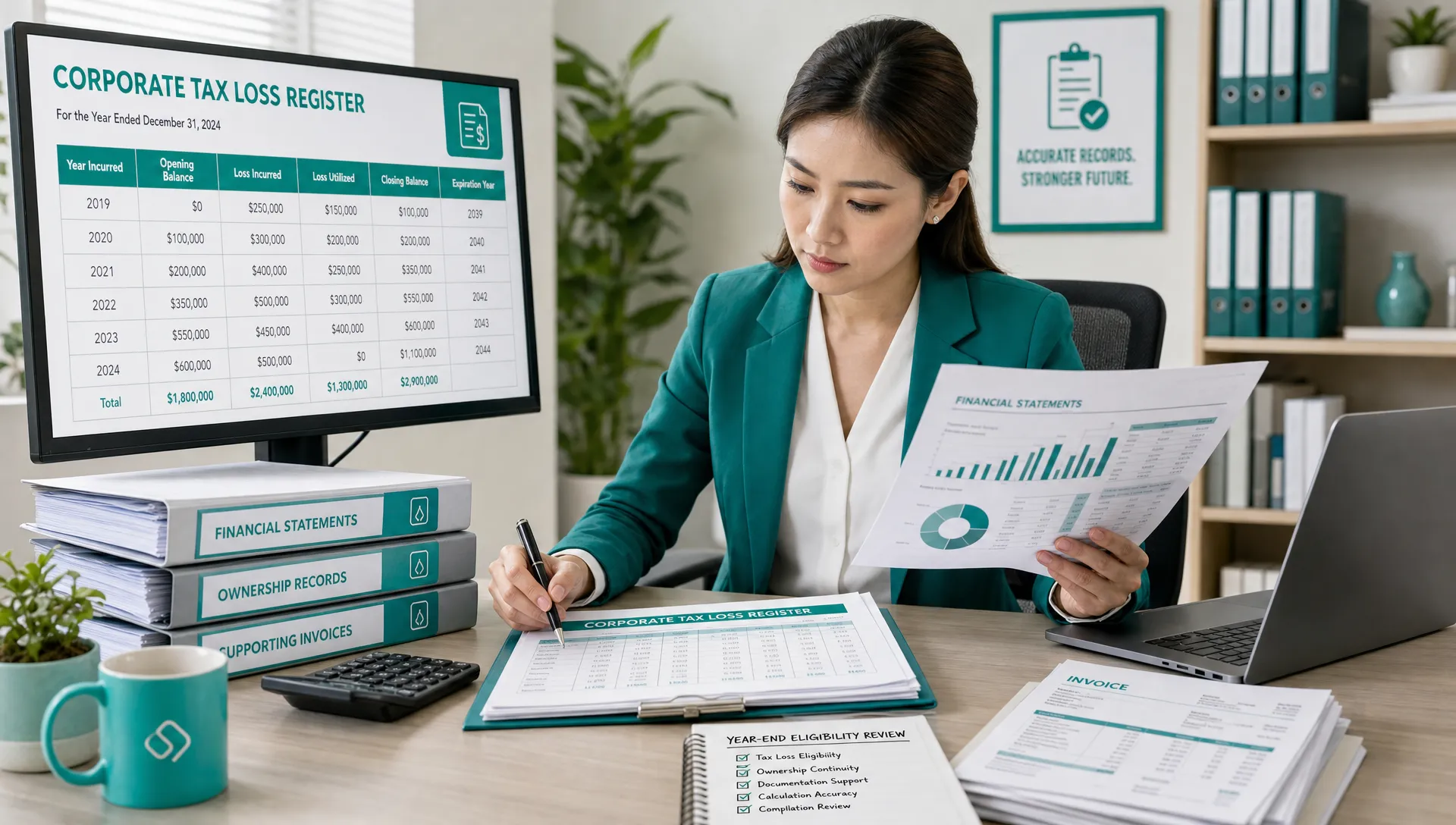
A useful register shows how UAE corporate tax losses arose, whether they remain eligible and how much has been used. Keep it by legal entity and originating tax period, even if management reviews the business on a consolidated basis.
| Field to track | Why it matters |
|---|---|
| Legal entity and tax registration number | Identifies the Taxable Person entitled to the loss |
| Originating tax period | Distinguishes eligible losses from earlier accounting deficits |
| Accounting result and tax adjustments | Explains how the tax loss was calculated |
| Opening eligible balance | Establishes the amount available before current-period movements |
| Current-period losses | Records additional losses arising in the tax computation |
| Losses used against own income | Supports the relief claimed in the return |
| Losses transferred or received | Prevents duplicate claims between related companies |
| Closing balance by originating period | Preserves the history of unused losses |
| Ownership and business-continuity status | Records whether carry-forward conditions remain satisfied |
| Supporting return and document references | Makes the calculation traceable during a review |
Reconcile the opening balance to the previous period’s closing register and filed return. If a return is corrected or an assessment changes a loss, update the register and preserve the explanation rather than overwriting the history.
Keep the evidence behind the balance
The register is a summary, not the underlying proof. Retain financial statements, general ledgers, invoices, contracts, tax-adjustment workings and the relevant return submissions.
For ownership conditions, keep share registers, transaction documents and an ownership chart showing direct and indirect interests. If continuity depends on carrying on the same or a similar business, preserve evidence of activities, assets and operational changes.
Article 56 generally requires supporting records to be retained for seven years after the end of the tax period to which they relate. Treat this as a statutory minimum, not an automatic instruction to delete evidence for unused losses. A loss used much later may still require its original calculation to be substantiated.
The FTA’s corporate tax guides and references provide further guidance on taxable-income calculations, records and relevant reliefs.
Review ownership changes before relying on old losses
An acquisition does not automatically erase UAE corporate tax losses, but it can change the eligibility analysis.
Broadly, Article 39 permits carry-forward where at least 50% of the ownership interests remain continuously held by the same person or persons, from the beginning of the period in which the loss arose through the end of the period in which it is used.
Where an ownership change of more than 50% occurs, the alternative condition concerns continuing the same or a similar business. The analysis looks beyond a matching trade-license description. Relevant considerations include continued use of assets, the business’s core identity and operations, and whether changes represent development of the existing business.
The ownership-change limitation does not apply to a Taxable Person whose shares are listed on a Recognized Stock Exchange.
Before a share sale or restructuring, prepare a dated eligibility review. Record the ownership position when each loss arose, subsequent changes and the basis for continued availability. Do not value accumulated losses in an acquisition as though they were unrestricted cash assets.
Transferring losses between related companies
Separate companies cannot freely share losses simply because they have the same founder or appear in consolidated accounts. Article 38 sets specific conditions for a transfer.
Both companies must be UAE-resident juridical persons. Neither may be an Exempt Person or a Qualifying Free Zone Person, and they must have the same financial year and use the same accounting standards.
The ownership test generally requires at least 75% direct or indirect ownership of one company by the other, or at least 75% ownership of both by a common third person. That relationship must exist from the beginning of the tax period in which the loss arose through the end of the recipient’s period in which it uses the loss.
The recipient uses its own available losses first. Transferred losses remain subject to the recipient’s 75% relief ceiling, taking its own loss relief into account. The transferring company must reduce its available balance by the amount transferred.
When managing UAE corporate tax losses across a group, maintain matching schedules for both companies, identifying the originating period, amount transferred, eligibility evidence and return treatment.
A formal corporate tax group is a different mechanism with separate entry requirements and rules for pre-group losses. Consolidated financial statements alone do not create a tax group or authorize loss sharing.
Relief elections and free zone status need separate tracking
Small Business Relief periods
A business electing for Small Business Relief is treated as having no taxable income for the relevant period. It cannot generate a tax loss for that elected period merely because its accounts show a deficit.
Eligible losses from earlier periods in which relief was not elected can remain available for later periods when Small Business Relief is not elected, subject to the normal conditions. They are not used against income during an elected relief period.
Under Ministerial Decision No. 73 of 2023, the relief applies to eligible tax periods ending on or before December 31, 2026. Businesses weighing the election should assess its consequences for losses alongside immediate tax savings. Alldren’s explanation of Small Business Relief in 2026 covers the broader eligibility requirements.
Free zone companies
Free zone incorporation does not, by itself, determine how a loss is treated. Distinguish a company subject to the ordinary corporate tax rules from a Qualifying Free Zone Person.
For a Qualifying Free Zone Person, map losses to the relevant income category and confirm the applicable carry-forward treatment. Do not assume every accounting loss can be pooled against income taxable at 9%. Qualifying Free Zone Persons are expressly excluded from the Article 38 loss-transfer mechanism.
Alldren’s guide to the UAE corporate tax free zone rules explains the status distinctions behind this review. Your loss register should record status changes and elections alongside the financial amounts.
What to check before filing
A year-end review of UAE corporate tax losses should connect the calculation, eligibility evidence and return disclosures. The most useful checks are:
- Reconcile the balance: Match opening losses to prior returns and incorporate corrections or assessments.
- Confirm eligibility: Review ownership, business continuity, relief elections and free zone status.
- Apply the ceiling: Calculate the 75% limit using taxable income before loss relief.
- Check group movements: Reconcile transfers in both entities and prevent duplicate use.
- Preserve the trail: Save the approved calculation and its supporting records with the filing documents.
Assign responsibility for the register to a named person. Bookkeeping establishes the accounting result, while the tax computation determines the eligible loss. Ownership transactions may involve a separate legal team, so finance needs a process for receiving those updates before filing.
A business with no tax payable may still have registration, filing and record-keeping obligations. A loss-making year should therefore receive the same documentation discipline as a profitable one.
Frequently asked questions
Can UAE corporate tax losses be carried forward indefinitely? Under the general rules, there is no fixed expiry period. Continued use depends on eligibility conditions, including the applicable ownership or same-or-similar-business test.
Can a company use losses to eliminate all taxable income? Generally not. Relief is normally capped at 75% of taxable income before loss relief. The remaining income may still fall within the ordinary AED 375,000 band taxed at 0%.
Does an accounting loss automatically qualify? No. Tax adjustments can increase, reduce or eliminate an accounting loss. Prepare a separate tax computation and retain the reconciliation.
Can losses be transferred to another company owned by the same individual? Potentially, but common ownership alone is insufficient. The Article 38 ownership, residency, timing and other conditions must all be satisfied.
Do unused losses produce a cash refund? Not by themselves. Loss relief reduces eligible taxable income in subsequent periods; it is not a general payment from the FTA for operating at a loss.
Keep loss tracking connected to corporate compliance
Loss balances are only useful when the calculation and continued eligibility can be supported. Before your next filing or ownership transaction, reconcile the register and resolve gaps in the evidence.
For businesses needing coordinated bookkeeping, tax registration and ongoing compliance support, Alldren’s corporate services provide direct access to senior experts. Bring your financial statements, prior returns and ownership history so the review starts with documented facts.