

Setting up a free zone company can be one of the fastest ways to start operating in the UAE, but the word “fast” is doing a lot of work. The real question is how long your specific registration will take and what the full, all-in cost will be once you include visas, office requirements, compliance, and banking.
This guide breaks down the true costs and a realistic timeline for company registration in UAE free zone structures, so you can budget properly, avoid common delays, and choose the setup path that matches your business model.
What “UAE free zone company registration” actually includes
A UAE free zone company is incorporated and licensed by a specific free zone authority (each free zone is its own regulator with its own rules, fees, activity lists, and processes). Your “registration” typically includes:
- Reserving and approving your company name
- Selecting and approving business activities
- Incorporation (legal entity formation) under the free zone’s registry
- Issuing a trade license (the document that allows you to operate)
- Leasing a workspace solution that meets free zone requirements (this can be a flexi-desk or a physical office, depending on the free zone and your needs)
- Optional but common add-ons: residence visas, establishment card/immigration file, corporate bank account support, bookkeeping and tax registrations
Free zones are often chosen for speed, predictable processes, and packaging (license plus workspace, sometimes with visa eligibility). The trade-off is that pricing and timelines vary materially from one free zone to another, and also based on your activity and compliance profile.
UAE free zone company registration costs: what you actually pay for
Free zone setup costs are best understood in two buckets:
- One-time costs (incorporation, initial approvals, some immigration file setup, document attestations)
- Recurring annual costs (license renewal, workspace lease renewal, ongoing compliance, sometimes audits)
The most common budgeting mistake is looking only at an advertised “starting from” package and missing the add-ons your case requires.
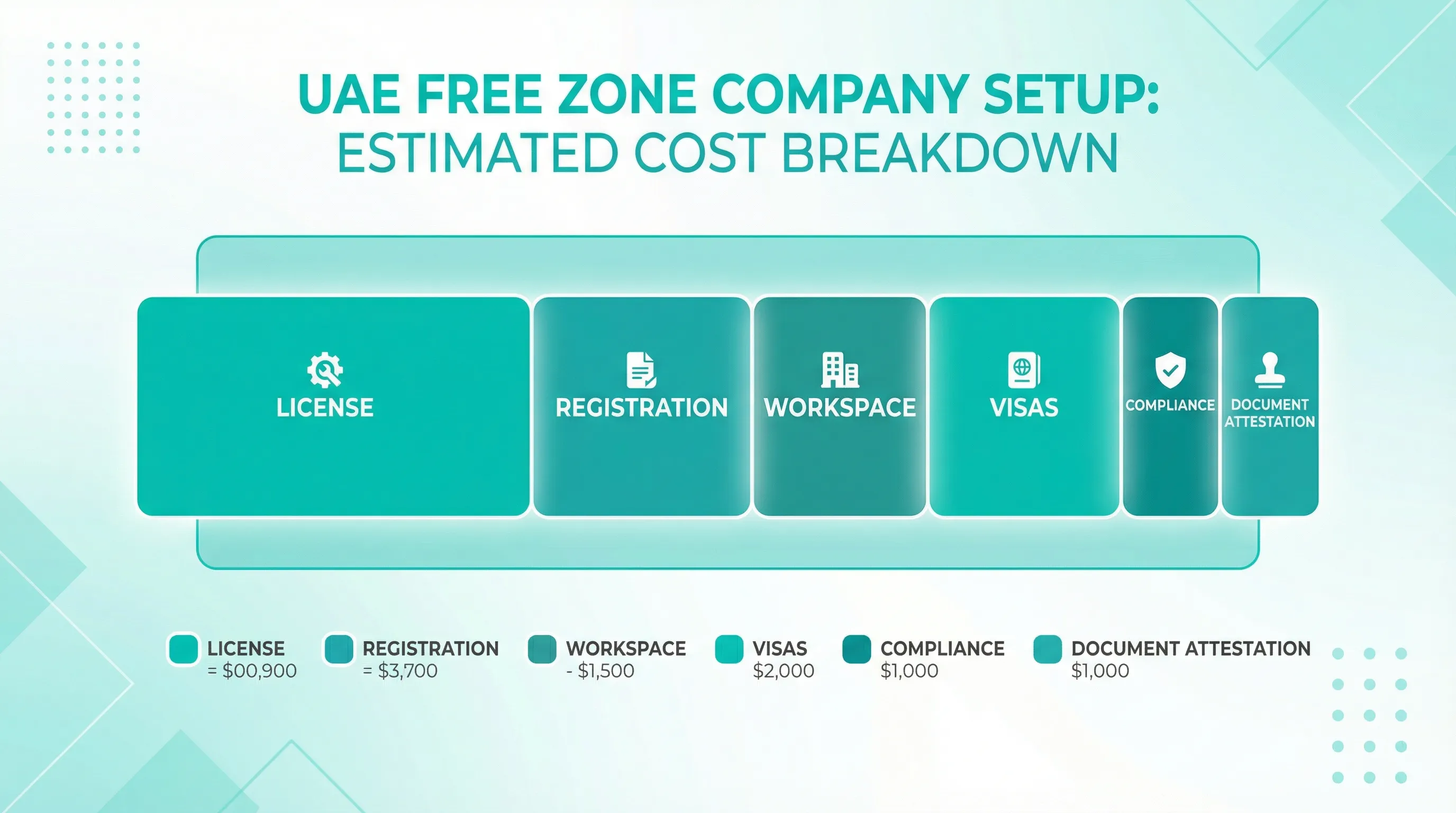
Cost components (with typical market ranges)
The ranges below are broad on purpose. Free zones update fee schedules, and your final cost depends on activity type, number of shareholders, visa quota, office size, and whether any special approvals apply.
| Cost component | Usually paid to | When it applies | Typical range (AED) | What drives the range |
|---|---|---|---|---|
| Registration and incorporation | Free zone authority | One-time (initial setup) | 5,000 to 20,000 | Entity type, shareholder count, free zone fee schedule |
| Trade license (annual) | Free zone authority | Annual (renewal each year) | 8,000 to 25,000 | Activity category (service, trading, industrial), regulated approvals |
| Workspace (flexi-desk/office/warehouse) | Free zone authority or landlord | Annual | 5,000 to 60,000+ | Desk vs office, size, location, visa quota tied to lease |
| Visas per person (entry permit, status, medical, Emirates ID) | Immigration-related authorities and service centers | Per person | 3,500 to 7,500 | Free zone process, whether you are inside/outside UAE, dependents |
| Establishment card / immigration file | Free zone / immigration | Setup and renewal (varies) | 1,500 to 3,500 | Free zone rules, number of visas, renewals |
| Document attestation, legalization, translation | External providers / embassies / MOFAIC routes | As needed | 500 to 5,000+ | Country of origin, document type, urgency |
| Corporate services support (structuring, filings, liaison) | Service provider | Optional but common | Varies | Scope, complexity, senior involvement |
| Bookkeeping, VAT and corporate tax registrations (where applicable) | Service provider / authorities | Ongoing / as required | Varies | Transaction volume, reporting requirements, thresholds |
Practical takeaway: for many small owner-managed setups, founders often budget from the mid five-figures AED all-in for year one once you include a license, workspace, and at least one visa. More complex or visa-heavy structures can go significantly higher.
The biggest drivers of your total cost
Business activity and approvals
A straightforward consulting or service license is usually simpler than trading, and regulated activities (financial services, education, healthcare, crypto-related, insurance-related, and certain professional services) can require additional approvals, higher scrutiny, and longer processing.
Even within “trading,” product categories can change requirements (for example, food, cosmetics, or medical items can trigger extra controls).
Office requirement and visa quota
Many free zones link visa eligibility to your workspace type. If you need multiple visas, your cheapest desk option may no longer qualify, which can push you into a larger office solution.
Number of shareholders and corporate shareholders
More parties means more KYC, more documentation, and sometimes additional registry fees. If a shareholder is a company (rather than an individual), expect more documents, more legalization, and more bank compliance scrutiny.
Banking complexity (often underestimated)
Bank account opening is not “just paperwork.” It is a compliance process. If your profile is higher-risk (complex ownership, certain nationalities, specific industries, or unclear source of funds), your time cost and professional support cost can rise.
Ongoing compliance you cannot ignore
Your license is the start, not the end. Most companies need an operational baseline that includes:
- Proper accounting records
- Tax considerations (corporate tax applies in the UAE, with free zone specific rules depending on facts)
- Economic substance and beneficial ownership disclosures (where applicable)
For official tax guidance, use primary sources such as the UAE Ministry of Finance corporate tax portal and the Federal Tax Authority.
UAE free zone company registration timeline: a realistic view
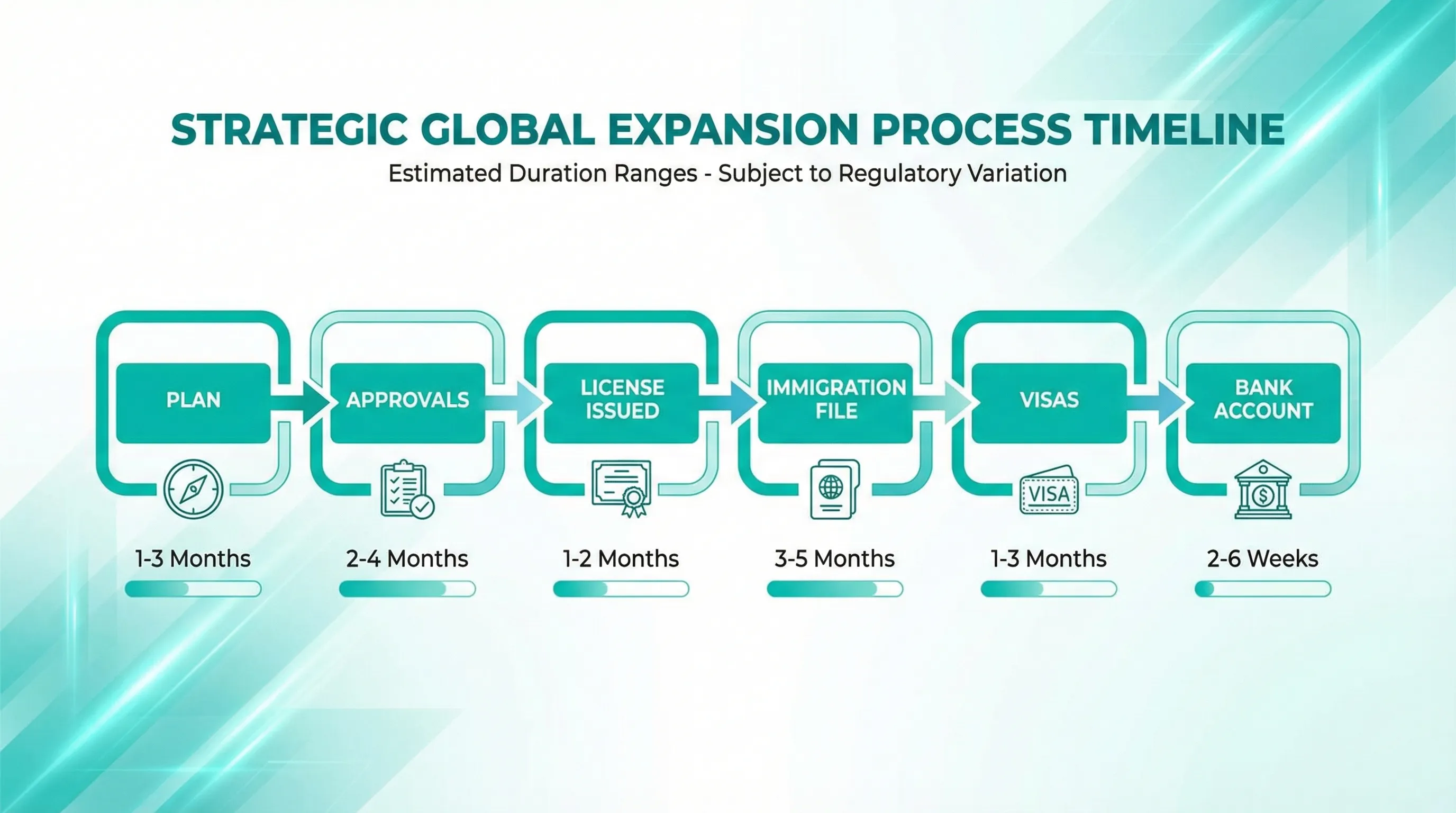
Timelines depend on your readiness (documents and decisions), the free zone’s processing speed, and whether your case needs extra approvals.
Typical step-by-step timeline
| Stage | What happens | Typical duration |
|---|---|---|
| Planning and pre-checks | Choose free zone, activities, name options, shareholder structure, visa needs | 1 to 5 business days (longer if decisions are unclear) |
| Name and initial approvals | Name reservation, activity approval, initial compliance screening | 1 to 5 business days |
| Incorporation and license issuance | Submit KYC, sign incorporation docs, pay fees, receive license | 3 to 10 business days |
| Immigration file setup | Establishment card / immigration file (if you will apply for visas) | 2 to 7 business days |
| Visa processing (per person) | Entry permit, status change, medical test, biometrics, Emirates ID | 2 to 6 weeks |
| Corporate bank account | Bank selection, application, compliance review, account opening | 2 to 8+ weeks |
Where timelines usually slip
Missing or inconsistent KYC documents
Expect to provide passport copies, proof of address, and background/business information. Delays happen when documents do not match (name formats, expired IDs, unclear addresses), or when corporate shareholder documents are not properly certified.
Activity mismatch
If your real business model does not match the selected activity (for example, you select “consulting” but intend to import and resell goods), you can run into licensing problems later, including during banking.
Underestimating visa lead times
Even when the entry permit is fast, completing medical tests, biometrics, and Emirates ID can take time, especially during peak periods.
Bank compliance review
Banking is often the longest critical path. If you need a bank account to invoice clients immediately, plan for this early, and ensure your incorporation structure and business narrative are bankable.
Documents to prepare (to avoid delays)
Exact requirements vary by free zone, but most founders should prepare:
- Passport copy for each shareholder and manager
- Recent proof of address (commonly a utility bill or bank statement, depending on the free zone)
- Passport photo (format requirements vary)
- Brief business description (what you sell, where customers are, expected volumes)
- If a shareholder is a company: incorporation certificate, register extracts, constitutional documents, and board resolution (often requiring notarization/legalization)
If your documents originate outside the UAE, factor in time for notarization and legalization where required.
Putting costs and timeline together: three common scenarios
These are not quotes, but planning examples to help you estimate the moving parts.
Scenario A: Solo consultant needing one residence visa
This is often the quickest path.
- Cost drivers: standard service activity, minimal workspace, one visa
- Timeline: license can be relatively fast once documents are ready, visa and Emirates ID often become the pacing item
- Typical pain point: bank account timeline, especially if your client base and expected inflows are not clearly explained
Scenario B: Small trading company with 2 to 3 visas
Trading setups are common, but need tighter alignment.
- Cost drivers: trading activity, possible extra approvals depending on goods, workspace that supports visa quota
- Timeline: incorporation can still be quick, but bank onboarding may request supplier/customer invoices, contracts, and logistics details
- Typical pain point: choosing the right activity wording and ensuring the license supports what the bank expects
Scenario C: Corporate shareholder, multi-partner structure, or regulated activity
This is where planning matters most.
- Cost drivers: more documents, more legalization, higher scrutiny, sometimes additional approvals
- Timeline: longer pre-incorporation phase due to document collection and structuring decisions
- Typical pain point: repeated back-and-forth during compliance checks if the ownership story is not cleanly documented
How to reduce your setup cost (without creating future compliance problems)
Trying to minimize year-one spend is reasonable, but optimizing the wrong thing can cost you more later (re-licensing, inability to open a bank account, or noncompliance exposure).
The most reliable “cost controls” are operational choices:
- Choose the correct activities from day one so you do not pay for amendments later.
- Right-size visas. Each visa has direct costs and also affects office requirements.
- Keep ownership and management simple where possible.
- Prepare a short, consistent business pack for banking (business model, counterparties, expected monthly flows, source of funds).
What happens after registration: annual costs and ongoing timeline
Free zone companies are not “set and forget.” Plan for:
- Annual license renewal (core recurring cost)
- Workspace renewal (if your lease is tied to your license)
- Visa renewals (timelines can be tight, plan ahead)
- Bookkeeping and financial statements (banks and tax compliance depend on clean records)
- Tax registrations and filings where applicable (for example, VAT and corporate tax obligations depend on facts and thresholds)
For identity and residency process references, the ICP portal is a useful starting point for Emirates ID and residency-related information.
When it makes sense to use an expert partner
If your goal is simply to “get a license,” many routes will look similar. The difference shows up when you need the structure to remain compliant and bankable over time.
Expert support is especially valuable when:
- You are unsure whether a free zone or another jurisdiction is better for your operating reality
- You need visas for multiple team members or dependents
- You have a corporate shareholder or complex ownership
- You need help sequencing incorporation, visas, and banking to reduce downtime
Alldren supports UAE company setup and ongoing management with an emphasis on transparent, upfront pricing and direct access to senior experts for structuring, compliance, banking support, and residency processing. If you want help mapping your expected year-one costs and building a realistic timeline for your specific case, start at Alldren.


