

If you run a business in the UAE, you will hear people use “TRN” and “Corporate Tax ID” as if they are interchangeable. They are not. Mixing them up can lead to practical problems like rejected registrations, mismatched filings, invoice compliance issues, or delays during bank or vendor onboarding.
This guide breaks down what a UAE Tax Registration Number (TRN) is, what people usually mean by Corporate Tax ID, when you need each, and how to use the right identifier in the right place.
TRN in the UAE, what it is (and what it is not)
A TRN (Tax Registration Number) is the identifier issued by the UAE Federal Tax Authority (FTA) when you register for certain UAE tax regimes.
Most commonly, when people say “TRN,” they mean the number issued after VAT registration. That VAT TRN is used to:
- Identify you on VAT returns and FTA correspondence
- Show tax registration on tax invoices (where applicable)
- Support VAT treatment in B2B relationships, especially when customers require a valid VAT number
A TRN is not:
- Your trade license number
- Your company registration number
- Your customs code
- Your establishment card number
If you are trying to complete tax registration, banking onboarding, or supplier setup, those IDs are often requested alongside tax IDs, but they serve different purposes.
For the VAT framework and the TRN concept, the primary reference point is the Federal Tax Authority.
What “Corporate Tax ID” usually means in the UAE
“Corporate Tax ID” is a common shorthand for the identifier you receive after registering for UAE Corporate Tax with the FTA.
In official contexts, you will generally see this discussed as Corporate Tax registration under the UAE Corporate Tax regime. Corporate Tax itself is administered by the FTA, and policy guidance is issued via the Ministry of Finance and related official channels. For regime overviews and guidance, start with the UAE Ministry of Finance Corporate Tax page.
Is the Corporate Tax ID the same as the VAT TRN?
Not always.
In practice, businesses can end up with:
- A VAT registration (with a VAT TRN)
- A Corporate Tax registration (with a Corporate Tax registration identifier)
Depending on your situation and how the registrations are issued and displayed in the FTA systems, the identifiers may be distinct. The safest operational approach is:
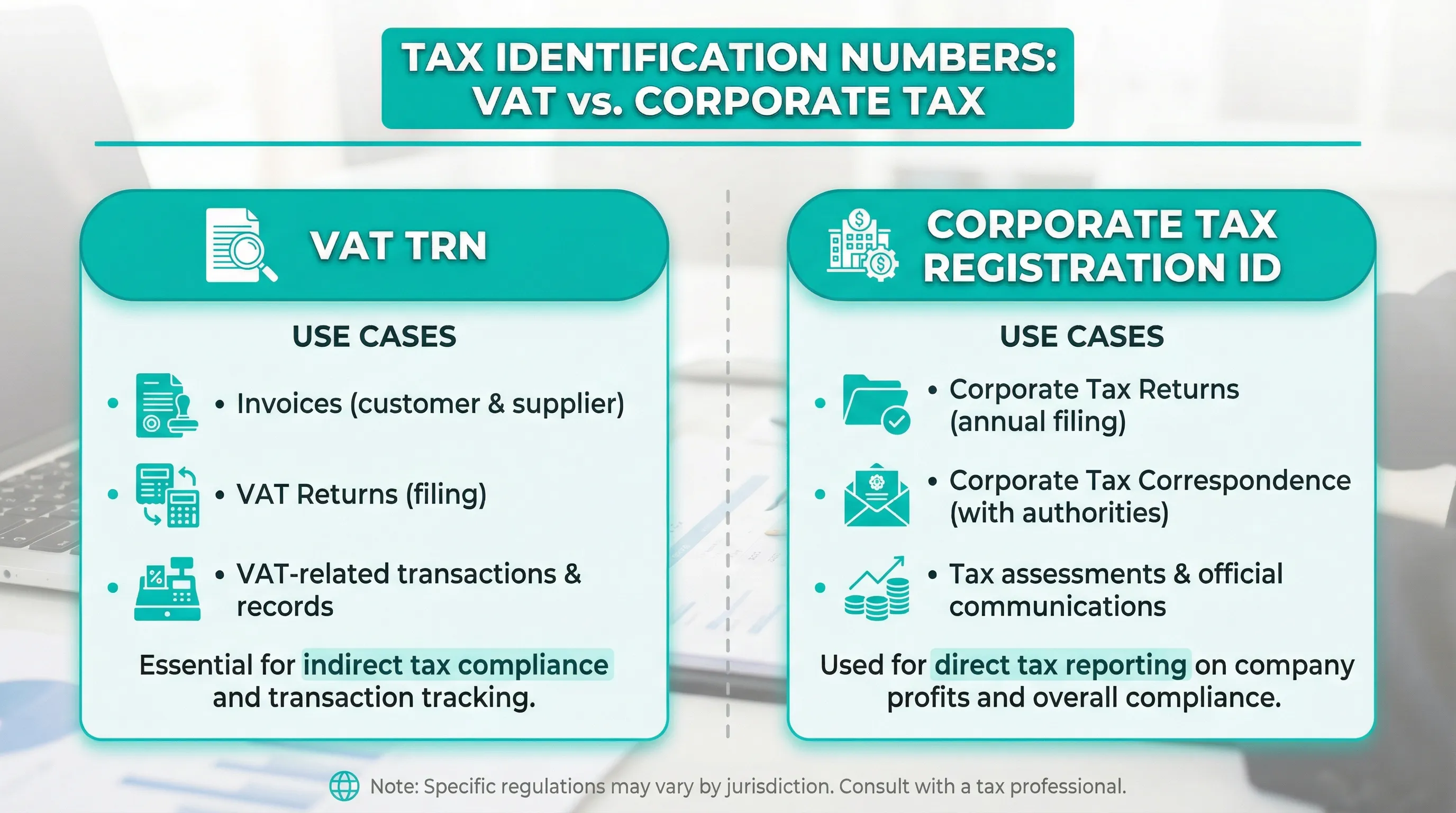
- Treat VAT TRN as the number used for VAT invoicing and VAT returns.
- Treat your Corporate Tax registration identifier as the number used for Corporate Tax returns, Corporate Tax correspondence, and Corporate Tax compliance workflows.
If you are unsure which number is being requested, do not guess. Ask whether the counterparty needs your VAT TRN or your Corporate Tax registration details, and verify directly in your FTA portal profile and tax certificates.
TRN vs Corporate Tax ID: side-by-side comparison
| Item | TRN (commonly: VAT TRN) | “Corporate Tax ID” (Corporate Tax registration identifier) |
|---|---|---|
| Issued by | Federal Tax Authority (FTA) | Federal Tax Authority (FTA) |
| Primary purpose | VAT compliance and identification | Corporate Tax compliance and identification |
| Where you use it most | VAT returns, VAT certificates, tax invoices (where required) | Corporate Tax registration, Corporate Tax returns, Corporate Tax correspondence |
| Who typically needs it | VAT-registered businesses | Businesses required to register for Corporate Tax |
| Common confusion | Used as a generic “tax number” everywhere | Assumed to be automatic if you already have a VAT TRN |
When you need a TRN (VAT) vs when you need Corporate Tax registration
When you need a VAT TRN
You generally pursue VAT registration when you meet the VAT registration requirements. The UAE has:
- Mandatory VAT registration thresholds
- Voluntary VAT registration thresholds
The exact thresholds and conditions can change, and edge cases matter (for example, group structures, exceptional supplies, or how taxable supplies are calculated). Always validate your position against official guidance, starting with the FTA VAT portal.
Once registered, you will use the VAT TRN in day-to-day commercial operations, particularly invoicing and vendor onboarding.
When you need Corporate Tax registration
Corporate Tax is a separate regime from VAT. Even if you are not VAT registered, you may still need Corporate Tax registration.
At a high level, Corporate Tax obligations depend on factors such as:
- Your legal form and where you are incorporated
- Whether you are conducting business in the UAE
- Whether you qualify for specific reliefs, exemptions, or Free Zone treatments
For the general regime overview and core concepts, refer to the Ministry of Finance Corporate Tax guidance.
A practical rule of thumb for operators
- VAT TRN answers: “What is your VAT number for invoicing and VAT returns?”
- Corporate Tax ID answers: “What is your Corporate Tax registration identifier for Corporate Tax compliance?”
Where to find your VAT TRN and your Corporate Tax registration details
Most businesses will retrieve these details from:
- The relevant FTA portal (for example, the sections for each tax type under your profile)
- Your tax registration certificates and official correspondence
Operationally, it is worth keeping a controlled internal record with:
- Legal entity name (exact spelling as registered)
- Trade license number and issuing authority
- VAT TRN (if VAT registered)
- Corporate Tax registration identifier (once registered)
- Registered address and main contact details used with the FTA
Keeping this consistent reduces mismatches across filings, bank onboarding, payment processors, and ERP or accounting configurations.
Common scenarios: which number should you provide?
| Scenario | What they usually want | What to provide (most common) |
|---|---|---|
| A customer asks for your “TRN” to set you up as a vendor | VAT verification | Your VAT TRN (if VAT registered) |
| You are preparing VAT-compliant tax invoices | VAT invoicing | VAT TRN on the invoice (where required) |
| You are completing Corporate Tax registration or filing | Corporate Tax compliance | Corporate Tax registration identifier (not your VAT TRN unless explicitly confirmed) |
| Bank onboarding asks for “tax identification” | Varies by bank and profile | Provide both VAT TRN and Corporate Tax registration details if you have them, plus trade license |
| A group structure with multiple entities | Entity-specific identification | The identifier for the specific legal entity signing the contract or filing the return |
If a counterparty uses a generic field called “Tax ID,” clarify which tax regime they mean.
Mistakes that cause delays (and how to avoid them)
Using the VAT TRN where Corporate Tax registration details are required
This often shows up when teams recycle onboarding templates or copy-paste tax details across systems. Result: mismatches with official certificates, confusion during audits, and back-and-forth with counterparties.
Fix: Maintain a single source of truth (even a controlled spreadsheet) that separates VAT and Corporate Tax details.
Assuming Corporate Tax registration is automatic because you already have a VAT TRN
VAT registration and Corporate Tax registration are related only in the sense that both are administered by the FTA. One does not automatically complete the other.
Fix: Treat Corporate Tax as its own compliance track, with its own registration process, deadlines, and internal owner.
Confusing a trade license number with a tax number
Trade license details are essential, but they are not tax registration numbers.
Fix: Build your “compliance pack” for onboarding with clearly labeled sections: licensing, VAT, Corporate Tax, UBO documentation, and authorized signatory.
Free Zone misconceptions
Some Free Zone businesses assume they have “no Corporate Tax” and therefore no Corporate Tax compliance steps. In reality, eligibility and conditions can be nuanced.
Fix: Confirm the exact Corporate Tax treatment for your legal entity and activities using official guidance, and get specialist advice if you are near the boundaries (for example, mainland customers, related-party transactions, or mixed activities).
What to prepare before registering (to move faster and reduce rework)
While requirements vary by tax type and entity profile, you typically need clean, consistent information across your company records.
Common items you should have ready include:
- Trade license and company incorporation documents
- Passport and Emirates ID details (as applicable) for owners and authorized signatories
- Contact details that match across official filings (email, phone, address)
- A clear description of business activities and revenue model
- Accounting records aligned to the entity that will file
None of this is complicated, but inconsistencies are what trigger delays.
Industry note: fast-scaling digital businesses often need both identifiers
If you run a digital-first business that onboards users globally, your compliance footprint tends to expand quickly, even if your headcount stays small.
Examples include SaaS, marketplaces, fintech-adjacent services, and platform businesses supporting regulated verticals. For instance, an iGaming platform provider building payment flows, KYC processes, and multi-currency reporting typically needs a strong compliance backbone across jurisdictions and internal entities. If you are evaluating platform infrastructure, Spinlab’s iGaming platform is an example of a modular setup focused on payments, compliance, and fast onboarding, which is exactly where having the right tax identifiers and corporate structure becomes operationally important.
The key takeaway is not industry-specific, it is operational: once you deal with payments, onboarding checks, and B2B procurement, people will ask for “your tax number.” You will save time by knowing which one they mean.
How Alldren can help (without guesswork)
Tax identifiers sit downstream of structuring decisions. Your legal form, Free Zone vs mainland approach, activity scope, and governance setup all affect your compliance workload.
Alldren supports UAE company setup and structuring, ongoing compliance management, corporate governance, and related services like bookkeeping and tax registration. If you want to avoid mis-registrations and build a clean compliance trail from day one, working with senior specialists who can align the structure, registrations, and ongoing obligations can prevent the most common (and most expensive) rework.
A simple internal control that prevents most TRN vs Corporate Tax ID issues
Before you share any “tax number” externally, run a two-question check:
- What tax regime is this for, VAT or Corporate Tax?
- Which legal entity is involved in the transaction or filing?
Then pull the identifier from your official certificate or portal record, not from old invoices or an email signature.
Getting this right is a small detail that protects invoicing, filings, onboarding, and credibility with banks and partners.


