

When people say they want to set up a “corporate company” in the UAE, they usually mean a registered legal entity that can hold assets, sign contracts, open bank accounts, hire staff, and operate with a clear governance structure (shareholders, directors or managers, and documented decision-making).
In practice, the UAE does not have a single license type literally called “corporate company.” Instead, “corporate” is a business and legal concept that typically contrasts with an individual operating in their personal capacity (or through a simpler sole establishment model). Understanding what “corporate company” means in the UAE is useful because it affects liability, tax and compliance obligations, banking, contracting, and how investors view your structure.
What is a corporate company in the UAE (plain-English definition)
A corporate company in the UAE is generally a company that:
- Is incorporated or registered with a UAE authority (mainland or a free zone, and sometimes an offshore registry).
- Has a separate legal personality from its shareholders (in most common forms), meaning the company can own property and take on obligations in its own name.
- Uses formal constitutional documents (for example, a Memorandum of Association) and formal governance (manager or directors, shareholder resolutions).
- Operates under UAE corporate and commercial regulations, plus ongoing compliance requirements.
This “separate legal personality” point is the one most founders care about because it usually comes with limited liability (subject to exceptions like fraud, misconduct, or certain guarantee arrangements).
Where the concept comes from in UAE law
Company formation and governance for many entities in the UAE is shaped by the UAE’s commercial companies framework. A key reference is the UAE Commercial Companies Law, set out in Federal Decree-Law No. 32 of 2021 (with subsequent amendments and implementing regulations over time).
Free zones (and financial free zones like DIFC and ADGM) also have their own company regulations and registrars, which can differ in governance rules, filings, and disclosure standards.
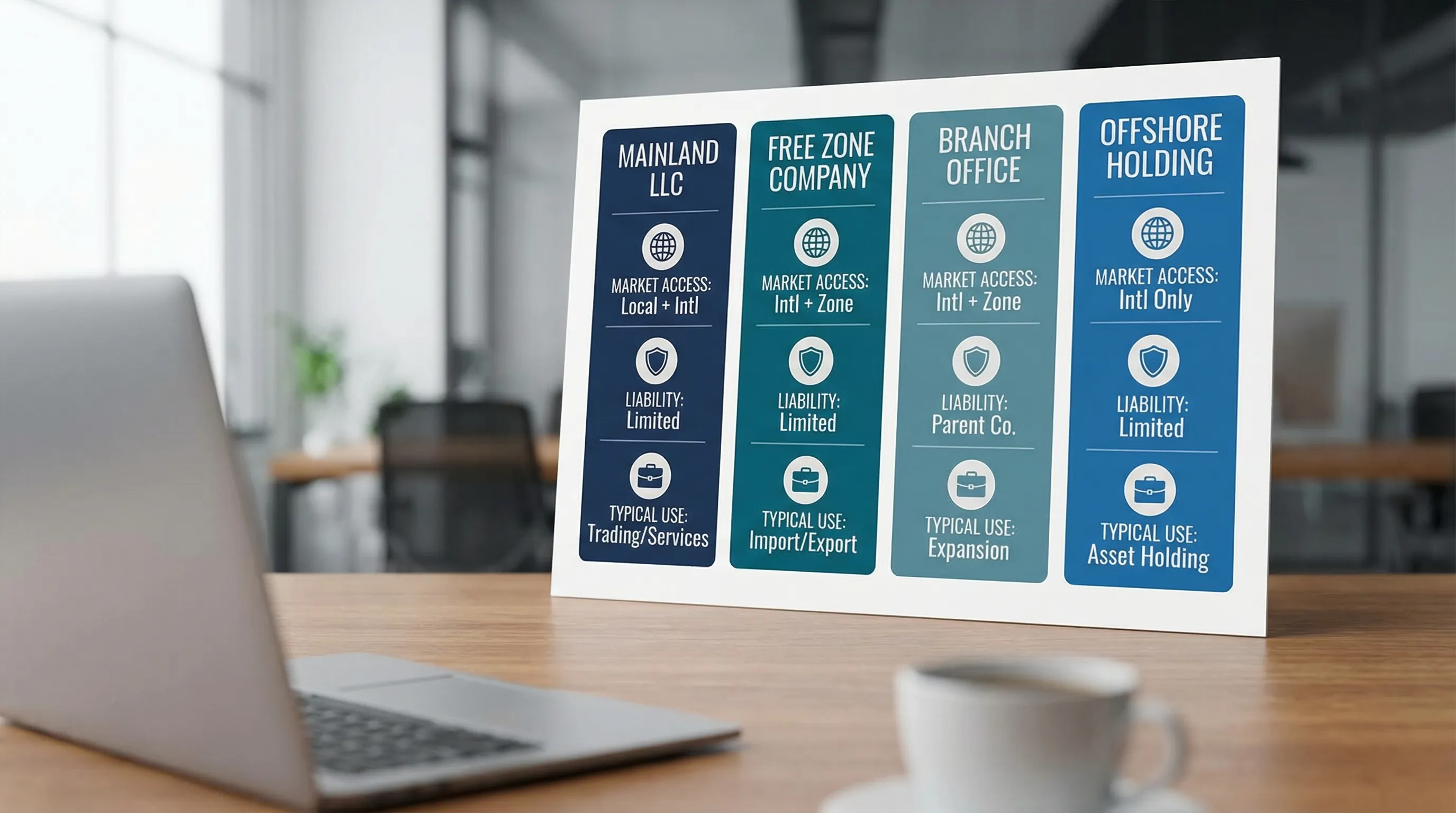
“Corporate company” vs common UAE business structures
People often use “corporate company” to mean “not a freelancer and not an individual proprietor,” but the UAE has several incorporation pathways. The best choice depends on where you will operate, your activity, your hiring plans, and your banking and investor needs.
Mainland (onshore) companies
A mainland company is licensed by the Department of Economy and Tourism (or the relevant Emirate-level authority). Mainland structures are often chosen when you want to:
- Trade directly with the UAE market without free zone constraints.
- Bid for certain tenders or work with certain counterparties that prefer mainland licensing.
- Lease office space anywhere in the Emirate (subject to rules).
Foreign ownership rules depend on the activity and regulatory approvals. Many activities now allow 100 percent foreign ownership, but it is still important to confirm requirements for your specific business activity and Emirate.
Free zone companies
A free zone company is incorporated and licensed within a specific free zone. Free zones are popular because they typically offer:
- Streamlined setup and licensing processes.
- 100 percent foreign ownership for many activities.
- Ecosystems designed for sectors such as trading, media, technology, logistics, or professional services.
Free zone entities may face constraints on doing business “on the mainland” directly, depending on the activity and the route used (for example, distributors, branch arrangements, or other permitted mechanisms).
Offshore companies (use-case specific)
Offshore companies in the UAE are usually used for holding purposes (for example, holding shares in another company) and not for operating a business with staff and physical premises in the UAE. Banking, substance expectations, and permitted activities vary by registry and by bank.
If your intent is to invoice customers in the UAE, hire employees, or lease premises, an offshore structure is often not the right match.
A quick comparison of typical “corporate company” options
| Structure (common) | Typical purpose | Can it operate in the UAE market directly? | Common governance elements | Notes |
|---|---|---|---|---|
| Mainland LLC (or similar onshore forms) | UAE trading and operations | Often yes | Shareholders, manager(s), resolutions, MOA | Requirements depend on activity and Emirate |
| Free zone company (FZ-LLC / FZE and equivalents) | Sector-focused setup, cross-border trade, services | Usually within free zone scope, mainland access depends on rules | Shareholders, directors or manager, resolutions, registrar filings | Often requires a lease package tied to the free zone |
| Branch of foreign company | Extending an existing overseas company | Often yes for approved activities | Parent company resolutions, local representative requirements may apply | Not a separate legal entity from the parent |
| Offshore company | Holding assets or shares | Typically no (operational limits) | Shareholders, directors, registered agent | Banking and compliance can be more challenging |
The right answer is rarely “pick the most popular structure.” It is “pick the structure that matches what you will actually do and what your counterparties require.”
Key characteristics that make a UAE company “corporate”
Even though “corporate company” is not a single legal label, corporate entities in the UAE tend to share a few practical characteristics.
1) Separate legal identity (and usually limited liability)
In most incorporations, the company is distinct from the individuals behind it. That affects:
- Contracting (clients sign with the company).
- Asset ownership (the company holds the lease, equipment, IP assignments, and sometimes real estate where permitted).
- Risk management (liability is generally limited to the company, subject to legal exceptions).
2) Shareholding and governance
A corporate company typically has:
- One or more shareholders.
- A manager or directors (depending on the authority and legal form).
- Documented decisions (board resolutions, shareholder resolutions).
These governance steps are not just paperwork. They are often required for banking, audits, investor diligence, visas, and major contracts.
3) Ongoing compliance responsibilities
A corporate company is expected to keep up with recurring obligations, which can include:
- License renewal and establishment card maintenance.
- Accounting and bookkeeping.
- Tax registrations and filings where applicable.
- Beneficial ownership declarations and updates when changes occur.
- Maintaining corporate documents and registers.
The exact list depends on where you incorporate (mainland vs free zone) and your activities.
Corporate tax and why “corporate” now matters more
Since the introduction of UAE federal corporate tax, founders are more careful about what “corporate” status implies.
The UAE corporate tax regime is primarily governed by Federal Decree-Law No. 47 of 2022 on the Taxation of Corporations and Businesses, with corporate tax generally applying to financial years starting on or after 1 June 2023.
A few practical takeaways:
- Most incorporated businesses should assume corporate tax compliance will be part of operating properly (even if your effective tax outcome is reduced by reliefs, exemptions, or thresholds that may apply).
- Corporate tax compliance quality depends heavily on getting the structure right from day one, because restructuring later can be costly and operationally disruptive.
This is one reason “corporate company” is more than a label. It is an operating model with reporting expectations.
Banking and “corporate company” reality in the UAE
Opening a UAE corporate bank account is often one of the most time-sensitive steps after incorporation. Banks commonly assess:
- Nature of business activity and expected transaction flows.
- Ownership and beneficial ownership details.
- Contracts, invoices, or pipeline evidence.
- Compliance posture and documentation quality.
A corporate structure that is perfectly valid on paper can still face delays in banking if documentation is incomplete or if the activity and flows are unclear.
Common misconceptions about corporate companies in the UAE
“Corporate company means I must be a large enterprise”
Not true. Many SMEs, startups, and single-founder consultancies operate through corporate entities because it is cleaner for contracting and liability.
“Free zone equals corporate, mainland equals complicated”
Sometimes a free zone is simpler, sometimes it creates constraints depending on where your customers are and what your activity requires. “Corporate” is about the legal form and governance, not about a particular jurisdiction.
“Once incorporated, compliance is minimal”
In the UAE, ongoing obligations can be very manageable, but they are not optional. Treat compliance as part of the cost of reliability, especially if you plan to scale, raise funds, or work with regulated counterparties.
How to choose the right corporate company structure in the UAE
Rather than starting with “mainland or free zone,” start with decision drivers:
Your activity and where revenue happens
If your revenue is mainly from UAE mainland customers, you need a structure and licensing approach that supports that reality. If your revenue is cross-border or within a free zone ecosystem, a free zone can be an efficient match.
Your hiring and visa needs
If you will sponsor employees, you will want clarity on:
- Visa eligibility linked to your license and office or flexi-desk arrangements.
- Ongoing immigration compliance.
Your contracting and risk profile
Some counterparties (especially enterprise clients) expect:
- Clear corporate governance.
- Proper signatory powers.
- Evidence of compliance (sometimes audited statements, depending on the free zone or the contract).
Your long-term plan (investment, exit, holding structure)
If you plan to raise capital, issue shares, or build a group structure (operating company plus holding company), it is worth designing the corporate structure upfront.
Where Alldren fits (and how to avoid costly structure mistakes)
A “corporate company” setup is not only about getting a license issued. The real work is engineering a structure that stays robust when you start signing contracts, onboarding employees, and meeting tax and governance expectations.
Alldren provides expert-led, transparent corporate services for establishing and managing UAE companies, including structuring, compliance support, governance, bank account opening support, visas, and bookkeeping and tax registration. If you want the setup done with long-term operations in mind, you can start by discussing your use case with a senior expert at Alldren.
Frequently Asked Questions
What does “corporate company” mean in the UAE? It usually means a formally incorporated legal entity (mainland or free zone, and sometimes offshore) with its own legal identity, governance, and ongoing compliance obligations.
Is an LLC considered a corporate company in the UAE? Yes. A UAE LLC is a common example of a corporate entity because it generally has separate legal personality and structured governance.
Is a free zone company a corporate company? Yes. A free zone company is typically an incorporated entity registered with a free zone authority and treated as a corporate vehicle for contracting, hiring, and operations (within its permitted scope).
Can a corporate company in the UAE be 100 percent foreign-owned? Often yes, depending on whether you incorporate in a free zone or choose a mainland activity that allows full foreign ownership. The exact rules depend on the Emirate and the licensed activity.
Do corporate companies in the UAE need to register for corporate tax? Many businesses will need corporate tax registration and compliance based on the corporate tax law and guidance, even if their tax payable is reduced by reliefs or thresholds. Your facts (activity, revenue, group structure) matter.
What is the biggest setup mistake when forming a corporate company in the UAE? Picking a jurisdiction or license based on speed or marketing claims rather than your real operating needs (where customers are, how you invoice, hiring plans, banking, and compliance).
Want a corporate structure that works in practice, not just on paper?
If you are deciding between mainland and free zone options, or you need a corporate setup that supports banking, visas, and long-term compliance, Alldren can help you structure and manage your UAE company with transparent, expert-led support. Explore your options at Alldren.


