
A RAK ICC company is often selected because it is flexible, efficient, and well suited to holding companies, special purpose vehicles, asset planning, and cross-border ownership structures. That flexibility is valuable, but it also creates a common mistake: treating governance as something to tidy up later.
For a low-transaction holding company, weak governance may not cause immediate friction. The company can be incorporated, shares can be issued, and assets can be transferred. The problem usually appears later, when a bank, buyer, lender, court, tax adviser, family member, or regulator asks a simple question: who had authority, what was approved, and where is the evidence?
Strong governance early is not bureaucracy. It is the operating system that makes the structure credible.
Governance is part of the structure, not an afterthought
In a RAK ICC context, governance means the rules, records, and decision-making processes that show how the company is controlled. It covers directors, shareholders, beneficial owners, reserved matters, signing authority, conflicts of interest, record keeping, accounting, and approvals for material transactions.
That matters because many RAK ICC companies are not used like ordinary trading businesses. They may hold shares, intellectual property, real estate interests, investment assets, or act as an SPV for a specific transaction. In those scenarios, there may be few invoices, few employees, and limited day-to-day activity. As a result, the corporate record becomes the main evidence that the company is real, properly controlled, and separate from the individual or group behind it.
A company that holds valuable assets but has thin governance can look efficient at first. Over time, it can become difficult to defend, difficult to bank, and difficult to exit.
The first governance decisions shape the company’s risk profile
Early decisions are harder to correct than they appear. The first shareholder structure, board composition, articles, powers of attorney, signatory rules, and transaction approvals create the foundation for every later event.
For example, a RAK ICC company used as a passive holding vehicle needs different governance from a transaction SPV with co-investors. A family asset vehicle needs different controls from a single-founder IP holding company. A company that may later open a bank account, receive dividends, sell an asset, or sit under a foundation needs a record that anticipates those steps.
If the purpose is not clear at the beginning, the governance documents often become generic. Generic documents can be acceptable for incorporation, but they may not answer the questions that matter when the structure is tested.
| Early governance question | Why it matters later |
|---|---|
| What is the company’s purpose? | Helps align the structure with banking, tax, asset ownership, and exit requirements. |
| Who controls the company? | Supports beneficial ownership, signing authority, and counterparty due diligence. |
| Which decisions require board or shareholder approval? | Reduces disputes and strengthens transaction evidence. |
| How are related-party transactions documented? | Helps avoid commingling and supports tax and asset protection analysis. |
| Where are records maintained? | Makes compliance, bank reviews, and future due diligence faster and more credible. |
For a deeper look at how these vehicles are commonly used, Alldren’s guide to a RAK ICC company for holding, SPV, and asset planning structures explains the practical differences between those use cases.
Banks and counterparties do not rely on the certificate alone
A certificate of incorporation proves that the company exists. It does not prove that the company is well governed.
When a RAK ICC company approaches a bank, enters into a purchase agreement, receives investment proceeds, or transfers assets, counterparties usually need more. They may ask for the ownership chain, ultimate beneficial owner information, source of funds, source of wealth, board resolutions, director authority, constitutional documents, and explanations of the company’s purpose.
This is not just local preference. Globally, financial institutions are expected to understand beneficial ownership and control. The Financial Action Task Force has made beneficial ownership transparency a central part of anti-money laundering standards, and banks have responded with more detailed onboarding and periodic review processes.
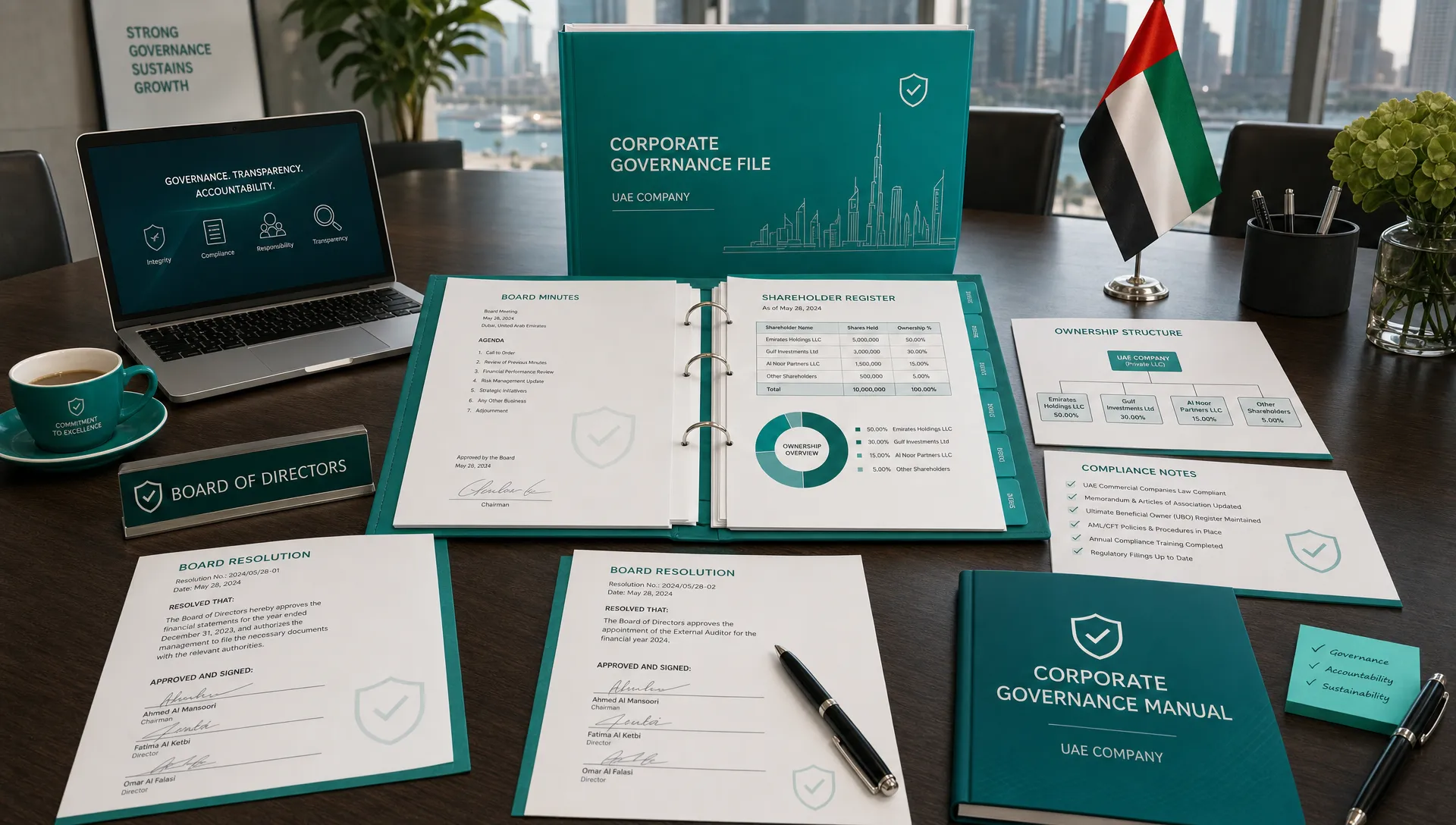
A well-governed RAK ICC company should be able to produce a coherent corporate file without reconstructing history under pressure. That file usually includes:
- Incorporation documents, constitutional documents, and registered agent records.
- Current registers of shareholders, directors, officers, and beneficial owners.
- First board resolutions and resolutions for each material transaction.
- Evidence of director appointment, authority, and acceptance.
- Contracts, asset transfer documents, loan agreements, and related-party approvals.
- Accounting records, tax assessment notes, and compliance correspondence.
The point is not to collect documents for their own sake. The point is to make the company understandable to third parties. If a bank officer or external counsel can follow the story from incorporation to transaction, risk decreases.
Directors need authority before the transaction starts
Director governance is one of the areas most often neglected in early-stage RAK ICC structures. A director may be appointed simply to satisfy formation requirements, while real decision making happens informally through the founder, family principal, adviser, or investor group.
That can create a mismatch between legal authority and practical control.
Good governance closes that gap. It clarifies who can bind the company, which matters must be approved by the board, when shareholder approval is required, and how conflicts are handled. It also creates a record that directors considered the relevant information before approving a transaction.
This is especially important where nominee directors, professional directors, or multiple stakeholders are involved. The director’s role should not be treated as a signature function. The company should have a documented mandate, clear reporting lines, and an approval process that reflects the real risk of the structure.
The same logic applies when selecting professional partners. A weak registered agent or purely administrative provider may complete incorporation, but governance quality depends on record discipline, responsiveness, and understanding of the company’s purpose. Alldren’s framework for selecting a RAK ICC registered agent is useful for advisers and clients who want to assess that operational risk early.
Tax and compliance issues are harder to retrofit
The UAE business environment has become more compliance-driven. Corporate tax, economic substance analysis, accounting records, anti-money laundering expectations, and beneficial ownership transparency all make governance more important than it was in a lighter-touch era.
The UAE corporate tax regime applies for financial years starting on or after June 1, 2023. The UAE Ministry of Finance provides official guidance on the regime, but each entity still needs its own assessment. A RAK ICC company should not assume that “offshore” means no tax analysis, no records, or no filings. Its position depends on its legal form, activities, income, management, ownership, and any applicable exemptions or reliefs.
Early governance supports that analysis. Board minutes can show where decisions were made. Accounting records can show the nature of income. Agreements can distinguish capital contributions, loans, service fees, dividends, and reimbursements. Related-party documentation can help explain why money moved between connected persons.
Trying to create these records years later is risky. Documents prepared after the fact may not carry the same evidentiary weight, and memory fades. Worse, retroactive cleanup can reveal that decisions were made without the approvals required by the company’s own documents.
Asset protection depends on separation, not just incorporation
Many clients form a RAK ICC company to separate assets from personal ownership, organize family wealth, hold investment assets, or create a more efficient acquisition and exit structure. Incorporation is only the first layer of that separation.
If the company is treated as an extension of the individual, the separation becomes weaker. Common problems include personal expenses paid from company accounts, undocumented shareholder loans, assets transferred without resolutions, informal promises to family members, and contracts signed by the wrong person.
Strong governance helps preserve separation by making every major action traceable. The company should have its own bank account where appropriate, its own records, its own approvals, and its own commercial rationale. If funds move between the shareholder and the company, the movement should be documented as capital, debt, distribution, or payment under a contract.
This is not only about litigation risk. It is also about credibility. Buyers, banks, trustees, executors, and tax authorities are more comfortable with a structure that behaves like a company rather than a personal wallet.
Strong governance makes exits easier
A RAK ICC company is often formed with a future event in mind: selling an asset, transferring shares, admitting investors, distributing wealth, restructuring ownership, or moving the company into a broader family office framework.
Those future events become more expensive when the record is incomplete.
In a sale process, legal due diligence may ask for board approvals, shareholder approvals, ownership history, registers, contracts, and evidence that the company had authority to acquire and hold the relevant asset. In a financing process, a lender may ask for constitutional documents, director resolutions, UBO evidence, and confirmation that no restrictions prevent the transaction. In a family succession process, heirs and advisers may need to understand control rights, economic rights, and transfer procedures.
The cleaner the governance record, the easier it is to move. Poor governance can slow a transaction, reduce buyer confidence, increase legal fees, or require warranties and indemnities that could have been avoided.
This is why governance should be designed for the end state, not only the incorporation date.
What strong early governance looks like in practice
Strong governance does not mean overcomplicating a simple company. It means matching controls to the purpose and risk of the structure.
| Stage | Practical governance actions |
|---|---|
| Before incorporation | Define the purpose, ownership chain, control rights, director role, banking needs, and tax assumptions. |
| At incorporation | Put constitutional documents, registers, first resolutions, director appointments, and UBO records in order. |
| First 90 days | Prepare bank and counterparty due diligence files, approve initial transactions, and assign compliance responsibility. |
| Ongoing operation | Maintain minutes, accounting records, annual reviews, register updates, and evidence for material decisions. |
| Before major events | Review authority, approvals, tax treatment, transfer restrictions, and due diligence readiness before signing. |
The best governance systems are simple enough to be used and disciplined enough to be trusted. A dormant holding company may need a lighter board calendar than a multi-investor SPV, but it still needs clear records. A single-shareholder company may not need complex veto rights, but it still needs resolutions for asset acquisitions, loans, distributions, and changes in control.
Common early mistakes to avoid
The most damaging RAK ICC governance mistakes are usually not dramatic. They are small gaps that accumulate until a third party reviews the company.
| Mistake | Typical consequence |
|---|---|
| Incorporating before defining the use case | The company may have unsuitable articles, directors, ownership rights, or banking assumptions. |
| Using informal approvals | Later due diligence may not show who approved a transaction or whether they had authority. |
| Mixing personal and company funds | Asset protection, accounting, and tax analysis become harder to defend. |
| Ignoring beneficial ownership records | Bank onboarding and compliance reviews become slower and more intrusive. |
| Treating tax as a year-end issue | The company may miss registration, record keeping, or structuring decisions that should have been made earlier. |
| Choosing providers only on speed or price | The structure may be incorporated quickly but lack the compliance support needed later. |
These mistakes are avoidable if governance is built into the setup process rather than attached after incorporation.
Governance should match the limits of the RAK ICC vehicle
A RAK ICC company can be powerful, but it is not the right vehicle for every activity. It is often well suited to holding, SPV, and asset planning roles, but businesses that need UAE operational substance, staff, visas, office space, local invoicing, or regulated activity may need a free zone, mainland, or other structure instead.
This distinction matters for governance because the wrong vehicle creates the wrong records. A company set up as a passive holding entity should not slowly drift into operational activity without a review. If the business model changes, the governance model should change too.
Alldren’s article on the best uses and limits of a RAK ICC offshore company explains where the structure fits and where another UAE vehicle may be more appropriate.
Frequently Asked Questions
Does a RAK ICC company need board minutes if it is only a holding company? Yes. A passive holding company may have fewer decisions, but the decisions it does make are usually important. Asset acquisitions, disposals, loans, distributions, director changes, and bank account approvals should be documented.
Can governance be fixed after incorporation? Some gaps can be corrected, but it is usually better and more credible to document decisions when they happen. Retroactive cleanup may not solve evidentiary, tax, banking, or dispute issues.
Is strong governance only necessary for large structures? No. Even a simple single-shareholder RAK ICC company benefits from clear authority, registers, resolutions, and accounting records. The level of detail should match the risk and value of the assets involved.
How does governance affect bank account opening? Banks want to understand ownership, control, purpose, source of funds, and transaction rationale. A complete governance file makes that review easier and can reduce avoidable delays.
Does RAK ICC governance replace tax advice? No. Governance supports tax analysis, but it does not replace UAE or foreign tax advice. The company should be reviewed based on its activities, income, management, ownership, and relevant jurisdictions.
Build the governance before the pressure arrives
A RAK ICC company is strongest when governance is designed at the same time as the structure. That means defining the purpose, documenting control, keeping accurate records, and preparing for the questions that banks, advisers, buyers, and authorities will ask later.
Alldren supports UAE company setup, structuring, compliance management, governance, bank account opening support, residency processing, bookkeeping, tax registration, and related corporate services with transparent, expert-led guidance. If you are planning a RAK ICC company or reviewing an existing one, start with the governance layer before it becomes urgent.
To discuss a structure with senior experts, visit Alldren and build your UAE company on a cleaner foundation from day one.