
A practical UAE invoice approval process should answer four questions before money leaves the business: is the supplier legitimate, is the charge correct, has the right person authorized it and can finance support the accounting treatment? Growing teams often answer these questions through scattered emails and messages. That works until an invoice gets paid twice, a bank detail changes unnoticed or nobody can explain who approved an unexpected expense.
The solution is not to make every payment a founder decision. It is to create a repeatable workflow with clear ownership, proportionate checks and a record that survives staff changes.
Separate invoice approval from payment authorization
Approving an invoice and releasing a bank payment are different decisions. Invoice approval confirms that the business accepts the charge. Payment authorization confirms that a particular transfer may be executed through the bank.
Keep three controls distinct:
| Control | Question it answers | Typical owner |
|---|---|---|
| Commercial approval | Did we order this and receive what the contract requires? | Budget owner or department lead |
| Finance review | Is the invoice accurate, properly supported and correctly treated for tax? | Finance or bookkeeping function |
| Payment authorization | May this payment leave the account under our bank mandate? | Authorized bank signatory |
One person may perform more than one role in a small company, but that does not remove the need for an independent check. Someone who requested an expense should not be its only approver.
An internal approval also does not override the bank mandate. Align the workflow with your UAE business bank account signing limits, while keeping the commercial review separate from the bank’s release requirements.
Assign owners before choosing software
A shared inbox, an invoice register and a controlled document folder can support a small team. Software becomes useful when transaction volume, multiple entities or complex routing make those tools difficult to manage.
Start by naming an owner for each stage. Finance records the invoice and checks the documentation. The budget owner confirms the commercial basis. An approver with sufficient delegated authority authorizes the expense. A bank signatory releases the payment.
Also name a backup for each role. An absent manager should not create an informal shortcut through someone else’s login or a retrospective approval after payment.
For a lean team, an independent director or senior manager can review higher-risk transactions and check the payment batch against supporting invoices. Outsourcing bookkeeping does not transfer management’s responsibility for approving expenditure. Your service provider needs a named internal decision-maker, not permission to infer approval from silence.
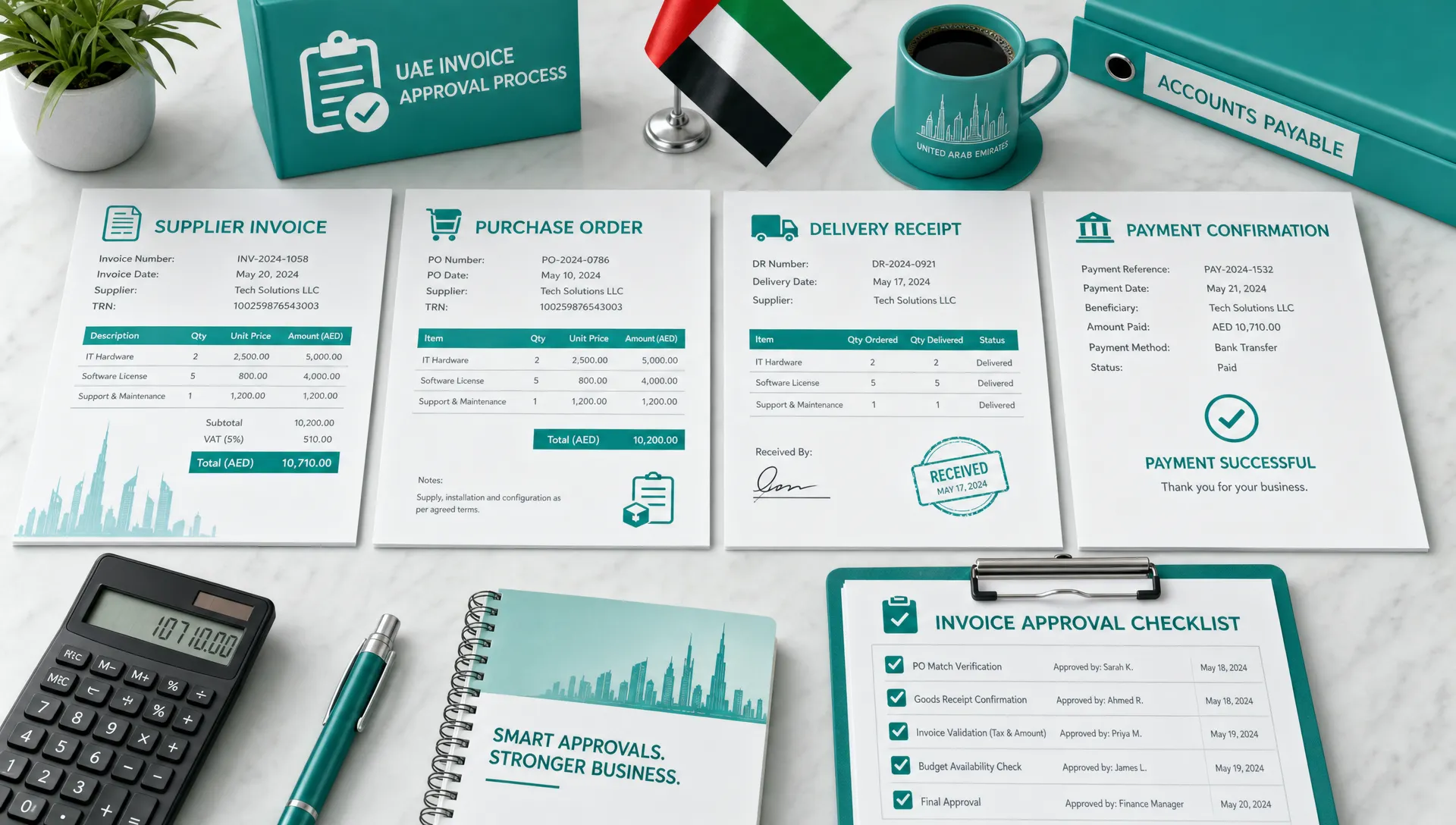
A UAE invoice approval process in six steps
1. Capture every invoice in one place
Ask suppliers to send invoices to a designated accounts payable address or intake channel. Employees who receive an invoice directly should forward it there rather than starting a separate approval conversation.
Record the supplier, invoice number, invoice date, receipt date, currency, amount, purchasing entity and contractual due date. Give each invoice a unique internal reference and a visible status, such as received, under review, awaiting approval, approved, scheduled or paid.
The receipt date helps measure processing time, but it does not automatically reset contractual payment terms. If a supplier agreement calculates the due date from another event, use that agreement.
Check for duplicates before routing. Compare the supplier and invoice number, then inspect matching amounts, dates and attachments. A renamed PDF or slightly altered invoice number can otherwise bypass a basic duplicate check.
2. Confirm the supplier and beneficiary
For a new supplier, check that the contracting party, invoice issuer and payment beneficiary are consistent. Obtain appropriate identity or registration evidence for the supplier type and jurisdiction. An individual freelancer will not necessarily have the same documents as a UAE company or an overseas corporate supplier.
Where UAE VAT is charged, verify the supplier’s Tax Registration Number (TRN) through the Federal Tax Authority’s verification service and compare it with the invoice details.
Treat bank details as controlled supplier data. A change should not be accepted solely because it appears on a new invoice or arrives in an email thread.
Verify changes through a trusted contact using contact details already held on file. Record who performed the check and how. A different beneficiary name may have a legitimate explanation, but finance should resolve and document it before payment.
3. Match the charge to the purchase and delivery
For goods, compare the invoice with the purchase order and goods receipt. For services, compare it with the signed engagement, agreed scope and evidence that the relevant milestone or billing condition has been met.
This is not always a three-way match. Rent, subscriptions, retainers and advance payments need checks suited to their contracts. A properly agreed advance payment should not be rejected because delivery has not yet occurred.
The budget owner should confirm the price, quantity, service period, entity being charged and any agreed variations. “Approved” is weak evidence if it does not identify what was reviewed.
When no purchase order exists, require a written explanation and supporting commercial approval. Repeated missing purchase orders are a purchasing-process problem, not a reason to invent reference numbers after the event.
4. Check the invoice and tax treatment
Finance should verify calculations, currency, discounts, credit notes and the total payable. For UAE VAT, distinguish between a standard tax invoice and a simplified tax invoice, since the required particulars differ and simplified invoices are only permitted in specified circumstances.
Depending on the invoice type, relevant details include the supplier’s name, address and TRN, invoice number and date, description of the supply, taxable value and VAT amount. A standard tax invoice also requires recipient details, including the recipient’s TRN where applicable. Use the Federal Tax Authority’s VAT guidance and current legislation to establish the applicable requirements.
An approved invoice does not automatically qualify for input VAT recovery or a corporate tax deduction. Finance must assess the transaction, supporting evidence and relevant tax rules separately.
Foreign-currency invoices may require AED tax information and an appropriate exchange rate. Overseas purchases may raise reverse-charge questions. Free zone status alone does not establish that a supply is outside UAE VAT.
Do not add VAT internally to compensate for a supplier’s defective invoice. Obtain a correction or appropriate tax advice.
5. Route it to the right approver
Use a written delegation-of-authority policy that identifies approval limits, permitted delegates and escalation rules. Route invoices according to value and risk, rather than whichever manager responds first.
Choose a consistent basis for thresholds. For example, the policy can use the gross invoice amount, including VAT, with foreign-currency amounts converted under a documented internal method. That internal conversion policy is separate from any legally required tax conversion.
Aggregate related purchases when testing authority limits. Splitting a single commitment across several invoices should not allow it to bypass a higher approval level.
The approver should be able to see the invoice, commercial support, coding and any unresolved exception. A chat message saying “go ahead” is inadequate if it cannot be linked reliably to the specific transaction.
6. Schedule payment and close the record
Once approved, place the invoice in a payment run based on its due date and agreed terms. Before release, reconcile the payment batch to approved invoices and the verified supplier bank details.
If an invoice changes after approval, assess whether it needs to return through the workflow. Changes to the amount, beneficiary or commercial basis should not slip into the payment batch unnoticed.
After payment, record the payment date, bank reference and amount settled. Allocate partial payments and credits correctly so the register does not show a fully paid invoice when a balance remains.
Keep the bank confirmation linked to the invoice record. This makes supplier queries, reconciliation and later reviews easier than searching separate inboxes for proof of payment.
Set approval thresholds that match your business
There is no single approval matrix suitable for every UAE company. Transaction size, cash flow, staffing and the company’s governing documents all affect the design.
The following is an illustrative internal policy, not a UAE legal requirement:
| Gross invoice value | Commercial approval | Finance and payment controls |
|---|---|---|
| Up to AED 5,000 | Budget owner, independent of the requester | Finance review followed by release under the bank mandate |
| AED 5,001 to AED 25,000 | Department head within delegated authority | Finance review followed by release under the bank mandate |
| Above AED 25,000 | Department head plus CFO, managing director or another authorized senior approver | Finance review followed by release under the bank mandate |
| Any value with a material exception | Escalation to an independent authorized decision-maker | Resolve or formally authorize the exception before release |
If the named approver requested the expenditure, route it to an alternative with sufficient authority. Add specific controls for related-party transactions, unbudgeted spending and unusual advance payments.
Invoice limits should also connect to purchasing authority. Approving a modest monthly invoice is not the same as authorizing a large annual contract. Review the total commitment when the contract is signed, then confirm subsequent invoices remain within it.
Handle exceptions without creating a second process
An exception route should resolve a problem, not provide a permanent escape from normal controls.
For a disputed amount, record the disputed element and assign someone to contact the supplier. Paying an undisputed portion may be appropriate where the contract and circumstances allow it. Avoid withholding an entire payment without considering contractual obligations.
For a missing or incorrect tax invoice, distinguish payment approval from VAT recovery. The commercial liability may still exist even if the tax documentation needs correction. Finance should document the treatment and follow up rather than assuming either that payment must stop or that VAT can be claimed.
For an urgent payment, require a recorded reason, an authorized exception decision and the essential supplier and beneficiary checks before release. Urgency is not a reason to skip bank-detail verification.
Track repeated exceptions by supplier and department. Frequent urgent requests, missing contracts or retrospective approvals usually reveal an upstream purchasing issue that needs a named owner.
Keep an audit trail that supports UAE obligations
The record should explain the transaction from beginning to end: who requested it, what supported it, who reviewed it, who approved it and how it was paid. Preserve timestamps and the final document version, not just the latest status in a spreadsheet.
Keep the invoice, purchase support, delivery or milestone evidence, approval record, exception decisions and payment confirmation together. Restrict access to supplier bank data and limit who can amend approved records.
Under UAE corporate tax rules, relevant records and documents generally must be retained for at least seven years after the end of the tax period to which they relate. See the Federal Tax Authority’s corporate tax information for the applicable framework.
VAT has separate retention requirements, generally at least five years, with longer periods or extensions applying in certain circumstances. Set a retention schedule that satisfies every applicable obligation rather than applying the shortest period to all files.
Payment records are only one part of the wider compliance checklist for a UAE company.
Introduce the workflow without slowing the team
Document the process in a short policy and test it on a limited batch of invoices. Include routine purchases, a foreign supplier invoice, an advance payment and a bank-detail change so the test covers more than straightforward bills.
Before rollout, explain what approvers are confirming and how they should reject or query an invoice. Set internal review targets that leave enough time to meet contractual due dates. A reminder and backup approver are more useful than escalating every delay to the founder.
Review a few operational measures monthly: time from receipt to approval, overdue invoices, unresolved exceptions and duplicates caught before payment. Treat these as process indicators, not targets that reward paying quickly without proper checks.
Revisit the policy when the business adds an entity, changes bank signatories, hires new department leads or materially increases spending. Also check current UAE electronic invoicing requirements and implementation guidance when designing invoice capture, since a PDF-only approach may not meet requirements applicable to your business.
Frequently asked questions
Does UAE law prescribe one invoice approval workflow for every company? No universal operational workflow applies to every business. Your process should reflect applicable tax and recordkeeping rules, governing documents, contractual obligations and bank mandates. Regulated businesses may have additional requirements.
Can the founder approve every invoice? A founder can approve expenditure within their authority, but this often becomes a bottleneck. Delegating routine approvals while retaining independent finance checks and escalation for higher-risk transactions is more scalable.
Can we approve invoices by email? Yes, provided the approval identifies the invoice, comes from an authorized person and is preserved with the supporting record. Avoid approvals that depend on an incomplete thread or an attachment that later changes.
Does a VAT error mean the supplier cannot be paid? Not automatically. Payment liability and input VAT recovery are separate questions. Resolve the documentation issue, assess the contractual obligation and record the tax treatment before proceeding.
Should offshore, free zone and mainland companies use different processes? The core controls are similar. Adapt the workflow to the entity’s activities, applicable tax position, governing documents and banking arrangements rather than assuming its location determines the treatment of every invoice.
Build the controls around your actual structure
Alldren provides corporate governance, bookkeeping and ongoing compliance support for UAE businesses. If invoice approvals depend on informal founder decisions, discuss your company’s operating structure with Alldren to align responsibilities, financial records and governance requirements before transaction volume makes the gaps harder to manage.