
A RAK ICC company is not the right structure for every UAE plan. In 2026, its best role is as a corporate structuring tool: legal ownership, asset separation, and international administration, rather than a vehicle for hiring employees, leasing offices, or trading locally in the UAE.
That distinction matters more than it did a few years ago. Banks, tax authorities, registries, and counterparties now expect a clear explanation of who owns the company, what it holds, where value is created, and why the structure exists. Used correctly, a RAK ICC company can be efficient, flexible, and credible. Used for the wrong purpose, it can create banking friction, tax uncertainty, and operational limits.
Quick answer: the best uses for a RAK ICC company in 2026
A RAK ICC company is usually strongest when it is designed for holding, investment, or special purpose functions. If the main goal is active operations in the UAE, a RAKEZ free zone company, mainland LLC, or other licensed vehicle may be more appropriate. If you are still comparing RAK ICC with RAKEZ free zone and mainland options, Alldren’s RAK license guide for new companies in 2026 explains the core licensing differences.
| Best use | Why RAK ICC can work well | 2026 watchpoint |
|---|---|---|
| Holding company | Clean ownership of shares, subsidiaries, or investment assets | Tax treatment and beneficial ownership records must be reviewed |
| Investment SPV | Ring-fences a specific deal, acquisition, or joint venture | Investor rights and authority should be documented early |
| Asset planning | Consolidates ownership and simplifies transfer planning | Succession documents must align with the company structure |
| Real estate holding | May hold permitted property interests subject to local rules | Land department, developer, lender, and bank acceptance must be checked |
| IP holding | Centralizes ownership of trademarks, software, or other IP | Transfer pricing and substance need careful analysis |
| Proprietary investment | Can hold a group or family portfolio outside active client business | Source of funds, brokerage acceptance, and tax reporting matter |
| Redomiciliation planning | Can help move an existing offshore structure into a UAE registry | Continuation rules, due diligence, and document history are critical |
What a RAK ICC company actually is
RAK ICC stands for Ras Al Khaimah International Corporate Centre. It is a corporate registry in Ras Al Khaimah for international business companies, commonly described as an offshore company UAE structure. It is separate from a UAE free zone operating license, such as a RAKEZ license.
The official RAK ICC registry provides the legal framework for these companies, but the practical point is simple: a RAK ICC company is usually used to own, hold, invest, or structure. It is not, by itself, a local UAE trading license. It does not automatically give you staff visas, office space, or the right to conduct licensed commercial activity inside the UAE.
That is why the best RAK ICC structures start with a purpose statement. Before incorporation, founders, family offices, and advisers should be able to answer three questions: What will the company own? Who controls decisions? Which obligations will the company have after setup?
Use case 1: holding shares in subsidiaries and joint ventures
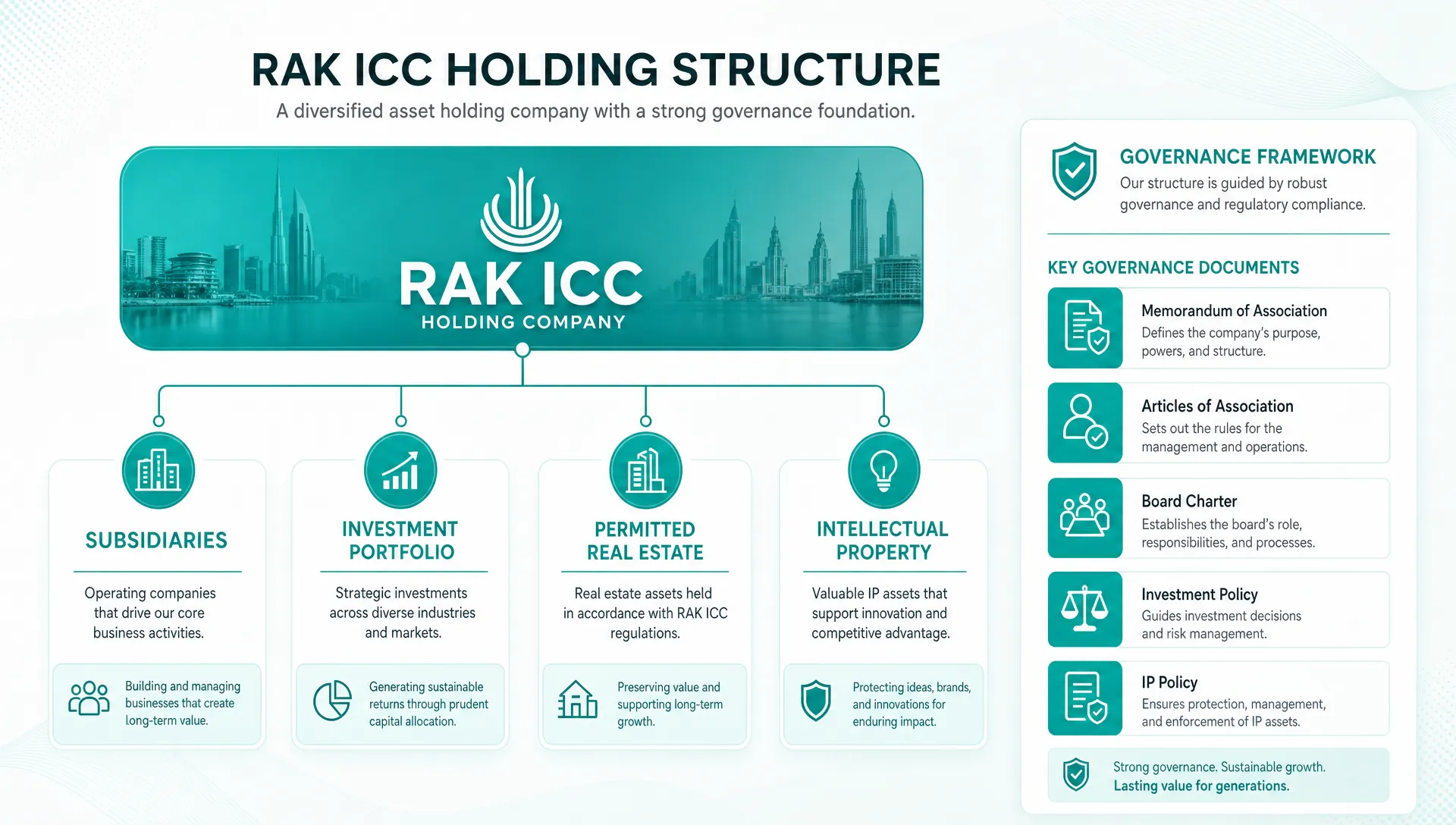
The classic RAK ICC use case is a holding company. It can sit above operating subsidiaries, foreign companies, or joint venture interests, creating a clear ownership layer between the ultimate owners and the underlying business assets.
This is particularly useful for international groups that want a UAE-based corporate holding structure without creating a new UAE operating business. A RAK ICC holding company can help separate ownership from operations, make cap table management cleaner, and provide a single entity through which dividends, sale proceeds, or shareholder decisions are handled.
In 2026, the holding use case should be designed with tax and reporting in mind from day one. The UAE Corporate Tax regime, transfer pricing rules, and foreign tax rules can all affect the outcome. A RAK ICC company should never be treated as automatically tax-neutral simply because it is offshore. The structure needs a commercial rationale, updated records, and appropriate UAE tax advisory where needed.
Use case 2: investment SPV for a defined deal
A RAK ICC company can also be used as a special purpose vehicle, or SPV, for a particular investment, acquisition, financing arrangement, or joint venture. The appeal is focus. Instead of placing multiple assets and obligations in one entity, the SPV holds one deal or one asset class.
This can be helpful when investors want clear boundaries around risk, economics, and exit rights. For example, an SPV may hold shares in a target company, participate in an acquisition, or act as a joint venture vehicle for a cross-border project. The board, shareholder approvals, and reserved matters can be tailored to that specific purpose.
The biggest mistake is treating an SPV as a blank shell with no governance. Even if the company has no employees, it still needs records, resolutions, registers, and a clear authority framework. Alldren has written separately about why a RAK ICC company needs strong governance from the start, and that point is especially important for SPVs with multiple stakeholders.
Use case 3: asset planning and family ownership structures
For private clients and family groups, a RAK ICC company can be useful where assets need to be consolidated under a corporate owner. This may include shares in private companies, investment accounts, certain real estate interests, or other long-term assets.
The benefit is administrative clarity. Rather than transferring each underlying asset directly between individuals, ownership can be organized through company shares, shareholder arrangements, and board-approved decisions. This can make succession planning, family governance, and asset segregation easier to manage.
However, a company is not a succession plan by itself. Wills, foundation structures, shareholder agreements, matrimonial considerations, and tax residence issues may all need to be coordinated. For higher-value structures, legal and tax advice in every relevant jurisdiction is essential.
Use case 4: proprietary investment and portfolio holding
A RAK ICC company may be appropriate for holding a proprietary investment portfolio, especially for entrepreneurs, family offices, or groups that want a dedicated vehicle for non-client assets. The company may hold listed securities, private investments, fund interests, or other financial assets, subject to acceptance by banks, brokers, and relevant counterparties.
The key word is proprietary. A RAK ICC company should not be used to conduct regulated financial services, manage third-party money, or present itself as a licensed investment business unless the required regulatory permissions are in place. Holding a family or group portfolio is very different from operating a fund, advisory firm, exchange, broker, or asset manager.
Crypto requires similar caution. A RAK ICC company may be considered for passive or proprietary holding in some circumstances, but operational Web3 businesses, token issuance, custody, exchange activity, or services to clients may require a licensed framework and specialist advice. In 2026, regulators and banks draw a sharper line between holding an asset and running a regulated business.
Use case 5: real estate holding, where rules allow it
Real estate is another common reason clients ask about RAK ICC companies. A corporate vehicle can make ownership administration easier, especially where multiple family members or investors are involved. It can also create separation between personal assets and investment assets.
The practical answer depends on the asset. A RAK ICC company may be able to hold certain property interests where the relevant land department, master developer, community rules, lender, and bank accept the structure. This must be checked before incorporation or acquisition, not after.
For UAE property, do not assume that every emirate, every building, or every developer will accept the same corporate owner. For international property, local law in the country where the property is located will matter. Stamp duty, withholding tax, inheritance law, capital gains tax, and beneficial ownership filings may all affect whether a RAK ICC company is efficient.
Use case 6: IP holding and royalty arrangements
A RAK ICC company can be considered for holding intellectual property, such as trademarks, software, domain portfolios, licensing rights, or other intangible assets. This can be useful when a group wants one entity to own the IP while operating companies use it under license.
The risk is that IP structures are heavily scrutinized. Tax authorities often look at where the IP was developed, who funds development, who controls risk, and who performs the key value-creating functions. A company that merely holds a registration but has no real control, documentation, or pricing logic may create more risk than benefit.
A well-designed IP holding structure should have clear assignment documents, license agreements, board approvals, valuation support, and transfer pricing analysis where related parties are involved. In other words, the RAK ICC company can be the owner, but the structure still needs a defensible business story.
Use case 7: redomiciliation and continuity planning
Some groups use RAK ICC for redomiciliation or continuation planning. This can be relevant where an existing offshore company in another jurisdiction is no longer suitable, or where owners want to align a structure with a UAE base, UAE advisers, or a broader Gulf strategy.
The attraction is continuity. In suitable cases, a company may be able to continue into a new registry without a full asset transfer, subject to the rules of both jurisdictions and approval by the registry. This can be more efficient than liquidating one company and setting up another.
The due diligence burden should not be underestimated. Registry history, good standing certificates, constitutional documents, shareholder approvals, sanctions checks, tax filings, and bank expectations all need to be reviewed. A continuation should be treated as a corporate migration project, not a simple form submission.
Where a RAK ICC company is usually not the best choice
The most common RAK ICC problems arise when the structure is used as a substitute for a license it does not provide. If you need a trading presence, employees, visas, local invoices, regulated activity, or a retail customer-facing business in the UAE, you are probably looking at a different structure.
| Business need | Why RAK ICC may not fit | Better direction to consider |
|---|---|---|
| UAE office, staff, and visas | RAK ICC does not provide an operating license or visa allocation by itself | RAKEZ free zone or mainland company setup UAE |
| Local UAE trading | Offshore companies are not designed for unrestricted UAE market activity | Mainland or free zone license based on activity |
| Regulated financial services | Licensing and regulatory permissions are separate from incorporation | Specialist regulated entity or licensed free zone |
| Client asset management | Holding proprietary assets is different from managing third-party assets | Regulated fund, manager, or advisory structure |
| Banking-led setup with no business rationale | Banks need source of funds, activity, ownership, and purpose | Build substance and documentation before account opening |
For some clients, the right answer is a two-layer structure: a RAK ICC holding company above a RAKEZ or other operating subsidiary. This can preserve a clean ownership layer while giving the business an operating license, banking narrative, and visa pathway. Alldren’s article on the RAK ICC Premium Product explores that combined approach in more detail.
2026 compliance and tax points to build in early
RAK ICC company formation is only the beginning. The quality of the structure depends on what happens after incorporation: records, renewals, tax analysis, banking support, and governance discipline.
The UAE has moved toward greater transparency and substance in corporate services UAE. The UAE Ministry of Finance Corporate Tax portal sets out the framework for Corporate Tax, and RAK ICC companies should be reviewed under that framework rather than assumed to sit outside it. Depending on facts, a RAK ICC company may need Corporate Tax registration, filings, transfer pricing support, or analysis of exemptions and foreign income.
| Compliance area | What to prepare | Why it matters |
|---|---|---|
| Beneficial ownership | Accurate UBO details and ownership records | Banks, registries, and counterparties expect transparency |
| Accounting records | Books that reflect assets, income, expenses, and decisions | Tax and banking reviews require evidence, not assumptions |
| Board approvals | Written resolutions for acquisitions, loans, dividends, and major contracts | Protects directors and validates corporate acts |
| Corporate Tax review | Registration and filing analysis based on actual activity and income | Offshore status does not automatically remove UAE tax obligations |
| Transfer pricing | Support for related-party loans, royalties, management fees, or asset transfers | Related-party arrangements need arm’s length logic |
| Annual renewals | Timely registered agent and registry maintenance | Missed renewals can damage standing and banking relationships |
The principle is simple: the more valuable the asset, the more important the paper trail. A RAK ICC company that owns a subsidiary, property, IP, or investment portfolio should have governance records that match the significance of what it owns.
How to decide if RAK ICC is right for your plan
Start with the business outcome, not the jurisdiction. If the company needs to employ staff, invoice UAE customers, rent office space, or apply for visas, RAK ICC alone is unlikely to be enough. If the company needs to hold shares, ring-fence a deal, own a family investment asset, or sit above an operating subsidiary, RAK ICC may be a strong candidate.
Then test the structure through four filters: banking, tax, control, and exit. Can the bank understand the purpose and source of funds? Does the tax position work in the UAE and abroad? Are decision rights properly documented? Can the asset be sold, transferred, inherited, or refinanced without unnecessary friction?
A good RAK ICC structure should be easy to explain in one paragraph. If the explanation sounds artificial, circular, or dependent on secrecy, the structure probably needs to be redesigned.
Frequently Asked Questions
Is a RAK ICC company the same as a UAE free zone company? No. A RAK ICC company is an international business company registered through RAK ICC. A free zone company, such as a RAKEZ entity, usually holds an operating license and may support visas, office options, and active business operations depending on its license.
Can a RAK ICC company open a UAE bank account? It may be possible, but it is not automatic. Banks will review the ownership structure, source of funds, business purpose, expected transactions, tax position, and supporting documents. A weak or unclear structure can make account opening difficult.
Does a RAK ICC company pay UAE Corporate Tax? It should be reviewed under UAE Corporate Tax rules. Offshore status does not automatically mean no registration, no filing, or no tax. The answer depends on the company’s activity, income, exemptions, ownership, and wider facts.
Can a RAK ICC company own UAE real estate? It may be possible in certain cases, but it depends on the property, emirate, land department rules, developer requirements, lender requirements, and bank acceptance. Always confirm before acquisition.
Can a RAK ICC company hire employees or provide UAE residence visas? Not by itself. If visas, employees, or an operating presence are required, a free zone or mainland structure should usually be considered, either instead of RAK ICC or alongside it.
Build the right RAK ICC structure before you incorporate
The best uses for a RAK ICC company in 2026 all have one thing in common: the company is built around a clear purpose. Holding, SPV, asset planning, IP, real estate, and redomiciliation structures can work well, but only when the legal, banking, governance, and tax position is engineered properly.
Alldren provides expert-led support for UAE business incorporation, Ras Al Khaimah company formation, structuring, compliance, bank account opening support, bookkeeping, tax registration, and ongoing governance. If you are considering a RAK ICC company, start with the structure first, then incorporate with the documents, controls, and compliance plan to match.