
A UAE company should not be designed around a license menu, the lowest setup cost, or whichever entity type looks fastest to form. It should be designed around what the business will actually do.
For founders, investors, family offices, and advisors, that may sound obvious. In practice, many corporate structures start the other way around. A founder chooses a free zone because incorporation is quick, forms an offshore company because it feels efficient, or copies a structure used by another business. Only later do they try to make the license, bank account, contracts, invoices, visas, and tax position fit the activity.
That is where friction begins.
In the UAE, real business activity is not just a commercial detail. It affects licensing, banking, tax registration, compliance, governance, visa eligibility, office requirements, and how credible the company looks to counterparties. If the structure does not reflect the activity, the company may be legally formed but difficult to operate.
The better approach is simple: define the activity first, then build the company around it.
What real business activity actually means
Real business activity is the commercial substance of the company. It is the answer to a practical question: what will this entity do in the real world?
It includes more than a broad label such as consulting, trading, holding, or e-commerce. A properly defined activity explains the company’s revenue model, customers, suppliers, markets, people, assets, decision-making, risk, and flow of funds.
A clear activity profile should answer questions such as:
- What product, service, asset, or right will the company sell, manage, or hold?
- Who are the expected customers, suppliers, investors, or counterparties?
- Where will the business be performed, delivered, managed, or controlled?
- Who will make decisions and who will perform the operational work?
- How will money enter and leave the company?
- What contracts, licenses, platforms, premises, staff, or systems will support the activity?
This activity profile becomes the foundation for the corporate structure. Without it, the company is a shell looking for a purpose. With it, the structure can be designed to be bankable, compliant, and commercially useful.
Why activity should come before jurisdiction
Many UAE incorporation discussions start with a familiar question: mainland, free zone, or offshore?
That question matters, but it should not be the first one. The first question should be what the company will actually do. Once that is clear, the jurisdiction decision becomes much more disciplined.
A mainland company may be suitable where the business needs to trade directly in the UAE market, contract with certain local customers, or operate in a regulated local environment. A free zone company may be suitable for international services, trading, logistics, digital businesses, or specialized activities, depending on the free zone and license. An offshore company, such as a RAK ICC structure, may be suitable for holding shares, assets, or investment positions, but it is not a substitute for an operating company that needs local staff, visas, customer-facing activity, or a UAE commercial presence.
The point is not that one structure is better than another. The point is that each structure should serve the activity. A company setup UAE process that begins with the commercial model is more likely to produce a structure that works in practice.
If you are still comparing entity types and licensing routes, Alldren’s guide on how to build a company in the UAE the right way gives a broader foundation. The activity-led approach in this article goes one step deeper: it asks whether the entity being formed actually matches the business that will operate through it.
The activity map every founder should prepare
Before incorporating, founders should be able to map the activity in a way that a bank, regulator, tax advisor, auditor, or commercial partner can understand. This does not need to be a 50-page business plan. It does need to be specific.
| Activity question | Why it matters | Practical evidence |
|---|---|---|
| What will generate revenue? | Drives license selection, tax analysis, and invoicing | Service description, product list, commercial proposal |
| Who will pay the company? | Supports banking, KYC, and risk assessment | Customer profiles, contracts, pipeline, website |
| Where will work be performed? | Affects jurisdiction, visas, premises, and substance | Office lease, remote work policy, supplier agreements |
| Who will do the work? | Shows operational capacity and governance | Employment contracts, contractor agreements, board records |
| How will funds move? | Helps banks understand transactions | Invoice flow, payment terms, expected currencies |
| What assets or risks sit in the company? | Helps distinguish operating, holding, and investment structures | Asset registers, shareholder agreements, insurance records |
This activity map is useful because it translates the business from an idea into an operating model. It also reduces the risk of vague or inconsistent explanations later.
For example, a company that says it provides management consultancy but expects large payments from commodity buyers in multiple jurisdictions will raise questions. A company that says it is a holding entity but also intends to invoice active clients for services may need a different structure. A business that expects UAE residence visas but chooses an entity that does not support its operational footprint may face practical constraints.
The earlier these mismatches are identified, the easier they are to fix.
How banks look at real activity
Banking is one of the clearest reasons to build around real activity. A company can be incorporated quickly, but that does not mean a bank will be comfortable opening and maintaining an account.
Banks want to understand the commercial purpose of the company. They will usually look at the license activity, ownership, source of funds, expected counterparties, countries involved, transaction volumes, contracts, invoices, and the background of directors and shareholders. A clean narrative matters.
If the company’s activity, license, website, invoices, and expected bank transactions all tell the same story, the application is easier to understand. If they point in different directions, the bank may ask for additional documents, delay onboarding, restrict services, or decline the relationship.
This is why activity-led structuring is not just a legal exercise. It is a banking strategy. A company that is built around its actual commercial model is easier to explain and easier to support with evidence.
For a detailed view of the banking lens, see Alldren’s article on what UAE banks want to see from new businesses. The short version is that banks are not only reviewing documents. They are assessing whether the business makes sense.
Real activity also shapes tax and compliance
The UAE’s corporate environment has matured significantly. Founders now need to think beyond formation certificates and trade licenses. Corporate Tax, VAT where applicable, bookkeeping, transfer pricing, governance, and recordkeeping all depend on what the company actually does.
The UAE Federal Tax Authority provides official information on Corporate Tax in the UAE, and the practical takeaway for founders is clear: tax and compliance decisions require accurate facts. Revenue type, customer location, related-party dealings, management location, free zone status, and business expenses all matter.
A free zone company, for instance, should not assume that being in a free zone automatically answers every tax question. Its actual income, activity, substance, and compliance position need to be reviewed. A holding company should understand whether it earns dividends, capital gains, management fees, interest, royalties, or other income. An operating company should maintain books that match the activity it claims to conduct.
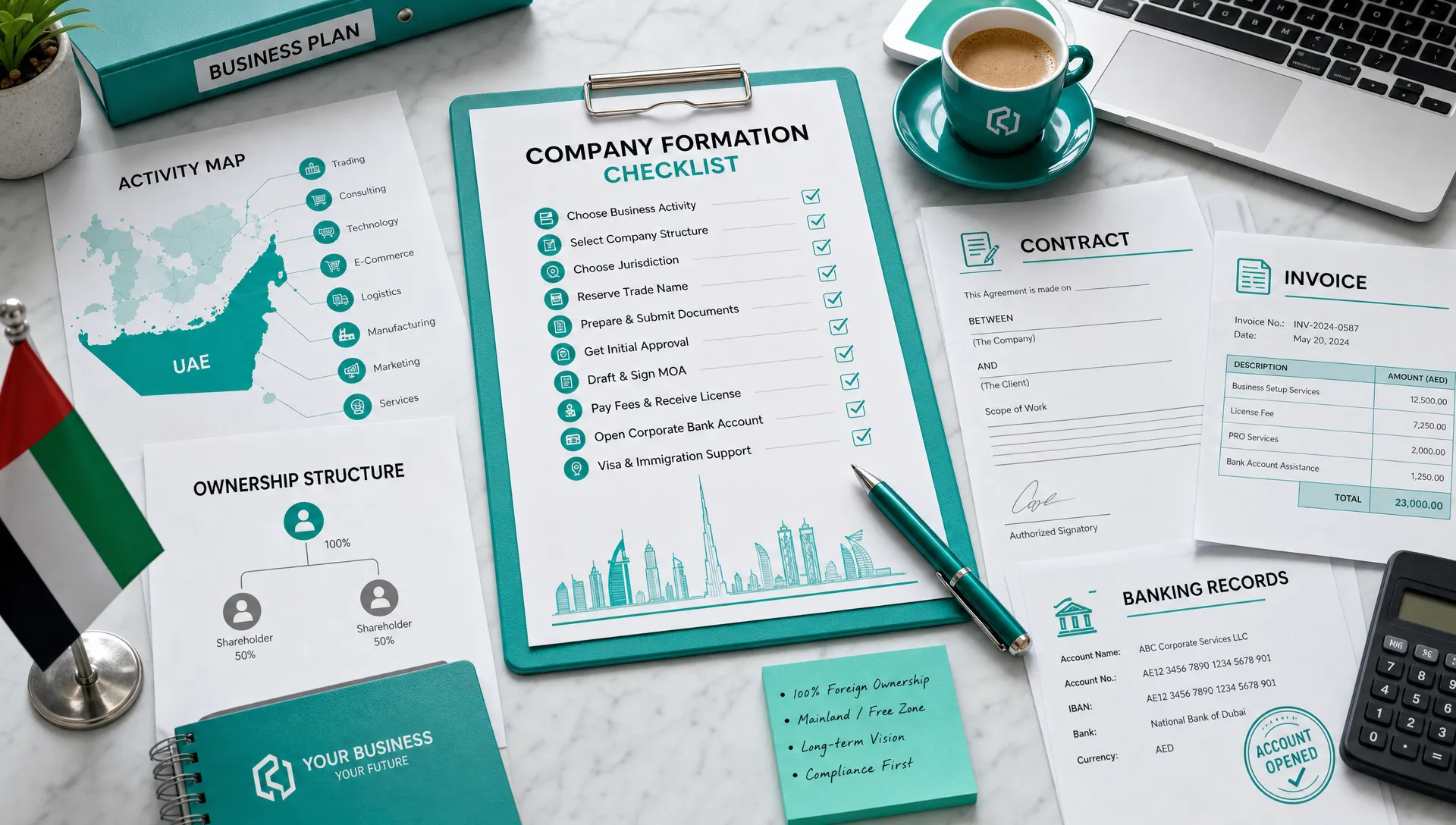
Good compliance is much easier when the company has been structured around its real activity from the start. The license, ownership, contracts, bookkeeping, governance records, and tax registrations can all be aligned instead of patched together later.
For founders who want to reduce future remediation, Alldren’s guide to building with compliance from day one is a useful companion to this activity-first approach.
Matching real activity to the right structure
There is no universal UAE structure that works for every founder. The right structure depends on the activity. Below are common examples, simplified for clarity.
Professional services and consulting
A consulting business should be able to explain the services it provides, who performs them, where clients are located, how fees are calculated, and whether the work is performed from the UAE or internationally.
The license activity should reflect the actual services. If the business provides strategic advice, technology implementation, marketing support, investment research, or management services, those differences matter. Banks and tax advisors will look beyond a generic label.
Trading and distribution
A trading company needs a clearer operational story. What goods are traded? Who are the suppliers? Where are goods stored, shipped, and insured? Does the company import into the UAE, re-export, or trade internationally without goods entering the country?
A RAKEZ free zone company, for example, may be appropriate for certain operating and trading models where the license, facilities, logistics, visas, and customer base align. But the decision should be based on the actual trading flow, not just the name of the free zone.
E-commerce and digital businesses
Digital businesses still need real activity analysis. A founder should define what is being sold, which platform processes orders, where inventory or digital infrastructure sits, who owns the customer relationship, and where fulfillment or service delivery occurs.
Even if the business has no traditional storefront, it still has operational substance: payment processors, websites, platform accounts, customer support, advertising spend, intellectual property, contractors, and data flows.
Holding and investment companies
A holding company should be structured around what it holds and why. It may hold shares in operating companies, real estate, intellectual property, investment portfolios, or family assets. The governance model, ownership, source of funds, and decision-making records are often more important than day-to-day trading activity.
An offshore company UAE structure, including a RAK ICC offshore entity, may be useful in some holding or investment contexts. But if the entity is expected to employ staff, obtain UAE visas, lease operational premises, or invoice active commercial clients, an offshore structure may not match the activity.
Multi-entity groups
Some businesses need more than one entity. For example, a group may use one company for operating services, another for holding intellectual property, and another for regional investment activity. That can be sensible, but only if each entity has a clear role.
Complexity without activity creates confusion. Complexity that reflects real commercial functions can support governance, risk management, and growth.
Common mistakes when activity is treated as an afterthought
Many problems in UAE business incorporation can be traced back to a weak activity analysis. The issues may not appear on the day of incorporation, but they often appear during banking, tax registration, license renewal, due diligence, or a future transaction.
Common mistakes include:
- Choosing the cheapest license without checking whether it reflects the true business model.
- Using a broad activity description that does not match contracts or invoices.
- Forming an offshore entity for an activity that needs an operating presence.
- Expecting banking approval without a clear source of funds or customer profile.
- Adding nominee or governance arrangements without proper records and rationale.
- Ignoring bookkeeping until after transactions have already started.
- Mixing personal, holding, and operating activity in one entity without a clear reason.
These mistakes are avoidable. The founder does not need to predict every future development, but they do need to create a structure that matches the business as it is expected to operate.
Build evidence of activity from day one
Real activity should not only be described. It should be documented.
From the beginning, the company should maintain records that support its commercial narrative. This includes board or shareholder decisions, customer contracts, supplier agreements, invoices, payment records, website materials, employee or contractor agreements, office or facility documents, accounting records, and tax files.
This evidence serves multiple purposes. It helps banks understand the business. It supports tax filings and accounting. It assists with license renewals and amendments. It improves governance. It also makes the company easier to sell, restructure, finance, or pass through due diligence later.
Founders often underestimate how valuable clean records are. A buyer, investor, bank, or regulator does not only want to hear what the business does. They want to see records that prove it.
The practical test: can a stranger understand the company?
A useful test is to imagine a knowledgeable outsider reviewing the company file. This could be a banker, tax advisor, auditor, regulator, investor, or corporate services provider.
Could that person understand the business within a reasonable time? Would the license activity match the invoices? Would the bank transactions match the contracts? Would the ownership structure make sense? Would the company’s stated purpose match its website, accounting records, and management decisions?
If the answer is yes, the company is likely built around real activity. If the answer is no, the structure may need refinement before it creates operational problems.
A strong UAE corporate structure is not only about forming an entity. It is about creating a coherent operating framework. The business activity, entity type, jurisdiction, license, ownership, banking, tax, bookkeeping, and governance should all point in the same direction.
Frequently Asked Questions
What does it mean to build a company around real business activity? It means designing the company structure around what the business will actually do, including its revenue model, clients, suppliers, operations, people, assets, and flow of funds. The activity should guide the license, jurisdiction, bank account, tax position, and governance framework.
Does real business activity affect UAE bank account opening? Yes. UAE banks typically want to understand the company’s purpose, ownership, source of funds, expected transactions, counterparties, and supporting documents. A company whose structure matches its real activity is usually easier to explain during onboarding.
Can a UAE offshore company conduct active business? It depends on the facts, but offshore structures such as RAK ICC companies are commonly used for holding, investment, and structuring purposes rather than UAE operating activity. If the business needs staff, visas, premises, local trade, or active client invoicing, another structure may be more appropriate.
Is a RAKEZ free zone company suitable for operating activity? It can be, depending on the license activity, facilities, visa needs, customers, logistics, and commercial model. The key is to confirm that the free zone setup matches how the business will actually operate.
Should founders choose the activity before choosing the jurisdiction? Yes. The activity should come first. Once the business model is clear, it becomes easier to choose between mainland, free zone, offshore, or a multi-entity structure.
Build the company that your business actually needs
A UAE company should be more than a certificate. It should be a working structure that reflects the real business behind it.
Alldren helps founders, investors, and private clients design UAE companies around clear commercial activity, robust governance, banking readiness, and ongoing compliance. If you want expert-led corporate services UAE support with transparent guidance from the start, speak with Alldren before you build the structure you may have to operate for years.