
For many founders, “free zone RAK” is shorthand for one simple idea: a cost-efficient UAE company with a practical setup process. In reality, Ras Al Khaimah gives founders several routes, and the right one depends on what the company will actually do after incorporation.
A consultancy with overseas clients, an e-commerce brand importing inventory, a Web3 venture, a marine services company, and a holding structure may all look at RAK for different reasons. They should not all choose the same setup.
In 2026, the best RAK free zone decision is less about finding the cheapest license and more about matching five things: licensed activity, facility, visa needs, banking profile, and tax position.
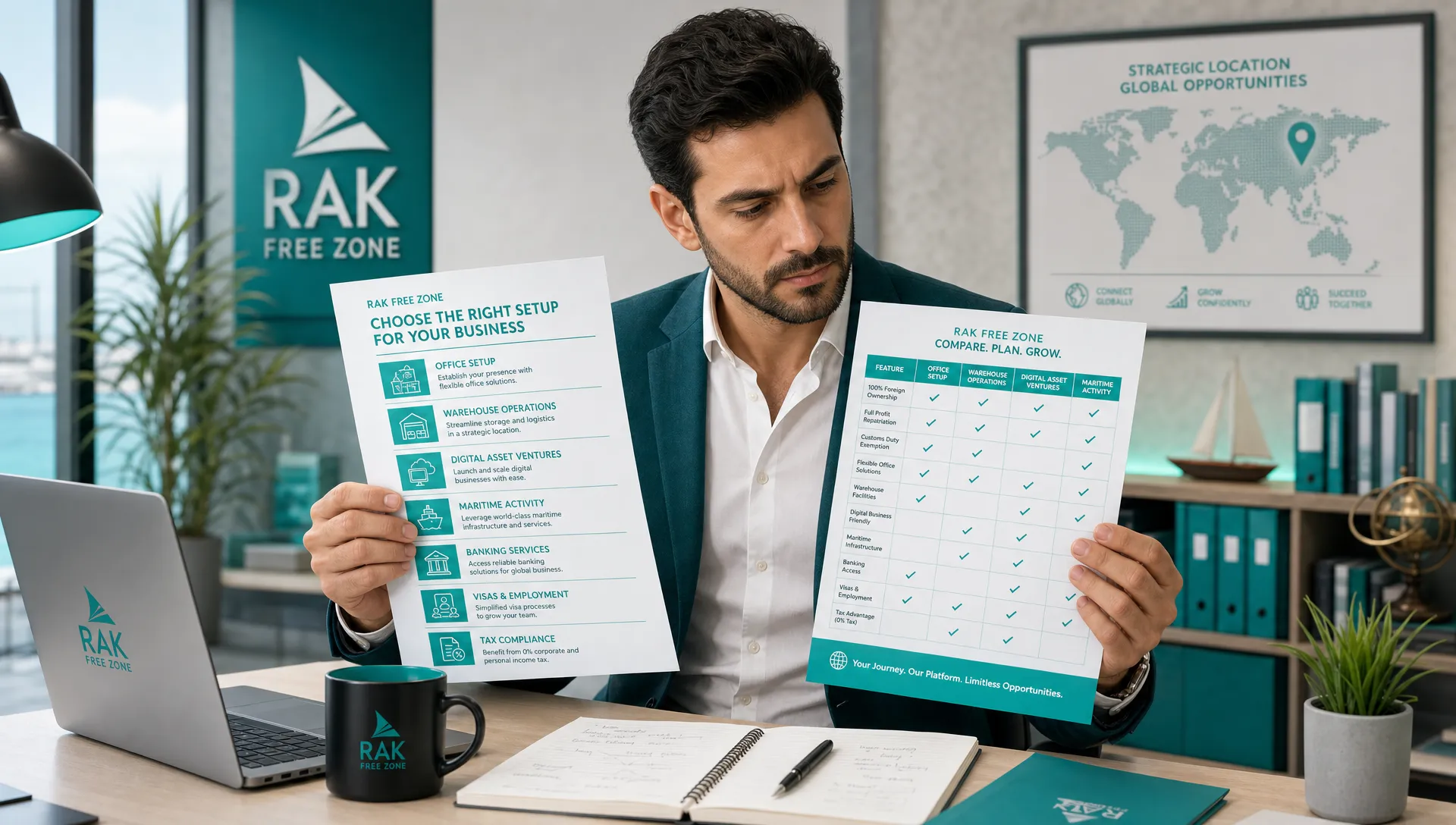
Quick comparison: RAK free zone options in 2026
| Option | Best for | Main advantage | Watch before choosing |
|---|---|---|---|
| RAKEZ operating company | Consulting, trading, e-commerce, SaaS, professional services, light industrial activity | Broad activity coverage and flexible facilities | Activity wording, visa allocation, banking evidence, renewal costs |
| RAKEZ warehouse or industrial setup | Import/export, storage, assembly, manufacturing, logistics-heavy businesses | Better fit for companies needing real premises and operational substance | Facility costs, customs flow, staff visas, inspections, approvals |
| RAK Digital Assets Oasis (RAK DAO) | Digital asset, Web3, blockchain, tokenization, and related technology ventures | Sector-specific ecosystem and activity focus | Regulated financial activities may need separate approvals |
| RAK Maritime City Free Zone | Marine, port, ship services, bulk handling, industrial and logistics operations | Port-adjacent environment for maritime activity | Facility suitability, environmental and operational permits |
| RAK ICC | Holding companies, asset ownership, SPVs, international structuring | Useful for non-operating corporate structures | Not an operating free zone license and generally not a visa route |
The important point: “RAK free zone” is not one universal product. It is a set of choices, and each choice sends a different signal to banks, tax advisers, immigration authorities, suppliers, and future investors.
Why RAK remains attractive for founders
Ras Al Khaimah is often considered by founders who want a UAE base without taking on the higher overhead associated with some larger emirates. It can be especially attractive for early-stage companies, international entrepreneurs, and SMEs that want a practical structure for ownership, residency, invoicing, and regional growth.
RAK can work well when the business model is clear, the activity is correctly selected, and the founder is realistic about compliance. It is less effective when founders choose a low-cost package first and only later ask whether it supports their bank account, customer contracts, visas, or taxable income profile.
If you are still deciding whether RAK is the right emirate at all, rather than just which RAK structure to use, this comparison of Ras Al Khaimah Economic Zone vs other emirates can help you evaluate the broader trade-offs.
Option 1: RAKEZ for broad operating businesses
For many founders, the default RAK free zone option is RAKEZ, the Ras Al Khaimah Economic Zone. RAKEZ is commonly used for operating companies in sectors such as consulting, general services, e-commerce, trading, light manufacturing, media, and technology services.
RAKEZ is attractive because it offers a wide range of business activities and facility types, from flexible workspaces and offices to warehouses and industrial land. Founders can review the authority directly through the official RAKEZ website, but the key decision is not simply whether RAKEZ is available. It is whether the exact license activity and facility match the real business model.
RAKEZ is often a good starting point if your company will issue invoices, serve customers, hire staff, apply for UAE residency visas, and operate as a real trading or service business. It is also generally easier to explain to banks when the company’s activity, website, contracts, and expected payments all point in the same direction.
When RAKEZ is a strong fit
RAKEZ may be suitable if you are forming a UAE company for professional services, management consulting, software services, online business, international trading, or small-scale operational activity. It can also suit founders who need a UAE residency visa linked to a company they own and control.
It is especially important for foreign founders to make the setup “bank-aware” from the beginning. A license may be issued quickly, but a bank still needs to understand who owns the company, where funds come from, what customers are being served, and why the UAE entity exists. Alldren’s guide to RAK free zone company formation for foreign founders explains this process in more detail.
Where founders make mistakes with RAKEZ
The most common mistake is choosing the cheapest available activity or facility and assuming it can be fixed later. Changes are possible in many cases, but they can add cost, delay bank onboarding, or create confusion when contracts do not match the license.
For example, a founder who describes the business as “consulting” but actually handles payment flows, digital assets, regulated financial products, commodities, or complex import/export transactions may face additional questions. Banks and authorities look at substance, not just the label on the license.
Option 2: RAKEZ with warehouse, industrial, or logistics facilities
Some RAK companies need more than a flexi desk or simple office. If your business imports goods, stores inventory, assembles products, manufactures, manages physical logistics, or needs staff on-site, your facility choice becomes part of the structure, not just an administrative detail.
A warehouse or industrial setup will usually cost more than a basic service package, but it can be more aligned with the actual business. It may also support a stronger operational narrative for banking and tax purposes, because the company can demonstrate a clearer physical presence and business function in the UAE.
This option is worth considering for founders in:
- E-commerce brands holding stock in the UAE
- Import/export businesses with recurring supplier shipments
- Light manufacturing or assembly businesses
- Product distribution companies
- Logistics, repair, packaging, or storage operations
The trade-off is that the company may need to budget for leases, utilities, approvals, visas, insurance, customs-related processes, and annual renewals. These costs can be justified when the facility is genuinely needed, but they should be modeled before incorporation. For fee-level planning, use this RAK free zone company setup cost breakdown rather than relying only on advertised starting prices.
Option 3: RAK Digital Assets Oasis for Web3 and digital asset ventures
RAK Digital Assets Oasis, often called RAK DAO, is a specialist free zone focused on digital assets and related technology businesses. Its positioning makes it more relevant for founders working in areas such as blockchain infrastructure, Web3 platforms, digital asset services, tokenization, and adjacent emerging technology.
This does not mean every crypto-related company can simply incorporate and operate freely. A company that touches regulated activities, such as exchange services, brokerage, custody, payments, investment products, or financial promotions, may need additional regulatory analysis and approvals. A free zone license is not a substitute for financial services authorization.
RAK DAO may be worth exploring if your business is genuinely built around digital assets or Web3 and you want the company’s jurisdictional story to align with that sector. Founders can review the official RAK Digital Assets Oasis website to understand its current positioning and activity scope.
The main question is whether your activity is technology-led or regulated-finance-led. A software platform that supports blockchain analytics is very different from a company custodying customer assets or facilitating financial transactions. Banks, payment providers, investors, and regulators will treat those models differently.
Option 4: RAK Maritime City Free Zone for marine and port-linked operations
RAK Maritime City Free Zone is a specialist option for companies connected to maritime, port, logistics, and industrial activity. It is relevant for founders whose business depends on proximity to marine infrastructure, ship services, storage, bulk handling, or port-related operations.
This option is much less likely to suit a solo consultant or online service provider. It is more relevant where the physical operating environment matters. If you need land, industrial space, marine access, or a location that supports port-linked activity, it may be a better fit than a standard office-based free zone setup.
As with all specialist zones, the key issue is alignment. If the company’s customers, suppliers, activity, and facility all point toward maritime or industrial operations, the structure is easier to justify. If not, a general RAKEZ setup may be simpler.
Where RAK ICC fits, and where it does not
RAK ICC is often mentioned in the same conversation as RAK free zone company formation, but founders should treat it differently. RAK ICC is designed for international business company structures, such as holding companies, SPVs, asset ownership, and certain cross-border structuring uses.
It is not the same as forming an operating free zone company with a trade license, office facility, and UAE residency visa route. If you want to invoice clients from a UAE operating company, hire staff, apply for visas, and open a business bank account for active trading, RAK ICC may not be the right standalone structure.
It can still be useful as part of a wider structure. For example, a founder may use an operating free zone company for commercial activity and a separate holding vehicle for ownership or asset planning. That decision should be made with tax, legal, and banking considerations in mind.
Which RAK option fits common founder scenarios?
| Founder scenario | Likely starting point | Why it may fit | Do not overlook |
|---|---|---|---|
| Solo consultant with international clients | RAKEZ service company | Simple operating profile and possible visa pathway | Client contracts, bank file, tax registration, renewal budget |
| E-commerce brand importing goods | RAKEZ trading license with suitable facility | Better alignment with inventory and supplier flows | Customs, VAT, storage, mainland sales arrangements |
| SaaS founder serving global customers | RAKEZ service or technology-related activity | Low physical footprint with international revenue model | Contracts, payment processors, corporate tax position |
| Web3 or digital asset startup | RAK DAO, subject to activity review | Sector-specific environment | Regulatory approvals and bank risk appetite |
| Marine services or port-linked business | RAK Maritime City Free Zone | Maritime and industrial context | Facility, permits, insurance, operational approvals |
| Passive holding or SPV structure | RAK ICC | Non-operating corporate structuring | No ordinary operating license or residency visa route |
The 2026 decision factors that matter more than the license fee
A low headline setup price can be useful, but it is not a complete decision-making tool. Founders should compare RAK free zone options using the operational reality of the business.
| Decision factor | Why it matters | Founder question |
|---|---|---|
| Activity | The license must match the actual work and revenue | Will my contracts, website, and invoices match this activity? |
| Facility | Banks, visas, and operations may depend on premises | Do I need only an address, or real office, warehouse, or land? |
| Visas | Visa allocation often depends on package and facility | How many visas do I need in year one and year two? |
| Banking | Banks assess risk beyond the license certificate | Can I explain customers, suppliers, payments, and source of funds? |
| Tax | Free zone tax benefits are conditional | Will my income qualify, and can I meet compliance obligations? |
| Renewals | Year-two costs can surprise founders | What will the structure cost to maintain, not just launch? |
Activity fit
Your activity is the foundation of the company. If it is too narrow, you may struggle to invoice for planned services. If it is too broad or vague, banks may ask more questions. If it touches regulated sectors, the free zone may not be the only authority involved.
Founders should map their first 12 to 24 months of revenue before choosing the activity. This includes current services, planned products, target countries, and expected payment flows.
Facility and substance
A basic facility may be enough for a lean consulting or online services company. It may not be enough for a business that claims to store goods, manage operations, hire a team, or perform industrial activity.
Substance also matters for tax. Under the UAE corporate tax regime, free zone companies may be able to access a 0% rate on qualifying income only if they meet specific conditions. These can include maintaining adequate substance, deriving qualifying income, complying with transfer pricing rules, and preparing audited financial statements where required. The UAE Ministry of Finance provides official information on corporate tax, but founders should obtain tailored advice before relying on free zone tax treatment.
Visa planning
Some founders only need a company license. Others need UAE residency for themselves, family members, or employees. Visa capacity can depend on the facility type, package, and authority rules. If relocation is part of the plan, visa planning should happen before license selection, not after.
A founder who chooses a zero-visa or low-cost package may save money upfront but later need amendments, upgrades, or a different facility. That can be slower than choosing the right structure from the beginning.
Banking profile
Banking is often the real test of a UAE company structure. A bank will look at the owner’s background, source of wealth, source of funds, business model, expected counterparties, countries involved, transaction volumes, website, contracts, and evidence of substance.
Higher-risk sectors, including digital assets, commodities, financial services, gaming, high-volume payment flows, and certain cross-border trading models, may face deeper due diligence. This does not mean they cannot be banked, but it does mean the setup should be planned with documentation in mind.
VAT and accounting
Founders should also plan for bookkeeping, tax registration, and VAT. In the UAE, VAT registration is generally mandatory when taxable supplies and imports exceed the mandatory threshold of AED 375,000, subject to the detailed rules of the Federal Tax Authority. Corporate tax registration and filing obligations can also apply even when a company expects to benefit from free zone tax treatment.
The practical lesson is simple: a RAK free zone company is not finished when the license is issued. It must be maintained properly.
Cost comparison: what to budget for
Founders often ask which RAK free zone is cheapest. A better question is: which structure is cost-effective for the company I am actually building?
Your first-year and renewal budget may include:
- License and registration fees
- Establishment card and immigration setup, if visas are needed
- Office, flexi desk, warehouse, land, or industrial facility costs
- UAE residency visa costs, medical testing, and Emirates ID processes
- Bank account preparation and supporting documentation
- Bookkeeping, corporate tax registration, VAT registration if required, and annual compliance
- Amendments, activity changes, or facility upgrades if the first setup was too limited
The cheapest setup can become expensive if it needs to be rebuilt. A slightly more expensive structure can be more efficient if it supports banking, visas, tax compliance, and operations from day one.
A practical founder framework for choosing a RAK option
Use this sequence before committing to any RAK free zone package:
- Define your real revenue model for the next 24 months.
- Identify whether the company is service-based, trading, industrial, digital asset-related, maritime, or purely a holding vehicle.
- Match the license activity to contracts, invoices, website wording, and customer expectations.
- Decide how many visas you need now and how many you may need at renewal.
- Test whether the facility supports your banking, tax, and operational story.
- Review whether any part of the business is regulated or high-risk from a bank’s perspective.
- Model the full first-year and second-year cost, including compliance.
This framework prevents the most common founder error: treating incorporation as an isolated event. A UAE company is a system. Formation, banking, tax, visas, renewals, governance, and operations all affect each other.
Frequently Asked Questions
Is RAKEZ the same as RAK Free Zone? In everyday founder conversations, “RAK Free Zone” often refers to RAKEZ, the main Ras Al Khaimah Economic Zone used for many operating companies. However, RAK also has specialist options, and older names may still appear in online searches.
Which RAK free zone option is best for a small consulting company? A RAKEZ service company is often the practical starting point for a consulting business, provided the activity matches the services, the visa plan is clear, and the bank file supports the business model.
Is the cheapest RAK free zone license the best choice? Not always. A low-cost license may work for a simple business with no visa or facility needs, but it can be the wrong choice if you need banking credibility, inventory storage, staff visas, or a stronger substance position.
Can a RAK free zone company sell to clients in Dubai or the UAE mainland? It may be possible depending on the activity, contract type, and whether you are selling services or goods. Goods entering the mainland can involve customs, importer, distributor, or mainland arrangements, so this should be checked before setup.
Is 0% UAE corporate tax automatic for RAK free zone companies? No. Free zone corporate tax treatment depends on meeting the conditions for qualifying income and Qualifying Free Zone Person status. Founders should review this before incorporation and maintain proper accounting after setup.
Can a foreign founder own 100% of a RAK free zone company? Free zones are commonly used by foreign founders because they can allow 100% foreign ownership, but the exact structure, activity, approvals, and compliance requirements still need to be selected carefully.
Build the RAK structure around the business, not the other way around
The best RAK option for 2026 founders is the one that supports the company after the license is issued. RAKEZ may be right for many operating companies, RAK DAO may suit a genuine digital asset venture, RAK Maritime City may fit port-linked activity, and RAK ICC may work for a non-operating holding structure.
Alldren helps founders design UAE company structures with setup, compliance, banking support, residency visas, bookkeeping, tax registration, and governance in mind. If you want a transparent, expert-led view before committing to a RAK free zone option, start with Alldren and build the structure around your real operating plan.