
Adding a partner to a company in the UAE can be simple on paper, but it is rarely just a form submission. You are changing who owns, controls, funds, or represents the business, and that can affect the trade license, constitutional documents, UBO records, bank KYC, tax files, visa eligibility, and internal governance.
The right process depends on the company’s jurisdiction, legal form, activity, and the role the incoming partner will actually play. A mainland LLC, a free zone company, a professional license, an offshore holding company, and a regulated entity will not follow the exact same route.
This guide explains the practical sequence to follow, the documents usually required, the decisions to make before filing, and the risks to avoid when adding a partner to a company in the UAE.
Start by defining what “partner” means
In UAE business language, “partner” can mean several different things. Before you amend anything, clarify whether the person or company is becoming a legal owner or only taking a commercial, managerial, or licensing role.
| Type of partner | What it usually means | Why it matters |
|---|---|---|
| Shareholder or equity partner | The person or entity receives shares or membership interests in the company | Requires ownership documents, authority approval, registry updates, UBO review, and bank KYC updates |
| Manager, director, or authorized signatory | The person helps manage or sign for the company but may not own shares | Requires governance approvals and possibly license, establishment card, or bank mandate updates |
| Commercial partner | A business collaborator, distributor, introducer, or joint venture counterparty | Usually handled by contract rather than changing the company license |
| License partner or local service arrangement | A person or entity is involved because of licensing, regulatory, or market access needs | Must be structured carefully so ownership, control, and liability are clear |
If the discussion is about a license partner rather than a true shareholder, pause before you proceed. The commercial and legal risks are different, especially where the partner appears on a license but is not intended to participate economically. Alldren’s guide on when you need a license partner in the UAE explains the distinction in more detail.
Check whether your company can add a partner in its current form
The first technical question is not “which form do we submit?” It is “does the current structure allow this change?”
A mainland LLC will usually deal with share transfer, capital change, or amendment of its memorandum or articles. A free zone company will follow the rules and portal process of its free zone authority. A DIFC or ADGM entity may have separate registrar requirements, and regulated activities may require approval before any change of control. A sole establishment or branch may not be able to “add a shareholder” in the same way, because the legal form is tied to an individual owner or parent company.
The UAE Commercial Companies Law provides the core corporate framework for many UAE companies, but the practical process is implemented through the relevant licensing authority, registrar, free zone, notary, and, in some cases, sector regulator.
You should review:
- The trade license and licensed activities.
- The legal form and jurisdiction.
- The memorandum, articles, and shareholder agreement.
- Any existing nominee, local service agent, or side agreements.
- Any bank facilities, investor agreements, or lender consent requirements.
- Any regulated activity approvals.
- The current UBO and management structure.
This review prevents a common problem: negotiating a commercial deal that the company cannot register cleanly without restructuring.
Choose the right route: share transfer, new shares, or restructuring
Most UAE partner additions fall into one of four routes. The route determines the paperwork, approvals, tax review, and banking impact.
| Route | How it works | Best suited for | Key issues to check |
|---|---|---|---|
| Transfer of existing shares | One or more current shareholders sell or assign part of their shares to the new partner | Bringing in a partner without changing total share capital | Valuation, transfer price, seller consent, notary or registrar requirements, UBO update |
| Issue of new shares or capital increase | The company creates new shares for the incoming partner | New capital injection, expansion funding, or dilution of existing owners | Capital clauses, proof of contribution, revised ownership percentages, authority acceptance |
| Conversion or restructuring | The business changes legal form or creates a new structure | Sole establishments, branches, or structures that cannot simply add shareholders | Asset transfers, contracts, licenses, employees, visas, tax and accounting continuity |
| Appointment without ownership | The person becomes manager, director, signatory, or operational partner without receiving shares | Operational control, investor oversight, or senior management | Board powers, signing limits, bank mandate, liability, employment or service contract |
Do not treat these routes as interchangeable. For example, a 20% share transfer and a 20% new share issue can produce different economics for the existing owners, different capital accounting, and different evidence requirements for banks.
Agree the commercial terms before filing anything
The registration step should reflect a deal that is already clear. If the owners are still debating economics, management control, exit rights, or who contributes capital, filing a partner amendment too early can create disputes.
At minimum, agree the following before documents are signed:
- Ownership percentage and share class, if applicable.
- Contribution amount, timing, and evidence of payment.
- Profit distribution rules and whether distributions depend on cash availability.
- Management rights, voting thresholds, and reserved matters.
- Who can sign contracts, open bank accounts, borrow money, or hire staff.
- Exit rights, transfer restrictions, pre-emption rights, and tag-along or drag-along provisions.
- Deadlock process if the partners cannot agree.
- Confidentiality, non-solicitation, intellectual property, and dispute resolution terms.
The license amendment only records part of the relationship. The shareholder agreement or constitutional documents govern how the partners actually make decisions. If you are adding a partner because the business is growing, use the moment to strengthen governance rather than simply updating names on a license. Alldren’s article on how to set up shareholders safely is a useful companion to this step.
Run due diligence on the incoming partner
Due diligence is not only for large acquisitions. UAE authorities and banks increasingly expect a clear picture of ownership, control, source of funds, and business rationale.
For an individual partner, you typically need to verify identity, nationality, residence status, contact details, and source of funds. For a corporate partner, you need to understand the full ownership chain, authorized signatories, board approvals, incorporation documents, and ultimate beneficial owners.
This step is especially important if the incoming partner is a foreign company, a trust, a holding structure, or an investor from a higher-risk sector. Delays often happen because documents are not legalized, translated, or sufficiently clear for the authority or bank.
The UAE’s beneficial ownership framework also matters. Companies are generally expected to maintain accurate beneficial ownership information and update the relevant registrar when ownership or control changes. The UAE Ministry of Economy’s guidance on Ultimate Beneficial Owner requirements is a helpful official reference.
Prepare the documents
The exact document list depends on the authority and company type, but most partner additions require a mix of corporate approvals, identity documents, constitutional amendments, and registry forms.
| Document category | Examples | Notes |
|---|---|---|
| Identity and KYC | Passport, Emirates ID if applicable, visa or entry status, proof of address, contact details | Required for individual partners, managers, and signatories |
| Corporate shareholder documents | Certificate of incorporation, trade license, certificate of incumbency or good standing, ownership chart, board resolution | Foreign documents may need notarization, legalization, attestation, and translation |
| Internal approvals | Shareholder resolution, board resolution, consent from existing partners | Must match the company’s articles and signing rules |
| Transaction documents | Share transfer agreement, subscription agreement, capital increase documents, sale and purchase agreement | The right document depends on whether shares are transferred or newly issued |
| Constitutional documents | Amended memorandum of association, articles of association, or equivalent charter | Mainland amendments may require notary involvement, while free zones use authority-specific processes |
| Registry and compliance forms | License amendment form, UBO declaration, manager or signatory forms, authority portal submissions | Requirements vary by mainland department, free zone, or registrar |
| Banking support documents | Updated license, shareholder register, UBO chart, resolutions, bank mandate forms | Banks may request the full ownership trail and commercial rationale |
If a corporate partner is joining, allow extra time for document preparation. A resolution from the foreign parent may not be enough if the UAE authority also wants evidence of the parent’s shareholders, directors, or signatory powers.
Submit the amendment to the relevant authority
Once the documents are ready, the company submits the amendment to the relevant licensing authority, free zone, registrar, or notary process. The workflow varies, but the authority will usually check whether the new ownership structure is consistent with the legal form, activity, and regulatory requirements.
For mainland companies, the process may involve initial approval, notarization of amended constitutional documents, payment of amendment fees, and issuance of an updated trade license or commercial registration. Some activities require external approvals from a ministry, municipality, economic department, or sector regulator.
For free zone companies, the process is usually handled through the free zone authority. The authority may require transfer forms, resolutions, compliance checks, original certificates, share certificates, amended articles, or portal approvals. Some free zones also require the updated company documents before immigration or visa changes can proceed.
For regulated businesses, a change in shareholder, controller, director, or manager may require pre-approval. This is common in sectors such as financial services, virtual assets, healthcare, education, insurance, and certain professional activities. Filing the corporate amendment before regulator consent can create avoidable delays or rejection.
Update UBO records, registers, and the trade license
After approval, do not assume the process is complete just because the authority issues an updated license. A proper partner addition should leave the company records consistent everywhere.
The company should update its shareholder register, UBO register, constitutional documents, trade license, commercial registration, and internal resolutions. If the new partner becomes a manager or authorized signatory, the manager register, establishment card, immigration file, and bank mandate may also need to be updated.
In practice, inconsistencies are one of the biggest causes of future delays. A bank may see one ownership structure, the free zone portal another, and the internal shareholder agreement a third. That creates friction during renewals, bank reviews, financing, visa applications, audits, or eventual exit transactions.
Notify the bank and prepare for KYC review
Adding a partner is a material KYC event. UAE banks typically want to know who now owns and controls the company, whether the new partner is a signatory, where the funds came from, and whether the business model has changed.
Do not wait until the bank discovers the change during a periodic review. Prepare a clean bank pack with the updated license, shareholder register, constitutional documents, resolutions, UBO chart, passports, Emirates IDs where applicable, proof of address, and transaction rationale.
If the new partner is also investing funds into the business, keep evidence of the transfer, subscription, loan, or capital contribution. The bank may ask whether the funds are equity, shareholder loan, advance payment, or another category. The answer should match your accounting records.
A bank-ready ownership and KYC pack can reduce friction significantly. For a broader view of how banks assess UAE companies, see Alldren’s guide on how to open a company bank account in the UAE faster.
Consider tax, accounting, and visa implications
Adding a partner is not always a taxable event by itself, but it can affect the company’s tax and accounting position. The transfer price, capital contribution, shareholder loan treatment, profit allocation, related-party dealings, and bookkeeping entries should all be reviewed.
For UAE Corporate Tax, the company should consider whether the new ownership changes related-party relationships, transfer pricing documentation needs, free zone qualifying income analysis, or group structure assumptions. If the company is VAT registered, adding a partner usually does not change VAT registration on its own, but a broader restructure, asset transfer, or change in activity may create VAT questions.
Residency is a separate issue. A person who becomes a shareholder may be eligible for an investor or partner visa depending on the company type, jurisdiction, ownership level, activity, and immigration rules in force. Do not promise residency to an incoming partner until the visa route has been checked with the relevant authority.
Accounting should also reflect the transaction correctly. A share transfer between existing shareholders is different from a capital injection into the company. A shareholder loan is different from paid-up capital. These distinctions matter for financial statements, bank reviews, and future exits.
Mainland, free zone, and other structures: practical differences
The UAE has multiple company routes, and each treats partner additions differently.
| Company type | Typical partner addition route | Practical watchouts |
|---|---|---|
| Mainland LLC | Share transfer, capital amendment, amended memorandum or articles, updated license | Notary process, economic department approval, external activity approvals, UBO and bank updates |
| Mainland professional license or civil company | Partner admission may be possible depending on form and activity | Local service agent arrangements, professional qualifications, activity approvals, liability profile |
| Free zone company | Free zone share transfer or new shareholder process | Each free zone has its own forms, timelines, fees, share certificate process, and compliance review |
| DIFC or ADGM company | Registrar filing and, if regulated, regulator approval | Financial free zone rules are distinct from ordinary mainland or free zone processes |
| Offshore or holding company | Registered agent or registrar filing | No UAE operating license, but ownership, UBO, and bank records still need updating |
| Branch | Usually no shareholder change at branch level because ownership sits with the parent | Changes may be needed at parent company level or through a new operating entity |
| Sole establishment | Cannot usually add a shareholder in the same way as a company | May require conversion, new company formation, or asset and license restructuring |
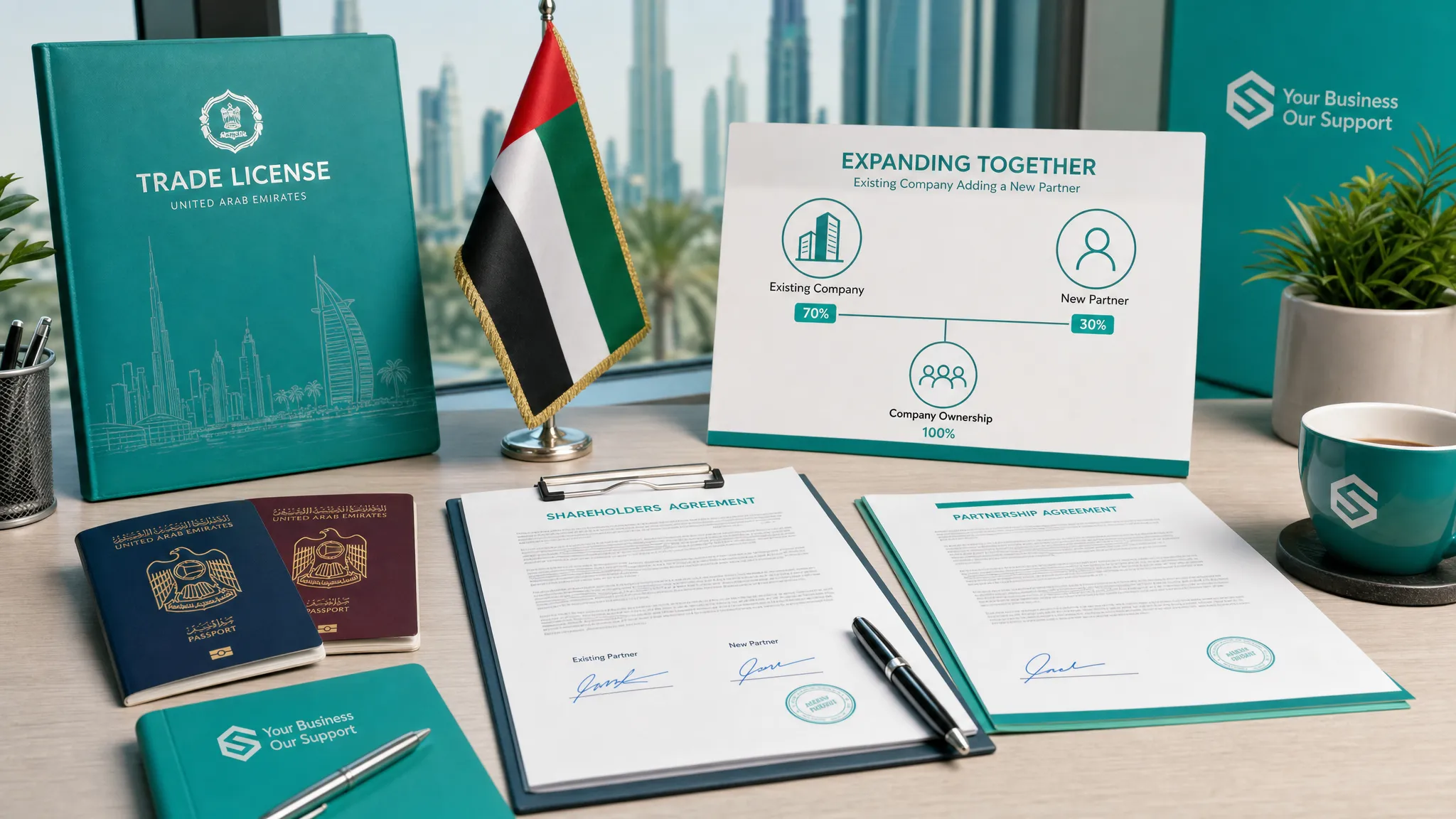
This is why a document-only approach is risky. The same commercial objective, adding a 30% partner, may require a simple share transfer in one jurisdiction and a full restructuring in another.
Common mistakes to avoid
Several problems appear repeatedly when UAE companies add partners without planning.
- Treating a commercial partner as a shareholder before the economics and exit rights are agreed.
- Filing a license amendment without updating the shareholder agreement or articles.
- Ignoring UBO, bank, tax, and immigration updates after the license is changed.
- Using a nominee, license partner, or informal side agreement without proper risk controls.
- Failing to legalize or translate foreign corporate documents early enough.
- Assuming a new minority shareholder automatically qualifies for a UAE residence visa.
- Not checking whether regulated activity approval is required before the ownership change.
- Allowing the bank record, license record, and accounting records to show different ownership facts.
Most of these mistakes are avoidable if the transaction is structured first, documented second, and filed third.
How long does it take?
There is no universal timeline. A straightforward partner addition in a well-organized free zone company may move quickly once documents are complete. A mainland company with notarization, external approvals, foreign corporate shareholders, or regulated activities can take longer. Bank KYC and foreign document legalization often take more time than the authority filing itself.
The main timeline drivers are document readiness, jurisdiction rules, whether the incoming partner is an individual or corporate entity, whether documents are foreign-issued, whether the activity is regulated, and whether banking or visa changes are being done at the same time.
Costs also vary by authority and structure. Typical cost components may include authority amendment fees, notary fees, translation, attestation, legal drafting, compliance review, updated license fees, and professional support. The safest approach is to scope the transaction before documents are prepared, so the partners understand the full cost and timing picture upfront.
Frequently Asked Questions
Can I add a foreign partner to a UAE company? In many UAE company structures, foreign shareholders can be added, but the answer depends on the jurisdiction, activity, legal form, and any sector-specific ownership rules. Some activities may require UAE participation, regulator approval, or additional conditions.
Is adding a partner the same as transferring shares? Not always. A partner can be added through a transfer of existing shares, an issue of new shares, a capital increase, a restructuring, or appointment as a manager or signatory without ownership. The right route depends on the intended economics and the company’s legal form.
Do I need a new trade license after adding a partner? You usually need an amended or updated license record if the legal ownership or management shown on the license changes. The company typically keeps the same legal identity unless a restructuring or new entity is required.
Does the bank need to be informed? Yes. Adding a shareholder, beneficial owner, manager, or authorized signatory is normally relevant to bank KYC. The bank may request updated corporate documents, UBO information, source of funds evidence, and a revised mandate.
Can the new partner get a UAE residence visa? Possibly, but shareholding alone does not guarantee eligibility. Visa options depend on the jurisdiction, company status, immigration file, activity, ownership level, and current authority rules. Check eligibility before making it part of the commercial deal.
Is a shareholder agreement necessary? It is strongly recommended, especially where there is more than one owner. The license records ownership, but a shareholder agreement can define voting, management rights, reserved matters, funding obligations, exits, deadlocks, and dispute resolution.
Need to add a partner without creating compliance risk?
Adding a partner is a corporate structuring exercise, not just an amendment form. Ownership, control, licensing, UBO records, banking, tax, visas, and governance all need to align.
Alldren provides expert-led, transparent support for UAE company structuring, compliance management, bank account opening support, residency visa processing, bookkeeping, tax registration, and corporate governance. If you are bringing a new partner into a UAE company, get the structure right before you file the change.