
A smooth exit from a UAE shareholder dispute requires more than agreement on a share price. You need a workable transfer process, clear treatment of outstanding loans and a plan for the responsibilities that remain attached to your name. Without those pieces, you can stop being a shareholder while still carrying financial or management exposure.
The practical objective is to separate ownership, payment and liability without damaging the business during negotiations. That means coordinating legal advice, valuation, corporate administration and banking requirements before anyone treats the dispute as settled.
This guide provides a planning framework. The legal steps depend on the company’s jurisdiction, constitutional documents and circumstances, so obtain UAE legal advice before signing or triggering an exit mechanism.
Define what a successful exit actually means
Before negotiating, write down what you need to achieve. A departing founder seeking immediate liquidity has different priorities from an investor willing to accept deferred payments or a director primarily concerned about personal guarantees.
Your exit objectives should address:
- Ownership: Whether you will sell all your shares, retain a minority interest or agree to an orderly winding-up.
- Payment: The amount, timing and security you require, including treatment of shareholder loans.
- Responsibilities: Which directorships, signing powers, employment arrangements and guarantees must end.
- Business continuity: How customers, employees, records and essential accounts will be handed over.
Separate non-negotiable conditions from matters you can trade. For example, you might accept instalments only if suitable security is available, but refuse to complete while a substantial personal guarantee remains unresolved.
A UAE shareholder dispute becomes easier to negotiate when both sides understand the intended outcome rather than exchanging a single headline price. Also establish your alternative if negotiations fail, with advice on its cost, practicality and legal basis.
Identify the rules governing your company
Do not assume every UAE company follows the same transfer or dispute process. The entity’s place of incorporation matters, as do the documents governing the relationship between its shareholders.
| Company structure | What to verify before planning an exit |
|---|---|
| Mainland LLC | Applicable federal company law, memorandum provisions, transfer restrictions and local licensing authority procedures |
| RAKEZ free zone company | Applicable free zone rules, constitutional documents and authority requirements for ownership and management changes |
| RAK ICC company | Applicable RAK ICC regulations, constitutional documents and registered-agent procedures |
| DIFC or ADGM company | The relevant jurisdiction’s company rules, constitutional documents and dispute-resolution provisions |
For many mainland LLCs, the federal starting point is Federal Decree-Law No. 32 of 2021 on Commercial Companies, as amended. Check the current legislation through the official UAE legislation portal rather than relying on an old incorporation checklist.
Collect the memorandum or articles, shareholders’ agreement, share register, relevant resolutions and any amendments. Ask counsel to identify transfer restrictions, pre-emption rights, consent requirements and deadlock provisions.
Also check the agreed dispute forum. Governing law, arbitration clauses and court jurisdiction can affect your options, but contractual terms cannot simply override mandatory rules. A UAE shareholder dispute involving several entities may require a separate analysis for each one.
Stabilize the business before negotiating the exit
An exit becomes harder to fund when the dispute disrupts trading. If the parties can cooperate, consider a written interim arrangement covering essential payments, access to information and decisions that require joint approval while negotiations continue.
The arrangement might restrict unusual withdrawals, new borrowing or related-party transactions without preventing payroll, supplier payments and licence renewals. Have counsel check that it is valid and consistent with existing authority arrangements.
Preserve relevant records lawfully, including contracts, accounts, resolutions and correspondence. Do not assume share ownership gives unrestricted access to every system or personal mailbox. Avoid deleting records, diverting customers or changing banking access as negotiating tactics.
If there is credible evidence of asset diversion, unauthorized transactions or threatened destruction of records, obtain urgent legal advice about available protective measures. Informal mediation should not delay a necessary response to an immediate risk.
Use one agreed communication channel for negotiations where possible. Document proposals carefully and ask counsel how settlement communications should be handled, rather than assuming that a confidentiality label automatically protects them.
Separate your shares from your other obligations
The central risk in a UAE shareholder dispute is treating several legal relationships as though they end together. They do not.
Selling shares does not automatically end a directorship, repay a shareholder loan or release a personal guarantee. Each item needs its own completion action and evidence.
| Relationship or exposure | What the exit plan should address |
|---|---|
| Share ownership | Transfer documents, required approvals and registration of the ownership change |
| Director or manager position | Resignation or removal process, replacement appointments and required filings |
| Shareholder loan | Agreed balance, repayment, assignment, waiver or other documented treatment |
| Personal guarantee | Written release from the creditor, or another arrangement the creditor expressly accepts |
| Bank signing authority | Bank-approved mandate changes and removal of relevant access |
| Employment and residency | Separate review of employment obligations and any company-linked sponsorship arrangements |
Alldren’s guide to structuring share ownership explains why legal ownership, economic rights and management authority should be considered separately. Apply that distinction to your exit checklist.
An indemnity from the buyer is not the same as a bank releasing you. It may give you a contractual recovery right against the buyer, but the creditor can retain its rights against you unless it agrees otherwise.
Similarly, changing shareholders does not erase the company’s debts. The settlement should distinguish personal obligations, company liabilities and contractual allocations between the parties.
Agree on valuation before arguing about the price
A negotiation can stall because one shareholder values future potential while the other focuses on current cash flow. Agree on the valuation method, financial information and valuation date before debating the final number.
Relevant issues include normalized earnings, cash, debt, working capital, disputed receivables and contingent liabilities. Consider whether the business depends heavily on the departing founder’s relationships, technical expertise or intellectual property.
Where figures are contested, an independent valuation or accounting review may help. Define the expert’s scope, access to information and whether the determination will be binding before appointing them.
Keep equity value and shareholder loans distinct
A shareholder loan is not automatically part of the share price. Establish the documented principal, interest, repayments and any dispute over whether the funds were debt or capital. Alldren’s guide to UAE shareholder loan agreements provides useful context for this review.
For illustration, suppose an agreed equity valuation is AED 1.8 million after accounting for all company debt, including a departing shareholder’s AED 200,000 loan. A 50% interest would represent AED 900,000 before negotiated adjustments. Separately repaying the loan would produce total proceeds of AED 1.1 million, assuming both amounts are agreed and payable.
In a UAE shareholder dispute, keeping those calculations separate helps prevent double counting and makes the payment obligations clearer.
Choose an exit route that can actually be completed
A buyout by the remaining shareholders
An internal buyout may preserve continuity, but confirm that the buyer can fund it and that the transfer complies with applicable restrictions. Do not assume company money can lawfully finance a shareholder’s purchase. Any use of company funds requires separate legal, accounting and tax review.
A sale to a third party
An external buyer may introduce funding, but also adds due diligence and approval requirements. Check pre-emption rights, consent provisions and confidentiality obligations before disclosing information or promising a transfer.
A contractual deadlock process or winding-up
A shareholders’ agreement may contain a buy-sell mechanism or another deadlock procedure. Do not trigger it without understanding the deadlines, funding requirements and enforceability. A mechanism intended to force a decision can leave its initiator obliged to buy or sell on unfavorable terms.
If no viable continuation exists, assess winding-up separately. Exiting ownership and closing the company are different projects, with different creditor and compliance consequences. Alldren’s explanation of the obligations involved in closing a UAE business covers that distinct route.
Turn the settlement into an executable agreement
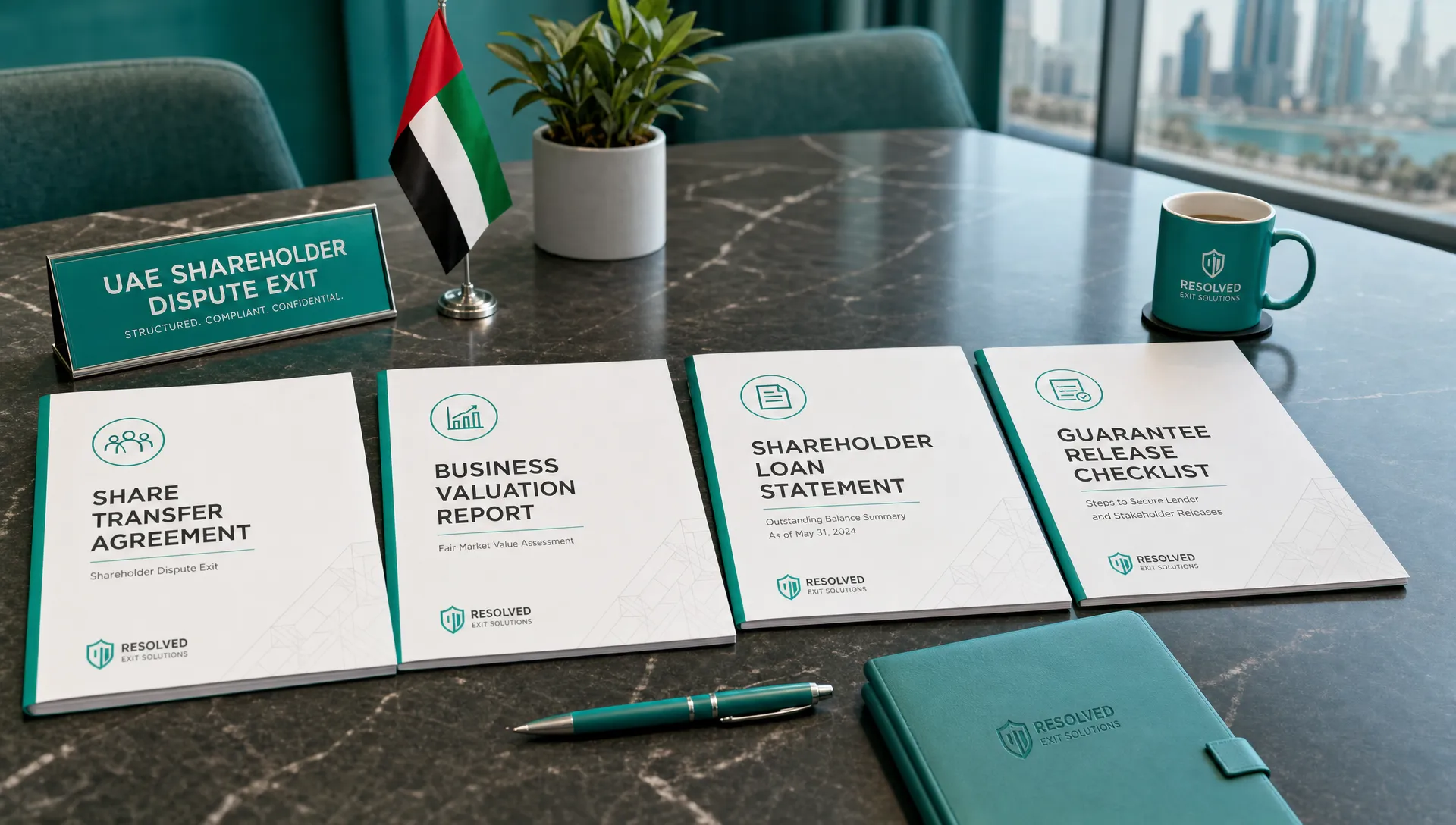
A signed settlement is useful only if the agreed actions can be completed. Have counsel identify the necessary documents, signatories and approvals before setting the completion date.
A term sheet should distinguish binding provisions from those still subject to definitive documentation. Do not assume that calling a document “heads of terms” determines its legal effect.
The definitive agreement should address the price, payment mechanics, loan treatment, necessary consents and conditions to completion. It should also allocate responsibility for fees, filings and the operational handover.
For deferred consideration, assess security and remedies if the buyer defaults. Depending on the circumstances and legal advice, the parties might consider an agreed escrow arrangement or another suitable security mechanism. Availability and enforceability must be checked rather than assumed.
In a UAE shareholder dispute, releases need particular care. Specify who is releasing whom, which claims are covered and what remains outstanding. The company may need to participate where its own rights or obligations are involved. A release between shareholders cannot bind an absent creditor or remove mandatory legal duties.
Address ongoing confidentiality, access to records and any proposed restrictive covenants. Set a procedure for resolving later disagreements over completion accounts, instalments or the handover rather than leaving those issues undefined.
Check tax, banking and compliance consequences
A change of ownership does not automatically end the company’s bookkeeping, tax filing or record-retention obligations. Allocate responsibility for outstanding filings and give the continuing management access to the records needed to complete them.
Obtain transaction-specific tax advice. Relevant questions can include the seller’s status, the nature of the interest being sold, related-party pricing and the treatment of loan waivers or settlement payments. Cross-border owners may also have reporting or tax obligations outside the UAE. Consult current Federal Tax Authority guidance alongside professional advice.
Check whether beneficial ownership records, licence details, registered-agent records or bank customer information require updating. A registrar’s ownership update does not necessarily complete the bank’s review.
If residency sponsorship or employment is connected to the company, plan those matters separately. Do not assume that a share transfer automatically determines visa status or resolves employment entitlements.
Coordinate signing, payment and registration
The final stage of a UAE shareholder dispute should be planned as a sequence of linked actions, not a collection of unrelated signatures.
Signing and completion may occur at different times. Some approvals or documents may be required before registration, while a bank may process its changes separately. Ask the relevant authority, registered agent and bank to confirm their requirements early.
Use a completion checklist covering:
- Pre-completion conditions: Required consents, agreed financial information, funding evidence and any creditor releases needed before you proceed.
- Transfer and payment: Execution requirements, registration steps, lawful payment arrangements and evidence that completion has occurred.
- Management handover: Director or manager changes, bank mandates, lawful transfer of business access and custody of corporate records.
- Post-completion evidence: Updated ownership records, filing receipts, loan treatment documents and confirmation of outstanding actions.
Where possible, coordinate payment with the legally effective transfer using arrangements approved by your advisers and accepted by the relevant parties. Do not assume that handing over a share certificate or signing a private agreement completes the transfer.
Retain an exit file containing executed documents, payment evidence, written releases and registry confirmations. Record unresolved items with a named owner and deadline.
If a creditor will not release you, treat that as an explicit commercial decision. Consider whether to delay completion, require alternative protection or decline the proposed deal, rather than discovering the continuing exposure afterward.
Frequently asked questions
Can I leave a UAE company simply by resigning as a director? Resignation addresses a management role, not share ownership. The required process depends on the company’s rules, and ownership must be dealt with separately. Resignation also does not automatically extinguish liabilities arising from earlier conduct.
Does selling my shares release my personal guarantees? No. Obtain a written release or another arrangement expressly accepted by the creditor. A buyer’s promise to indemnify you does not prevent the creditor from enforcing a guarantee that remains in place.
What happens if the other shareholder refuses to buy me out? There is no universal right to compel a buyout. Counsel should assess the governing documents, any deadlock mechanism, potential third-party transfer and available legal remedies. Mediation may help where a negotiated outcome remains possible.
Can a shareholder loan be repaid as part of the exit? It can be addressed in the settlement, subject to the loan terms, required approvals, the company’s financial position and applicable law. Document its treatment separately from the share price and consider tax consequences.
Should the company be closed to resolve the dispute? Not necessarily. A buyout or permitted third-party sale may preserve the business. Winding-up is a separate process requiring consideration of creditors, employees, tax obligations and closure formalities.
Plan the exit around evidence, not assumptions
The strongest exit plan identifies what must happen, who must authorize it and which documents prove it is complete. Price matters, but so do creditor releases, valid ownership records and a controlled handover.
Alldren provides corporate structuring, governance, compliance management, bookkeeping and tax registration services, with direct access to senior experts and transparent upfront pricing. Discuss the corporate administration and ongoing compliance aspects of your proposed exit, while engaging qualified legal counsel for dispute strategy, settlement terms and any contested proceedings.