
Most share ownership problems start with a percentage that looked fair on day one. Two founders split 50/50 because they trust each other. A spouse is added to the share register for convenience. An investor gets ordinary shares when they actually expected veto rights. A holding company is added after the operating company has already signed contracts, hired staff, opened bank accounts, and registered for tax.
The issue is not that these choices are always wrong. The issue is that they are often made before anyone has defined what ownership is supposed to achieve.
In the UAE, share ownership affects far more than who receives dividends. It shapes licensing, banking, beneficial ownership disclosures, governance, exit rights, succession, corporate tax, investor due diligence, and family risk. The right structure is not necessarily the most complex one. It is the one where legal title, economic rights, control, and compliance all point in the same direction.
Share ownership is not just a percentage
A cap table shows who owns how many shares, but it does not always show who controls the company, who benefits economically, or what happens when a shareholder leaves, dies, divorces, defaults, or wants to sell.
Good ownership structuring separates five concepts that are often confused.
| Ownership layer | What it answers | Why it matters |
|---|---|---|
| Legal ownership | Whose name appears on the share register | Determines formal shareholder rights and filings |
| Beneficial ownership | Who ultimately owns or controls the shares | Required for KYC, UBO records, AML checks, and bank onboarding |
| Economic ownership | Who receives dividends, sale proceeds, or carried value | Drives commercial expectations and tax analysis |
| Voting control | Who can approve or block decisions | Protects founders, investors, and families from unwanted actions |
| Management authority | Who runs the company day to day | Affects signing powers, governance, liability, and banking comfort |
When these layers align, the structure is easier to explain to banks, regulators, investors, auditors, and family members. When they conflict, even a simple company can become difficult to manage.
For example, a person may legally hold 40 percent of the shares but have no board appointment right. A founder may hold 70 percent but still need unanimous consent for issuing new shares, selling assets, or changing the business. A holding company may be the legal shareholder, while individuals behind it remain the ultimate beneficial owners for disclosure purposes.
That distinction is not academic. It is the difference between a structure that survives growth and a structure that creates disputes.
Start with the outcome, not the percentage split
Before choosing a free zone, drafting a shareholder agreement, or issuing shares, define the commercial objective. A company formed to run a trading business needs a different ownership design from a company formed to hold property, intellectual property, family assets, or shares in subsidiaries.
The key questions are straightforward:
- What will the company own or do?
- Who is contributing cash, intellectual property, relationships, guarantees, or operational work?
- Who should control major decisions?
- Who should receive profits and sale proceeds?
- How can a shareholder exit without damaging the business?
- What happens on death, incapacity, divorce, bankruptcy, or a dispute?
- Will investors, lenders, banks, or family members need to understand the structure later?
If the answers are simple, the structure should usually stay simple. Complexity should earn its place. A multi-layer structure can be valuable, but only when it solves a real issue such as risk separation, succession, investor admission, privacy with transparency, asset protection, or tax planning.
If you need a broader framework before deciding who should own what, Alldren explains the ownership, control, and operations layers in its guide to the corporate structure of a company.
Choose the ownership model that matches the function
There is no universal best shareholding structure. A solo consultant, a venture-backed founder, a real estate investor, and a family office do not need the same architecture.
In UAE business incorporation, the right model depends on the role of the entity. A RAKEZ free zone company may be appropriate for an operational business that needs a UAE license, visas, office facilities, and commercial substance. A RAK ICC offshore company or foundation may be considered for holding shares, investment assets, or special purpose structuring, where it is suitable and accepted by counterparties. A mainland entity may be required for certain activities or market access.
The important point is not to confuse the tool with the strategy. An offshore company UAE structure is not a substitute for an operating license. A free zone license is not a shareholder agreement. A nominee arrangement is not a governance system. Each part must have a job.
| Model | Common use case | Main advantage | Main caution |
|---|---|---|---|
| Direct individual shareholding | Simple founder-owned company | Clear and easy to administer | Personal events can affect the shares |
| Operating company owned by active partners | Joint venture or co-founder business | Aligns ownership with contribution | Needs exit, deadlock, and leaver provisions |
| Holding company owning operating company | Group, investor, or asset separation structure | Separates ownership from trading risk | Adds compliance, banking, and tax considerations |
| Foundation or private structure | Family ownership, succession, or long-term control | Can create continuity beyond individual ownership | Requires careful governance and professional administration |
| Nominee or controlled appointment arrangement | Administration, continuity, or confidentiality with disclosure | Can simplify management in specific cases | Must not obscure UBO reality or bank disclosures |
For founders and investors considering a group model, Alldren's article on when a UAE holding company structure works is a useful companion to this discussion.
Design economics, control, and exit rights together
A common mistake is to negotiate ownership percentages first and governance rights later. That approach creates gaps. A shareholder's percentage tells you how much of the company they own, but not what they can do with that ownership.
The main rights should be designed as one package.
| Right | What to decide before shares are issued |
|---|---|
| Dividend rights | Whether profits are distributed by percentage, preference, class, or board decision |
| Voting rights | Which matters need ordinary approval, special approval, or unanimous consent |
| Board or manager appointment | Who can appoint directors, managers, signatories, or authorized representatives |
| Reserved matters | Which decisions need founder, investor, or family approval |
| Transfer restrictions | Whether shares can be sold, pledged, gifted, or transferred to affiliates |
| Pre-emption rights | Whether existing shareholders must be offered shares before outsiders |
| Drag and tag rights | How minority and majority shareholders are treated on a sale |
| Leaver provisions | What happens if a founder or partner stops contributing |
| Deadlock mechanisms | How 50/50 disputes or veto deadlocks are resolved |
| Succession provisions | What happens on death, incapacity, divorce, or inheritance events |
Equal ownership is not the same as fair ownership. A 50/50 split can work when the partners have strong trust, clear roles, and a deadlock mechanism. Without those protections, it can paralyze the company. A 60/40 split can also fail if the minority shareholder expected consent rights that were never documented.
For partner-led companies, it is worth reviewing Alldren's guidance on setting up shareholders safely, especially where contributions, control, and exit rights need to be balanced from the beginning.
Make founder and partner equity earnable where needed
Not every shareholder contributes in the same way. One founder may provide cash. Another may build the product. A third may bring licensing, client relationships, or market access. If everyone receives fully vested shares on day one, the company may be exposed if one person leaves early.
That is why founder shares often need vesting, milestone-based issuance, call options, transfer obligations, or leaver provisions, subject to what is legally available in the relevant jurisdiction and company type. The commercial principle is simple: long-term equity should usually be tied to long-term contribution.
This is especially important in professional services, technology, real estate, and family-backed ventures where the value of the company depends on active involvement. If a shareholder stops contributing but keeps the same rights forever, the remaining team may be left carrying the business while value is locked in the wrong hands.
The same applies to intellectual property. If IP is central to the business, the ownership structure should confirm who owns it, who licenses it, whether it sits in the operating company or a holding entity, and what happens if a founder departs.
Keep assets separate from operating risk
Many UAE structures fail because every asset is placed inside one company. The same entity signs supplier contracts, hires employees, takes client risk, owns IP, holds investment assets, and receives family capital. That may be simple at the start, but it can become inefficient and risky as the business grows.
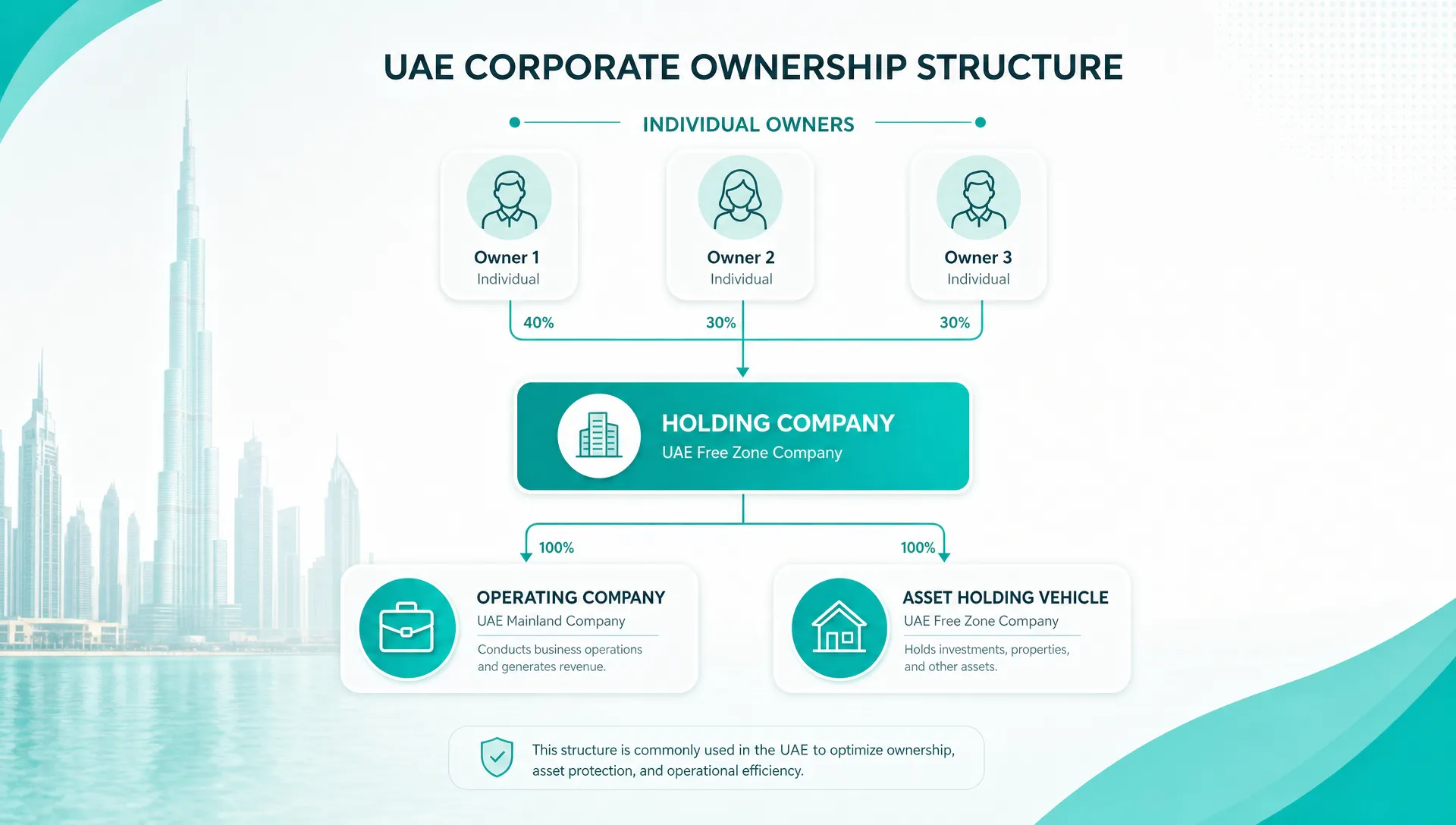
A more robust approach may separate the layers:
- An operating company carries on the licensed business activity.
- A holding company owns shares in operating entities.
- An asset company holds specific assets such as IP, property, or investment interests.
- A foundation or private structure may sit above the group for succession or family governance where appropriate.
This does not mean every business needs three entities. Many do not. But high-value assets should not automatically sit in the same company as day-to-day trading liabilities unless there is a good reason.
For Ras Al Khaimah company formation, this distinction is particularly relevant because RAKEZ free zone entities and RAK ICC structures serve different purposes. RAKEZ is commonly associated with licensed UAE business activity, while RAK ICC is often considered for international companies, SPVs, foundations, and holding structures. The right combination depends on activity, banking, tax, ownership, and governance needs.
Make the documents match the reality
The best ownership structure is not only a chart. It must be reflected in documents, filings, registers, and operating practice.
At minimum, the structure should be consistent across the memorandum and articles, shareholder register, shareholder agreement, board resolutions, UBO records, licensing documents, bank KYC forms, tax registrations, accounting records, and any nominee or service agreements.
This consistency matters because counterparties test structures through documents. A bank may ask who controls the company. An investor may ask who owns the IP. A regulator may ask for ultimate beneficial owner details. A tax adviser may ask why dividends, management fees, or related party payments move between entities. If the paperwork gives different answers, the structure loses credibility.
A shareholder agreement is particularly important, but it should not be treated as a magic fix. It needs to align with constitutional documents and the rules of the relevant UAE jurisdiction. If the agreement says one thing while the public or internal company records say another, enforcement and practical administration can become difficult.
Treat compliance and governance as part of ownership
Share ownership is inseparable from compliance and governance. UAE authorities, banks, and professional counterparties expect transparency over who ultimately owns and controls companies. International standards also place growing emphasis on beneficial ownership transparency, as reflected in the FATF guidance on beneficial ownership of legal persons.
A well-structured company should be able to answer these questions without hesitation:
- Who are the legal shareholders?
- Who are the ultimate beneficial owners?
- Who has voting control?
- Who appoints managers or directors?
- Who can sign contracts and bank instructions?
- Who receives profits?
- Who bears risk?
- Why does each entity in the structure exist?
This is where compliance and governance become practical. The structure must be easy to administer, not just impressive on paper. If a company has multiple shareholders but no process for approving accounts, distributions, share transfers, borrowing, or related party transactions, disputes are only delayed.
Do not leave tax and banking until the end
Ownership choices can affect UAE corporate tax, withholding assumptions in other jurisdictions, VAT registration, accounting, transfer pricing, and banking. Tax should not be the only driver of the structure, but it must be considered before shares are issued or transferred.
The UAE corporate tax regime, administered under the framework explained by the UAE Ministry of Finance, generally applies a 9 percent rate to taxable income above AED 375,000, while qualifying free zone treatment may apply only where specific conditions are met. Related party dealings, management fees, financing arrangements, intellectual property licensing, and dividend flows may all require proper analysis.
Banks also care about ownership. A clean bank account opening process usually depends on a structure that is explainable. Multi-layer structures can be acceptable, but only if the commercial rationale, source of funds, source of wealth, business activity, UBOs, and control rights are clear.
In practice, the structure that looks tax efficient on a diagram may fail if a bank does not understand it, if the free zone activity does not match the revenue model, or if documentation does not support the claimed ownership and control position. UAE tax advisory, banking support, and corporate structuring should therefore be coordinated early.
Common share ownership mistakes to avoid
Most ownership disputes are predictable. They usually come from missing documents, unclear expectations, or structures copied from another business without considering the actual stakeholders.
Avoid these common mistakes:
- Splitting shares equally with no deadlock mechanism.
- Giving someone shares before their contribution is delivered.
- Using a friend, spouse, or nominee without clear legal documentation and UBO transparency.
- Mixing high-value assets with operating liabilities for convenience.
- Assuming a free zone license defines shareholder rights.
- Ignoring what happens on death, incapacity, divorce, or bankruptcy.
- Adding a holding company after value has already accumulated without tax and legal review.
- Letting bank mandates, accounting records, and shareholder agreements tell different stories.
The solution is not to overcomplicate every structure. It is to document the commercial bargain before the company becomes valuable, regulated, indebted, or disputed.
A practical process for structuring share ownership
A disciplined process helps avoid expensive redesign later.
- Map the stakeholders, including founders, investors, family members, nominees, managers, and ultimate beneficial owners.
- Identify what the company will own, what risks it will take, and where revenue will be generated.
- Choose the right entity type and jurisdiction based on activity, control, tax, banking, and licensing needs.
- Decide the cap table, share classes, voting rights, economic rights, and reserved matters before incorporation where possible.
- Draft and align the shareholder agreement, constitutional documents, registers, resolutions, UBO filings, and service agreements.
- Prepare a banking and compliance narrative that explains the structure clearly and truthfully.
- Review the structure whenever a new investor, partner, asset, jurisdiction, financing arrangement, or succession issue appears.
This process is especially valuable for founders using company setup UAE services, because incorporation is only one step. The deeper question is whether the company can operate, raise capital, distribute profits, survive disputes, and pass due diligence.
When should ownership be reviewed?
Share ownership is not a one-time decision. It should be reviewed before major events, not after them.
A review is sensible when a new shareholder joins, a founder leaves, the company raises funding, IP is created or transferred, a new subsidiary is formed, assets are acquired, a bank requests more documentation, a family succession plan changes, or the company becomes subject to new tax or reporting obligations.
A structure that was perfect for a two-person startup may be unsuitable for a regional group. A direct personal shareholding may be fine for a simple business, but less appropriate once family wealth, investor rights, or cross-border assets are involved.
The right question is not whether the current structure still exists legally. The right question is whether it still reflects the commercial, personal, tax, and governance reality.
Frequently Asked Questions
What is the best share ownership structure for a UAE company? The best structure depends on the company's activity, shareholders, assets, tax position, banking needs, and succession goals. A simple direct shareholding may be right for a small owner-managed company, while a holding company, RAK ICC offshore vehicle, or foundation may be suitable for more complex ownership or asset protection needs.
Should co-founders split shares 50/50? A 50/50 split can work, but only if there is a clear deadlock mechanism, defined roles, leaver provisions, and agreed decision rules. Without those protections, equal ownership can stop the company from making key decisions.
Can a RAK ICC offshore company own shares in a UAE operating company? In many structures, a RAK ICC vehicle may be considered as a holding or SPV company, subject to the rules of the relevant operating company, free zone, bank, and activity. It should be assessed before implementation because licensing, tax, UBO, and banking requirements still apply.
Does a shareholder agreement override the company documents? Not automatically. A shareholder agreement should be aligned with the memorandum, articles, registers, resolutions, and local jurisdiction rules. If documents conflict, the structure may be harder to enforce or administer.
How does share ownership affect UAE corporate tax? Ownership can affect related party treatment, dividend flows, transfer pricing, free zone qualification, participation exemptions, and the tax analysis of share transfers. UAE tax advisory should be integrated before shares are issued, transferred, or placed into a holding structure.
Are nominee arrangements safe? They can be appropriate in specific circumstances when properly documented and transparently disclosed where required. They are risky when used informally, when the beneficial owner is hidden from banks or authorities, or when control rights are not clearly documented.
Build share ownership that can survive scrutiny
The right share ownership structure should be clear to shareholders, acceptable to banks, compliant with UAE rules, practical for management, and resilient during disputes, exits, and succession events.
Alldren provides expert-led corporate services UAE clients use for company setup, structuring, compliance management, governance, bank account opening support, UAE residency visa processing, bookkeeping, tax registration, and ongoing administration. The focus is not just incorporation. It is building a corporate structure that works after the company is formed.
If you are planning UAE business incorporation, restructuring an existing company, or reviewing ownership before bringing in partners or investors, speak with Alldren before the share register becomes difficult to unwind.
This article is general information and should not be treated as legal or tax advice. Share ownership decisions should be reviewed against your specific facts, jurisdiction, documents, and objectives.