
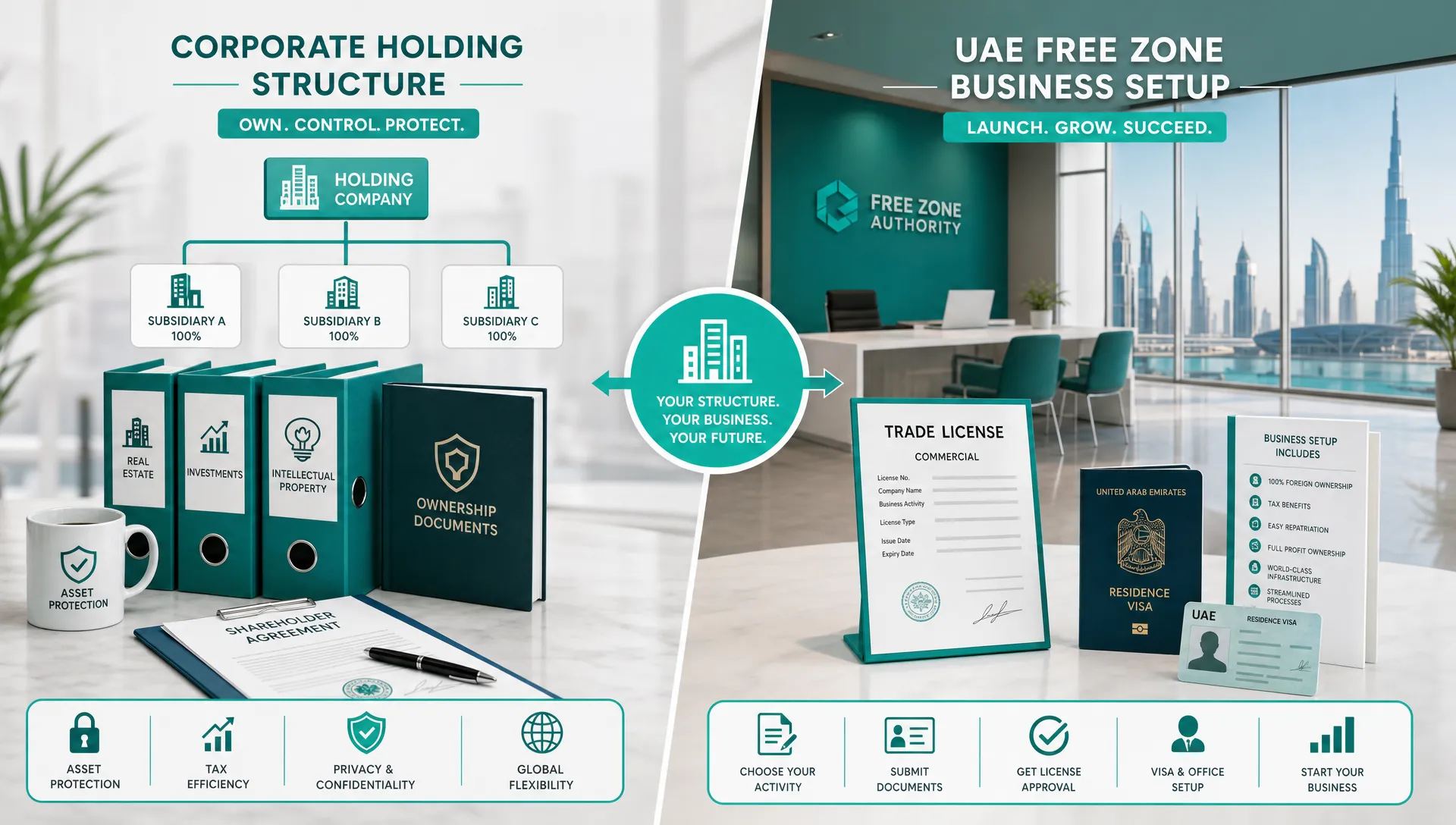
Choosing between a RAK ICC company and a UAE free zone company is not really a question of which structure is “better.” It is a question of purpose. One is primarily a corporate holding and structuring vehicle. The other is an operating platform for licensed business activity, visas, premises, and commercial presence.
That distinction matters because the wrong choice can create banking friction, tax uncertainty, licensing gaps, and avoidable restructuring costs later. A RAK ICC company may be ideal for a holding company, SPV, or asset planning structure, but it is usually a poor fit for a founder who needs UAE residency visas and a day-to-day operating license. A free zone company can support commercial activity and employee visas, but it may be more than you need if your only goal is to hold shares or ring-fence an asset.
This guide gives you a practical decision framework for 2026, with a focus on RAK ICC offshore structures and Ras Al Khaimah free zone options such as RAKEZ.
The core difference: holding vehicle vs operating company
A RAK ICC company is incorporated through the Ras Al Khaimah International Corporate Centre, often described in the market as an offshore company in the UAE. It is commonly used for holding shares, acting as a special purpose vehicle, owning certain assets subject to registry rules, succession planning, treasury structuring, and international investment arrangements.
A free zone company, such as a company formed in RAKEZ, is a licensed business entity. It is designed for active commercial activity under an approved license category, such as consulting, trading, e-commerce, manufacturing, services, or other permitted activities. It can typically lease a facility or flexi desk, apply for visa eligibility according to its package, and operate from within the free zone framework.
Put simply, a RAK ICC company is usually chosen when the company’s main job is to own, hold, or structure. A free zone company is usually chosen when the company’s main job is to operate, hire, invoice, and build a business presence.
If you want a deeper explanation of the offshore side, Alldren’s guide to a RAK ICC offshore company’s best uses and limits is a useful companion to this comparison.
RAK ICC vs free zone at a glance
The fastest way to narrow the choice is to map your structure to your real business objective. The table below summarizes the typical fit.
| Goal | RAK ICC company | Free zone company, such as RAKEZ | Usually better fit |
|---|---|---|---|
| Hold shares in other companies | Strong fit for holding and SPV use | Possible, but often more operational than needed | RAK ICC |
| Run an active consulting or service business | Generally not the right tool for UAE operations | Strong fit if activity is licensed | Free zone |
| Apply for UAE residence visas | Not typically available | Available subject to license, facility, and quota | Free zone |
| Lease office or flexi desk space | Not the purpose of the structure | Core part of many free zone setups | Free zone |
| Hold family or investment assets | Often suitable, subject to asset rules and tax advice | Possible, but may be less efficient | RAK ICC |
| Trade goods from a UAE base | Not usually appropriate for UAE trading operations | Suitable if trading activity and customs needs are planned correctly | Free zone |
| Build commercial substance in the UAE | Limited, unless combined with other arrangements | Better suited to operational substance | Free zone |
| Create a group holding company above an operating entity | Often a strong fit | Can be used, but may not be the cleanest option | RAK ICC |
| Open a bank account for an active operating business | Possible in some cases, but may face more scrutiny | Often clearer if activity, premises, and transactions align | Free zone |
| Keep compliance simple for passive ownership | Can be efficient, but not compliance-free | More annual operational obligations | RAK ICC |
This is not a substitute for legal, tax, or banking advice. It is a starting point for choosing the right corporate architecture before you commit to incorporation.
Choose a RAK ICC company when the goal is ownership or structuring
A RAK ICC company is usually a strong candidate when the entity is not meant to be the public-facing operating business. Its purpose is often to sit above assets, subsidiaries, or investment positions.
Common RAK ICC use cases include:
- Holding shares in UAE or non-UAE companies
- Acting as a special purpose vehicle for a specific transaction
- Holding intellectual property, subject to tax and substance analysis
- Ring-fencing assets or liabilities within a wider group
- Supporting family wealth, succession, or estate planning objectives
- Holding investment portfolios or treasury assets, subject to banking and tax review
The attraction is structural flexibility. A RAK ICC company can provide a clean corporate layer without the same operational footprint that a free zone company normally requires. That can be valuable for founders, private clients, family offices, and international groups that need a UAE-incorporated holding vehicle rather than an operating license.
However, “offshore” should not be misunderstood. A RAK ICC company is not a shortcut for carrying on licensed business in the UAE, avoiding tax obligations, or bypassing bank due diligence. Banks, tax authorities, counterparties, and asset registries will still ask what the company does, who owns it, where value is created, and why the structure exists.
Choose a free zone company when the goal is operations
A free zone company is usually the better fit when you need to conduct active business from the UAE. In Ras Al Khaimah, RAKEZ is one of the most widely considered options for entrepreneurs because it supports a broad range of licensed activities and facility choices.
A free zone company is typically more appropriate if you need to:
- Invoice clients from a licensed UAE entity
- Apply for UAE residence visas for shareholders or employees
- Open a bank account for day-to-day business activity
- Lease a workspace, warehouse, flexi desk, or other facility
- Build operational substance in the UAE
- Import, export, trade, or provide services under a defined license
- Hire staff and manage payroll, accounting, VAT, and corporate tax compliance
The important point is that a free zone company is license-led. Your activity, revenue model, customers, facility, and visa needs should be aligned from the beginning. A mismatch between what your license says and what your business actually does can create problems with renewals, banking, contracts, and tax filings.
For founders comparing RAKEZ specifically, Alldren’s RAKEZ Free Zone Ras Al Khaimah guide for founders explains how activity selection, facilities, banking readiness, and compliance planning work together.
The five decision factors that matter most
The right answer usually becomes clear once you test your goals against five practical factors: activity, visas, banking, tax, and governance.
1. What will the company actually do?
Start with the business reality, not the label. If the company will simply hold shares, hold an asset, or act as an SPV, RAK ICC may be appropriate. If the company will sell services, hire people, sign operating contracts, or trade goods, a free zone structure is usually more suitable.
A common mistake is forming a RAK ICC company because it appears simpler, then using it like an operating company. That can create issues if the activity requires a UAE trade license, sector approval, customs registration, or a physical presence.
2. Do you need UAE residence visas?
If visas are part of the plan, a free zone company is usually the starting point. Free zone companies can generally apply for immigration eligibility depending on the selected package, facility type, and visa quota. RAK ICC companies are not normally used to sponsor UAE residence visas.
This is often the deciding factor for founders relocating to the UAE. If the founder needs a residence visa, Emirates ID, local banking pathway, and an operating base, a free zone company usually fits better than an offshore company.
3. What will the bank need to see?
Banking is not only about incorporation documents. UAE and international banks increasingly focus on economic rationale, beneficial ownership, source of funds, expected transaction flows, and whether the company’s structure matches its activity.
A free zone company may be easier to explain when it has a clear license, physical address, invoices, contracts, and operating plan. A RAK ICC company can still be bankable in appropriate cases, especially for holding or investment structures, but the bank may ask more questions about the reason for the offshore vehicle, the location of counterparties, and the source of wealth or funds.
In both cases, the best banking strategy starts before incorporation. The company name, activity description, ownership structure, countries of transaction, and supporting documents should all be considered early.
4. What are the tax and compliance consequences?
Neither structure should be treated as automatically tax-free or compliance-free. The UAE corporate tax regime applies a federal framework, and free zone companies must assess whether they qualify for any preferential treatment under the relevant rules. The UAE Federal Tax Authority provides official guidance through its corporate tax resources, but each structure still needs case-specific review.
Free zone companies may need to consider corporate tax registration and filing, VAT registration if taxable supplies exceed the applicable threshold, accounting records, audited financial statements where required, transfer pricing, and substance considerations. RAK ICC companies may also need to consider corporate tax, economic substance, accounting records, beneficial ownership information, and any reporting duties that apply to the company’s activities.
The right question is not “Which structure has no compliance?” The right question is “Which compliance profile properly matches my activity and risk?”
5. How will the structure evolve?
A structure that works for year one may not work for year three. A solo consultant may begin with a simple free zone company, then later add a holding company above it. A family office may start with a RAK ICC holding vehicle, then form a free zone company for active management or advisory operations. A startup may require a structure that is understandable to investors, banks, and future acquirers.
Think about exit, succession, investment, and asset protection from the beginning. It is usually easier to design a clean structure upfront than to repair a confused structure after accounts, contracts, and ownership records are already in place.
Scenario-based recommendations
The following examples show how the choice often plays out in real life.
Scenario 1: A founder relocating to the UAE to run a consultancy
A consultant who wants to live in the UAE, invoice clients, open a bank account, and sponsor a residence visa will generally be better served by a free zone company. The company needs an operating license, and the founder needs immigration eligibility. RAK ICC is unlikely to meet those practical needs on its own.
Scenario 2: An investor holding shares in several companies
An investor who wants a UAE-incorporated vehicle to hold shares in operating companies may find RAK ICC more appropriate. The entity’s primary role is ownership, not trading. This can be especially relevant where the goal is a clean holding layer, future sale planning, or separation between personal ownership and operating risk.
Scenario 3: An e-commerce business selling across markets
An e-commerce founder needs to examine where goods are stored, where customers are located, how payment processing will work, whether import or export activity is involved, and what license category is required. In many cases, a free zone company is the more natural fit because the business is active and commercial. RAK ICC may still be relevant as a holding company above the operating entity, but not usually as the trading entity itself.
Scenario 4: A family holding real estate or investment assets
RAK ICC may be useful for asset holding or succession planning, but asset-specific rules matter. Real estate registries, banks, lenders, insurers, and foreign tax rules may impose their own requirements. Before using any offshore company UAE structure for property or investments, confirm that the asset can be held by that entity and that the tax treatment is understood in every relevant jurisdiction.
Scenario 5: A startup preparing for investors
Startups often need a structure that can issue shares, sign operating contracts, hire people, receive investment, and satisfy investor due diligence. A free zone operating company may be appropriate for the business itself, while a RAK ICC company may be considered as a holding or SPV layer depending on investor expectations and legal advice.
When both structures may be the right answer
For some clients, the choice is not RAK ICC or free zone. It is RAK ICC plus free zone, with each entity doing a different job.
A common arrangement is a holding company and operating company structure. The RAK ICC company may hold shares in a RAKEZ or other free zone operating company. The free zone company runs the business, employs staff, signs client contracts, and holds the relevant license. The RAK ICC company sits above it as the shareholder, supporting group organization, asset separation, succession planning, or future investment structuring.
This can be powerful, but only when designed carefully. Intercompany agreements, accounting, transfer pricing, tax filings, bank explanations, and governance records should all be consistent. A holding company that has no clear purpose may add cost and complexity. A holding company with a clear purpose can make the wider structure more robust.
If you are still comparing RAK structures beyond this two-way choice, Alldren’s RAK license guide for new companies provides a broader view of mainland, free zone, and offshore options.
Common mistakes to avoid
The most expensive errors usually happen before incorporation, not after. Here are the mistakes to watch for.
| Mistake | Why it creates problems | Better approach |
|---|---|---|
| Choosing RAK ICC for an active UAE business | The company may not have the right operating license, visa pathway, or commercial footprint | Use a free zone or mainland structure if you need active UAE operations |
| Choosing a free zone company only to hold passive assets | You may take on unnecessary license, facility, and renewal obligations | Consider whether a RAK ICC holding vehicle is cleaner |
| Treating “offshore” as tax-free | UAE and foreign tax rules may still apply | Review corporate tax, VAT, ESR, and home-country implications |
| Ignoring banking until after incorporation | The bank may reject or delay the account if the structure is unclear | Build the banking narrative before setup |
| Selecting the wrong license activity | Contracts, invoices, and bank activity may not match the license | Align activity, revenue model, and future plans |
| Forgetting annual compliance | Renewals, records, filings, and governance can be missed | Create a compliance calendar from day one |
A practical decision checklist
Before you decide, answer these questions honestly. The answers will usually point toward the right structure.
- Will the company actively sell goods or services? If yes, a free zone company is usually more appropriate.
- Do you need UAE residence visas? If yes, a free zone company is usually required.
- Is the company mainly holding shares, assets, or investments? If yes, RAK ICC may be a strong candidate.
- Will you need a physical facility, warehouse, or flexi desk? If yes, look at free zone options.
- Will banks expect evidence of operating substance? If yes, a free zone company may be easier to support.
- Are there investors, lenders, or asset registries involved? If yes, confirm their requirements before incorporation.
- Do you need both a holding layer and an operating entity? If yes, consider a combined structure rather than forcing one entity to do everything.
The best structure is not the one with the shortest setup form. It is the one that will still make sense when a bank, auditor, tax adviser, investor, or regulator reviews it later.
Frequently Asked Questions
Is a RAK ICC company the same as a RAKEZ free zone company? No. RAK ICC is typically used for offshore-style holding, SPV, and asset structuring purposes. RAKEZ and other free zones issue licenses for active business operations, facilities, and visa eligibility.
Can a RAK ICC company sponsor UAE residence visas? Generally, no. If UAE residency visas are part of your goal, a free zone company is usually the more appropriate route, subject to the selected package, facility, and immigration requirements.
Is a RAK ICC company tax-free? You should not assume that. UAE corporate tax, economic substance, accounting, and foreign tax rules may still need to be assessed. The correct treatment depends on the company’s activity, income, ownership, and management.
Can a free zone company trade with mainland UAE customers? It depends on the activity, licensing model, and how the business is conducted. Some free zone companies can serve mainland clients, while certain trading or regulated activities may require additional permissions, distribution arrangements, or a mainland structure.
Which is easier for bank account opening, RAK ICC or free zone? There is no guaranteed answer. A free zone company often has a clearer operating profile for banks because it has a license, address, and business activity. A RAK ICC company can be suitable for holding or investment purposes, but the bank will usually want a clear explanation and strong supporting documents.
Can I start with one structure and change later? Sometimes, but it may require forming a new entity, transferring assets, updating contracts, or restructuring ownership. It is better to design the right structure at the beginning, especially if tax, banking, investment, or asset ownership is involved.
Build the structure around the goal
RAK ICC and free zone companies solve different problems. If your goal is holding, asset planning, or an SPV, RAK ICC may be the cleaner tool. If your goal is active business, visas, facilities, and licensed operations, a free zone company is usually the better fit. If you need both asset separation and operating capability, a combined structure may be the right answer.
Alldren helps founders, investors, and private clients design UAE corporate structures with a focus on transparency, compliance, and long-term usability. If you are weighing RAK ICC against a free zone company, or considering a holding and operating company setup, you can work with Alldren’s UAE corporate services team to assess the right path before you incorporate.