

If you are considering setting up a UAE company in a cost-efficient free zone with solid infrastructure and straightforward incorporation, RAKEZ Ras Al Khaimah (Ras Al Khaimah Economic Zone) is often on the shortlist. The practical questions are always the same: which license do you need, what fees should you budget for, and what are the exact steps to get from “idea” to an issued trade license.
This guide breaks down RAKEZ Ras Al Khaimah licenses, fee components, and setup steps in a decision-ready way, without guessing at numbers that can change by activity, visa quota, and facility choice.
What is RAKEZ (Ras Al Khaimah Economic Zone)?
RAKEZ is a major UAE free zone authority based in the Emirate of Ras Al Khaimah. Like other UAE free zones, RAKEZ enables foreign founders to establish a company that can be owned 100% by non-UAE nationals (subject to the chosen legal form and rules), and it provides licensing, immigration (visa) processing, and facility options.
RAKEZ is commonly chosen for a mix of cost, speed, and flexibility, especially for:
- Services and consultancy firms
- Trading and import-export businesses
- Light industrial and manufacturing activities
- E-commerce models
- Founders who want a UAE entity plus residency visas
For official references, start with the RAKEZ website for the current activity list, packages, and authority requirements.

RAKEZ license types (and how to choose the right one)
Your RAKEZ license type must match what you actually do. This matters for compliance, bank account opening, invoicing, and VAT or corporate tax positioning.
While RAKEZ’s exact naming and permitted activities can evolve, most setups fall under a few familiar categories.
Common RAKEZ license categories
| License category (common) | Typically suitable for | Typical examples |
|---|---|---|
| Commercial / Trading | Buying and selling physical goods | Trading specific product categories, import-export, distribution |
| General Trading (where available) | Broader trading scope than a single product/activity | Multi-category trading under one license (subject to authority rules) |
| Service / Professional | Selling expertise, time, or digital deliverables | Consulting, marketing, IT services, design, management services |
| Industrial / Manufacturing | Making, processing, assembling, or packaging | Light manufacturing, processing, industrial operations |
| E-commerce (where available) | Online selling models | Online retail, marketplace selling (activity-specific) |
The most important “fit check” is: your activity description should match your contracts and invoices. A mismatch can create issues later, especially with compliance reviews, immigration renewals, or bank due diligence.
Legal forms you may see in RAKEZ
RAKEZ commonly offers structures such as:
- A free zone company with a single shareholder (often referred to as an establishment in some free zones)
- A free zone limited liability company with multiple shareholders
- A branch of an existing UAE or foreign company
The right option depends on ownership, liability preferences, planned substance, and how your group is structured.
RAKEZ fees: what you actually pay for (and what drives the total)
People often search “RAKEZ fees” hoping for a single number. In practice, the total setup budget is the sum of several components, and the biggest drivers are usually:
- License category and number of approved activities
- Legal form (new entity vs branch)
- Facility package (flexi desk, dedicated office, warehouse, land, etc.)
- Number of residency visas required
- Whether your activity is regulated or requires external approvals
Typical fee components in a RAKEZ setup
| Cost component | What it covers | What changes the price |
|---|---|---|
| Registration / incorporation | Forming the entity and issuing initial documents | Entity type, shareholder complexity, approvals |
| License issuance and renewal | Your trade license and annual renewal | Activity type, number of activities, approvals |
| Facility / lease | Flexi desk or physical premises | Size, location, warehouse vs office, term |
| Immigration establishment file | Ability to sponsor visas | Quota, authority rules, timing |
| Visa processing | Entry permit, status change, medical, Emirates ID, stamping | Number of visas, applicant profile, processing route |
| Compliance and operations | Accounting, VAT registration (if required), corporate tax considerations | Business model, thresholds, recordkeeping needs |
Two important notes for planning:
- Banking-related preparation is not a line item on the RAKEZ invoice, but it often affects timelines and professional support costs.
- Renewals matter. Your year-two budget can look different from year one depending on facility commitments, visa renewals, and operational compliance.
Corporate tax and VAT: do not treat them as afterthoughts
Since 2023, the UAE has implemented federal corporate tax rules. The standard corporate tax rate is 9% on taxable income above a threshold (with specific rules and potential free zone considerations for qualifying income). Always confirm your positioning against official guidance from the UAE Ministry of Finance and tax authority.
- Corporate tax overview: UAE Ministry of Finance
- VAT general information: UAE Federal Tax Authority
This is not just “tax talk”. Banks and counterparties may ask how you manage compliance, bookkeeping, and reporting.
RAKEZ setup steps (from planning to license issuance)
Below is a practical sequence most founders follow. Your exact path can vary based on whether you need visas immediately, whether the activity needs external approvals, and how quickly KYC documents are available.
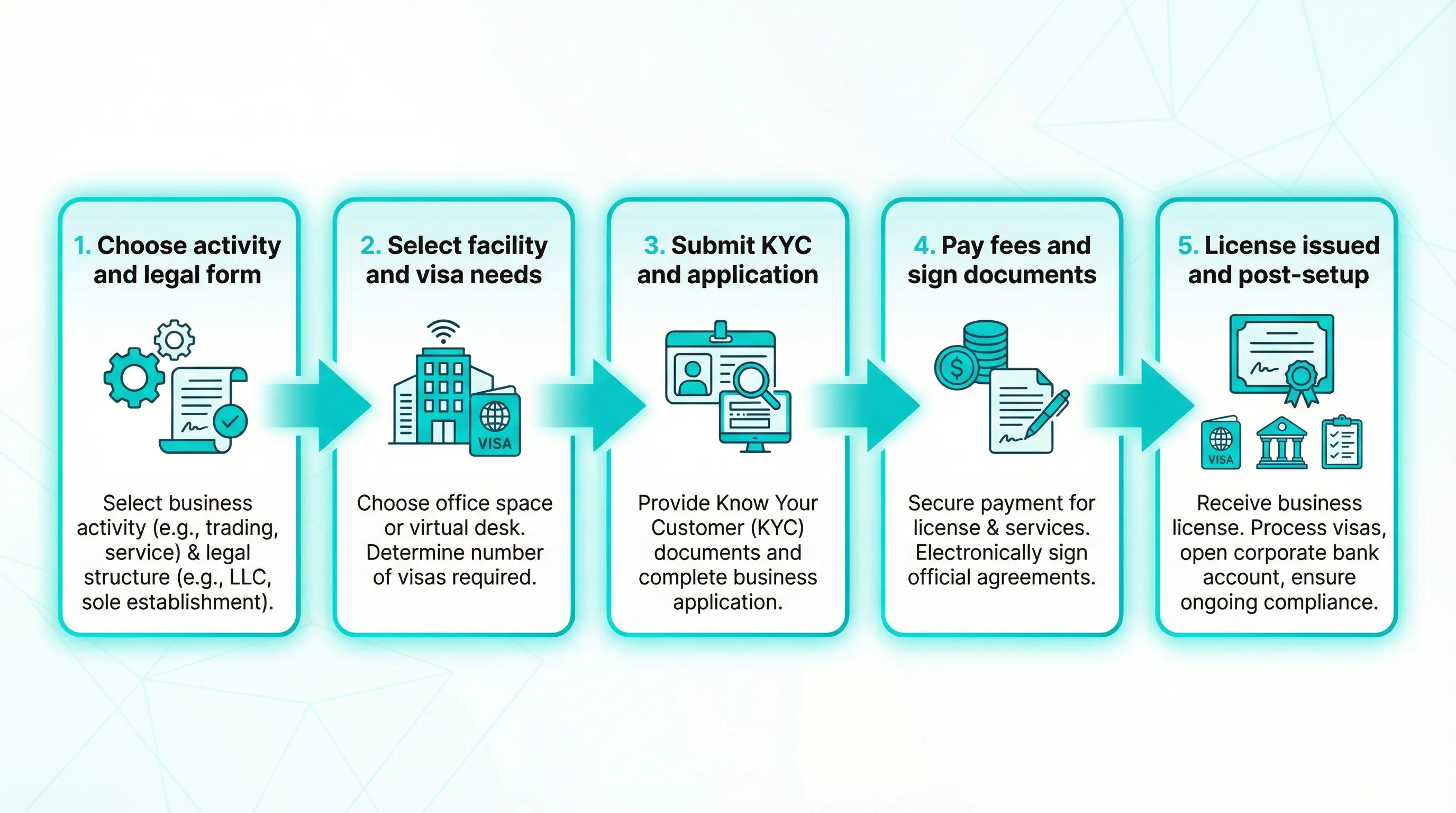
Step 1: Define your activity and compliance profile
Start by writing down:
- What you sell (service, goods, or manufacturing)
- Where customers are located (UAE, GCC, global)
- How you deliver (online, physical, on-site)
- Whether you need a regulated approval (industry-specific)
This step drives your license type and reduces the risk of selecting an activity that later causes banking or invoicing friction.
Step 2: Choose a legal structure (and shareholders)
Decide whether you need:
- A new free zone entity (single or multiple shareholders)
- A branch of an existing company
Consider governance early. If you will have multiple shareholders, clarify signing authority, profit distribution, and decision-making. These “paper decisions” tend to become real operational issues during banking and contract signing.
Step 3: Select a facility package and visa plan
Facility selection is not only about workspace, it is often linked to:
- Eligibility for a certain number of visas (quota)
- The credibility of your operating presence for counterparties
- Long-term cost commitments
Many early-stage founders choose a lighter facility footprint and expand when headcount grows, but it should still align with the substance your business realistically needs.
Step 4: Prepare and submit KYC and incorporation documents
Exact requirements vary by shareholder type (individual vs corporate) and your activity, but you should typically be prepared to provide:
- Passport copies and identity information for shareholders and managers
- Proof of address (commonly requested in KYC)
- Basic business profile (what you do, website if available, client or supplier profile)
- For corporate shareholders, legalized company documents may be required
If banking is a priority, build a “bank-ready” file at this stage. Strong documentation often prevents weeks of delays later.
Step 5: Pay fees, sign incorporation documents, and obtain your license
Once the authority approves the application and documents, you will:
- Sign incorporation and authority forms
- Pay the required fees
- Receive the issued trade license and company documents
After this, you can proceed with the operational steps many founders actually care about.
Post-setup: visas, bank account opening, and ongoing compliance
Residency visas (if needed)
If you plan to live in the UAE or hire team members under your entity, visas become part of your setup project plan. Typical stages include entry permit, medical, Emirates ID, and visa stamping, but the sequence depends on your current location and immigration status.
Because timelines can shift, treat visa processing as a parallel track, not something you start only after everything else is done.
Bank account opening
Banking outcomes depend on your profile, activity, countries involved, transaction expectations, and documentation quality. Practical steps that usually help include:
- Clear contracts or client pipeline evidence
- A coherent explanation of source of funds and expected flows
- Proper company documentation and signatory clarity
RAKEZ licensing is an enabler, but banking is a separate approval process handled by the bank.
Ongoing compliance
Plan for the “boring but essential” work from day one:
- Bookkeeping and record retention
- VAT registration and filing (if applicable)
- Corporate tax registration and compliance approach
- License renewal planning and immigration renewals
Good compliance reduces the risk of disrupted invoicing, delayed renewals, and banking friction.
Common mistakes when setting up in RAKEZ (and how to avoid them)
Picking an activity that does not match reality
If you invoice for “consulting” but your license is trading, or you run e-commerce but your activity is too narrow, you can face avoidable compliance and banking questions.
Underestimating the visa and renewal calendar
Your first-year setup can look smooth, then year-two becomes painful if you did not plan for:
- Renewal lead times
- Immigration renewals
- Facility commitments
- Compliance readiness
Treating “fees” as the only decision metric
A low headline price can be outweighed by:
- Extra paid amendments later (activity changes, signatory changes)
- A facility choice that restricts visa quota
- Delays due to missing KYC preparation
A good setup optimizes for total cost, speed, and long-term operability, not only the first invoice.
Frequently Asked Questions
Is RAKEZ Ras Al Khaimah a free zone? Yes. RAKEZ is a free zone authority in the Emirate of Ras Al Khaimah that issues licenses and supports company formation and related services.
How long does a RAKEZ company setup take? Timelines vary by activity, document readiness, and whether external approvals are needed. Most delays come from incomplete KYC or banking and visa dependencies.
Can I get a UAE residency visa through RAKEZ? In many cases, yes, if your RAKEZ company has eligibility for visas based on its package and the authority’s immigration rules. The number of visas depends on the setup.
Do I need an office to open a RAKEZ company? RAKEZ typically links company formation to a facility solution (which can range from flexible desk options to offices or warehouses). The right choice depends on your operational needs and visa plan.
Are RAKEZ fees the same for every business? No. RAKEZ fees depend on license type, activities, facility selection, number of visas, and whether your shareholder structure adds complexity.
Does a RAKEZ company have corporate tax or VAT obligations? Potentially, yes. Corporate tax and VAT applicability depends on your facts and the UAE rules. Use official guidance and professional advice to determine your obligations.
Set up in RAKEZ with a structure that stays bankable and compliant
If you want a RAKEZ Ras Al Khaimah setup that is not only “approved” but also practical for banking, visas, and long-term compliance, work with specialists who build corporate structures for real-world operations.
Alldren provides expert-led, transparent UAE company setup and ongoing compliance support, with direct access to senior experts for structuring, governance, tax registration coordination, visa processing, and bank account opening support.
Explore Alldren’s UAE company formation services or get help assessing the right RAKEZ license and setup path via the contact page.


