
A Ras Al Khaimah free zone company can be one of the most cost-efficient ways to establish a UAE operating presence, but the cheapest advertised package is rarely the full commercial picture. The real budget depends on what the company will do, whether you need visas, what facility you choose, how bankable your structure is, and how you will keep the entity compliant after licensing.
This guide explains the practical cost components behind a Ras Al Khaimah free zone company setup cost in 2026, with realistic planning ranges and the questions founders should ask before signing a proposal.
What “Ras Al Khaimah free zone” usually means
When founders refer to a Ras Al Khaimah free zone company, they are usually referring to a company formed through Ras Al Khaimah Economic Zone, commonly known as RAKEZ. RAKEZ is an operating free zone for businesses that need a UAE trade license, premises or flexi-desk options, visa eligibility, and a structure that can be presented to banks, clients, and authorities as an active UAE company.
It is important not to confuse this with a RAK ICC offshore company. A RAK ICC entity is generally used for holding, SPV, asset ownership, and international structuring purposes. It is not the same as a free zone operating company and does not serve the same visa or local operating function. If you are unsure which route fits your business, start with a jurisdiction comparison such as Alldren’s guide to company formation in Ras Al Khaimah.
A free zone setup cost normally combines several layers: authority fees, facility costs, immigration, visa processing, documentation, banking preparation, tax registration, bookkeeping, and professional support. A proposal that includes only the license can look attractive, but it may leave out the expenses that determine whether the company can actually operate.
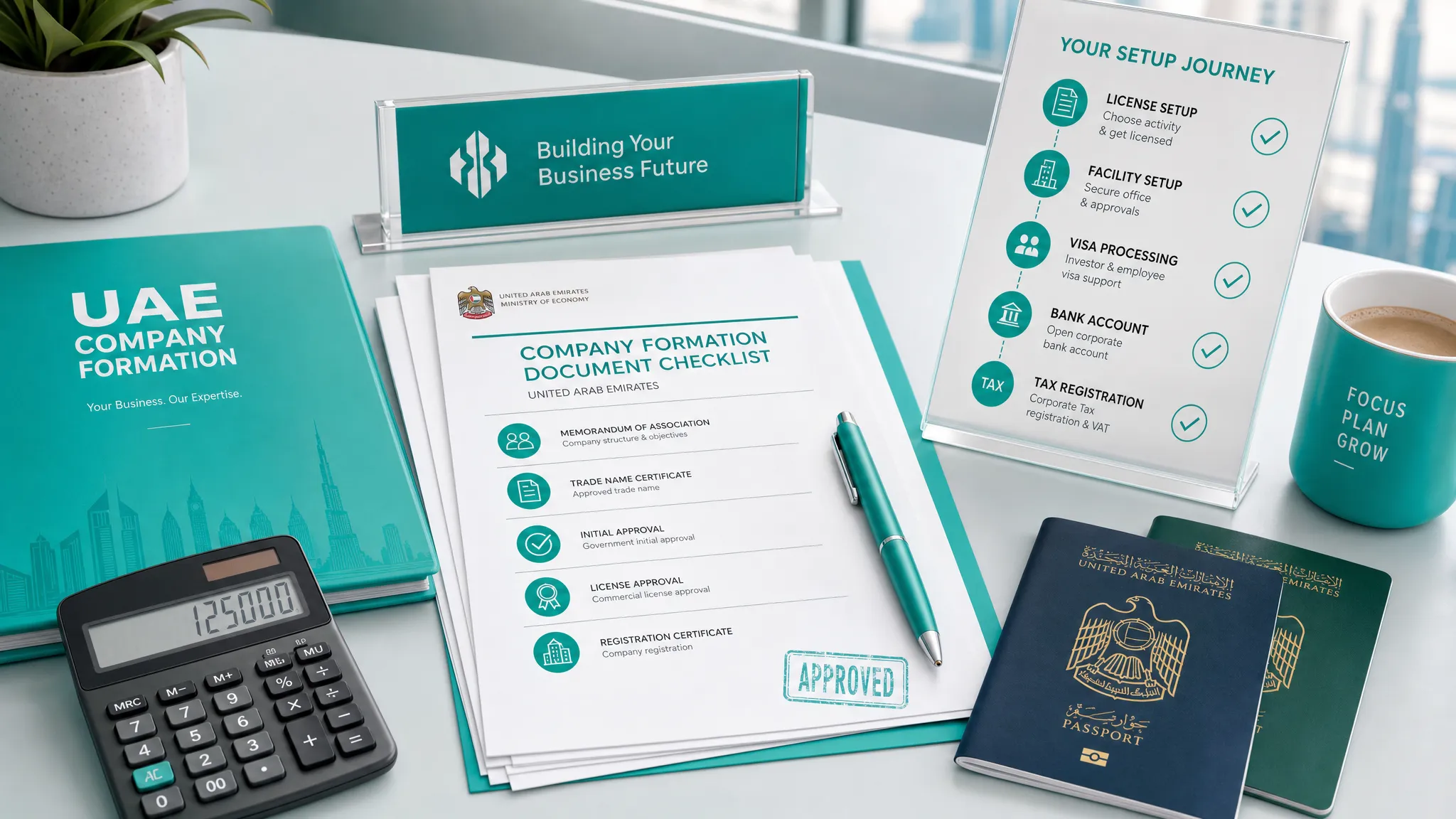
The main cost components to budget for
The table below is not an official fee schedule. RAKEZ packages and government charges can change, and the authority quotation should always control. However, these indicative planning ranges help founders understand where the money typically goes.
| Cost component | What it usually covers | Indicative planning range | Why it varies |
|---|---|---|---|
| License and registration | Name reservation, incorporation, business license, authority processing | AED 6,000 to AED 18,000+ | Activity type, package, legal form, number of activities |
| Facility or workspace | Flexi-desk, shared office, dedicated office, warehouse, industrial unit | Included in some packages to AED 30,000+ | Visa quota, bank expectations, operating model, facility size |
| Establishment card and immigration file | Company immigration registration for visa processing | AED 1,500 to AED 3,500+ | Authority fees and whether visas are required |
| Investor or employee visas | Entry permit, medical test, Emirates ID, stamping or status change, related processing | AED 3,000 to AED 7,500+ per person | Inside or outside UAE application, insurance, urgency, dependant planning |
| Document preparation and attestation | KYC, translations, notarization, legalization, corporate shareholder documents | AED 500 to AED 8,000+ | Individual vs corporate shareholder, foreign documents, country of origin |
| Banking preparation | Business profile, KYC pack, ownership chart, source-of-funds narrative, bank coordination | Quote-based | Risk profile, shareholder residence, activity, expected transactions |
| Bookkeeping, tax, and compliance setup | Accounting system, Corporate Tax registration, VAT assessment, recordkeeping | AED 3,000 to AED 15,000+ annually | Transaction volume, VAT status, cross-border activity, reporting needs |
| Professional advisory and corporate services | Structuring, incorporation management, compliance calendar, renewals, ongoing support | Quote-based | Scope, complexity, senior involvement, ongoing administration |
For a simple, non-regulated service company with one individual shareholder, no employees, and no immediate visa requirement, the first-year cash outlay can sit at the lower end of the market. For a company needing visas, a more credible facility, bank account support, and tax-ready bookkeeping, the realistic first-year budget is often materially higher.
Why headline setup prices can be misleading
A low license fee may be accurate, but incomplete. Many headline offers focus on the authority package and omit the items that founders eventually need before they can invoice clients, hire staff, obtain residency, or satisfy a bank’s KYC team.
The most common omissions are visa costs, establishment card fees, Emirates ID and medical costs, document legalization, health insurance, bank application preparation, accounting setup, Corporate Tax registration, VAT assessment, and renewal support. None of these are optional if they apply to your business model.
Banking is the biggest overlooked cost driver. A company with a low-cost license, vague activity, no credible operating narrative, and weak documentation may technically be incorporated but difficult to bank. That can create months of delays and additional advisory costs. For more detail, see Alldren’s UAE company bank account approval checklist.
Key factors that change the final cost
Business activity
Service businesses are usually simpler to set up than trading, industrial, logistics, or regulated activities. A consultant, marketing agency, software provider, or management services company may require a straightforward professional or service activity. A trading company may need import-export planning, customs registration, warehouse arrangements, product documentation, or additional approvals depending on the goods.
Regulated or sensitive activities can increase costs because the authority, bank, or another regulator may request additional information. Financial services, crypto-related activities, insurance, certain education activities, healthcare, and specific advisory activities should be reviewed carefully before incorporation.
Facility choice
Your facility affects more than the invoice. It can affect visa quota, banking comfort, commercial credibility, and long-term operating flexibility. A flexi-desk may be adequate for a lean services business, but a trading or logistics company may need a dedicated office, warehouse, or industrial facility to match its stated activity.
Choosing the cheapest facility can become expensive if the bank later questions whether the business has enough UAE presence for its expected turnover. This does not mean every founder needs a large office. It means the facility should be proportionate to the business model.
Number of visas
Visa requirements have a direct effect on setup costs. If the founder needs UAE residency, the budget should include the company’s immigration file, establishment card, investor or employee visa costs, medical test, Emirates ID, and any status change fees if the person is already in the UAE.
If dependants will be sponsored later, that does not always need to be included in the company formation quote, but it should be part of the personal relocation budget. You may find it useful to read Alldren’s guide to UAE residency through business before deciding how many visas you need at launch.
Shareholder structure
A company with one individual shareholder is usually easier and cheaper to document than a company owned by another company, trust, foundation, or multi-layered group. Corporate shareholders often require board resolutions, certificates of incumbency, constitutional documents, good standing certificates, notarization, legalization, and translations.
This does not mean corporate shareholders should be avoided. They are often necessary for asset protection, group governance, succession planning, or investor readiness. The point is that ownership complexity should be designed deliberately, not discovered during onboarding.
Banking profile
Banks assess the entire story: activity, shareholders, source of wealth, source of funds, expected counterparties, countries involved, transaction volumes, and physical presence. Non-resident founders, high-risk jurisdictions, complex ownership chains, crypto exposure, large expected inflows, and weak business evidence can all increase the work required to prepare a bankable file.
No corporate services provider can guarantee bank approval. What a strong provider can do is structure the company coherently, prepare a complete onboarding pack, match the application to suitable banks, and coordinate responses to compliance questions.
Tax and bookkeeping requirements
Free zone companies are not automatically free from tax obligations. UAE Corporate Tax applies at the federal level, and free zone companies must understand whether they qualify for any preferential treatment. The UAE Ministry of Finance provides official information on Corporate Tax, including the general 0% rate on taxable income up to AED 375,000 and 9% above that threshold, subject to the detailed rules.
VAT is also a separate issue. A UAE business must monitor whether its taxable supplies cross the mandatory VAT registration threshold. The Federal Tax Authority provides guidance on VAT registration. For many businesses, especially exporters of services, VAT analysis should be done early because zero-rated supplies can still be relevant to registration obligations.
Sample first-year budgets by founder profile
These are planning examples, not quotations. They assume ordinary, non-regulated activity and can change depending on authority fees, package availability, visa needs, documentation, and professional scope.
| Founder profile | Likely first-year budget pressure | Practical planning range |
|---|---|---|
| Solo service founder, no visa at launch | License, basic facility, documentation, basic compliance setup | AED 8,000 to AED 20,000+ |
| Founder needing UAE residency | License, facility, immigration file, one visa, Emirates ID, banking pack | AED 20,000 to AED 40,000+ |
| Small services or e-commerce team | Multiple visas, stronger facility, bank support, bookkeeping, VAT review | AED 35,000 to AED 75,000+ |
| Trading company | License, facility, customs or logistics planning, banking evidence, compliance | AED 40,000 to AED 90,000+ |
| Industrial or warehouse-based business | Facility-heavy setup, approvals, fit-out, utilities, operational permits | Quote-based and often substantially higher |
The difference between the low and high end is usually not one single fee. It is the accumulation of visa count, workspace, banking complexity, documentation, and compliance expectations.
First-year costs vs renewal costs
The first year normally includes one-time setup items that may not repeat, such as incorporation, name reservation, initial documentation, and the first immigration setup. Renewal years usually focus on license renewal, facility renewal, visa renewals when due, ongoing accounting, tax filings, and corporate services.
However, renewals can become expensive if the company has not maintained proper records. Common renewal complications include expired leases, outdated UBO information, activity mismatches, missing accounting records, unfiled tax registrations, and bank KYC refreshes. A company that looked cheap in year one can become costly in year two if compliance was not built into the structure.
A good first-year budget should therefore include both formation and the operating rhythm needed after incorporation. Alldren’s guide to managing your business in the UAE after setup explains the post-license obligations founders should plan for.
RAKEZ free zone vs RAK ICC offshore vs mainland
Cost comparisons are only useful when you compare structures that serve the same purpose. RAKEZ, RAK ICC, and mainland companies solve different problems.
| Structure | Best suited for | Visa eligibility | Typical cost logic |
|---|---|---|---|
| RAKEZ free zone company | UAE operating company, international services, trading, e-commerce, SME operations | Yes, subject to package and facility | Cost-effective operating setup with facility and compliance requirements |
| RAK ICC offshore company | Holding, SPV, asset ownership, international structuring | Generally no | Lower operating footprint, but not a substitute for a UAE operating license |
| RAK mainland company | Direct UAE onshore trading, certain local market activities, wider local contracting | Yes | Can be more suitable for UAE-market operations, but cost depends on license, lease, and approvals |
If you need visas, a UAE operating license, a bankable business profile, and the ability to contract as an active company, a free zone company is often more appropriate than an offshore entity. If the goal is asset holding or an SPV, RAK ICC may be better. If your activity requires unrestricted UAE mainland access, a mainland structure may be required.
How to control costs without weakening the structure
The objective is not to buy the cheapest license. The objective is to set up the least expensive structure that still supports your banking, tax, visa, and commercial reality.
Use these checks before committing to a package:
- Map revenue streams before choosing the activity.
- Decide how many visas are needed in the first 12 months.
- Choose a facility that matches the company’s bank narrative.
- Prepare shareholder KYC and source-of-funds evidence early.
- Ask whether Corporate Tax registration and VAT assessment are included.
- Request a renewal estimate, not only a setup quote.
- Confirm what happens if you need to add activities, shareholders, or visas later.
A slightly higher setup cost can be sensible if it avoids rework, bank rejection, activity amendments, or compliance gaps. The cheapest path is often the one that requires the fewest corrections.
Questions to ask before accepting a quote
Before choosing a provider or package, ask for the scope in writing. The proposal should separate authority fees, government fees, facility charges, immigration and visa costs, professional fees, and optional services.
Ask these questions before signing:
- Does the quote include the trade license, registration, and facility?
- Does it include the establishment card and immigration file?
- Are visa costs, medical tests, Emirates ID, and health insurance included?
- Are document attestation, translation, and legalization costs included?
- Does the provider help prepare a bank-ready KYC pack?
- Is Corporate Tax registration included?
- Will the provider assess VAT registration obligations?
- What are the expected renewal costs in year two?
- What costs apply if the license activity needs to be changed?
- Who will manage compliance reminders after incorporation?
A transparent quote should make exclusions obvious. If a proposal is vague, very cheap, or promises guaranteed bank approval, treat it with caution.
When professional support is worth the cost
Some founders can manage a simple setup directly, especially if the business is low-risk, has one shareholder, does not need immediate banking complexity, and has straightforward documentation. Professional support becomes more valuable when the company must be bankable quickly, involves non-resident shareholders, has multiple owners, needs visas, will trade internationally, or must fit into a wider holding or tax structure.
Expert-led support also matters when the company is expected to grow. Changing a poorly scoped license, adding shareholders, cleaning up UBO records, fixing tax registration gaps, or rebuilding a bank file later can cost more than structuring correctly from the start.
Frequently Asked Questions
How much does a Ras Al Khaimah free zone company setup cost? A simple setup may start in the low five figures in AED, while companies needing visas, facilities, banking preparation, and compliance support often require a higher first-year budget. The exact cost depends on activity, visa count, facility, shareholders, and professional scope.
Is Ras Al Khaimah cheaper than Dubai for company setup? Ras Al Khaimah is often cost-effective for SMEs, consultants, trading businesses, and founders who do not need a Dubai free zone brand or location. Cost should not be the only factor. Banking, activity fit, facility needs, and client perception also matter.
Does the setup cost include a UAE bank account? Usually no. Incorporation and bank account opening are separate processes. A provider can help prepare the company for banking and coordinate applications, but the final approval decision sits with the bank.
Can I set up a RAK free zone company without a UAE visa? In many cases, yes. Some founders form the company first and apply for residency later. However, visa status, UAE presence, and facility choice can affect banking and operational credibility, so this should be planned before incorporation.
Is RAKEZ the same as RAK ICC? No. RAKEZ is a free zone for operating companies. RAK ICC is an offshore corporate registry commonly used for holding companies, SPVs, and asset ownership. They have different uses, costs, visa implications, and banking profiles.
Are RAK free zone companies tax-free? Not automatically. UAE Corporate Tax and VAT rules must be reviewed for every company. Some free zone income may qualify for preferential treatment if conditions are met, but companies still need proper registration, accounting, and records.
Build the right RAK free zone budget before you incorporate
The right Ras Al Khaimah setup is not just a license. It is a working corporate structure that supports your activity, visas, bank account, tax position, and ongoing compliance.
Alldren helps founders and private clients design and implement UAE company structures with transparent pricing, senior expert access, bank account opening support, residency visa processing, bookkeeping, tax registration, and ongoing compliance management.
If you want a clear first-year and renewal budget before committing, speak with Alldren about a tailored Ras Al Khaimah free zone setup plan.