
Ras Al Khaimah is one of the UAE’s most practical jurisdictions for entrepreneurs who want a cost-efficient base, access to the UAE business environment, and flexible structuring options. But setting up a company in Ras Al Khaimah should not begin with the cheapest license package. It should begin with a clear decision on what the company will actually do, where it will trade, how it will bank, who will own it, and what compliance obligations it will need to meet.
In 2026, a RAK company needs to be more than incorporated. It needs to be bankable, tax-ready, and aligned with its real commercial activity. This guide walks through the process step by step, with practical notes on RAKEZ, RAK mainland, and RAK ICC structures.
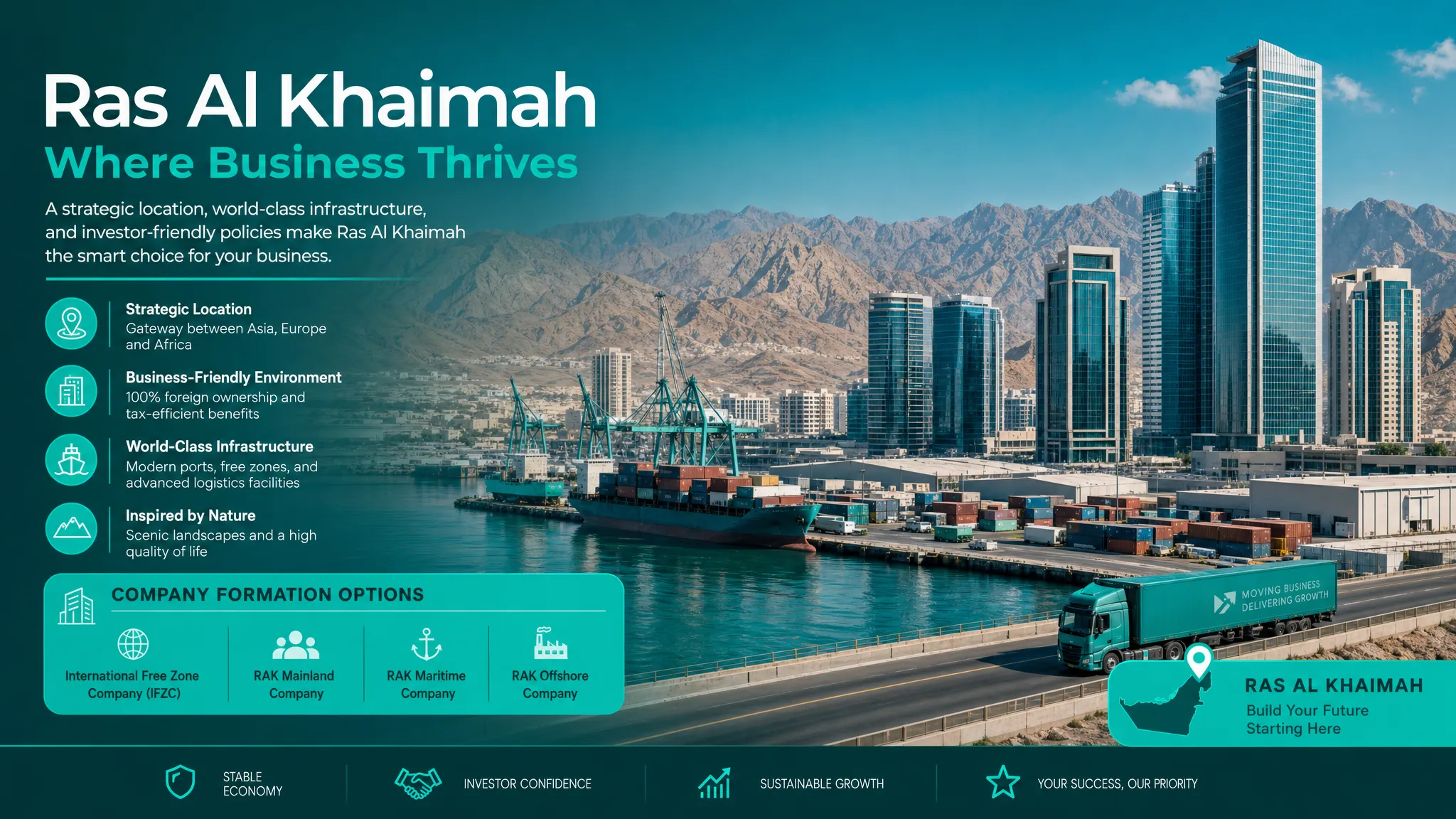
First, understand the three main RAK company routes
A Ras Al Khaimah company can mean different things depending on the authority and structure you choose. The right route depends on your activity, market, visa needs, premises requirements, and banking profile.
| Route | Typical authority | Best suited for | Key limitations |
|---|---|---|---|
| RAKEZ free zone company | Ras Al Khaimah Economic Zone | Trading, services, e-commerce, light industrial activity, international business, founders needing UAE residency visas | Mainland UAE trading may require additional arrangements depending on the activity and customer flow |
| RAK mainland company | RAK Department of Economic Development | Businesses selling directly across the UAE mainland, local retail, local services, government or onshore contracting | Usually requires suitable premises and may involve external approvals for regulated activities |
| RAK ICC offshore company | Ras Al Khaimah International Corporate Centre | Holding companies, SPVs, asset ownership, international contracting, family or private wealth structures | Not a UAE operating license for local business, generally no UAE visas, and banking can require stronger documentation |
For most operating founders, the decision is usually between a RAKEZ free zone company and a RAK mainland company. For holding, investment, succession, or asset protection purposes, RAK ICC may be more appropriate. In some cases, a layered structure can combine a holding entity with an operating company, but that should be designed deliberately rather than added later as a workaround.
You can review the official authority websites for more context: RAKEZ, RAK Department of Economic Development, and RAK ICC.
Step 1: Define the commercial model before choosing the license
The first step is not filling out an application. It is mapping the business model clearly enough that the license, bank account, tax profile, and visa plan all make sense together.
Before you choose a RAK structure, answer these questions:
- Who will your customers be, UAE mainland clients, free zone clients, overseas clients, or a mix?
- Will the company sell goods, provide services, hold assets, manage investments, or employ staff?
- Do shareholders or employees need UAE residency visas?
- Will the business need a physical office, warehouse, retail space, or only a flexi-desk style facility?
- Which banks, payment processors, suppliers, or enterprise clients will need to approve the company profile?
- Will the company need VAT registration, corporate tax registration, audited accounts, or transfer pricing documentation?
This step prevents the most common RAK setup mistake: choosing a license because it is inexpensive, then discovering that it does not support banking, visas, premises, or client onboarding.
If you are still comparing RAK against other UAE routes, Alldren’s guide to business setup in Ras Al Khaimah is a useful starting point.
Step 2: Choose RAKEZ, RAK mainland, or RAK ICC
Once the commercial model is clear, choose the jurisdiction that matches it.
A RAKEZ free zone company is often suitable for founders who want a UAE operating company, a trade license, visa eligibility, and a relatively efficient setup process. It can work well for consultants, online businesses, trading businesses, e-commerce operators, and SMEs that do not need a Dubai or Abu Dhabi license specifically.
A RAK mainland company is usually better when the business will operate directly in the UAE mainland market, lease local commercial premises, serve local customers without free zone limitations, or work in activities where mainland licensing is expected by clients or regulators.
A RAK ICC offshore company is different. It is a corporate vehicle rather than a standard operating license. It may be appropriate for holding shares, real estate interests, intellectual property, investment assets, or acting as an international SPV. It is not the right vehicle if your primary need is UAE visas, a local office, or direct UAE trading activity.
Step 3: Select the legal form
After choosing the route, select the legal form. The terminology varies by authority, but the practical decision is usually about ownership, liability, governance, and whether the company is a new entity or a branch.
| Legal form | Common use | Practical note |
|---|---|---|
| Free zone establishment or single-shareholder company | One founder or one corporate shareholder | Simple ownership, often suitable for solo founders and holding-operating setups |
| Free zone company with multiple shareholders | Partnerships, co-founders, joint ventures | Requires clearer governance, signing authority, and transfer rules |
| Branch of a foreign company | Existing foreign company expanding into RAK | Parent company remains central to liability, documents often need attestation |
| Mainland LLC | UAE onshore operations with limited liability | Often suitable for businesses trading directly in the UAE mainland |
| RAK ICC business company | Holding, SPV, international structuring | Must be incorporated through a registered agent and used for appropriate purposes |
Be careful with structures that expose the owner personally. Sole establishments and freelance-style arrangements can be simple, but they may not provide the same liability separation as a limited liability company. If contract risk, employee risk, or client liability is meaningful, limited liability should be part of the discussion.
Step 4: Confirm the licensed activities and external approvals
Your activity selection determines what the company is legally allowed to do. It also affects banking, tax classification, premises, approvals, and whether the activity is treated as low-risk or higher-risk by compliance teams.
For example, management consultancy, general trading, e-commerce, software development, logistics, manufacturing, and investment-related activities can have very different documentation and approval expectations. Some activities may need third-party approval from sector regulators before the license can be issued.
This is where precision matters. A license that is too narrow can block revenue streams later. A license that is too broad or vague can raise bank questions because the expected transactions do not match the official activity.
A good activity description should align with:
- The company’s contracts and invoices
- The business website and marketing materials
- The expected counterparties and geographies
- The bank account application narrative
- VAT and corporate tax treatment
Step 5: Prepare the KYC, UBO, and incorporation documents
RAK authorities, registered agents, and banks all need to understand who owns and controls the company. A clean document pack can shorten incorporation and reduce bank account delays.
| Document category | Typical examples | Why it matters |
|---|---|---|
| Individual shareholder documents | Passport, UAE visa or entry stamp if applicable, Emirates ID if resident, proof of address, contact details | Confirms identity, residence, and eligibility |
| Corporate shareholder documents | Certificate of incorporation, constitutional documents, incumbency certificate, ownership chart, board resolution | Shows legal existence, authority, and ultimate ownership |
| UBO information | Ultimate beneficial owner details, ownership percentages, control structure | Required for transparency, AML, and regulatory filings |
| Business evidence | Business plan, website, contracts, invoices, supplier details, customer profile | Supports licensing and bank account onboarding |
| Source of funds or wealth | Bank statements, sale agreements, salary records, investment records, audited accounts where relevant | Helps banks and compliance teams understand funding origins |
Documents from outside the UAE may need notarization, legalization, attestation, or certified translation depending on the authority and document type. Corporate shareholders usually require more preparation than individual shareholders, especially if there are multiple layers of ownership.
Step 6: Reserve the trade name and obtain initial approval
The trade name should be consistent with the intended activity and acceptable under UAE naming rules. Names that imply regulated activities, government affiliation, restricted sectors, or misleading scope may be rejected or require additional clearance.
Initial approval, where applicable, means the authority has no preliminary objection to the proposed activity, shareholder profile, and company formation route. It is not the same as final licensing, but it is an important checkpoint before committing to premises, immigration, and banking workstreams.
For offshore RAK ICC entities, the process is handled through a registered agent rather than a standard free zone or mainland application portal. The registered agent plays a central role in incorporation, statutory records, renewals, and compliance coordination.
Step 7: Choose premises and plan visa capacity
Premises are not just a formality. They affect license issuance, visa eligibility, banking perception, and the company’s substance profile.
A RAKEZ company may use a free zone facility option that matches the business model, such as a flexi-desk, office, warehouse, or industrial facility, subject to availability and authority rules. A mainland company generally needs premises appropriate to the activity. A RAK ICC offshore company typically uses a registered office through its registered agent and does not use premises as an operating company would.
If residency visas are part of the objective, plan them at this stage. Visa capacity is usually linked to the company structure, facility type, and authority rules. The founder should also distinguish between UAE immigration residency and tax residency. A UAE visa is not automatically a Tax Residency Certificate.
For a deeper look at residency through company formation, see Alldren’s guide to UAE residency through business.
Step 8: Submit the incorporation application and sign documents
Once the structure, activity, name, documents, and premises are ready, the authority or registered agent can submit the incorporation application. Depending on the route, this may involve signing application forms, constitutional documents, shareholder resolutions, lease or facility agreements, and compliance declarations.
The signing process may be digital, in person, or through notarized documents depending on the authority, shareholder location, and corporate structure. If a foreign company is a shareholder, additional corporate approvals and attested documents may be required before submission can be completed.
At this stage, consistency is critical. Names, passport details, addresses, share percentages, signing authority, and UBO records should match across every document. Small inconsistencies can delay licensing and later create problems during bank onboarding.
Step 9: Receive the trade license and corporate documents
After approval, the authority issues the core corporate documents. These may include a trade license, certificate of incorporation or registration, memorandum or articles, share certificate, lease or facility agreement, and other authority-specific documents.
Do not treat the license as the end of the setup process. The license allows the company to exist and operate within its permitted scope, but the business still needs the post-incorporation stack: immigration, banking, tax registration, bookkeeping, governance records, and compliance calendar.
This is also the time to create a clean corporate file. Banks, clients, tax advisers, auditors, and regulators may request these documents repeatedly. Keeping them organized from day one saves time and reduces inconsistencies.
Step 10: Open the immigration file and process visas if needed
If the company will sponsor visas, the next stage is immigration setup. The exact process depends on the authority, but it generally involves opening or activating the company’s immigration file, applying for entry permits, completing medical testing, biometrics, Emirates ID processing, and visa stamping or issuance under current UAE procedures.
Visa planning should be coordinated with banking and tax. A UAE resident manager, signatory, or shareholder may improve the company’s practical operating profile, but the person’s actual role and authority should be properly documented.
If dependants will be sponsored, factor in the founder’s own visa completion, salary or income evidence where required, tenancy documentation, and family document attestation.
Step 11: Prepare and submit the corporate bank account application
A RAK license does not guarantee a UAE bank account. Banks apply their own KYC, AML, sanctions, source-of-funds, and business-model checks. This is especially important for new companies, non-resident shareholders, corporate shareholders, holding entities, crypto-linked businesses, import-export businesses, and high-value consulting or investment activities.
A strong bank application usually includes a clear one-page business profile, ownership chart, shareholder KYC, source-of-funds evidence, expected transaction volumes, customer and supplier examples, contracts or invoices if available, and a short explanation of why the company is incorporated in RAK.
The bank narrative should match the license. If the company is licensed for consultancy but the bank sees commodity trading, third-party fund flows, or investment activity, the application may be delayed or rejected.
For practical banking preparation, read Alldren’s guide on how to open a company bank account in the UAE faster. Professional support can improve packaging and coordination, but final approval always remains with the bank.
Step 12: Register for tax and build the bookkeeping system
UAE companies should plan tax compliance immediately after incorporation. Corporate tax, VAT, accounting records, invoicing, and transfer pricing should not be left until the first filing deadline approaches.
The UAE corporate tax regime generally applies a 0% rate to taxable income up to AED 375,000 and 9% above that threshold, subject to the detailed rules. Free zone companies may access a 0% rate on qualifying income if they meet the conditions for Qualifying Free Zone Person status. Small Business Relief may also be relevant for eligible businesses within the applicable period and revenue threshold.
VAT is separate. Businesses must monitor the AED 375,000 mandatory VAT registration threshold for taxable supplies, with voluntary registration potentially available at a lower threshold. Exported services may still count toward VAT registration even if the applicable VAT rate is 0%, depending on the facts.
Use the UAE Federal Tax Authority as the official source for tax registration and filing processes, and see Alldren’s overview of UAE tax for businesses in 2026 for practical planning points.
Step 13: Put governance and compliance on a calendar
A well-structured RAK company needs ongoing administration. This includes license renewals, facility renewals, UBO updates, corporate tax filings, VAT filings where registered, accounting records, bank KYC refreshes, visa renewals, board or shareholder resolutions, and changes to ownership or management.
| Compliance area | What to maintain | Why it matters |
|---|---|---|
| Corporate records | License, constitutional documents, resolutions, registers, ownership chart | Supports authority filings, bank reviews, and investor due diligence |
| UBO and KYC | Current beneficial owner details and supporting documents | Required for transparency and AML compliance |
| Tax and accounting | Books, invoices, bank statements, tax registrations, filings | Reduces audit risk and supports bank credibility |
| Banking file | Updated business profile, contracts, source-of-funds records, signatory documents | Helps with account reviews and new bank applications |
| Immigration | Visa records, Emirates IDs, establishment card, renewal dates | Prevents operational disruption and penalties |
The best time to build this system is immediately after incorporation. The worst time is when a bank asks for updated records during a review, a client requests onboarding documents, or the tax authority issues a query.
Typical timeline for setting up a company in Ras Al Khaimah
Timelines vary by activity, authority, shareholder structure, document readiness, and bank risk profile. A straightforward free zone setup with individual shareholders can move quickly once documents are complete. A structure with foreign corporate shareholders, regulated activities, or complex UBO layers will take longer.
| Workstream | Typical timing for straightforward cases | Common delay factors |
|---|---|---|
| Structuring and document preparation | A few days to two weeks | Unclear activity, missing KYC, corporate shareholder attestations |
| License issuance | Several business days to a few weeks | Name rejection, external approvals, premises issues |
| Immigration and visas | Several weeks | Medical, biometrics, immigration file issues, document attestation |
| Bank account opening | Often several weeks or longer | Weak business evidence, non-resident UBOs, complex ownership, high-risk activity |
| Tax and bookkeeping setup | Can begin immediately after incorporation | Missing financial process, unclear invoicing, delayed registration decisions |
The practical lesson is simple: do not run every step sequentially. Banking, tax, document preparation, and visa planning should be prepared in parallel with licensing wherever possible.
Cost drivers to clarify before you proceed
RAK can be cost-effective, but the final cost depends on more than the headline license fee. A reliable quote should separate government or authority fees from professional fees, facilities, immigration, banking support, tax registration, and bookkeeping.
| Cost component | What affects it | What to ask before signing |
|---|---|---|
| License and registration | Activity type, authority, legal form, number of activities | Is this first-year only, and what is the renewal cost? |
| Facility or premises | Flexi-desk, office, warehouse, industrial space, mainland lease | Does it support the visa quota and banking profile? |
| Visas and immigration | Number of visas, dependants, medical and Emirates ID requirements | Are establishment card and immigration steps included? |
| Documentation | Attestation, translation, notarization, corporate shareholder documents | Which documents are excluded from the quote? |
| Banking support | Complexity of UBOs, activity, source of funds, bank selection | Is support limited to introductions, or does it include bank-ready packaging? |
| Tax and bookkeeping | VAT needs, corporate tax, transaction volume, reporting requirements | When will bookkeeping start, and who owns filing deadlines? |
The lowest setup quote can become expensive if it leaves out banking preparation, visa planning, bookkeeping, or renewals. A transparent quote should explain both first-year and recurring obligations.
Common mistakes to avoid
The most costly RAK setup errors usually happen before incorporation, not after. They come from treating company formation as an administrative purchase instead of a structural decision.
| Mistake | Why it creates problems | Better approach |
|---|---|---|
| Choosing the cheapest license | May not support banking, visas, or real activity | Choose based on activity, clients, bankability, and compliance |
| Using RAK ICC for an operating business | Offshore companies are not local operating licenses | Use RAK ICC for appropriate holding or SPV purposes |
| Selecting vague activities | Banks and clients may question mismatched transactions | Match activities to actual contracts and revenue streams |
| Ignoring tax until year-end | Registration, VAT, and records may be missed | Build accounting and tax processes from day one |
| Leaving banking until after licensing | Bank requirements may expose structure problems | Prepare bank narrative before incorporation |
| Weak shareholder agreements | Co-founder disputes can block operations | Document governance, signing authority, exits, and transfers early |
When to get expert support
Some founders can handle a simple setup directly, especially if there is one individual shareholder, a low-risk activity, no complex banking needs, and a straightforward visa plan. Expert support becomes more valuable when the structure involves multiple shareholders, foreign corporate owners, high-value assets, regulated or sensitive activities, UAE residency planning, tax residency considerations, or bank account complexity.
A good corporate services partner should not simply process forms. They should test whether the structure works commercially, whether the license matches the activity, whether the bank narrative is credible, and whether the company can remain compliant after incorporation.
Frequently Asked Questions
Can a foreigner own a company in Ras Al Khaimah? Yes, many RAK free zone and offshore structures allow foreign ownership, and many UAE mainland activities now permit 100% foreign ownership. Some strategic or regulated activities may have additional rules, so the activity must be checked before incorporation.
Is RAKEZ the same as RAK ICC? No. RAKEZ is a free zone for operating businesses that may need licenses, facilities, and visas. RAK ICC is an international corporate registry mainly used for offshore holding companies, SPVs, and private structuring. They serve different purposes.
Can a RAK company sponsor UAE residency visas? RAKEZ and RAK mainland companies can generally support visa applications subject to the relevant authority rules, facility type, quota, and immigration requirements. RAK ICC offshore companies generally do not provide UAE residency visas.
Do I need an office to set up in Ras Al Khaimah? It depends on the route. A RAKEZ company usually needs an approved facility option, a mainland company typically needs suitable premises, and a RAK ICC company uses a registered office through its registered agent rather than an operating office.
How long does setting up a company in Ras Al Khaimah take? A straightforward license can often be issued relatively quickly once documents are complete, but visas and bank account opening usually take longer. Complex ownership, external approvals, or weak documentation can extend the timeline significantly.
Does a RAK company automatically get a UAE bank account? No. Banks make independent approval decisions based on KYC, UBO transparency, business activity, source of funds, expected transactions, and risk profile. A bank-ready application improves the odds but does not guarantee approval.
Is a RAK company subject to UAE corporate tax? UAE corporate tax rules can apply to RAK companies, including free zone and offshore entities depending on their classification and activities. VAT may also apply if taxable supplies exceed the registration threshold. Tax advice should be taken based on the company’s actual facts.
Build your RAK company on the right foundation
Setting up a company in Ras Al Khaimah is straightforward when the structure, license, banking, visas, and compliance plan are designed together. It becomes difficult when the company is incorporated first and the commercial reality is considered later.
Alldren helps founders, investors, and private clients establish and manage UAE companies with expert-led structuring, transparent pricing, bank account opening support, UAE residency visa processing, bookkeeping, tax registration, and ongoing compliance management.
If you are planning a RAK setup, speak with Alldren before you choose the license. We can help you design a structure that is not only incorporated, but operational, compliant, and bank-ready. Visit Alldren to discuss your Ras Al Khaimah company formation plan.
This article is general information only and should not be treated as legal, tax, immigration, or financial advice. Always seek advice tailored to your circumstances.