
A contract authority matrix tells a UAE company who may approve a deal, who may sign it and when additional review is required. Without one, a routine supplier agreement can become an unauthorized commitment, a founder can become the bottleneck for every decision and employees can confuse purchasing permission with legal signing power.
The objective is not to add paperwork to every transaction. It is to make ordinary contracts move quickly while ensuring that exceptional commitments receive the right scrutiny. For growing businesses, this is a practical governance control that should develop alongside the company’s structure.
Approval, signing authority and payment authority are different
Three separate decisions often get treated as one:
- Commercial approval: Does the business want the goods, services or commercial arrangement on these terms?
- Signing authority: Does the proposed signatory have the authority to bind this particular legal entity to this transaction?
- Payment authority: Who may release funds under the company’s banking arrangements and internal controls?
A department head might approve a purchase without having authority to execute the supplier’s contract. A bank signatory might release an approved payment without having authority to sign the underlying lease. A director’s powers may depend on the entity’s governing documents and the nature of the transaction.
An internal approval does not, by itself, create legal signing authority. Equally, a person with legal signing authority may breach internal policy by signing without the required approvals. Whether that breach affects the company’s obligations to a third party requires separate legal analysis.
Why a contract authority matrix matters in the UAE
UAE businesses operate across different corporate frameworks. Mainland companies, free zone entities, DIFC companies and ADGM companies do not necessarily follow identical rules on management powers or execution requirements.
For entities subject to Federal Decree-Law No. 32 of 2021 on Commercial Companies, the applicable provisions should be checked against the current amended text available through the official UAE Legislation portal. Other entities require a review of their own applicable framework.
That legal review must connect with the company’s actual documents: its memorandum or articles, appointment documents, resolutions and any powers of attorney.
This matters particularly when a business has several entities under common ownership. Authority to sign for an operating company does not automatically extend to its holding company or a sister company. A mainland LLC, a RAKEZ free zone company and a RAK ICC entity should not share authority assumptions merely because they have the same ultimate owner.
A documented matrix makes those distinctions visible before someone commits the wrong entity or signs outside their remit.
The business risks it should prevent
Unauthorized commitments and unclear accountability
A salesperson agrees to an extended warranty. A procurement manager accepts a supplier’s indemnity. A founder signs an agreement naming the wrong group company.
Each situation can create disputes about what was authorized and who accepted the risk. A contract authority matrix establishes the approval route before the commitment is made and creates a record of the decision.
Slow decisions and dependence on one founder
Requiring the owner to approve every agreement creates delays without necessarily improving oversight. Employees still need to know which terms are acceptable and which exceptions require escalation.
A useful matrix delegates routine decisions within clear boundaries. Senior management can then focus on commitments that affect borrowing, strategic assets, long-term obligations or material liability.
Contracts that bypass normal purchasing controls
Not every obligation arrives through a purchase order. Online subscription terms, customer order forms, settlement agreements and renewal notices can all create commitments.
The policy should cover how obligations are accepted, not just documents titled “contract.” Otherwise, a carefully controlled purchasing process can coexist with uncontrolled click-through subscriptions or informal commercial promises.
What belongs in the matrix
A workable document combines financial limits with transaction-specific risk controls. At minimum, capture:
- Entity and scope: The legal entity covered, relevant contract categories and any excluded transactions.
- Financial exposure: Approval thresholds, calculation rules and treatment of recurring commitments.
- Required reviewers: The commercial owner, finance reviewer and legal or specialist reviewer where needed.
- Approval and execution: The required approver, authorized signing route and supporting authority documents.
- Exceptions and records: Escalation triggers, permitted substitutes, approval evidence and storage requirements.
Use roles rather than personal names in the main matrix, then maintain a controlled register identifying current role holders and authorized signatories. This makes personnel changes easier to manage without obscuring who held authority on a particular date.
Give the document an owner, version number and approval date. State which governing body adopted it and how amendments must be approved. It should also explain that applicable law and constitutional requirements take priority over the internal policy.
An illustrative approval matrix for a growing business
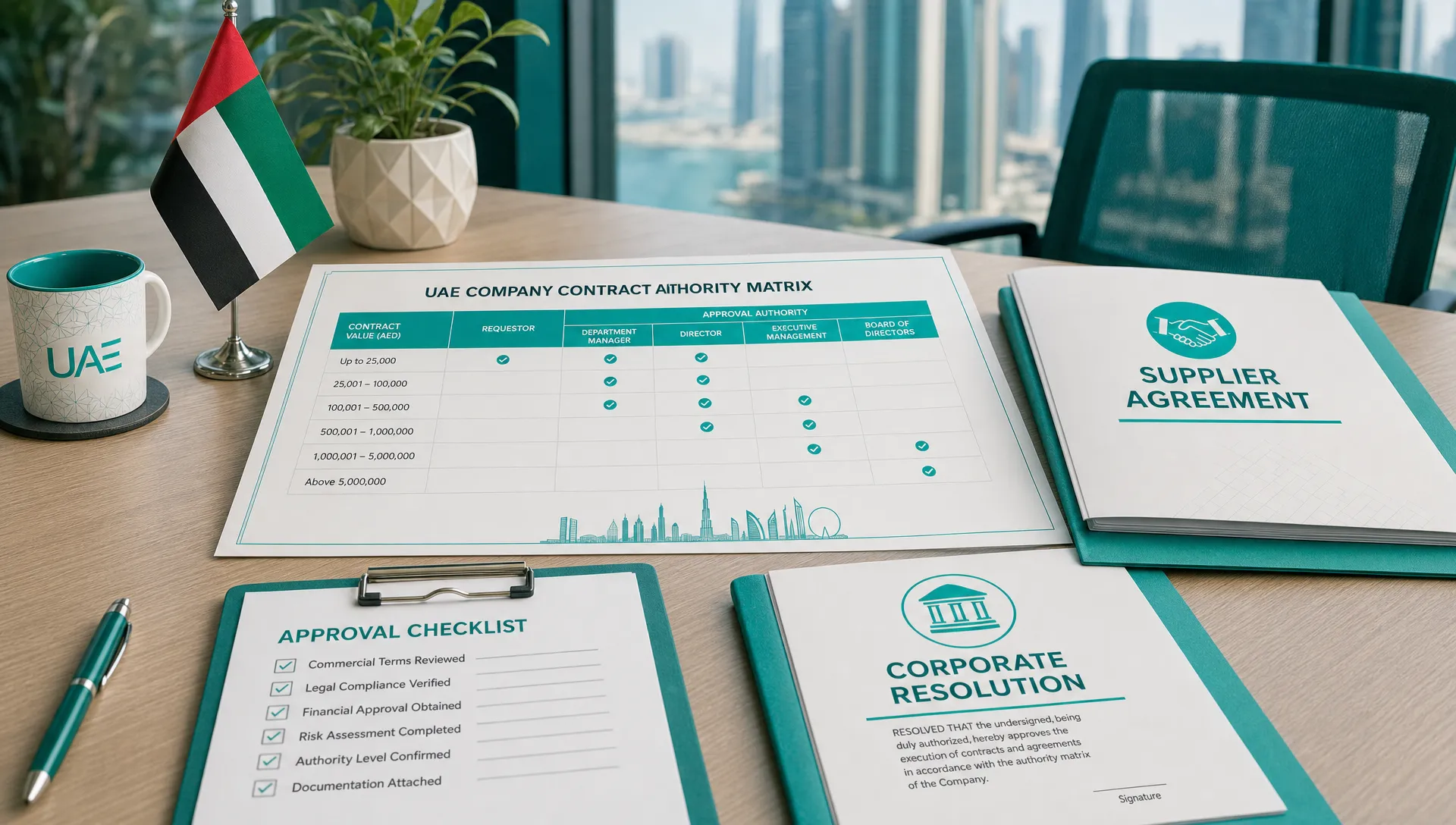
The following example shows a possible internal approval structure. The AED thresholds are illustrative policy choices, not UAE statutory limits. Each company should select limits appropriate to its size, risk profile and governing documents.
| Contract category | Illustrative exposure | Internal approval route | Additional control |
|---|---|---|---|
| Routine supplier agreement on approved terms | Up to AED 25,000 | Budget owner and finance | Confirm budget and use of approved terms |
| Routine supplier agreement on approved terms | Above AED 25,000 to AED 250,000 | General manager and finance | Check total commitment and delegated limits |
| Material commercial agreement | Above AED 250,000 | Board or other competent governing body | Record the decision and check execution requirements |
| Guarantee, borrowing or security document | Any value | Escalate to the competent governing body | Legal review and confirmation of specific powers |
| Agreement involving unusual liability, exclusivity or IP transfer | Any value | Senior management and legal review, with further escalation as required | Assess the risk independently of contract price |
| Related-party agreement | Any value | Refer through the applicable conflict-management process | Check disclosure, approval and participation requirements |
For every row, the final signature must come from a person with valid authority for that entity and transaction. Approval by a manager or board does not mean that any employee may then sign.
Calculate exposure consistently
A contract authority matrix needs a clear rule for measuring value. Consider the committed term, minimum purchases, implementation charges and non-cancellable fees rather than looking only at the first invoice.
For example, a non-cancellable three-year subscription priced at AED 8,000 per month creates an AED 288,000 subscription commitment before any other charges. Treating it as an AED 8,000 purchase would defeat a cumulative approval threshold.
Specify whether thresholds include VAT and how foreign-currency commitments are converted. Prohibit splitting one commercial arrangement into smaller contracts to avoid escalation. Renewal options and contingent liabilities should also receive explicit treatment rather than being ignored because their value is uncertain.
How to implement the matrix
Map the authority that already exists
Start with the legal position, not the organizational chart. Review the constitutional documents, manager and director appointments, relevant resolutions and powers of attorney.
Record any limits on transaction type, value, duration, joint signatures or delegation. Check whether a power of attorney remains valid and whether the proposed transaction requires particular formalities.
Where the documents are inconsistent or unclear, resolve the issue before relying on the matrix. The questions in Alldren’s guide to appointing a UAE company manager are particularly relevant when defining management powers and accountability.
Identify risks that override financial thresholds
Low price does not mean low exposure. A small software contract may contain broad data-use permissions. A modest customer order may include uncapped liability or an extensive indemnity.
Define mandatory review triggers for guarantees, security, unusual termination restrictions, material intellectual property transfers, sensitive data processing and non-standard dispute provisions. Related-party transactions need their own conflict-management route.
The matrix should make escalation automatic when these triggers appear, even if the contract falls within a manager’s normal spending limit.
Connect approvals to the final contract version
Approval evidence should identify the entity, counterparty, contract version, financial exposure and any accepted exceptions. An email saying “approved” is weak evidence if nobody can establish which draft it covered.
Require reapproval when negotiations materially change the approved position. Changes to liability, duration, price, scope or termination rights can alter the risk even when the document looks broadly similar.
Only release the agreed final version for signature after the required approvals are complete. Electronic signature tools may support the workflow, but they do not replace the underlying authority check or any applicable execution formalities.
Define substitutes and urgent exceptions
Absence should not bring routine business to a halt, but a substitute must have the necessary authority. Naming a deputy in an internal spreadsheet does not automatically confer legal signing powers.
Set a documented process for temporary approval cover and, where needed, separate signing authority. Any urgent exception should identify who may authorize the departure, what evidence is required and whether retrospective reporting is necessary.
Do not assume that internal ratification will cure every unauthorized act. Where a contract has already been signed outside the expected route, obtain advice on the specific facts before treating it as resolved.
Keep the controls active after signature
The signed agreement should enter a contract register showing the responsible business owner, relevant entity, committed value, renewal dates and notice deadlines. Store the final contract alongside its approvals and supporting authority documents.
Connect this record to accounts payable. Alldren’s guide to a practical UAE invoice approval process explains the downstream controls that help prevent payment approval from becoming a substitute for checking the underlying obligation.
Contract amendments, extensions and settlements should pass through the appropriate approval route too. An approved initial agreement should not become an unlimited authorization for later changes.
Review the contract authority matrix whenever managers change, entities are added, powers of attorney expire or governing documents are amended. Periodic sample checks should test whether contracts were approved before signature and whether the signatory held the required authority. Track repeated exceptions so the policy can be improved rather than routinely bypassed.
Frequently asked questions
Is a contract authority matrix legally mandatory for every UAE company? There is no single universal requirement that every UAE company maintain a document with this title. Specific obligations depend on the entity, regulatory status and applicable rules. The matrix is a practical way to document internal controls without replacing those requirements.
Does being a shareholder automatically give someone signing authority? No. Ownership alone should not be treated as sufficient evidence of authority to bind the company. Check the person’s corporate role, governing documents and any valid authorization for the transaction.
Can a bank signatory sign supplier contracts? Not solely because they are a bank signatory. A banking mandate and authority to execute commercial contracts serve different purposes. The individual may hold both powers, but each should be verified separately.
Can a small business use a simple matrix? Yes. A single-entity business may need only a short policy with a few approval bands and clear risk triggers. Simplicity is useful as long as the document accurately reflects legal authority and actual working practices.
Put signing authority on a documented footing
Start by comparing one recently signed contract with the company’s authority documents and approval evidence. If the entity, approver, signatory or accepted risk is unclear, that is a concrete gap to address.
Alldren’s corporate governance services support UAE businesses with structuring, governance and ongoing compliance. Discuss how your approval arrangements should align with your company’s legal structure, management powers and day-to-day contracting needs.