
Good governance is not only for large listed companies. In the UAE, even a founder-led free zone company, a family holding entity, or a special purpose vehicle needs a basic governance system: clear records, documented decisions, controlled signing authority, and a reliable compliance calendar.
The goal is not bureaucracy. The goal is to make your UAE business easier to operate, bank, audit, sell, finance, or restructure. When governance is handled informally, problems often appear later, during bank KYC reviews, license renewals, Corporate Tax filing, investor due diligence, shareholder disputes, or director changes.
This simple governance checklist is designed for UAE businesses that want a practical operating framework. It is relevant whether you run a mainland company, a RAKEZ free zone entity, a RAK ICC offshore company, or another UAE structure, but the exact requirements will depend on your jurisdiction, legal form, activity, and regulator.
What governance means for a UAE business
Corporate governance is the system that decides how a company is directed, controlled, documented, and held accountable. In practice, it answers a few basic questions:
- Who owns the company?
- Who can make decisions?
- Who can sign contracts and move money?
- What records prove that decisions were valid?
- What must be filed, renewed, registered, or reported?
- How are conflicts, related-party transactions, and shareholder rights managed?
For a small company, governance may be a lean folder, a calendar, and a few well-drafted resolutions. For a multi-shareholder company or holding structure, it may include board procedures, reserved matters, shareholder approvals, director registers, signing matrices, and formal meeting minutes.
The important point is proportionality. Governance should match the risk and complexity of the business. A trading company with VAT exposure, employees, and bank facilities needs more controls than a dormant asset holding company. A group with nominee director arrangements, cross-border shareholders, or related-party transactions needs more documentation than a simple owner-managed consultancy.
If you are still designing the entity itself, it is worth aligning governance with the structure from day one. Alldren’s guide to building a robust corporate structure in the UAE explains how jurisdiction, ownership, licensing, and control should fit together before operations begin.
The simple UAE governance checklist
Use the checklist below as a baseline. It does not replace legal, tax, or regulatory advice, but it gives you a practical framework for keeping control of the company.
| Governance area | What to check | Evidence to keep |
|---|---|---|
| Legal identity and license | Confirm the company name, jurisdiction, license activity, registered office, and renewal dates | Trade license, certificate of incorporation, constitutional documents, lease or flexi-desk agreement |
| Ownership and UBO records | Keep shareholder, member, and ultimate beneficial owner information current | Share registers, UBO declarations, ownership charts, filings with the registrar |
| Directors and managers | Document appointments, resignations, powers, and responsibilities | Board resolutions, shareholder resolutions, appointment letters, powers of attorney |
| Decision authority | Define which decisions need owner, board, manager, or shareholder approval | Reserved matters list, approval matrix, board or shareholder minutes |
| Signing and banking controls | Clarify who can sign contracts, approve payments, and operate bank accounts | Bank mandates, signing authority schedule, payment approval records |
| Accounting and tax | Maintain books, invoices, contracts, tax registrations, and filing records | Accounting ledgers, Corporate Tax and VAT records, invoices, receipts, tax filings |
| Contracts and commitments | Track important agreements and renewal dates | Contract register, signed agreements, amendments, termination notices |
| Related-party transactions | Identify transactions with owners, directors, group companies, or connected persons | Agreements, pricing support, approvals, transfer pricing documentation where relevant |
| Compliance calendar | Track annual renewals, filings, meetings, tax deadlines, visas, and insurance | Calendar, reminders, renewal receipts, submitted forms |
| Governance review | Review the structure when ownership, activity, banking, or tax position changes | Annual governance review notes, updated registers, new resolutions |
The checklist is simple, but it only works if someone owns it. In many UAE companies, governance fails because responsibility is unclear. The founder assumes the accountant is handling it, the accountant assumes the corporate service provider is handling it, and the free zone portal only shows part of the picture.
1. Keep your constitutional and statutory records current
Start with the company’s core documents. These are the records that prove the company exists, who owns it, what it is licensed to do, and who has authority to act.
A basic governance file should include the certificate of incorporation or registration, trade license, memorandum and articles of association or equivalent constitutional documents, shareholder register, director or manager register, UBO information, powers of attorney, and major resolutions.
Do not treat these as static setup documents. They need to reflect reality. If a shareholder changes address, a director resigns, a manager is replaced, or the company adds a new activity, the records may need to be updated with the relevant authority. The process will vary by jurisdiction, but the principle is the same: your internal records, licensing authority records, bank KYC file, and tax profile should tell the same story.
This is especially important for group structures, holding companies, and offshore company UAE vehicles. Banks, counterparties, and regulators often ask for an ownership chart, UBO evidence, and proof that signatories were validly appointed. If the company cannot produce clean records quickly, routine transactions can stall.
2. Document who can make decisions
Many owner-managed companies rely on informal decision-making. That may feel efficient at first, but it becomes risky when the company signs material contracts, opens bank accounts, takes on investors, hires senior staff, or enters related-party arrangements.
At a minimum, define who can approve the following matters:
- Opening, closing, or changing bank accounts
- Signing customer, supplier, lease, financing, or employment contracts
- Issuing shares or transferring ownership interests
- Appointing or removing directors, managers, officers, or authorized signatories
- Taking loans, granting guarantees, or creating security
- Entering transactions with shareholders, directors, group companies, or connected persons
- Changing the licensed activity, jurisdiction, registered office, or company name
This approval framework can be simple. For a single-shareholder company, a written shareholder resolution may be enough for major matters. For a multi-partner company, the shareholders agreement and articles should clarify reserved matters, voting thresholds, deadlock procedures, transfer restrictions, and exit rights.
The key is to document decisions before they are needed by a bank, auditor, investor, or court. A resolution created months later is rarely as persuasive as one prepared and signed at the time of the decision.
3. Build a practical meeting and resolution habit
Governance does not require endless meetings. It does require a disciplined habit of recording important decisions.
For many UAE businesses, a quarterly governance review is enough. The meeting can be short, but it should cover license status, banking issues, tax filings, cash controls, major contracts, shareholder matters, and upcoming deadlines. Keep minutes that state who attended, what was reviewed, what was approved, and what actions were assigned.
Board and shareholder resolutions should be clear and specific. Avoid vague wording. If the company authorizes a bank account opening, state the bank, authorized signatories, approval limits, and documents approved for submission. If the company appoints a manager, state the person’s role, effective date, powers, and any limits.
If your company has a designated company secretary or outsourced secretarial support, that function should maintain registers, draft resolutions, track filings, and keep the corporate record coherent. For a deeper operational view, see Alldren’s company secretarial duties checklist.
4. Align license activities with real business activity
A UAE company’s license is not a decoration. It defines the activities the company is authorized to conduct. Governance should include a regular check that actual revenue, contracts, website descriptions, invoices, and banking activity remain consistent with the licensed activities.
This matters because banks and authorities may question activity mismatches. For example, if a company is licensed for consultancy but invoices for trading physical goods, payment processing, recruitment, or regulated financial services, it may face banking friction, compliance questions, or licensing issues.
A simple control is to review the license before launching a new product, signing a new contract category, opening a new revenue line, or adding a new market. If the activity has changed, confirm whether an amendment, additional approval, or different structure is required.
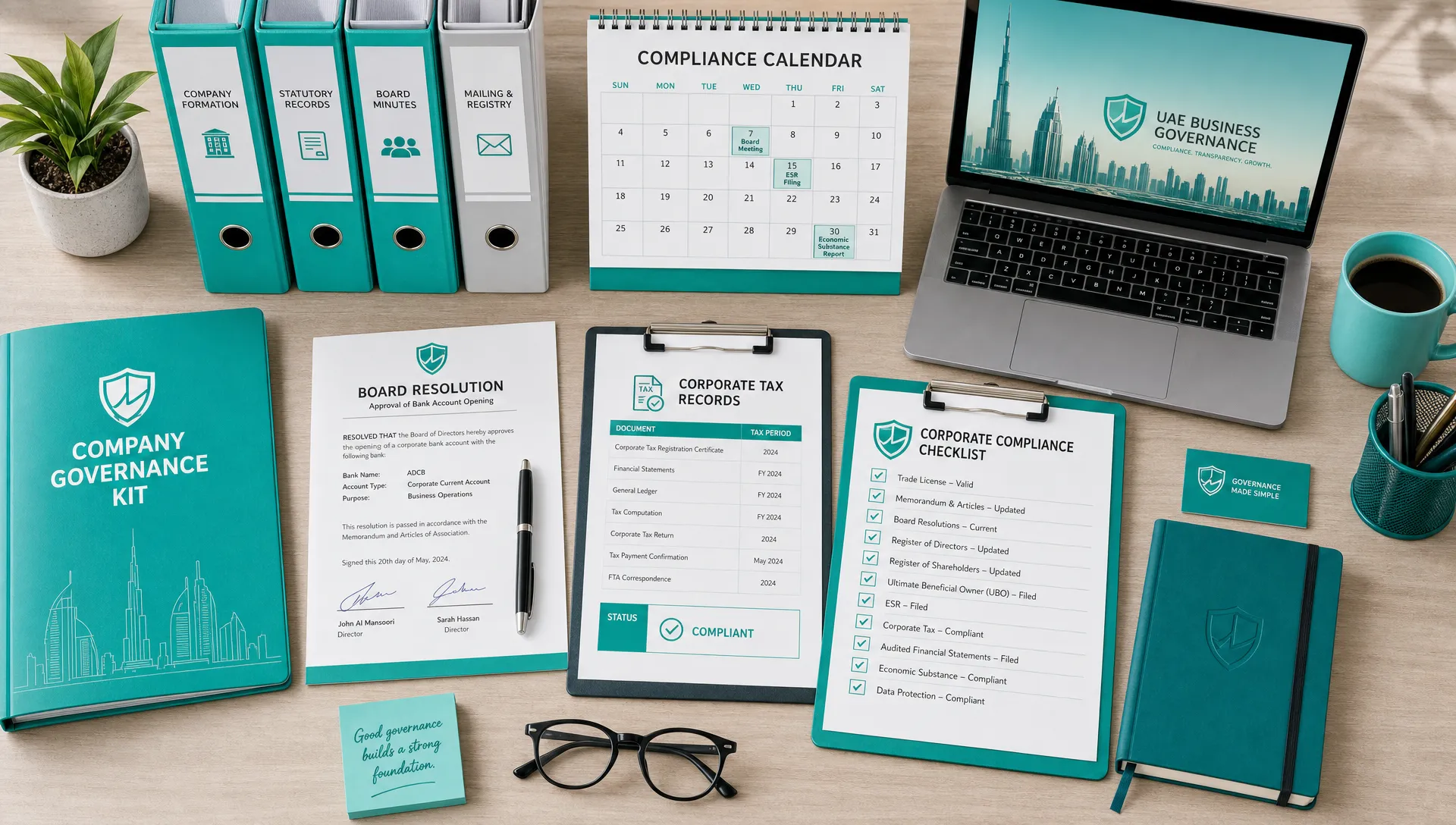
5. Treat tax governance as part of corporate governance
Tax is now a central governance issue for UAE companies. Corporate Tax, VAT, accounting records, and transfer pricing considerations should not sit separately from board and management decisions.
The UAE Federal Tax Authority provides official information on Corporate Tax registration and obligations. In governance terms, the key point is simple: the company should know its tax registration status, filing deadlines, accounting period, recordkeeping process, and responsibility for submissions.
Good tax governance means keeping invoices, contracts, bank statements, accounting ledgers, tax returns, and supporting calculations organized. It also means documenting business reasons for major transactions, especially related-party arrangements, management fees, intercompany loans, shareholder charges, or asset transfers.
For many companies, the governance risk is not that no one filed a return. It is that no one can explain the numbers later. If the company is asked to support revenue, expenses, tax positions, or related-party pricing, the evidence should be available and internally consistent.
If financial controls are a weak point, Alldren’s guide on how to keep your UAE company audit-ready offers practical ways to organize records before an audit or review becomes urgent.
6. Maintain banking KYC readiness
Banking in the UAE is closely tied to governance. Banks commonly request updated licenses, ownership charts, UBO details, shareholder passports, proof of address, tax information, invoices, contracts, office evidence, and board or shareholder resolutions.
A company that keeps these documents current can respond quickly. A company that has to reconstruct ownership, authority, and activity under pressure may face account restrictions, delayed payments, or rejected onboarding.
Your governance process should include a banking KYC folder with current versions of core records. It should also include internal rules for payment approvals, expense reimbursements, and segregation of personal and business funds. Even small businesses should avoid using the company account as a personal wallet. That habit creates tax, audit, and credibility problems.
Where there are multiple signatories, define approval limits. For example, day-to-day payments may be approved by a manager, while larger payments require shareholder or board approval. The exact thresholds should match the company’s size and risk.
7. Manage conflicts and related-party transactions clearly
UAE businesses often involve founders, family members, holding companies, sister companies, or directors who have interests in more than one entity. That is not necessarily a problem. The governance issue is whether those relationships are disclosed, approved, and documented.
Examples include a shareholder leasing property to the company, a director providing consultancy services, a parent company charging management fees, or a group company lending funds. These transactions should have written agreements, clear pricing, approval records, and accounting support.
For larger or more complex groups, transfer pricing may also be relevant under UAE Corporate Tax rules. Even when formal documentation thresholds do not apply, it is prudent to keep evidence showing that transactions had a commercial purpose and were not arbitrary.
A simple conflicts register can help. Record the connected person, nature of the interest, transaction type, approval date, and supporting documents. Review it at least annually.
8. Create a governance calendar
Governance improves dramatically when deadlines are visible. A shared calendar should include license renewal, lease renewal, visa renewals, establishment card renewals, UBO updates, board or shareholder meetings, tax registration deadlines, Corporate Tax filing dates, VAT filing dates where applicable, insurance renewals, and contract renewal or termination windows.
The calendar should show the deadline and the preparation date. If a license renewal is due on 30 September, the governance task should begin well before then. Waiting until the deadline often exposes missing documents, expired leases, unresolved shareholder signatures, or unpaid authority fees.
Assign each deadline to a named person or adviser. A deadline without an owner is not a control.
9. Review governance when the business changes
A governance checklist should not be completed once and forgotten. Review it whenever the business changes materially.
Common trigger events include adding a shareholder, changing directors or managers, opening a new bank account, hiring employees, entering a new market, changing licensed activities, taking external investment, creating a holding structure, transferring assets, or starting related-party transactions.
The review does not need to be complicated. Ask whether the company’s license, constitutional documents, bank mandates, tax profile, UBO records, contracts, and approval matrix still match the business as it operates today. If they do not, update them before the mismatch becomes a problem.
Common governance mistakes to avoid
The most common governance failures are rarely dramatic. They are small omissions that accumulate over time.
Avoid these patterns:
- Keeping setup documents but never updating them after ownership, director, or activity changes
- Signing contracts without checking whether the signatory is properly authorized
- Letting bank KYC records differ from licensing authority or tax records
- Mixing personal and business expenses without clear documentation
- Treating related-party transactions as informal arrangements
- Missing license, visa, lease, or tax deadlines because no one owns the calendar
- Preparing resolutions only after a bank, auditor, investor, or regulator asks for them
Each issue is fixable, but it is much easier to prevent them with a lightweight governance rhythm.
Frequently Asked Questions
Do small UAE companies really need corporate governance? Yes. Governance should be proportionate, but even a small UAE company needs accurate records, clear signing authority, tax documentation, and a compliance calendar. These controls protect the company during banking, renewals, audits, ownership changes, and disputes.
Is governance the same as compliance? Not exactly. Compliance is about meeting legal, tax, licensing, and regulatory obligations. Governance is broader. It covers how decisions are made, who has authority, how conflicts are managed, and how the company proves that actions were properly approved.
How often should a UAE company review its governance records? A quarterly review is practical for many operating companies, with a more detailed annual review before license renewal or financial year-end. You should also review governance whenever ownership, directors, banking, activity, tax status, or group structure changes.
Who should be responsible for governance in a UAE business? Responsibility should be assigned clearly. It may sit with the founder, manager, director, company secretary, or external corporate services provider. The important point is that one person or team owns the records, calendar, resolutions, and follow-up actions.
Make governance simple before it becomes urgent
A good governance system should make your UAE company easier to run, not harder. It should give founders, shareholders, directors, banks, auditors, and advisers confidence that the company is properly structured, properly documented, and ready for scrutiny.
If you want to strengthen your governance framework, Alldren provides expert-led corporate services UAE businesses can use for company setup, structuring, ongoing compliance management, governance support, bank account opening support, residency visa processing, bookkeeping, tax registration coordination, and related corporate administration.
To build a cleaner, more resilient UAE company structure, start with a practical conversation with Alldren.