If you are planning a company setup in the UAE, you are probably trying to answer three practical questions before you commit: how long will it take, what will it cost, and what are the exact steps so nothing gets missed.
The good news is that UAE incorporation can be fast and predictable when the scope is clear (jurisdiction, activity, visa needs, banking expectations). The less good news is that costs and timelines vary widely depending on choices that are easy to underestimate, especially licensing activity, office requirements, and bank account onboarding.
Below is a clear, real-world guide to timelines, cost drivers, and the step-by-step setup process, written for founders and investors who want to move quickly while staying compliant.
UAE company setup at a glance (realistic timeline)
There is no single “UAE setup timeline,” but most projects fall into these ranges:
- Fast track (simple free zone setup, no complex shareholders, no regulated activity): often 1 to 2 weeks for licensing, then banking can extend total time to 3 to 8+ weeks.
- Typical (free zone or mainland, visa(s), lease or flexi-desk, standard banking): 3 to 6 weeks end-to-end.
- Complex (regulated activities, multi-entity structuring, multiple shareholders across jurisdictions, heavier bank compliance): 6 to 12+ weeks.
Two important notes:
- Licensing is usually not the bottleneck. Banking is. Even with a license in hand, account opening can be the longest and most document-heavy stage.
- “Timeline” depends on who is waiting on whom. Many delays come from name rejections, unclear activity descriptions, missing KYC documents, and last-minute visa or office decisions.
What a UAE company setup typically costs (and what drives the number)
You will see “starting from” prices online, but the true cost depends on your exact inputs. Instead of quoting a single number that may be wrong for your case, use the structure below to estimate accurately and compare like-for-like proposals.
The main cost components
| Cost component | What it covers | What changes the price most |
|---|---|---|
| Registration and license fees | Initial incorporation and annual license issuance/renewal | Jurisdiction (mainland vs free zone), activity category, promotional packages vs standard |
| Office / address solution | Flexi-desk, coworking, or physical office lease | Free zone requirements, number of visas, location and square footage |
| Immigration and visas | Establishment card, entry permit, medical, Emirates ID, residency visa stamping | Number of visas, whether dependents are included, Emirate-specific steps |
| Corporate services and PRO support | Document handling, government portal submissions, attestations | Complexity of case, whether end-to-end handling is needed |
| Bank account opening support | Preparation of bank pack, KYC alignment, meeting coordination | Shareholder profile, source of funds complexity, business model risk rating |
| Tax and accounting setup | Corporate tax registration, VAT assessment, bookkeeping onboarding | Revenue level, transaction volume, need for audited financials |
The biggest cost drivers (the “why did my quote change?” list)
Jurisdiction choice
- Mainland (licensed via the emirate’s Department of Economy and Tourism or equivalent) can be ideal if you need to trade directly in the local UAE market, sign certain government or large enterprise contracts, or want broader operational flexibility.
- Free zones can be efficient for international trading, holding structures, services, and e-commerce models, depending on the zone and permitted activities.
Licensing activity and approvals
Some activities are straightforward (consulting, trading in many categories). Others are regulated (financial services, insurance-related, certain health activities, education, crypto-related activities). Regulated activities can add approvals, compliance obligations, and time.
Visas and immigration footprint
The number of visas often impacts office requirements and total fees. Even if you only need one visa initially, plan for what you will need in 6 to 12 months so you do not end up restructuring prematurely.
Banking profile
Banks assess risk based on business model, countries of operation, transaction patterns, and shareholder background. If your expected flows are international, high volume, or involve higher-risk corridors, onboarding usually becomes more demanding.
Step-by-step: Company setup in the UAE (from planning to operational)
Below is the practical sequence most founders follow. Some steps can run in parallel, but this order helps avoid rework.
1) Define your target operating model (before you pick a jurisdiction)
Start with three decisions:
- Where will you sell? UAE local market, GCC, global.
- What will you do, exactly? Your activity description should match the license categories available in your chosen jurisdiction.
- What will your bank need to see? A credible story for source of funds, expected customers, invoices, contracts, and counterparties.
This is also the moment to decide whether you need:
- A single operating company
- A holding company plus operating company
- Multiple entities for risk separation, investor structure, or regional expansion
If you are unsure, it is usually cheaper to design the structure properly at the start than to fix it after licenses and visas are issued.
2) Choose the jurisdiction (mainland vs free zone) and emirate
At a high level:
Mainland can be a fit if you:
- Need maximum flexibility to trade in the UAE market
- Want to open physical premises in the city and hire locally at scale
- Expect clients to require mainland contracting (common in some sectors)
Free zones can be a fit if you:
- Want a streamlined setup path and a packaged office solution
- Operate primarily internationally, online, or business-to-business
- Prefer specific free zone ecosystems (industry clusters) and onboarding processes
This decision should also reflect immigration strategy, office needs, and banking expectations.
3) Validate the activity list and license type
The activity list is not just a formality. It can affect:
- Whether additional approvals are required
- Whether you can open certain bank accounts smoothly
- Whether VAT, customs, or other registrations become relevant
- What you can legally put on invoices, contracts, and marketing materials
Be precise. “Consulting” is not always enough, and “trading” can be split into different product categories.
4) Reserve the trade name and obtain initial approval
You will typically need to:
- Propose trade name options
- Ensure the name meets UAE naming rules
- Align the name with your activity (some authorities require this)
Name rejections are a common source of avoidable delay. Have backup options ready.
5) Prepare incorporation documents and KYC
Authorities and banks will ask for documents that prove identity, ownership, and legitimacy. Common requirements include:
- Passport copies and, where applicable, entry stamps
- Proof of address
- Shareholder and manager details
- Corporate documents if a shareholder is a company (with notarization/attestation as required)
- UBO (Ultimate Beneficial Owner) details
If banking is important (it usually is), build your “bank pack” early: business plan, expected turnover, sample contracts/invoices, source of funds narrative, and a clear explanation of counterparties.
6) Secure an office solution (flexi-desk, coworking, or lease)
Your office arrangement can affect both licensing and visas.
- Many free zones offer bundled desk solutions that satisfy licensing requirements.
- Mainland setups often involve leasing and registration steps (for example, tenancy contracts and related filings).
Choose the simplest office solution that meets your current visa and operational needs, while staying scalable.
7) License issuance and company registration
Once approvals and documents are in place, the authority issues:
- The company registration documents
- The trade license (or equivalent)
At this point, your company exists legally, but you are not fully operational yet if you still need immigration, banking, and tax setup.
8) Immigration setup (establishment card) and visa processing
If you need UAE residency visas, there is typically an employer or establishment file step before visas are processed.
A standard visa journey often includes:
- Entry permit (if required)
- Medical test
- Emirates ID biometrics
- Residency visa stamping/issuance
Because requirements and sequences can vary by emirate and applicant circumstances, it helps to plan the visa path in parallel with banking.
9) Bank account opening (plan for this early)
Banking is frequently the most unpredictable part of UAE setup, largely due to global compliance standards (KYC, AML, source of funds checks).
To reduce delays:
- Prepare a crisp business model summary (what you sell, to whom, and where)
- Document shareholder background and source of wealth/source of funds
- Provide real commercial proof where possible (contracts, invoices, pipeline, website)
- Keep expected transaction volumes and geographies realistic and consistent
Even with great preparation, timelines vary by bank and profile. Build this into your launch plan.
10) Corporate tax registration, VAT assessment, and bookkeeping onboarding
Two key tax touchpoints to plan for:
- UAE Corporate Tax: The UAE has a federal corporate tax regime. The Federal Tax Authority (FTA) provides official guidance on scope, rates, and registration expectations. Start with the FTA corporate tax guidance and confirm how it applies to your structure.
- VAT: VAT registration depends on thresholds and your taxable supplies. The official starting point is the FTA VAT section.
Bookkeeping is not just “admin,” it is what supports compliant filings, clean audits (when needed), and smoother banking relationships.
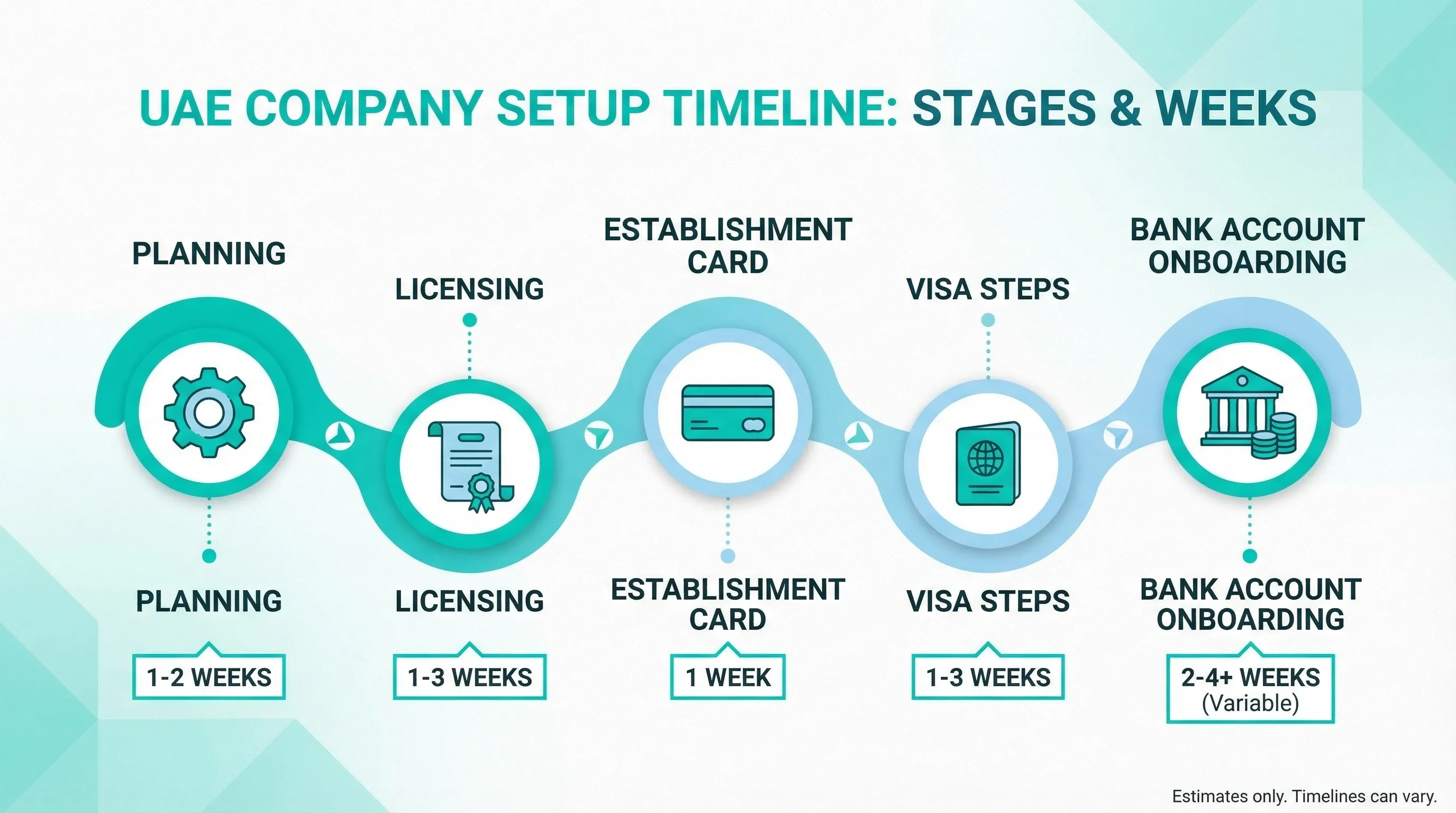
A practical timeline table (what happens when)
Use this as a planning template. Steps may overlap.
| Phase | What you do | Typical duration (indicative) |
|---|---|---|
| Planning and structuring | Choose jurisdiction, activity, shareholders, office approach, visa needs | 2 to 7 days |
| Name reservation and initial approvals | Trade name, initial approval, activity confirmation | 2 to 10 business days |
| Incorporation and license issuance | Submit documents, pay fees, receive license | 3 to 15 business days |
| Immigration setup and visas | Establishment file, medical, Emirates ID, visa issuance | 1 to 3+ weeks |
| Banking | KYC pack, meetings, compliance review, account opening | 2 to 8+ weeks |
| Tax and accounting | Corporate tax registration planning, VAT assessment, bookkeeping onboarding | 1 to 3 weeks |
Treat banking and visas as parallel workstreams whenever possible.
Common mistakes that slow down UAE company setup
Most delays are preventable. These are the patterns that come up repeatedly.
Picking a jurisdiction before confirming the activity reality
Founders sometimes choose a free zone based on headline pricing, then discover that:
- Their specific activity needs a different license category
- Their visa or office requirements are higher than expected
- Their bank views the structure as mismatched to the business model
Solve for activity and operations first, then pick the jurisdiction.
Underestimating bank compliance
Banks are not only checking documents, they are checking coherence. If your application says “IT consulting,” but your expected transactions look like international trading across many categories, expect questions.
Not planning the “day 2” compliance obligations
Depending on your setup, you may need ongoing support for:
- Corporate governance and resolutions
- UBO updates
- Accounting and periodic filings
- Tax registrations and submissions
A setup that is cheap on day 1 can become expensive on day 180 if compliance is not designed into the structure.
Trying to do everything sequentially
If you wait for the license before thinking about banking, and then wait for banking before planning visas, timelines stretch. A coordinated plan can reduce total time even when each individual step has fixed processing times.
How to choose the right setup path for your case
If you are comparing options, evaluate them on four dimensions instead of only price:
- Legal fit: Does the license actually cover your activity and contracting needs?
- Operational fit: Does the office and visa allocation match your hiring plan?
- Banking fit: Will your profile and flows align with realistic banking outcomes?
- Compliance fit: Can you maintain the structure cleanly over time (tax, bookkeeping, governance)?
If you want an official reference point when sanity-checking terminology and business forms, the UAE Ministry of Economy is a helpful starting hub for business information and policy context: UAE Ministry of Economy.
When it helps to bring in an expert-led corporate services partner
Many founders can submit forms. Fewer can reliably design a structure that stays robust under scrutiny from banks, counterparties, and regulators.
A partner is most valuable when:
- You have multiple shareholders, holding entities, or cross-border ownership
- Banking is critical to your launch timeline
- You need visas for founders and employees, with a clear hiring plan
- You want ongoing compliance managed with clear accountability
Alldren provides expert-led, transparent corporate services for establishing and managing UAE companies, including structuring, company setup, compliance, governance, banking support, and visa processing. If you want a setup plan that is built around your operating model (not just a license quote), start at Alldren and align the timeline, costs, and steps before you file.