
For many international founders, investors, and CFOs, company formation looks simple from a distance: choose a jurisdiction, submit documents, receive a license, open a bank account, and begin trading. In practice, setup friction often appears in the gaps between those steps.
A business activity may not match the revenue model. A shareholder document may be incomplete for registry review. A bank may ask for a clearer source of funds narrative. A tax registration deadline may arrive before accounting processes are ready. None of these issues is unusual, but each one can slow down a launch, increase costs, or create governance problems later.
This is where global corporate services create value. The best providers do more than process forms. They coordinate structure, licensing, compliance, banking, governance, and ongoing administration so that each decision supports the next one. In a market such as the UAE, where mainland, free zone, and offshore options can serve very different purposes, that coordination can significantly reduce setup friction.
What setup friction really means
Setup friction is any obstacle that turns a corporate launch from a planned sequence into a stop-start process. It can be procedural, such as missing attestations or inconsistent names across documents. It can be strategic, such as choosing a license that does not support the intended contracts. It can also be operational, such as securing incorporation before understanding bank onboarding, tax registration, or visa requirements.
For UAE business incorporation, friction is rarely caused by one dramatic mistake. More often, it is the cumulative effect of small misalignments. A company can be incorporated quickly, yet still be difficult to operate if the bank file is weak, the ownership structure is not well documented, or the accounting setup is treated as an afterthought.
| Setup friction point | Why it happens | How global corporate services reduce it |
|---|---|---|
| Jurisdiction selection | The founder focuses on speed or cost before confirming operational needs | Compare mainland, free zone, and offshore options against the real business model |
| Activity and license scope | Proposed activities do not align with contracts, websites, or invoices | Map business activities to revenue streams before filing |
| Document preparation | KYC, shareholder, and corporate documents are inconsistent or incomplete | Standardize document collection and review before submission |
| Banking delays | Banks need more evidence of substance, ownership, or source of funds | Prepare the bank narrative and supporting file early |
| Tax and bookkeeping gaps | Compliance is considered only after incorporation | Build tax registration, bookkeeping, and reporting into the launch plan |
| Governance weakness | Resolutions, authorities, and internal records are not formalized | Create a governance framework that supports future decisions |
Reducing friction does not always mean making every step faster. It means preventing avoidable rework, unanswered questions, and structural decisions that later need to be unwound.
Why global corporate services matter in the UAE
The UAE is attractive because it offers multiple routes to market, international connectivity, and a sophisticated corporate environment. According to the UAE Government portal for business services, companies can access a range of business setup options depending on activity, ownership, and location. That flexibility is an advantage, but it also means founders must make choices that fit their objectives.
A local formation-only approach may be enough for a simple case. But cross-border entrepreneurs, family offices, holding companies, trading businesses, consultants, and digital companies often need more than a license. They need a structure that can support banking, contracts, tax filings, shareholder changes, visas, and future expansion.
Global corporate services reduce friction by connecting those moving parts from the start. Instead of treating company setup UAE work as a one-time transaction, they treat incorporation as the foundation for a functioning corporate system.
For a broader view of how this connects to international expansion, Alldren has also covered how global corporate services support cross-border growth beyond the initial formation stage.
Friction reduction starts before the application
The most important work often happens before any application is filed. A skilled corporate services team will clarify the commercial purpose of the entity, the ownership profile, the expected transaction flow, and the practical needs of the business.
This early diagnosis helps answer questions such as: Will the company need UAE residency visas? Will it invoice local UAE clients, international clients, or group companies? Will it hold assets, trade goods, provide services, or act as a regional headquarters? Will it need a physical office, a flexi-desk, or no operational premises? Will the shareholders be individuals, corporate entities, trusts, or a mix?
These questions may seem basic, but they shape the entire setup. If they are not addressed early, they often reappear later as banking questions, tax questions, or licensing constraints.
Choosing the right structure reduces downstream delays
A common source of friction is selecting a jurisdiction based only on price or promised speed. In the UAE, mainland, free zone, and offshore structures each serve different purposes. A free zone company may be suitable for many international service, trading, or holding activities. A mainland company may be more appropriate for certain UAE market operations. An offshore company UAE structure may work for specific holding, asset ownership, or international structuring needs, but it is not a substitute for an operational business license.
Ras Al Khaimah company formation illustrates this distinction well. A RAKEZ free zone company and a RAK ICC offshore company can both be valid structures, but they are not interchangeable. RAKEZ may be considered where a business needs a licensed free zone vehicle, operational facilities, visas, or a UAE commercial presence. RAK ICC may be considered for certain international corporate, holding, or asset-related purposes where an offshore company is appropriate.
A global corporate services provider reduces friction by testing the intended use of the company against the structure. This avoids a common problem: forming an entity quickly, then discovering that it is not the best vehicle for banking, contracts, visas, or future transactions.
Documentation becomes a managed workflow
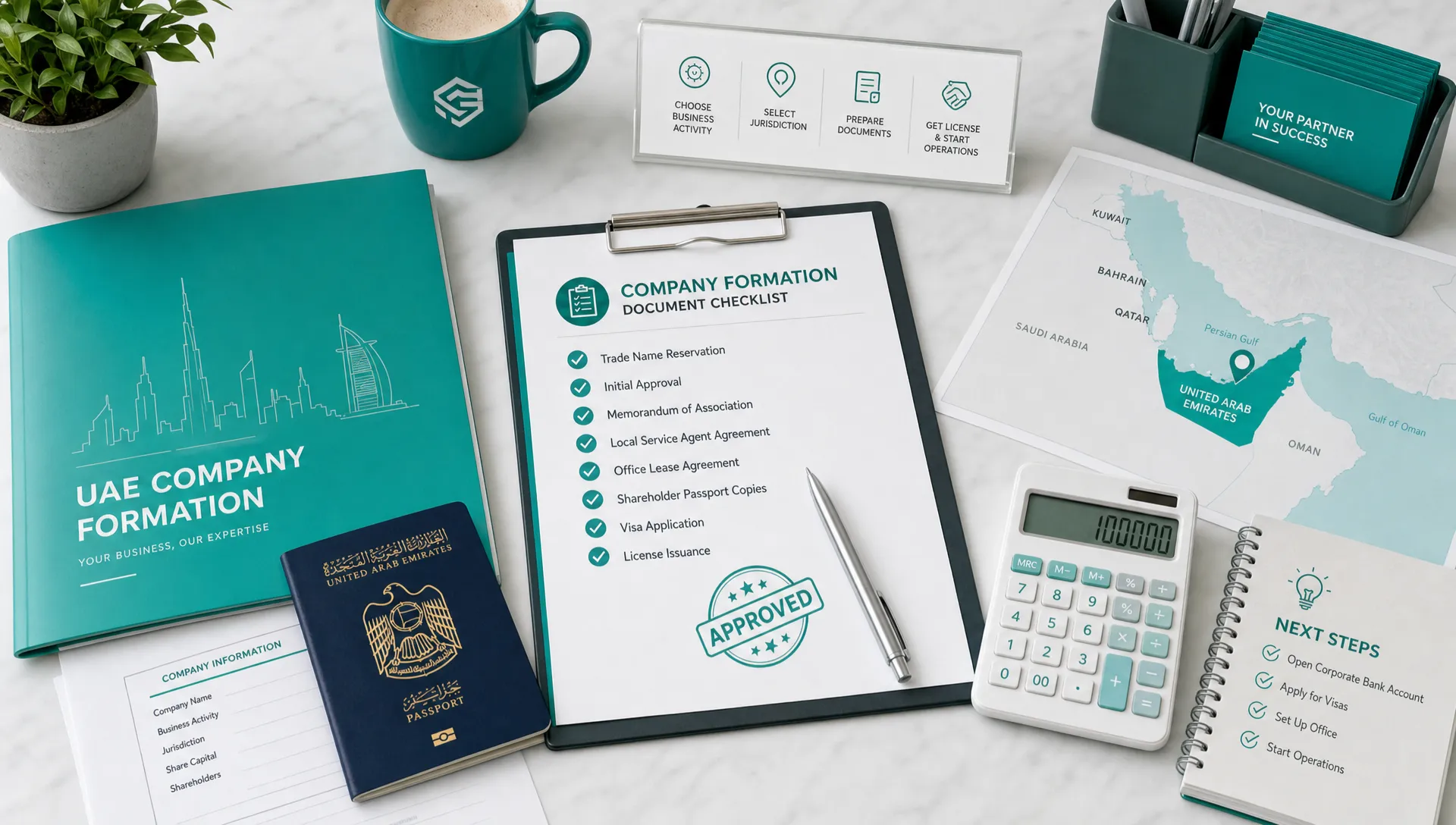
Company setup often slows down because documents are collected reactively. One authority requests a passport copy. Another needs proof of address. A bank requests corporate charts, source of funds evidence, invoices, contracts, or information about counterparties. If these items are assembled only when each request appears, the process becomes fragmented.
A well-run corporate services process treats documentation as a single workflow. Identity, ownership, authority, and business rationale should be consistent across incorporation, banking, tax, and governance files. This is especially important for international shareholders, multi-layered ownership, or corporate shareholders from different jurisdictions.
The goal is not simply to submit documents. The goal is to make the file understandable to every institution that reviews it. A clear structure chart, coherent business description, and complete KYC pack can reduce follow-up questions and help the company move through review more efficiently.
Banking readiness is built into the setup
Bank account opening support is one of the biggest friction reducers in corporate services UAE work. Many founders assume that receiving a license automatically makes banking straightforward. In reality, banks conduct their own due diligence and may ask detailed questions about ownership, source of funds, expected transactions, counterparties, and the commercial logic of the UAE entity.
A strong setup process prepares for banking before incorporation is complete. That means the business description should match the license activity, website, contracts, invoices, and projected transaction flow. Shareholder backgrounds should be explainable. The purpose of the UAE company should be commercially credible.
This is where global corporate services differ from basic filing support. They do not treat banking as a separate problem that begins after the license is issued. They help shape the incorporation file so the company is more bankable from the outset.
Compliance is designed into the company, not added later
In 2026, UAE company formation cannot be separated from tax and compliance planning. The UAE corporate tax regime applies to financial years starting on or after 1 June 2023, and the Federal Tax Authority provides official guidance on registration, filing, and compliance obligations. Depending on the business model, companies may also need to consider VAT, bookkeeping, payroll, and record-keeping requirements.
Friction appears when incorporation is completed first and compliance is discussed afterward. By that point, the company may already be issuing invoices, signing contracts, or receiving funds without the right accounting framework. This can create avoidable pressure around tax registration, financial records, or reporting deadlines.
Global corporate services reduce that risk by integrating compliance early. The company is formed with an understanding of who will maintain books, who will monitor filings, how documents will be stored, and how corporate decisions will be recorded.
Governance prevents future operational bottlenecks
Governance may sound like something only large companies need, but even a small UAE company benefits from clear authorities and records. Who can sign contracts? Who can approve bank instructions? How are shareholder decisions documented? What happens when the company adds a partner, changes activity, appoints a manager, or opens a new account?
Without governance, routine decisions can become bottlenecks. Banks, free zones, tax advisers, and counterparties may request resolutions, registers, or evidence of authority. If those records do not exist, the company loses time recreating decisions after the fact.
Corporate governance services reduce friction by keeping the company administratively ready. This includes maintaining statutory records, preparing resolutions when needed, documenting beneficial ownership, and ensuring that decision-making authority is clear. These foundations are especially valuable when a company later seeks financing, enters a joint venture, restructures ownership, or expands into another jurisdiction.
A coordinated provider reduces handoff risk
Many setup delays happen during handoffs. A licensing adviser completes incorporation, then a separate bank consultant starts from scratch. A tax adviser later asks questions that were not considered during setup. A bookkeeping provider receives incomplete opening balances. A visa process begins without confirming the company’s eligibility or quota.
Global corporate services reduce handoff risk by coordinating the sequence. The license, bank file, tax registration, bookkeeping setup, visa planning, and governance documents are treated as related parts of one operating structure.
This is particularly useful for growing firms that need repeatable processes across entities. If your company is planning multiple jurisdictions, group subsidiaries, or a regional operating model, using a structured planning tool such as a global corporate services checklist for growing firms can help ensure that core decisions are not missed.
What founders should prepare before engaging a provider
Corporate services work best when the founder or CFO can explain the business clearly. You do not need every document ready on day one, but you should be prepared to discuss the commercial objective and the practical operating model.
Before starting a UAE setup, gather the following information:
- The intended business activity and expected revenue streams
- The countries where clients, suppliers, and shareholders are based
- The ownership structure and source of funds background
- Expected banking needs, currencies, and transaction volumes
- Visa requirements for shareholders, employees, or family members
- Accounting, tax, and reporting expectations after launch
This preparation helps the provider recommend a structure rather than simply sell a license. It also gives you a more realistic view of timing and costs. For a step-by-step view of practical setup variables, see Alldren’s guide to company setup in the UAE, including timelines, costs, and steps.
Signs your setup process may create friction later
A smooth sales conversation is not the same as a smooth setup. If a provider recommends a jurisdiction before understanding your business model, that is a warning sign. If banking is treated as automatic, you may face surprises later. If tax, bookkeeping, and governance are excluded entirely from the discussion, the initial setup may be cheaper but more fragile.
Other warning signs include vague pricing, unclear scope, limited access to senior experts, and an unwillingness to explain why a structure is appropriate. A reliable provider should be able to explain the trade-offs, not just the benefits. They should also be transparent about what is included, what is not included, and what may depend on third-party approvals.
The real outcome: a company that is ready to operate
The purpose of corporate setup is not to receive a certificate. The purpose is to create a company that can operate, bank, contract, comply, and grow. Global corporate services reduce setup friction by aligning the company’s legal form with its commercial reality.
That alignment matters from day one. It affects how quickly a bank can understand the business, how confidently directors can sign documents, how cleanly accounting records begin, and how easily the company can respond to future due diligence.
For founders and investors entering the UAE, the question is not only how fast the company can be incorporated. The better question is whether the structure will still make sense after the first bank review, first tax filing, first major contract, and first expansion decision.
Frequently Asked Questions
How do global corporate services reduce setup friction? They coordinate structuring, documentation, licensing, banking readiness, compliance, and governance so the company is built as an operating system rather than a standalone filing.
Is company setup in the UAE difficult for foreign founders? It can be straightforward when the structure fits the business model and documents are prepared correctly. Friction usually appears when jurisdiction choice, banking, tax, or ownership documentation is handled too late.
Do I need corporate services after incorporation? In many cases, yes. Ongoing compliance management, bookkeeping, tax registration, governance records, visa processing, and bank support can be just as important as the initial license.
What is the difference between a free zone company and an offshore company in the UAE? A free zone company is generally used for licensed business activity and may support operational needs such as visas and facilities. An offshore company is typically used for specific international structuring or holding purposes and is not the same as an operating license.
When should banking be considered in the setup process? Banking should be considered before incorporation, not after. The company’s activity, ownership, documents, and business rationale should be consistent with the bank account the company expects to open.
Reduce friction before it becomes a delay
If you are planning a UAE company, the strongest setup is the one designed around your real business model. Alldren provides expert-led corporate services for company setup, structuring, compliance management, governance, banking support, residency visa processing, bookkeeping, and tax registration.
With transparent upfront pricing and direct access to senior experts, Alldren helps founders, investors, and private clients establish UAE structures that are robust, compliant, and ready to operate.