
Opening a UAE bank account for a RAKEZ company is usually achievable, but it is not automatic. The license gives your company legal existence; the bank still has to understand the commercial purpose, ownership, source of funds, expected transactions, and compliance profile behind the business.
For founders, this is where many delays begin. A company may be incorporated correctly, yet still struggle with banking because the file does not clearly answer the bank’s risk questions. A RAKEZ banking strategy should therefore be designed before incorporation, not treated as an administrative step after the license is issued.
This guide explains how UAE banks typically assess RAKEZ Ras Al Khaimah Economic Zone companies, what documents to prepare, which setup choices affect approval, and how to keep the account in good standing once it is open.
Why banking should be part of your RAKEZ setup plan
RAKEZ is a well-established UAE free zone used by trading businesses, consultants, e-commerce operators, industrial companies, and international founders looking for a UAE base. It offers multiple license types and facility options, but the bank account process is governed by the bank’s own due diligence standards.
That distinction matters. A free zone authority registers the company and issues the license. A bank decides whether the company fits its onboarding risk appetite. Those are related processes, but they are not the same process.
UAE banks operate under anti-money laundering and counter-terrorist financing rules supervised by the Central Bank of the UAE. In practice, this means banks must identify beneficial owners, understand the nature of the business, assess geographic and sector risk, and monitor activity after the account is opened.
If you are still choosing your activity, legal form, or facility, it is worth reviewing the underlying setup decisions first. Alldren’s guide to RAKEZ licenses, fees, and setup steps explains the formation side in more detail, while this article focuses specifically on banking readiness.
How UAE banks assess a RAKEZ company
Banks are not only asking, “Does this company have a valid license?” They are asking, “Can we understand and monitor this business responsibly?”
A strong banking file usually makes five points clear: who controls the company, what the business actually does, why it needs a UAE bank account, where money will come from, and where money will go. If any of those points are vague, the bank may ask for more documents, delay the application, or decline to proceed.
| Bank review area | What the bank wants to understand | Examples of supporting evidence |
|---|---|---|
| Ownership and control | Who owns and controls the company, including ultimate beneficial owners | Passports, ownership chart, UBO declaration, corporate shareholder documents |
| Business activity | Whether the licensed activity matches the real business model | License activity, website, contracts, invoices, business plan |
| Source of funds | How the shareholder or company obtained the funds being introduced | Personal or corporate bank statements, sale agreements, salary records, investment records |
| Transaction profile | Expected currencies, volumes, counterparties, and countries | Customer list, supplier list, projected turnover, trade documents |
| UAE nexus | Why a UAE account is commercially justified | RAKEZ license, UAE office or facility, UAE residency, UAE clients, UAE suppliers |
| Compliance posture | Whether the company can maintain records and respond to bank queries | Bookkeeping process, tax registration where applicable, internal approvals |
A company does not need to be large to satisfy these points. It needs to be coherent. A small consulting company with a clear client base, clean ownership, and realistic transaction volumes may be easier to onboard than a larger company with unclear counterparties or inconsistent documentation.
Setup choices that can help or hurt banking
Several RAKEZ incorporation choices have a direct impact on how the bank views the company. These decisions are often made for cost or speed reasons, but they should also be evaluated from a banking perspective.
Licensed activity and business model alignment
Your RAKEZ license activity should match the business you intend to conduct. If the license says management consultancy but the bank file describes commodity trading, the bank will likely ask questions. If the activity involves regulated services, financial products, crypto assets, payment processing, or cross-border trade with higher-risk jurisdictions, expect enhanced due diligence.
The issue is not whether a business is legitimate in principle. The issue is whether the bank can understand and support the risk profile under its internal policies.
Facility and substance
RAKEZ offers different facility options depending on the business need. From a bank’s perspective, substance means more than simply having an address. It can include management presence, staff, operational records, local contracts, inventory, website activity, and a realistic explanation of how the business is run from the UAE.
For some business models, a flexi desk or shared facility may be commercially appropriate. For others, especially trading, manufacturing, logistics, or businesses with employees, banks may expect stronger evidence of operational capacity.
Shareholder residence and UAE visa status
A UAE residency visa is not always a legal prerequisite for opening a corporate bank account, but it can make the file easier for some banks to assess. Resident shareholders or managers may be able to provide Emirates ID, UAE address evidence, and a clearer local presence.
Non-resident ownership is common in UAE company formation, but non-resident files often face more questions. Banks may ask for notarized documents, overseas bank references, proof of address, tax residency details, or additional information about source of wealth.
Corporate shareholders and group structures
If a RAKEZ company is owned by another company, the bank will need to trace ownership through the chain until it identifies the ultimate beneficial owners. This is standard KYC practice. The more layers in the structure, the more documents the bank will request.
For holding structures, investment vehicles, and cross-border groups, the key is to prepare a clean ownership chart and ensure all corporate documents are current, translated where needed, and properly certified if required.
Documents usually needed for RAKEZ corporate banking
Requirements vary by bank and by risk profile, but most applications follow a similar pattern. It is better to prepare a complete file before approaching banks than to submit a thin application and react to questions later.
| Document category | Common examples | Practical note |
|---|---|---|
| RAKEZ company documents | Trade license, certificate of incorporation or registration, memorandum and articles, share certificate, lease or facility agreement | Use the latest issued versions and ensure names match exactly |
| Authority documents | Board resolution, power of attorney, authorized signatory documents | The bank must know who can operate the account |
| Shareholder and director KYC | Passport, UAE visa if available, Emirates ID if available, proof of address, CV or professional profile | Non-residents may need additional certification or overseas address proof |
| Source of funds and wealth | Personal bank statements, corporate bank statements, salary records, sale agreements, investment statements | Explain the origin of funds, not only the current balance |
| Business evidence | Website, contracts, invoices, supplier list, customer list, business plan, purchase orders | Early-stage companies can use projections and signed letters of intent where actual invoices do not yet exist |
| Tax and compliance | Tax registration details where applicable, accounting records, VAT information if applicable | UAE corporate tax and bookkeeping readiness are increasingly important |
Since the UAE corporate tax regime now applies broadly to businesses, banks may also ask how the company will maintain accounts and meet tax obligations. The UAE Ministry of Finance corporate tax resources are a useful starting point for understanding the framework, but company-specific advice should be taken before making tax decisions.
Choosing the right UAE bank for a RAKEZ company
There is no single best bank for every RAKEZ company. The right choice depends on your ownership, activity, transaction profile, expected balances, currencies, and need for trade finance or digital banking.
A common mistake is to submit applications to many banks at once without tailoring the file. A better approach is to shortlist banks based on fit, then submit a complete and consistent application.
| Business need | Banking considerations |
|---|---|
| Professional services | Online banking quality, international transfers, low operational friction, clear client contracts |
| Trading and import-export | Trade documentation, supplier countries, customs records, multicurrency needs, payment terms |
| E-commerce | Payment gateway compatibility, platform statements, refund flows, chargeback risk, customer geography |
| Manufacturing or industrial activity | Facility evidence, supplier payments, employee payroll, equipment purchases, inventory records |
| Holding or investment activity | Source of wealth, investment policy, ownership structure, expected asset flows |
Minimum balance requirements, account maintenance fees, transfer charges, foreign exchange margins, and onboarding standards can differ significantly between banks. These details change over time, so founders should verify current terms directly with the bank or through a corporate services adviser before applying.
If total setup budget is still being planned, remember that banking readiness can affect cost. You may need document certification, accounting support, tax registration, UAE residency processing, or more robust facility choices. Alldren’s article on RAKEZ costs and setup decisions can help you think through the wider budget before committing to a package.
How long does RAKEZ bank account opening take?
Timelines vary. A straightforward resident-owned company with a clear activity and complete documents may move relatively quickly. A non-resident company with corporate shareholders, cross-border trading, high-risk geographies, or limited operating evidence can take longer.
It is safer to plan in weeks rather than days. The company formation process may be fast, but bank due diligence often includes internal compliance review, relationship manager questions, document checks, and sometimes additional approvals.
| Factor | Likely effect on timing |
|---|---|
| Complete KYC file at first submission | Usually reduces back-and-forth |
| Non-resident shareholders | May require extra address, tax, or source-of-wealth evidence |
| Corporate shareholder layers | Requires ownership tracing and additional corporate documents |
| High-risk business sector | May trigger enhanced due diligence |
| Transactions with sensitive jurisdictions | May lead to additional compliance questions |
| Inconsistent business description | Often causes delays or rejection |
| Prompt responses to bank queries | Helps keep the application moving |
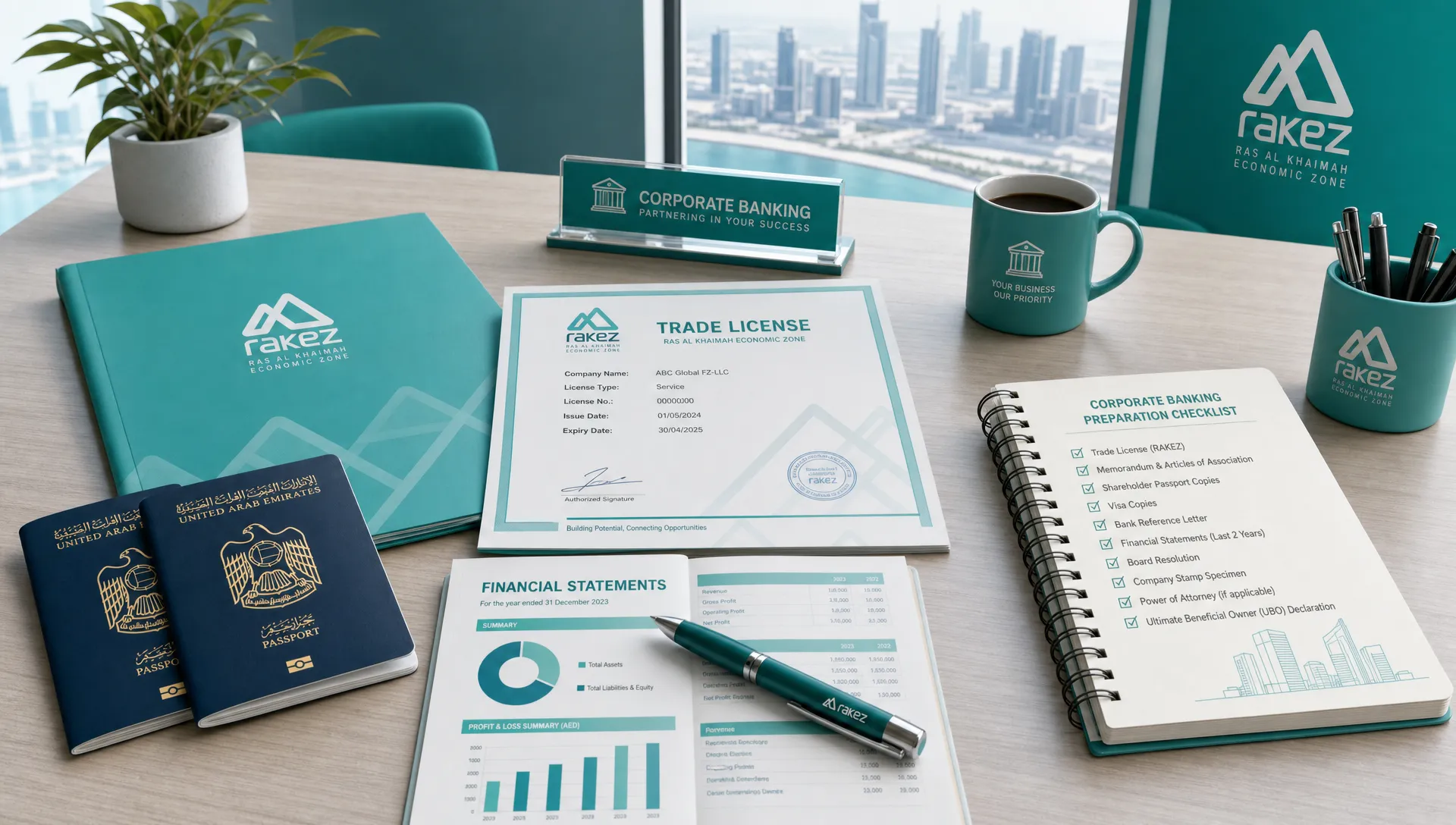
Step-by-step RAKEZ banking preparation
A bank-ready RAKEZ setup is built through preparation, not luck. The following sequence helps reduce avoidable delays.
- Define the banking profile before incorporation: Clarify expected turnover, currencies, client locations, supplier locations, source of funds, and why the company needs a UAE account.
- Choose the RAKEZ activity carefully: Make sure the licensed activity reflects the real business and does not create unnecessary ambiguity.
- Prepare shareholder KYC early: Collect passports, proof of address, bank statements, CVs, tax residency details, and source-of-funds evidence before the license is issued.
- Create a short business explanation: Write a concise description of services, products, customers, suppliers, and expected transactions in plain commercial language.
- Organize corporate documents: Keep the trade license, constitutional documents, share certificate, facility agreement, resolutions, and signatory authorities consistent and accessible.
- Shortlist suitable banks: Match the bank to the business profile instead of applying randomly.
- Respond consistently to bank questions: Make sure every answer matches the license, business plan, website, invoices, and shareholder documents.
The quality of the explanation is often as important as the number of documents. A bank officer should be able to read the file and understand the business without guessing.
Common reasons RAKEZ banking applications are delayed or declined
Many account opening problems are preventable. The most common issues are not dramatic compliance failures; they are inconsistencies, missing evidence, or weak explanations.
For example, a company may state that it will trade globally but provide no supplier details, no product description, and no expected shipping documents. A consultant may claim international clients but have no website, no proposal, and no signed engagement letter. A shareholder may transfer significant startup capital but provide no evidence showing how those funds were accumulated.
Other common blockers include expired documents, mismatched names, unclear ownership chains, unexplained nominee arrangements, unrealistic turnover projections, and transactions involving countries or sectors outside the bank’s risk appetite.
Nominee director or nominee shareholder arrangements require particular care. They should never be used to obscure control. Banks will still expect transparent disclosure of beneficial ownership, authority, and the commercial reason for the structure.
RAKEZ free zone company vs RAK ICC offshore company for banking
Founders sometimes compare RAKEZ free zone companies with RAK ICC offshore companies. Both can be useful, but they are different structures and banks may treat them differently.
A RAKEZ free zone company is generally intended for licensed business activity from a UAE free zone and can usually build a stronger operating case through a facility, visa eligibility, contracts, staff, and UAE substance. A RAK ICC offshore company is often used for holding, asset ownership, estate planning, or international structuring. It may have a more limited operating footprint in the UAE.
That does not mean one is automatically better than the other. It means the banking strategy must match the structure. If the goal is to operate a UAE business with active commercial transactions, a RAKEZ free zone company may be easier to explain to banks than a passive offshore entity. If the goal is holding assets, the bank will focus more heavily on source of wealth, ownership, and the investment purpose.
For a broader comparison of RAK routes, Alldren’s guide to Ras Al Khaimah company registration explains how RAKEZ, RAK ICC, and mainland options differ.
Keeping the account compliant after opening
Opening the account is only the beginning. UAE banks continue to monitor activity and may request updated documents during periodic KYC reviews. If actual transactions differ sharply from the original profile, the bank may ask for explanations or supporting documents.
Good governance helps prevent account restrictions. Keep invoices, contracts, shipping documents, loan agreements, board approvals, and accounting records organized. Renew the RAKEZ license on time and inform the bank of changes to ownership, directors, signatories, address, business activity, or expected transaction patterns.
| Ongoing obligation | Why it matters for banking |
|---|---|
| License renewal | Banks may restrict accounts linked to expired licenses |
| Updated UBO records | Ownership transparency is a core compliance requirement |
| Bookkeeping | Transaction history should be explainable and supported |
| Corporate tax and VAT compliance where applicable | Banks increasingly expect tax-aware operations |
| Contract and invoice retention | Supports incoming and outgoing payments during reviews |
| Change notifications | Banks need current information on directors, signatories, address, and activity |
A company that treats compliance as a routine operating function will usually have a smoother banking relationship than one that only reacts when the bank asks questions.
Practical founder checklist before approaching a bank
Before submitting a RAKEZ bank account application, ask whether your file answers the following questions clearly.
- Who are the ultimate beneficial owners, and can ownership be proven through documents?
- What exactly does the company sell or provide?
- Who are the expected customers and suppliers?
- Which countries and currencies will be involved?
- How much money will enter and leave the account each month?
- What is the source of the initial funds?
- Why is a UAE bank account commercially necessary?
- Who will manage the account and sign payments?
- Are tax, bookkeeping, and license renewal responsibilities assigned?
If the answers are clear, documented, and consistent, the application is in a stronger position. If the answers are vague, fix the file before approaching the bank.
Frequently Asked Questions
Can a RAKEZ company open a UAE bank account? Yes, a RAKEZ company can apply for a UAE corporate bank account, but approval is subject to the bank’s due diligence, risk appetite, and document requirements.
Is a RAKEZ trade license enough to open a bank account? No. The trade license is essential, but banks also review ownership, business activity, source of funds, expected transactions, shareholder KYC, and supporting commercial evidence.
Do RAKEZ shareholders need UAE residency for banking? Not always, but UAE residency and Emirates ID can make some applications easier. Non-resident shareholders can still apply, though they should expect more documentation and due diligence.
How long does RAKEZ bank account opening take? Timelines vary by bank and risk profile. Founders should generally plan for several weeks, especially if shareholders are non-resident, the structure includes corporate owners, or the business model requires enhanced review.
Can a newly formed RAKEZ company open an account without invoices? Often yes, but the company should provide alternative evidence such as a business plan, signed contracts, letters of intent, supplier details, website, or realistic transaction projections.
Will using a nominee director help with bank account opening? A nominee arrangement does not remove the need for transparency. Banks still require accurate disclosure of ultimate beneficial owners, controllers, signatories, and the reason for the structure.
Build RAKEZ banking into the structure from day one
The strongest RAKEZ banking applications are not assembled at the last minute. They are designed from the first structuring conversation, with the license activity, facility, ownership, tax position, documents, and operating narrative aligned.
Alldren provides expert-led UAE company setup, compliance management, governance support, bookkeeping and tax registration coordination, residency visa processing, and bank account opening support. We do not treat banking as a separate afterthought, because the bank’s questions are often shaped by decisions made during incorporation.
If you are planning a RAKEZ company and want a structure that is transparent, compliant, and bank-ready, speak with Alldren before you file the application.