

Ras Al Khaimah (RAK) is one of the UAE’s most practical jurisdictions for founders who want a cost-effective setup, clear licensing pathways, and a credible base for banking and residency. The part that trips people up is not “registration” itself, it’s choosing the right RAK authority and getting the details (activity, documents, premises, tax posture, banking narrative) aligned from day one.
This guide makes Ras Al Khaimah company registration simple by explaining the options, the real step-by-step workflow, and what to prepare to avoid delays.
What “company registration” in Ras Al Khaimah actually includes
In practice, setting up in RAK usually means you complete several parallel tracks:
- Legal incorporation and licensing (your authority issues the license/registration).
- Immigration establishment file (needed if you will issue visas).
- Corporate banking onboarding (often the longest critical path).
- Tax registrations and finance setup (Corporate Tax, VAT where relevant, bookkeeping, invoicing readiness).
It helps to think of registration as “getting operational,” not just receiving a certificate.
Step 1: Choose the right RAK route (RAKEZ vs RAK ICC vs mainland)
Most RAK setups fall into two buckets:
- RAKEZ (Ras Al Khaimah Economic Zone): for operating businesses that need a trade license, premises options, and typically visas.
- RAK ICC (Ras Al Khaimah International Corporate Centre): for offshore-style holding and international structuring where you generally do not need visas or local premises.
A third route exists for certain cases:
- RAK mainland (Department of Economic Development licensing): for businesses that need broad onshore market access in the UAE.
Here is a simplified comparison to orient your decision:
| Option | Best for | UAE visas | Physical premises | Can trade directly in UAE mainland? | Typical use cases |
|---|---|---|---|---|---|
| RAKEZ free zone company | Operating SMEs and scalable setups | Yes (quota depends on package) | Required (flexi, office, warehouse, etc., depending on package) | Not directly (usually via distributor/agent or specific structuring) | Services, trading, e-commerce, light industrial, regional HQ |
| RAK ICC company | Holding and international structuring | No | Typically no operating premises requirement, registered agent address applies | No | Holding company, SPV, asset holding, international contracting (non-UAE) |
| RAK mainland company | Direct UAE onshore access | Yes | Required | Yes | UAE-facing businesses, local contracting, certain regulated or onshore activities |
If you are unsure, start with the question: Will you be operating in the UAE with staff, visas, and local customers, or do you mainly need a holding or international vehicle? That answer usually determines whether RAKEZ or RAK ICC is the right first step.
If you want deeper reading on each track, these guides are useful:
- RAKEZ explained: who it’s for and why
- RAK offshore company: setup and uses
- Offshore UAE: when an offshore company makes sense
Step 2: Define your licensed activity (this is where most rework starts)
In the UAE, licensing is activity-based. Your invoices, contracts, website copy, bank narrative, and tax posture should match what you are licensed to do.
Before you apply, write a one-page “activity brief”:
- What you sell (products/services)
- Where customers are located (UAE, GCC, global)
- How you deliver (online, in-person, logistics)
- How you get paid (bank transfer, card payments, platforms)
- Whether you will hire in the UAE
This brief is also extremely helpful for bank compliance, because it becomes the backbone of your KYC profile.
Step 3: Prepare a clean, bank-ready document pack
Authorities can often incorporate quickly once documents are complete. Banks, however, will ask for more context and evidence.
A practical “bank-ready” pack usually includes:
- Passport copies (and visa/entry status where applicable)
- Proof of residential address
- Basic CV or LinkedIn profile
- Ownership and control chart (especially for multi-owner structures)
- A short business profile (what you do, customers, markets, payment flows)
- Supporting evidence such as contracts, invoices, proposals, or platform statements (when available)
If your ownership is layered (holding companies, trusts/foundations, multi-jurisdiction groups), it is worth preparing the ownership narrative early. It reduces back-and-forth later.
For banking specifics, see:
- Business bank account opening in the UAE: checklist
- How to open a company bank account in UAE faster
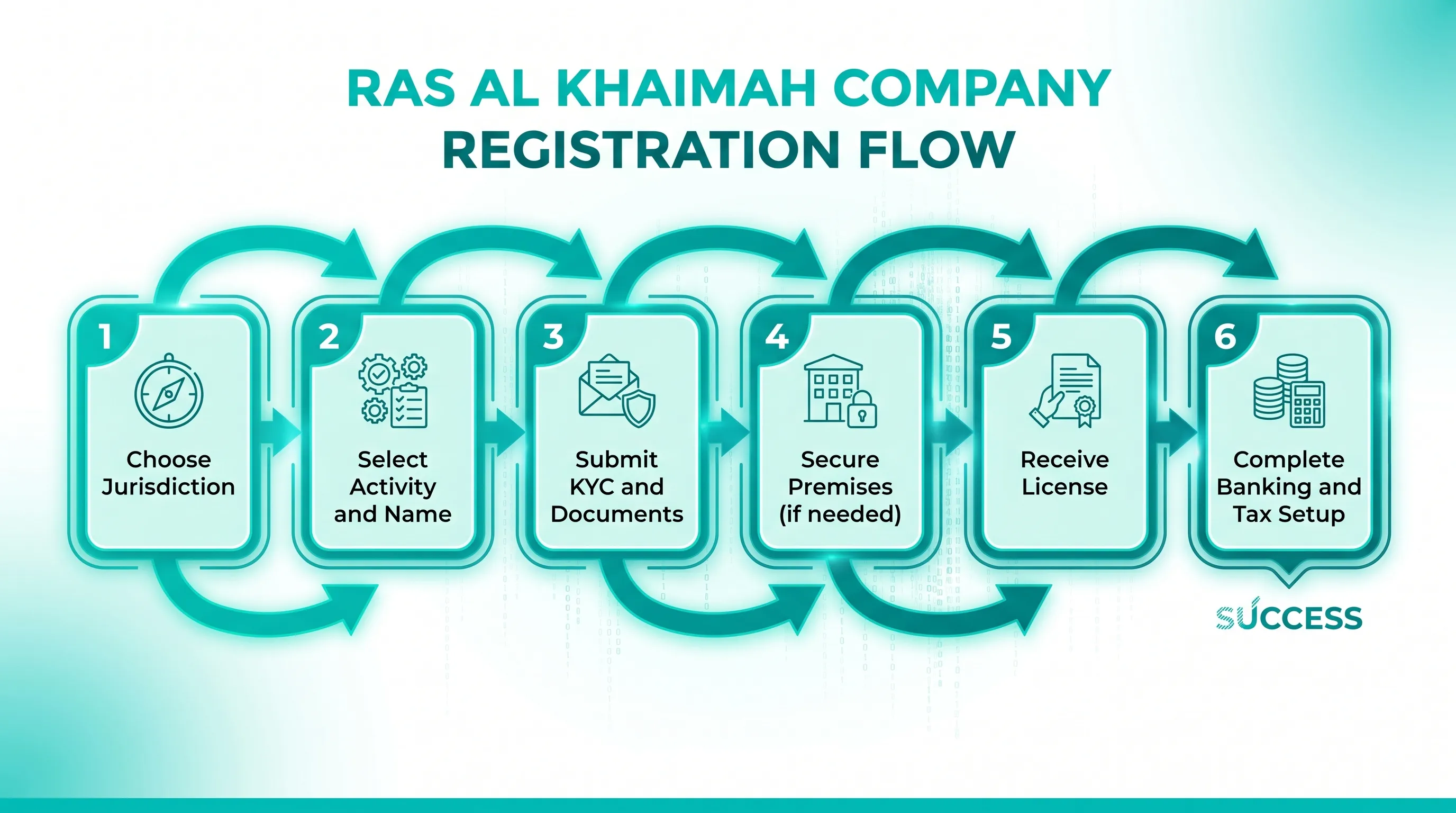
Step 4: Follow the actual registration workflow (simple version)
While details vary by authority and activity, most Ras Al Khaimah setups follow the sequence below.
- Structuring and jurisdiction confirmation: Confirm whether you need RAKEZ, RAK ICC, or mainland, and validate the activity fit and any special approvals.
- Name selection and reservation: Choose a compliant trade name and reserve it (name rules and availability checks apply).
- KYC and incorporation documents: Submit shareholder/UBO documents and sign incorporation forms.
- Premises selection (if applicable): For operating companies, choose the facility type that matches your visa plan and banking expectations.
- License issuance and company documents: Receive license and formation documents (what you receive depends on the authority and structure).
- Post-registration setup: Open immigration file (if you need visas), start bank onboarding, and set up tax and finance operations.
Step 5: Plan banking and “substance” from day one (especially in 2026)
In 2026, banking expectations in the UAE are less forgiving of “paper-only” setups. Even legitimate businesses can face delays if their premises, governance, and operating story look inconsistent.
Common banking friction points include:
- Generic addresses with weak evidence of real operations
- Shareholders/signatories not available for calls or in-person verification
- Activity mismatch (licensed as “consultancy,” operating like trading, brokerage, or payments)
- Unclear source of funds/source of wealth narratives
If you are choosing a facility purely based on cost, read this first:
Step 6: Don’t treat the license as the finish line (tax, bookkeeping, UBO, renewals)
New UAE founders often underestimate how quickly compliance tasks stack up after issuance.
At a minimum, you should set up:
- Bookkeeping process and document retention (audit-ready records)
- Corporate Tax registration and ongoing compliance (where applicable)
- VAT assessment (mandatory registration can be triggered even when many supplies are zero-rated, depending on facts)
- UBO and ownership change management (updates can be time-sensitive)
- Renewal calendar (license, establishment card, visas, leases)
Two practical starting points:
For official references, see the UAE Ministry of Finance Corporate Tax overview and the Federal Tax Authority.
The simplest decision framework (pick the right structure in 3 questions)
If you want to keep this extremely simple, answer these three questions:
1) Do you need UAE residency visas through the company? If yes, you are typically looking at a free zone or mainland route (often RAKEZ for RAK-focused setups).
2) Will you trade or contract inside the UAE mainland? If yes, mainland licensing or a compliant route to serve the mainland matters. If no, a free zone or RAK ICC structure may fit.
3) Is this an operating business or a holding/asset vehicle? Operating usually points to RAKEZ or mainland. Holding/asset structuring often points to RAK ICC (sometimes paired with an operating subsidiary if banking and substance require it).
If you want broader context before deciding, see Company structure basics for UAE businesses.
Common mistakes that make RAK registration feel “hard” (and how to avoid them)
Most problems are preventable if you design the setup around how you will actually operate.
Choosing the cheapest option, then paying for fixes later
A low-cost package can be fine for some profiles, but banking, visas, and tax posture may require a stronger setup. It is usually cheaper to align these upfront than to rebuild later.
Using an offshore vehicle for an onshore operating reality
RAK ICC is powerful for holding and structuring, but it is not designed to be your day-to-day operating platform inside the UAE. Misuse can cause banking issues and commercial friction.
Not owning the bookkeeping and tax workflow early
Even if you outsource bookkeeping, someone internally must own:
- source documents
- approvals
- invoice discipline
- calendar deadlines
This is how you stay audit-defensible.
Underestimating bank onboarding timelines
Incorporation can be relatively fast once documents are ready. Banking can be longer and more iterative. Run banking preparation in parallel with registration.
When it’s worth getting expert-led support
DIY can work for very simple, single-owner, low-risk profiles. It becomes risky when any of the following are true:
- You have multiple shareholders, different economic rights, or you need a shareholder agreement
- Your activity is sensitive (financial services, brokerage-like activity, payments, crypto-related activity, regulated sectors)
- You need a holding structure (HoldCo plus OpCo), SPVs, or asset segregation
- You have cross-border tax residency concerns (place of effective management, control, dividend flows)
- You need a “bankable” setup with credible substance from day one
Alldren’s approach is to treat registration as engineering a compliant operating system, not just filing forms.
Frequently Asked Questions
How long does Ras Al Khaimah company registration take? Timelines depend on the authority, activity, document readiness, and whether you need premises and visas. In many cases, incorporation can move quickly once KYC is complete, while banking often takes longer.
Do I need an office for Ras Al Khaimah company registration? If you form an operating company (free zone or mainland), you generally need a premises solution tied to the license. Offshore-style entities are different and typically rely on a registered agent address rather than operating premises.
Can a Ras Al Khaimah company open a UAE bank account? Yes, but approval depends on your activity, ownership clarity, documentation, and substance signals (premises, management presence, contracts, and a consistent business story). Preparing a bank-ready pack early is critical.
Is RAK ICC the same as RAKEZ? No. RAKEZ is a free zone for operating businesses and visas. RAK ICC is an international corporate registry used mainly for holding and structuring, not for employing staff locally or operating onshore.
Do I need to register for UAE Corporate Tax after setup? Many entities must register for Corporate Tax even if the effective tax due is low or nil. The correct position depends on your facts, including free zone status and revenue profile.
Can I get UAE residency through a Ras Al Khaimah company? Often yes if you use a structure that supports visas (commonly a free zone or mainland company). The exact pathway and quotas depend on your license and facility package.
Make Ras Al Khaimah registration simple, and keep it simple
If you want Ras Al Khaimah company registration to be genuinely straightforward, the key is aligning four things early: activity, structure, premises, and banking narrative. Everything else becomes a controlled execution.
Alldren provides expert-led, transparent support for RAK setups, from structuring and incorporation to compliance management, banking support, visas, and ongoing governance. If you want a senior team to sanity-check your plan before you file, start here: Alldren corporate services.


