

Opening a UAE company bank account is no longer a box-ticking exercise after incorporation. Banks are not simply asking, “Is this company registered?” They are asking whether the company is real, understandable, properly controlled, and capable of being monitored under UAE AML/CFT rules.
That distinction matters. Many rejected applications are not rejected because the business is illegitimate. They fail because the file leaves unanswered questions: who really controls the company, where the money came from, why the UAE structure exists, how the business will generate revenue, and whether the company has enough UAE substance to justify a local banking relationship.
A stronger application does not guarantee approval, because each bank has its own risk appetite. But it can materially improve the probability of success, shorten clarification cycles, and reduce the risk of being quietly declined after weeks of review.
What banks are really approving
A bank account approval is a risk decision. UAE banks are regulated by the Central Bank of the UAE and must apply customer due diligence, beneficial ownership checks, sanctions screening, source-of-funds review, and ongoing transaction monitoring. The UAE Central Bank’s AML/CFT framework is the reason banks ask for more than a trade license and passport copy.
In practice, the bank is trying to answer four questions before it opens the account.
| Bank question | What improves confidence | What weakens confidence |
|---|---|---|
| Is the company’s activity clear? | License, website, contracts, and business plan all describe the same activity | Vague consulting descriptions, mismatched activity codes, unclear revenue model |
| Can the bank identify control? | Simple ownership chart, verified UBOs, clear directors and signatories | Layered ownership with missing documents, nominee arrangements, inconsistent names |
| Is the money explainable? | Documented source of wealth and source of funds, with bank statements or sale records | “Personal savings” with no support, sudden large deposits, unexplained third-party funds |
| Can the account be monitored? | Realistic transaction forecast, known counterparties, countries, currencies, and payment channels | Unclear counterparties, high-risk jurisdictions with no rationale, projected volumes unsupported by activity |
The best applications are not necessarily the largest. They are the most coherent. Every document should tell the same story.
The main factors that improve UAE company bank account approval
1. A license that matches the real business model
Banks compare the licensed activity against the company’s website, invoices, contracts, shareholder background, and expected account activity. If the license says “management consultancy” but the company expects import payments, marketplace collections, or crypto-related inflows, the file will trigger questions.
This is why bankability starts before incorporation. The cheapest license or fastest setup is not always the right choice if it does not match how money will actually move.
A strong application shows:
- The licensed activity matches the revenue stream.
- The business description uses plain language, not generic buzzwords.
- Any regulated, financial, payment, crypto, investment, or brokerage element is disclosed and properly scoped.
- The expected counterparties and payment flows are consistent with the license.
For example, an e-commerce company should be able to explain its suppliers, fulfillment model, payment processor, target markets, and refund process. A consulting company should show service agreements, founder CVs, client pipeline, and deliverables.
2. Clear UBO documentation and control
Ultimate beneficial ownership is one of the first areas banks test. If the bank cannot clearly identify who owns or controls the company, the application slows down or fails.
A clean UBO file usually includes a current ownership chart, shareholder registers, certificates, constitutional documents, passport copies, proof of address, and corporate documents for any entity shareholders. If there are holding companies, trusts, foundations, or nominee arrangements, the file needs a concise explanation of the governance structure and who exercises real control.
Banks are particularly sensitive to inconsistencies. Small discrepancies can create large delays, such as a shareholder name written differently across documents, an outdated register, a missing board resolution, or a signatory who is not clearly authorized.
For companies with multiple shareholders, family structures, or offshore holding layers, a professional-grade corporate pack can be the difference between a manageable review and a compliance dead end.
3. Strong source-of-wealth and source-of-funds evidence
Banks often use “source of wealth” and “source of funds” together, but they are not the same.
| Concept | Meaning | Examples of evidence |
|---|---|---|
| Source of wealth | How the UBO built overall wealth | Business sale agreement, dividend records, salary history, investment statements, inheritance documents, audited financials |
| Source of funds | Where the specific money entering the account comes from | Bank statements, loan agreement, capital injection record, client contract, invoice, sale proceeds documentation |
A common mistake is to write “savings” or “investment proceeds” without evidence. That may be true, but banks need a document trail.
For a founder capitalizing a new UAE company, the bank may want to see personal bank statements and an explanation of how the funds were earned. For an international group, the bank may ask for parent-company financials, board approvals, and intercompany funding agreements. For a property SPV or investment vehicle, the bank will look closely at asset acquisition documents and the origin of capital.
If digital assets are involved, expectations are higher. Wallet histories, exchange statements, transaction reports, and a clean narrative are often necessary. Unexplained wallet flows, mixer exposure, or rapid conversion from crypto to fiat without documentation can be a serious approval obstacle.
4. Real UAE substance, not only a registered address
UAE banks increasingly look beyond the trade license address. They want to understand whether the company has a genuine operational connection to the UAE.
Substance does not mean every company needs a large office or staff from day one. But the setup should fit the activity and risk profile. A solo consultant may be able to justify a modest workspace and resident founder. A trading company, regulated activity, investment platform, or international holding structure may need stronger evidence.
Approval usually improves when the company can show:
- A dedicated or appropriate workspace, lease, Ejari, or free zone facility agreement.
- A UAE-resident manager, director, or authorized signatory where commercially justified.
- Local contact details and operational presence.
- UAE bookkeeping, tax registration planning, and a corporate governance file.
- Actual UAE decision-making rather than a purely paper structure.
Generic addresses, registered-agent-only locations, and minimal flexi-desk arrangements can be problematic for higher-risk profiles. For a deeper discussion of this issue, see Alldren’s article on UAE corporate banking address requirements.
5. Commercial proof before the application is filed
Banks do not expect every startup to have revenue on day one. They do expect the company to look commercially credible.
For an operating business, commercial proof may include signed contracts, invoices, purchase orders, supplier agreements, import/export documentation, platform agreements, website screenshots, marketing material, or client correspondence. For a new venture, a founder CV, business plan, pipeline, letters of intent, investor documents, and supplier quotations may help.
The key is specificity. “We provide business services globally” is weak. “We provide CFO advisory services to UK and EU SaaS companies, invoiced monthly under retainer agreements, with expected receipts of AED X to AED Y per month from named clients” is much stronger.
A bank is more comfortable approving an account it can understand and monitor.
6. Realistic expected account activity
Banks ask about expected monthly credits, debits, average balances, currencies, countries, counterparties, and transaction types because they will monitor the account after opening. If the stated forecast is unrealistic, the bank may decline or later restrict the account when transactions do not match the onboarding profile.
A strong forecast should explain:
- Expected monthly transaction volume and value.
- Main incoming and outgoing counterparties.
- Countries involved and why they are relevant.
- Currencies required.
- Whether cash, cheques, cards, payment gateways, or trade finance are needed.
- Expected opening deposit and average balance.
Avoid overstating volumes to appear more attractive. Banks prefer a conservative, well-supported forecast over aggressive projections with no evidence.
7. Governance that supports the banking mandate
Corporate governance is often overlooked in bank applications. Banks need to know who can open the account, who can operate it, and whether the company has authorized those actions properly.
This is especially important when there are multiple shareholders, corporate shareholders, foreign directors, nominee directors, or holding structures.
Approval improves when the file includes a clear board resolution, signing authority matrix, specimen signatures, current registers, and constitutional authority for the proposed banking arrangements. If a director or manager is not a UAE resident, the bank may ask how documents will be signed, how meetings will be conducted, and who will be available for onboarding calls or branch visits.
Nominee arrangements require particular care. A bank will not be reassured by a director who appears on paper but cannot explain the company’s activity, ownership, or expected transactions.
8. Tax and bookkeeping readiness
A company that has no accounting process, no tax plan, and no document retention system looks harder to monitor. By contrast, a company with a bookkeeping provider, chart of accounts, invoicing process, and tax registration plan appears more operationally credible.
For UAE companies, this matters because banks may ask for VAT TRN details where applicable, corporate tax registration status, invoices, financial statements, or management accounts. Even if the company is newly incorporated, it should be able to explain how it will maintain records and comply with UAE tax obligations.
This is not just a tax issue. It is a banking issue. A bank account that receives commercial revenue must be supported by invoices, contracts, accounting records, and a consistent audit trail.
Bankability by company profile
Different types of UAE companies face different banking questions. The approval strategy should match the risk profile.
| Company profile | What improves approval | Extra scrutiny usually focuses on |
|---|---|---|
| Professional services company | Founder CV, client contracts, clear service scope, UAE resident signatory, realistic monthly receipts | Vague consulting activity, personal invoices, lack of client evidence |
| Trading or import/export company | Supplier contracts, customer pipeline, logistics documents, product details, countries and currencies mapped | High-risk trade routes, sanctions exposure, no warehouse or fulfillment plan |
| E-commerce company | Platform agreements, payment processor details, inventory or dropshipping model, refund policy | Chargeback risk, unclear suppliers, activity mismatch |
| Holding or property SPV | Asset documents, source-of-funds trail, governance records, tax position, clear purpose | Passive activity, weak substance, complex ownership |
| Digital asset or investment structure | Wallet/exchange history, policy documents, licensing analysis, source-of-wealth evidence | Unexplained crypto flows, regulated activity risk, third-party funds |
| International group subsidiary | Parent financials, group chart, board approvals, intercompany agreements, UAE role explained | Treaty-shopping concerns, place of effective management, no UAE operating rationale |
The lesson is simple: do not submit a generic bank pack. Submit a bank pack that answers the questions your specific profile will trigger.
Approval starts before incorporation
Many founders think banking begins after the trade license is issued. In reality, the most important banking decisions are often made earlier.
Before forming the company, consider how the structure will look to a bank. Will the license activity match the revenue model? Is the chosen jurisdiction suitable for the activity? Will the company have a UAE address and visa pathway that fits the risk profile? Is the ownership structure unnecessarily complex? Will the bank understand why an offshore, free zone, or mainland entity was chosen?
For some businesses, a lean free zone setup is appropriate. For others, especially those involving international trading, regulated services, passive holding, property, crypto, or multi-layer ownership, a more deliberate structure may be needed.
This is where cheap incorporation can become expensive. If the company is formed in a way that banks perceive as thin, inconsistent, or difficult to monitor, you may need to restructure, upgrade premises, amend activities, appoint proper management, or prepare additional governance documents before a bank will consider the file.
For broader structuring considerations, see Alldren’s guide to structuring a business in the UAE.
What a strong bank pack should include
A strong application is not a random collection of documents. It is a structured evidence pack that makes the compliance officer’s job easier.
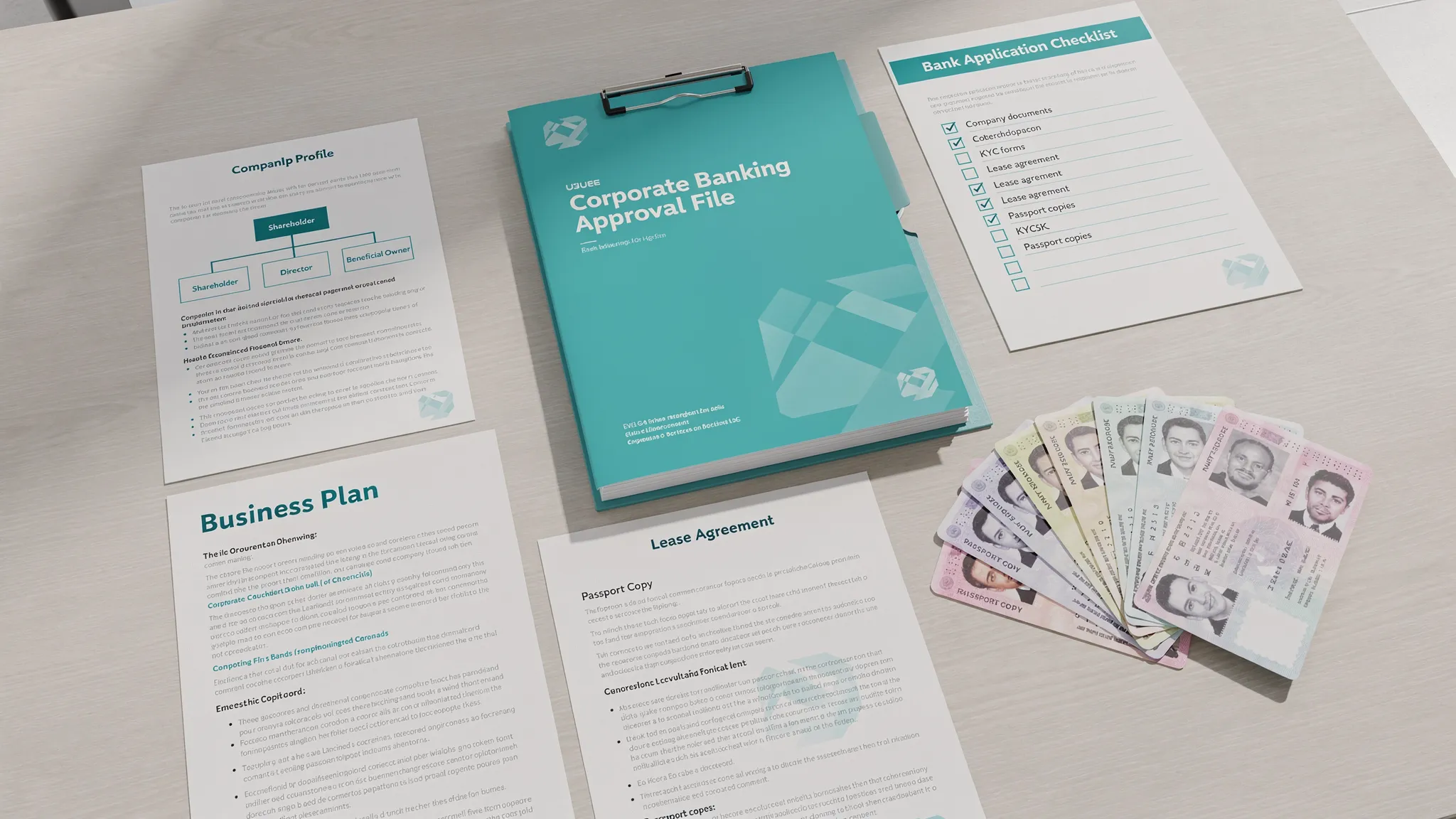
At minimum, the pack should include corporate documents, UBO/KYC documents, a business profile, source-of-funds evidence, expected transaction activity, and proof of operational substance. The best packs also include a short cover note that ties everything together.
| Bank pack component | Purpose |
|---|---|
| One-page business profile | Explains what the company does, who it serves, how it earns revenue, and why it is in the UAE |
| Ownership chart | Shows UBOs, holding entities, percentages, and control clearly |
| Source-of-wealth and source-of-funds summary | Connects UBO wealth and opening deposits to supporting documents |
| Commercial evidence | Shows that the activity is real or commercially ready |
| Substance evidence | Demonstrates UAE presence through office, lease, manager, visa, or local operations where relevant |
| Transaction forecast | Helps the bank understand expected account behavior and monitoring parameters |
| Governance documents | Confirms who may open and operate the account |
The cover note should not be a sales pitch. It should be a compliance roadmap. If a bank officer can understand the file in five minutes, the application is already in a stronger position.
For a more document-focused checklist, you can also review Alldren’s company bank account opening approval checklist.
Common mistakes that reduce approval odds
Many applications fail because of avoidable presentation and structuring issues.
The most common weaknesses include vague business descriptions, inconsistent names across documents, missing UBO evidence, unsupported source-of-funds statements, no UAE operational presence, unrealistic transaction forecasts, and bank selection that does not match the company profile.
Another frequent mistake is applying to multiple banks with the same weak file. This can create more problems than it solves. If one bank raises a valid compliance concern, the solution is usually to fix the file, not to submit the same narrative elsewhere.
Founders should also avoid changing the story mid-review. If the application says the company is a consulting business, but later explanations introduce trading, investment management, payment collection, or crypto activity, the bank may treat the file as unreliable.
A bankable application is internally consistent from the license to the business plan, contracts, ownership records, and transaction forecast.
How to handle bank clarification requests
Clarification requests are normal. A request for additional information does not mean rejection. How you respond can determine whether the application progresses or stalls.
Good responses are complete, organized, and consistent. If the bank asks five questions, answer all five in one package with supporting documents named clearly. Do not send fragmented messages over several days unless the bank requests it.
If a question reveals a real gap, acknowledge it and explain the remediation. For example, if the company is newly incorporated and has no invoices yet, provide letters of intent, founder experience, supplier quotations, or a timeline for launch. If the UBO’s source of wealth comes from a business sale, provide the sale agreement and bank statement showing receipt of proceeds.
Banks dislike uncertainty more than complexity. A complex structure can be approved if it is documented. A simple structure can be declined if the file is inconsistent.
Choosing the right bank matters
Not every bank wants every client profile. Some banks are better suited to trading businesses. Others are more comfortable with professional services, international groups, local SMEs, high-balance relationships, or digital onboarding for straightforward companies.
Bank selection should consider:
- The company’s activity and risk profile.
- Shareholder residency and nationality.
- Ownership complexity.
- Expected balances and transaction volumes.
- Required currencies and payment corridors.
- Need for trade finance, cards, cheques, or payment gateway integration.
- Whether the bank has appetite for the sector.
Choosing the wrong bank can waste time even when the company is legitimate. A well-prepared application sent to a bank with no appetite for the profile may still fail. A well-prepared application sent to a suitable bank has a much better chance of moving through review efficiently.
When professional support improves the process
Professional support is most valuable when the company has complexity, such as foreign shareholders, corporate shareholders, passive holding activity, digital assets, international trade, regulated-adjacent services, property SPVs, or limited UAE substance.
A good corporate services partner should not promise guaranteed approval. Instead, they should help you structure the company properly, prepare a coherent bank pack, identify weak points, select appropriate banks, coordinate responses, and align banking with tax, governance, and compliance requirements.
Alldren supports clients with UAE company setup, structuring, ongoing compliance, corporate governance, bank account opening support, UAE residency visa processing, bookkeeping, and tax registration. The objective is not simply to file an application. It is to engineer a corporate structure that banks, regulators, counterparties, and owners can understand.
Frequently Asked Questions
Can approval for a UAE company bank account be guaranteed? No. Approval is always the bank’s decision and depends on its internal risk appetite, compliance review, and the company’s profile. A stronger file can improve approval odds, but no adviser should guarantee an account.
Does a UAE resident shareholder or director improve approval? Often, yes. A UAE-resident manager, director, or signatory can improve operational substance and make onboarding easier, especially when supported by a real address, visa, Emirates ID, and local decision-making. It is not always mandatory, but it can be a strong positive signal.
Are free zone companies easier to bank than offshore companies? Operating free zone companies are generally easier to explain than pure offshore entities because they can have a trade license, facility, visas, and local operations. However, approval still depends on activity, ownership, source of funds, and bank appetite.
What is the biggest reason UAE company bank account applications are rejected? The biggest reason is usually not one missing document. It is an unclear or inconsistent risk story, such as weak UBO evidence, unsupported source of funds, activity mismatch, limited substance, or transaction flows the bank cannot monitor.
How long does UAE corporate bank account approval take? Timelines vary by bank and risk profile. Straightforward, well-documented applications can move faster, while complex ownership, high-risk sectors, non-resident UBOs, or incomplete source-of-funds evidence can extend the process significantly.
Should I open the bank account before tax registration and bookkeeping are in place? A new company may apply before all tax processes are complete, but it should still have a clear bookkeeping and tax compliance plan. Banks are more comfortable with companies that can maintain proper records and explain their invoicing, tax, and reporting obligations.
Build a bankable UAE company from day one
If your UAE company bank account is central to your launch, banking should not be treated as an afterthought. The right license, ownership structure, address, governance file, source-of-funds evidence, and compliance plan can all affect approval.
Alldren provides expert-led UAE corporate services with transparent, upfront pricing and direct access to senior specialists. We help founders, investors, and private clients design compliant structures, prepare bank-ready documentation, and manage the ongoing obligations that keep a UAE company credible after incorporation.
To discuss your structure and banking readiness, contact Alldren before you apply, not after the bank asks questions your file cannot answer.


