
A UAE incorporation quote can look deceptively simple. Founders often see a license package, compare it with another authority or free zone, and assume that is the full cost of entering the market. In practice, UAE company setup costs are a first-year operating budget, not just a registration fee.
The number you should budget for depends on what the company must do after incorporation. Will it employ people? Need UAE residency visas? Hold assets? Import goods? Lease physical premises? Open a bank account quickly? Register for VAT? Meet investor-grade compliance and governance standards?
This guide breaks down the cost categories founders should plan for before they commit to a structure. It is not a replacement for a formal quote or UAE tax advisory, but it will help you ask better questions and avoid the most common budget gaps.
Start with structure, because structure controls cost
The biggest mistake is comparing company setup UAE options only by headline license price. Mainland, free zone, and offshore structures solve different problems, and each creates different setup and renewal costs.
If you are still deciding where your company should sit, it is worth reviewing the broader company setup in the UAE timeline, costs, and steps before you price individual packages.
| Structure | Common use case | Main cost drivers | Budget caution |
|---|---|---|---|
| Mainland company | UAE market operations, local contracts, retail, services, government-facing work | License activity, office lease, immigration quota, municipal or external approvals, professional support | Often requires a more substantial operating presence than a basic free zone package |
| Free zone company | Consulting, technology, e-commerce, regional services, export-oriented trade | Free zone package, activities, workspace type, number of visas, renewal fees, bank readiness | Low-cost packages may exclude visas, office upgrades, tax support, or banking preparation |
| Offshore company UAE | Holding assets, international structuring, SPV use, succession or investment planning | Registered agent, incorporation, annual renewal, certified documents, bank and compliance support | Usually not suitable for conducting active UAE business from the offshore entity |
Ras Al Khaimah company formation is a good example of why details matter. A RAKEZ free zone company and a RAK ICC offshore company may both be associated with Ras Al Khaimah, but they are not interchangeable. RAKEZ is commonly used for licensed free zone operations, while RAK ICC offshore structures are often used for holding or international corporate structuring. Their setup costs, bankability, visa eligibility, and compliance profile differ.
One-time UAE company setup costs to budget for
Your first budget should separate mandatory authority costs from commercial and advisory costs. A clean quote should show what is payable to the government or free zone authority, what is payable for professional services, and what may be required later depending on your business model.
License and registration fees
This is the line founders usually focus on first. It may include name reservation, initial approval, incorporation, trade license issuance, chamber or authority registration, and other administrative charges.
The amount varies by jurisdiction, license activity, legal form, and number of activities. A simple services license in a free zone will not be priced like a regulated financial activity, a mainland trading license, or a business that needs warehousing.
For free zone founders, compare what is included in the package rather than only the published price. A license that looks cheaper may be less useful if it excludes the activity you need, has limited visa eligibility, or requires an upgrade before you can operate properly. For a more detailed breakdown of this route, see Alldren’s guide to UAE free zone company registration costs and timelines.
Legal documents and corporate approvals
Incorporation often requires constitutional documents, shareholder resolutions, ultimate beneficial owner information, passport copies, proof of address, specimen signatures, and sometimes notarized or attested documents.
Founders should budget for translation, notarization, certification, attestation, courier costs, and document re-issuance if a bank or authority requests a different format. These are not always large costs individually, but they can delay a setup if they are not planned.
Where there are multiple shareholders, holding companies, trusts, nominee arrangements, or cross-border investors, document preparation becomes more important. This is where low-cost incorporation can become expensive later if the corporate structure is not engineered correctly at the beginning.
Office, flexi-desk, or workspace costs
Many UAE business incorporation routes require some form of address or workspace arrangement. The cost depends on whether the company needs only a flexi-desk, a shared office, a dedicated office, a warehouse, a retail unit, or a lease that supports a specific visa quota.
Workspace is not only a licensing issue. It can affect banking, immigration capacity, operational credibility, and commercial contracts. If a founder plans to hire staff or meet clients in the UAE, the cheapest address may not be the right business decision.
Visa and immigration costs
If the founder or staff need UAE residency, budget beyond the company license. Visa-related costs can include establishment card issuance, immigration file opening, entry permit, status change, medical test, Emirates ID, visa stamping or equivalent processes, and medical insurance where applicable.
The number of visas also influences workspace needs. Some packages include no visas, some include eligibility for one or more visas, and some require office upgrades for additional allocations. Founders relocating to the UAE should budget for dependents separately, including family visas, insurance, document attestation, and renewal cycles.
Bank account opening support and banking readiness
Banking is rarely just a formality. UAE banks typically review the company activity, ownership, source of funds, expected transactions, counterparties, economic substance, and supporting contracts. A company may be incorporated quickly but still need time and documentation before an account is approved.
Budget for preparing a bank file, business plan, proof of address, corporate chart, shareholder documents, invoices or contracts, and compliance responses. Also consider bank minimum balance requirements, account maintenance fees, payment gateway costs, and delays that may require temporary cash planning.
No serious advisor should guarantee a bank account approval, but strong preparation can reduce avoidable friction.
Professional structuring and advisory fees
Professional fees vary widely because the work varies widely. A simple single-shareholder free zone company is not the same engagement as a multi-jurisdiction holding structure, a regulated activity review, nominee director service, or governance framework for investors.
When comparing providers, ask what the fee actually covers. Does it include structure design, license activity mapping, bank preparation, tax registration guidance, visa processing, bookkeeping setup, and renewal reminders? Or is it only a filing service? Alldren’s framework for comparing company setup services in the UAE can help founders evaluate scope before comparing price.
The first-year cost categories founders often miss
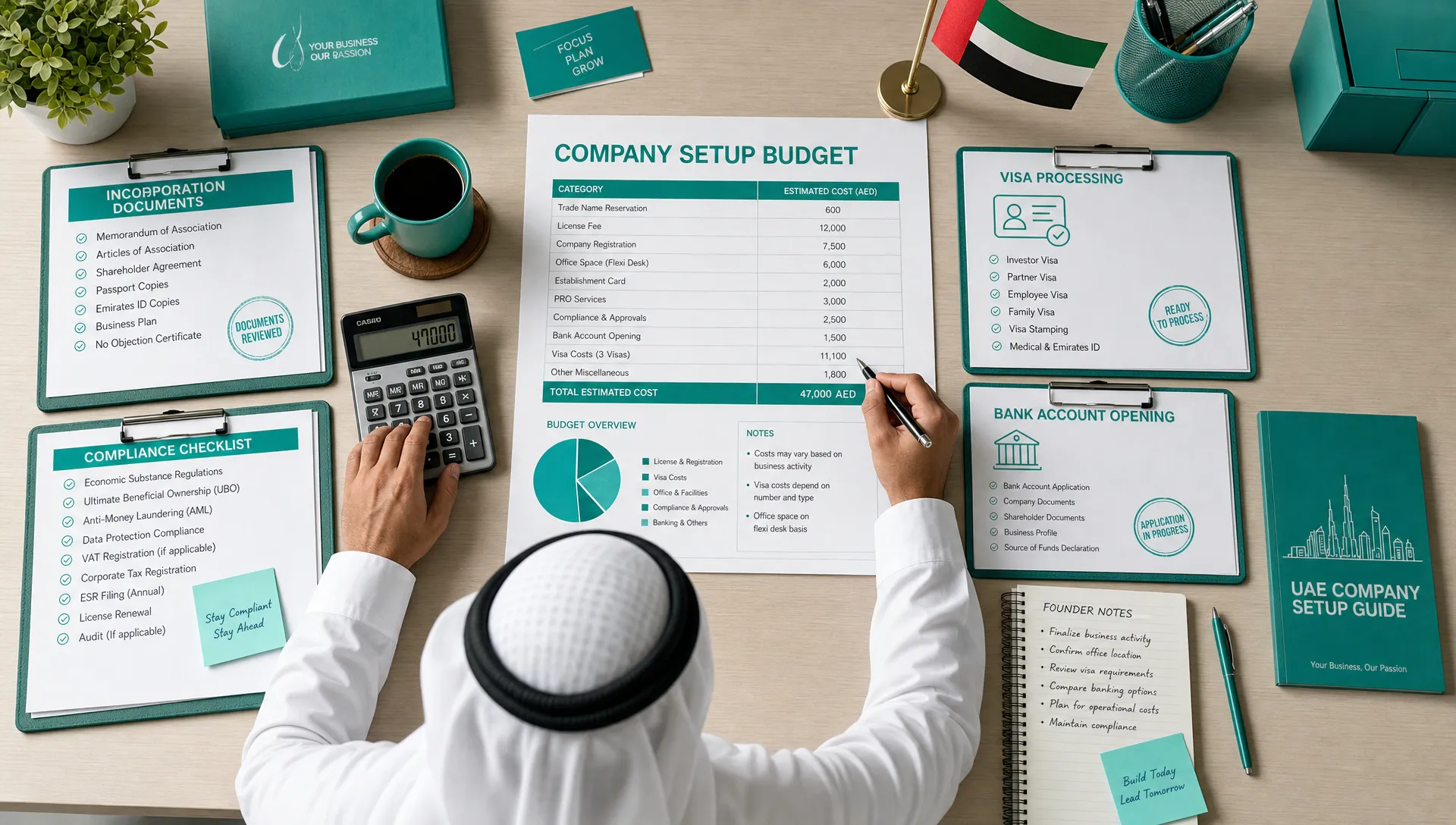
The formation invoice is only one part of the first-year budget. The costs below are often missed because they arrive after the license is issued.
| Cost category | Why it matters | When to budget for it |
|---|---|---|
| Corporate tax registration and advice | UAE corporate tax rules can affect mainland, free zone, and some offshore-linked structures | Before or soon after incorporation |
| VAT registration and filing | Required once taxable supplies and imports exceed the mandatory threshold, with voluntary registration possible in some cases | Before revenue scales or contracts start |
| Bookkeeping | Clean accounts support tax filings, banking, renewals, audits, and investor reporting | From the first transaction |
| Audit or financial statements | Some authorities, shareholders, banks, or tax positions may require audited or formal financials | Before year-end, not after |
| License renewal | Most licenses renew annually, and late renewal can create penalties or operational disruption | Reserve monthly from launch |
| Governance documents | Resolutions, registers, minutes, and approvals support compliance and bank confidence | Whenever ownership, directors, or activities change |
| Insurance and payroll administration | Required or commercially necessary for employees, visas, contracts, and risk management | Before hiring or signing contracts |
At the federal level, the UAE corporate tax regime generally applies a 9% rate to taxable income above AED 375,000, with specific rules for Qualifying Free Zone Persons and other categories. Founders should refer to the Federal Tax Authority’s corporate tax information and obtain advice for their own structure.
VAT is also important. The UAE mandatory VAT registration threshold is AED 375,000 in taxable supplies and imports, with voluntary registration available at a lower threshold in certain cases. The Federal Tax Authority’s VAT guidance is the official reference, but founders should plan bookkeeping and invoicing before they reach the threshold.
Budget by founder profile, not just by jurisdiction
There is no single correct budget for UAE business incorporation. A better approach is to model the first year around the founder’s actual operating profile.
Solo consultant or service founder
A solo consultant may prioritize a simple free zone license, one UAE residency visa, a flexi-desk or shared workspace, bank account opening, bookkeeping, and basic tax registration support.
The budget risk is assuming that a no-visa license package is enough when the founder actually needs residency, local banking, contracts with UAE clients, or a credible office arrangement. The lowest-cost package can be appropriate, but only if it matches the founder’s commercial reality.
Trading, e-commerce, or import business
Trading businesses often need more budget flexibility. They may require the right license activity, customs registration, product approvals, logistics relationships, warehousing, insurance, VAT planning, payment gateways, and stronger banking documentation.
If the company will import goods into the UAE mainland or sell locally, the structure must be designed carefully. A free zone license may still be suitable for certain models, but founders should confirm customs, distribution, and mainland sales implications before choosing purely on license price.
Investor, holding, or asset ownership structure
An offshore or holding structure may have lower operational costs than an active trading company, but it can require more legal and banking preparation. A RAK ICC offshore vehicle, for example, may be useful in the right asset-holding or international structuring context, but it should not be priced as though it were an operating trade license.
Budget for registered agent fees, annual renewal, certified corporate documents, ownership records, bank due diligence, and cross-border tax advice where the shareholders or assets are outside the UAE.
Funded startup or multi-shareholder company
A startup with co-founders, investors, option arrangements, intellectual property, or future fundraising needs should budget for governance from day one. Cheap incorporation can become expensive if the shareholding structure, voting rights, director authorities, or IP ownership need to be repaired later.
Founders in this category should set aside budget for shareholder agreements, board approvals, cap table planning, accounting, tax registration, and clean corporate records that investors can review.
A practical first-year budget framework
Instead of asking, how much does company setup cost in the UAE, build a budget in three layers.
The first layer is incorporation. This includes authority fees, license issuance, registration, legal documents, workspace required for licensing, and professional filing support.
The second layer is operational readiness. This includes visas, Emirates ID, insurance, bank account preparation, accounting setup, tax registration, payment systems, contracts, and any activity-specific approvals.
The third layer is annual continuity. This includes license renewal, lease renewal, visa renewals when due, bookkeeping, tax filings, audit where required, governance maintenance, and ongoing compliance support.
A simple founder budget formula looks like this:
First-year budget = incorporation costs + workspace + visas + banking readiness + tax and accounting + advisory fees + renewal reserve + contingency
A contingency is not a sign of poor planning. It is a recognition that banks, authorities, landlords, and commercial counterparties may request additional documents or upgrades. Many founders reserve 10% to 20% for unexpected setup and launch costs, especially when the company involves multiple shareholders, regulated activities, physical premises, or cross-border ownership.
Questions to ask before accepting a setup quote
A good UAE company setup quote should be clear enough that you can see what is included, what is excluded, what is optional, and what will renew annually.
Before you approve a proposal, ask these questions:
- Does the quoted license activity match exactly what the company will do?
- Are visas included, or only visa eligibility?
- What workspace is included, and does it support the required visa quota?
- Are government or free zone authority fees separated from advisory fees?
- What are the annual renewal costs for the license, office, establishment card, and visas?
- Is bank account support included, and what documents will be prepared?
- Are corporate tax, VAT, bookkeeping, and compliance obligations included or quoted separately?
- Who will advise on structure if the bank, tax position, or ownership chain is complex?
The cheapest answer is not always the lowest-risk answer. Founders should be especially careful when the quote is vague, excludes renewals, promises guaranteed banking, or ignores tax and compliance entirely.
Why compliance and governance belong in the budget
Many founders view compliance and governance as future costs. In the UAE, that can be a costly assumption. Banks, free zones, tax authorities, investors, and counterparties increasingly expect companies to maintain accurate records and explain their ownership, activity, and source of funds.
Budgeting for compliance and governance does not mean overcomplicating the company. It means keeping the basics clean: shareholder registers, UBO information, accounting records, invoices, contracts, board or shareholder resolutions, license renewals, tax registrations, and annual filings where applicable.
For private clients, holding structures, and nominee arrangements, governance is even more important. The structure should be understandable, documented, and aligned with the founder’s commercial and personal objectives.
Frequently Asked Questions
What is usually the biggest UAE company setup cost? The biggest cost depends on the structure. For a simple free zone company, the license and visa package may be the largest early cost. For mainland or operational businesses, office space, approvals, staffing, and compliance can quickly exceed the basic registration fee.
Is a free zone company always cheaper than a mainland company? Not always. A basic free zone package may be cheaper at formation, but the right comparison includes visas, workspace, banking, VAT, customs needs, ability to trade in the UAE market, and renewal costs. The cheaper structure is the one that fits the business without later restructuring.
Should founders budget for UAE corporate tax from day one? Yes. Even if no tax is payable immediately, founders should budget for registration, bookkeeping, accounting, and advice. Free zone companies should also confirm whether they can meet the conditions for any beneficial tax treatment rather than assuming it automatically applies.
Can an offshore company in the UAE reduce setup costs? An offshore company UAE can be cost-effective for certain holding or international structuring purposes, but it is not a substitute for an operating license. If the company needs UAE visas, local operations, or active trading from the UAE, an offshore structure alone may not be suitable.
How can founders avoid hidden costs? Ask for an itemized first-year and renewal budget. Confirm authority fees, professional fees, visa costs, workspace, bank preparation, tax registration, bookkeeping, audit requirements, and renewal obligations before incorporation.
Build the budget before you build the company
The right UAE company setup budget starts with structure, not paperwork. A founder who budgets only for a license may be surprised by visa, banking, tax, accounting, office, and renewal costs. A founder who budgets for the full operating reality can launch with fewer delays and stronger compliance from day one.
Alldren helps founders and private clients design UAE corporate structures with transparent pricing, senior-led advice, and practical support across setup, banking, visas, bookkeeping, tax registration, and ongoing compliance. If you want a company that is built correctly rather than cheaply patched later, start with Alldren.