
A Free Zone RAK setup can be a smart route for founders who want a UAE company with cost control, flexible licensing, and access to Ras Al Khaimah’s business ecosystem. But the setup is only “simple” when the structure matches the founder’s real activity, banking profile, visa needs, and compliance obligations.
The most expensive mistakes often happen before incorporation. A founder chooses the cheapest license, picks an activity that sounds close enough, assumes the bank account will follow automatically, or treats tax registration as a problem for later. The company may still be incorporated, but it can become difficult to bank, renew, expand, or defend from a compliance perspective.
This guide focuses on the practical setup mistakes founders should avoid when considering Free Zone RAK, especially RAKEZ free zone structures, RAK ICC offshore companies, and other Ras Al Khaimah company formation options.
Mistake 1: Treating “Free Zone RAK” as one single product
“Free Zone RAK” is often used casually, but founders should be precise. Ras Al Khaimah has several structures that serve different purposes. A RAKEZ free zone company is commonly used for operating businesses such as consulting, services, trading, light industrial activities, and e-commerce. RAK ICC offshore companies are typically used for holding, structuring, and international corporate purposes, not for running a UAE operating business with visas.
Other RAK options may be relevant for specialized sectors, but the main point is this: the structure should be selected around the business model, not around a vague idea of “opening a company in RAK.”
If you are still deciding between available jurisdictions and structures, Alldren’s comparison of Free Zone RAK options for 2026 founders is a useful starting point before you commit to one path.
The wrong choice can create practical problems. For example, an offshore company may look attractive from a cost or simplicity perspective, but it will not solve the same needs as a free zone operating company if the founder requires UAE residency visas, operational substance, or local banking for active commercial activity.
Mistake 2: Choosing the license activity too quickly
Your license activity is not just a label. It should match how the company will earn revenue, how it will invoice clients, what its website says, what contracts describe, and how banks understand the business.
A common founder mistake is choosing the activity that is cheapest or fastest rather than the one that accurately reflects the business. This can create friction later when the company applies for a bank account, signs customer contracts, imports goods, adds payment processing, or expands into related services.
A license that is too narrow can restrict commercial flexibility. A license that is too broad or poorly matched can raise questions during bank onboarding or compliance reviews. The right approach is to map your activities before incorporation, including your first revenue stream and likely near-term expansion.
Founders should clarify:
- What will the company sell or provide in the first 12 months?
- Will it provide services, trade physical goods, sell digital products, or hold assets?
- Will customers be outside the UAE, in the UAE mainland, or in free zones?
- Will the company need import, export, warehousing, or customs support?
- Will any activity require external approval or regulated licensing?
This is especially important for founders combining multiple activities, such as consulting plus software resale, e-commerce plus logistics, or trading plus brand management.
Mistake 3: Assuming incorporation equals bankability
A RAK free zone license does not automatically guarantee a UAE bank account. Banks conduct their own due diligence. They assess the founder, ownership structure, source of funds, business model, expected transaction flows, customer profile, and economic rationale for the UAE company.
Founders often leave banking until after the license is issued. That is risky. By then, the company name, activity, shareholder structure, facility type, and documents may already be fixed. If any of those choices are not bank-friendly, the founder may need amendments, extra explanations, or a longer onboarding process.
A bank-aware setup starts before incorporation. The company file should tell a coherent story. The business activity, shareholder background, contracts, website, invoices, financial projections, and source of funds should all support the same commercial narrative.
Banks may request documents such as passports, proof of address, corporate documents, shareholder details, business plans, contracts, supplier information, customer information, and evidence of source of wealth or funds. Requirements vary by bank and by case, so founders should not rely on generic promises that a bank account is “included.”
Mistake 4: Confusing RAKEZ free zone companies with RAK ICC offshore companies
This is one of the most important setup mistakes to avoid. RAKEZ and RAK ICC can both be relevant in Ras Al Khaimah, but they are not interchangeable.
| Structure | Common use | Key limitation to understand |
|---|---|---|
| RAKEZ free zone company | Operating business, services, trading, e-commerce, industrial or professional activity | Must maintain the right license, facility, renewals, and compliance for its activity |
| RAK ICC offshore company | Holding assets, international structuring, SPVs, succession or investment planning | Generally not designed for UAE operational trading, UAE office space, or UAE residence visas |
| Combined structure | Holding company plus operating subsidiary, where appropriate | Needs careful governance, banking, tax, and documentation planning |
An offshore company UAE structure can be valuable in the right context, but it should not be used as a shortcut for founders who actually need a UAE operating company. If you need to employ staff, apply for residence visas, invoice operational clients from a UAE business, or build local substance, a free zone operating company may be more appropriate.
The reverse is also true. If the goal is asset holding or a specific corporate structuring objective, an operating free zone company may be more than is needed. The right answer depends on purpose, not popularity.
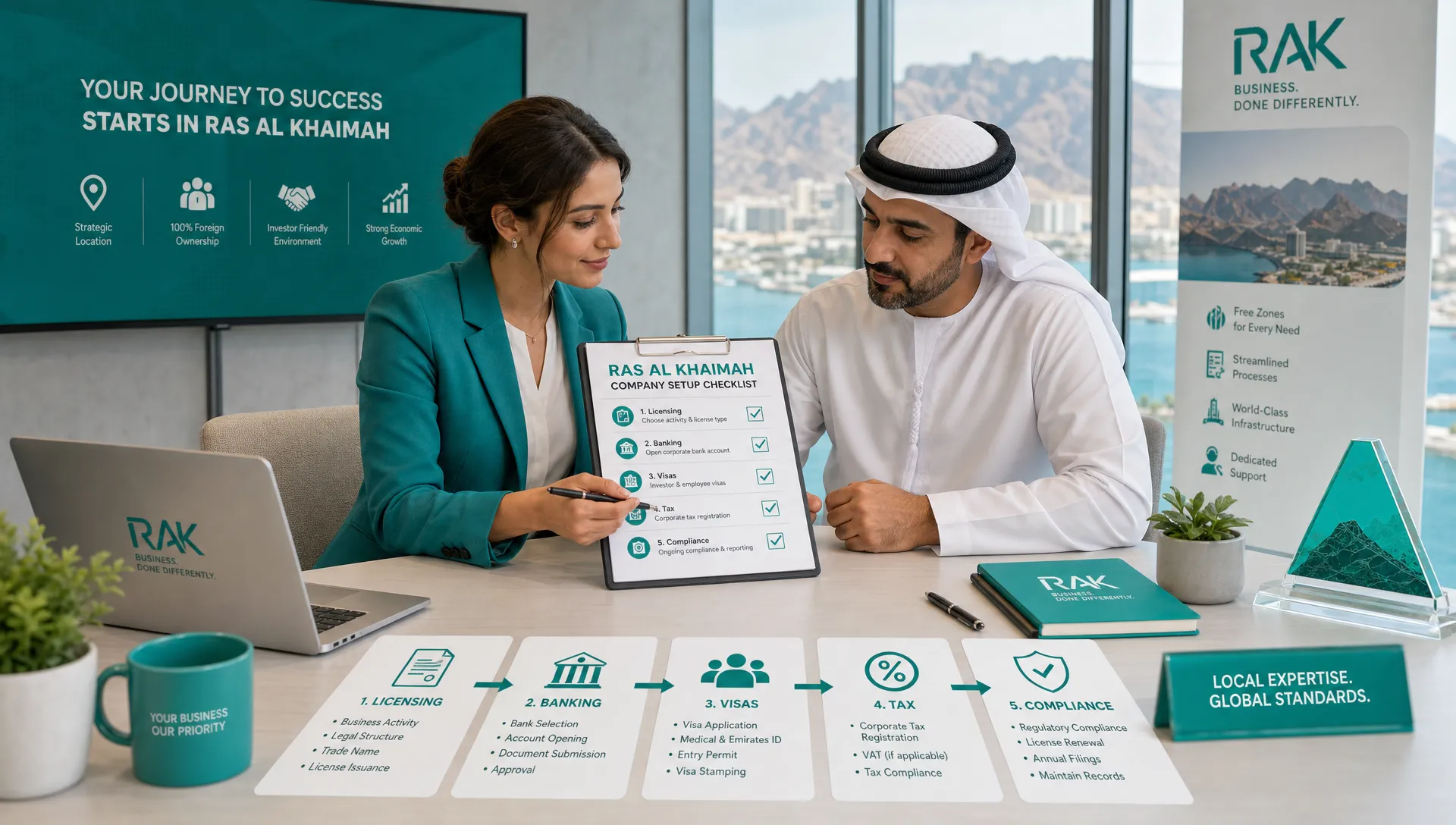
Mistake 5: Leaving tax and accounting until “after launch”
The UAE is a business-friendly jurisdiction, but it is not a no-compliance jurisdiction. Corporate tax, VAT, accounting, recordkeeping, transfer pricing, and free zone tax conditions all need to be considered from the start.
The UAE Corporate Tax regime applies to financial years starting on or after 1 June 2023. The UAE Federal Tax Authority provides official guidance on corporate tax obligations, including rules that may apply to free zone persons. Qualifying free zone treatment can be valuable, but it is not automatic for every free zone company and depends on meeting specific conditions.
Founders should also consider VAT. The FTA’s VAT guidance explains registration and compliance requirements. In practice, VAT exposure depends on the nature of supplies, customer location, revenue thresholds, and other facts.
The mistake is not simply failing to register. The deeper mistake is building a company without knowing how the revenue model will be treated for tax and accounting purposes. A founder should know whether the company needs bookkeeping from day one, whether invoices must be structured in a particular way, whether contracts support the intended tax position, and whether the company can produce proper records at renewal, audit, or bank review.
For founders evaluating RAKEZ specifically, Alldren’s RAKEZ Free Zone Ras Al Khaimah guide explains how activity, facility, banking, and compliance decisions fit together before setup.
Mistake 6: Underestimating facility, visa, and substance decisions
A facility choice is not just an address. It can affect visa eligibility, operational credibility, renewal cost, and bank perception. Founders sometimes choose the smallest or cheapest workspace without considering whether it supports the company’s real plans.
A solo consultant with no immediate hiring plans may have different facility needs from a trading company, a team-based service provider, or a business that requires warehousing. If the founder needs UAE residency, the setup must also account for visa allocation, immigration steps, medical testing, Emirates ID processing, and timing.
Substance matters too. Banks, counterparties, and tax authorities may look at whether the company has an economic rationale, adequate records, management control, and a credible UAE presence for the activities it performs. Substance does not always mean a large office, but it does mean the setup should be defensible and consistent with the business model.
Mistake 7: Ignoring governance in multi-shareholder setups
Many founders focus on getting the trade license issued and leave governance for later. That can become a serious problem if there are co-founders, investors, family shareholders, nominee arrangements, or cross-border ownership layers.
Before incorporation, founders should decide who owns the shares, who controls bank signing, who can bind the company, and what happens if a shareholder exits. In a simple single-founder company, this may be straightforward. In a multi-shareholder structure, it deserves careful planning.
Governance issues to address early include shareholding percentages, manager appointments, signing authority, reserved matters, capital contributions, profit distribution, share transfers, dispute resolution, succession, and document custody.
This is where compliance and governance are not abstract legal concepts. They protect the founder’s control, reduce future disputes, and make the company easier to explain to banks, auditors, investors, and counterparties.
Mistake 8: Comparing only the first-year setup cost
A low first-year quote can be misleading if it excludes renewals, visas, facility fees, amendments, immigration costs, document services, compliance work, tax registration, bookkeeping, or bank account support. Founders should compare total setup and maintenance cost, not just the headline incorporation fee.
The real question is not “What is the cheapest RAK setup?” The better question is “What structure gives me the lowest total friction for my business over the next two to three years?”
A founder who chooses the wrong activity or facility may save money at incorporation and spend more later on amendments, delays, or restructuring. A founder who ignores accounting may save money in month one and face cleanup costs before tax filing, bank review, or renewal.
For a practical view of the cost components founders should budget for, see Alldren’s guide to RAK free zone company setup costs, steps, and timeline.
Mistake 9: Assuming free zone means unrestricted UAE mainland business
A RAK free zone company can be highly effective for international business, free zone activity, and certain UAE-facing models. But founders should not assume that a free zone license automatically permits unrestricted trading across the UAE mainland.
The correct route depends on the activity. A services company may be able to serve clients in different ways from a physical goods trader. A trading business may need customs planning, import arrangements, distributors, logistics providers, or additional approvals. A regulated activity may require approvals outside the free zone authority.
E-commerce founders should be particularly careful. Selling online can involve licensing, payment gateways, warehousing, customs, consumer protection, data handling, and VAT considerations. The license should match the actual operating chain, not just the website description.
Mistake 10: Not documenting the rationale for the structure
A strong UAE business incorporation file should answer a simple question: why does this structure make sense?
That rationale should be clear to the founder, the bank, the free zone authority, accountants, tax advisors, and future stakeholders. It should explain why Ras Al Khaimah was selected, why the activity was chosen, why the shareholder structure is appropriate, how the company will generate revenue, and what compliance steps are planned.
Founders who rely only on verbal advice can struggle later. Written records matter. Keep copies of incorporation documents, shareholder resolutions, license certificates, lease or facility documents, UBO information, tax registrations, accounting records, bank correspondence, and renewal deadlines.
A good structure is not only formed correctly. It is also maintained correctly.
A practical pre-setup checklist for founders
Before approving a Free Zone RAK setup, founders should be able to answer the following questions with confidence.
| Question | Why it matters |
|---|---|
| What will the company actually do? | Determines license activity, approvals, tax treatment, and bank narrative |
| Who are the shareholders and controllers? | Affects governance, UBO reporting, banking, and future transfers |
| Where will customers and suppliers be located? | Impacts VAT, contracts, banking risk, customs, and mainland considerations |
| Does the founder need UAE residency? | Influences facility choice, visa package, timing, and personal relocation planning |
| What will banks see when reviewing the file? | Helps avoid inconsistent documents and weak onboarding explanations |
| What are the annual compliance obligations? | Prevents renewal surprises, tax issues, and poor recordkeeping |
| What is the two-year cost, not just year one? | Gives a realistic picture of setup, maintenance, and amendment costs |
This checklist does not replace legal, tax, or corporate advice, but it helps founders avoid rushed decisions. The best setup process is not the fastest one on paper. It is the one that produces a company that can operate, bank, renew, and scale without avoidable restructuring.
Frequently Asked Questions
Is RAKEZ the same as RAK ICC? No. RAKEZ is commonly used for free zone operating companies, while RAK ICC is generally used for offshore company and holding structures. They serve different purposes and should not be treated as interchangeable.
Can a RAK free zone company open a UAE bank account? It may be able to, but incorporation does not guarantee bank approval. Banks conduct due diligence on the activity, shareholders, source of funds, expected transactions, and overall business rationale.
Is a Free Zone RAK company tax-free? Not automatically. UAE corporate tax rules apply, and free zone treatment depends on meeting the relevant conditions. Founders should assess corporate tax, VAT, accounting, and recordkeeping obligations before setup.
What is the biggest setup mistake founders make? The biggest mistake is choosing a structure based only on setup cost. Activity, banking, visas, tax, governance, and renewal requirements should be considered together.
Do I need a physical office for a RAK free zone company? It depends on the activity, visa needs, facility package, and operational substance required. Some founders may use flexible facilities, while others need offices, warehouses, or more substantial premises.
Build the structure before you build around the license
A Free Zone RAK setup can be efficient, flexible, and commercially useful when the structure is designed around the founder’s real goals. But if the early decisions are rushed, the company may face avoidable issues with banking, visas, tax, renewals, and governance.
Alldren helps founders and private clients approach UAE company setup with transparent structuring, compliance planning, and ongoing corporate support. If you want a setup that is built for how your business will actually operate, start with a structure-led conversation with Alldren.