
Choosing between RAKEZ and other UAE free zones is not just a question of which package looks cheapest on a website. It is a structuring decision that affects your license scope, visa capacity, banking story, tax position, renewal obligations, and how credible your company looks to clients, suppliers, and financial institutions.
RAKEZ, short for Ras Al Khaimah Economic Zone, is one of the UAE’s most practical free zone options for founders who want a cost-conscious, operationally flexible base. But it is not always the best answer. A Dubai address may matter more for some client-facing businesses. A regulated financial activity may need ADGM or DIFC. A heavy logistics model may need a port or airport-linked zone. A passive holding structure may not need a free zone license at all.
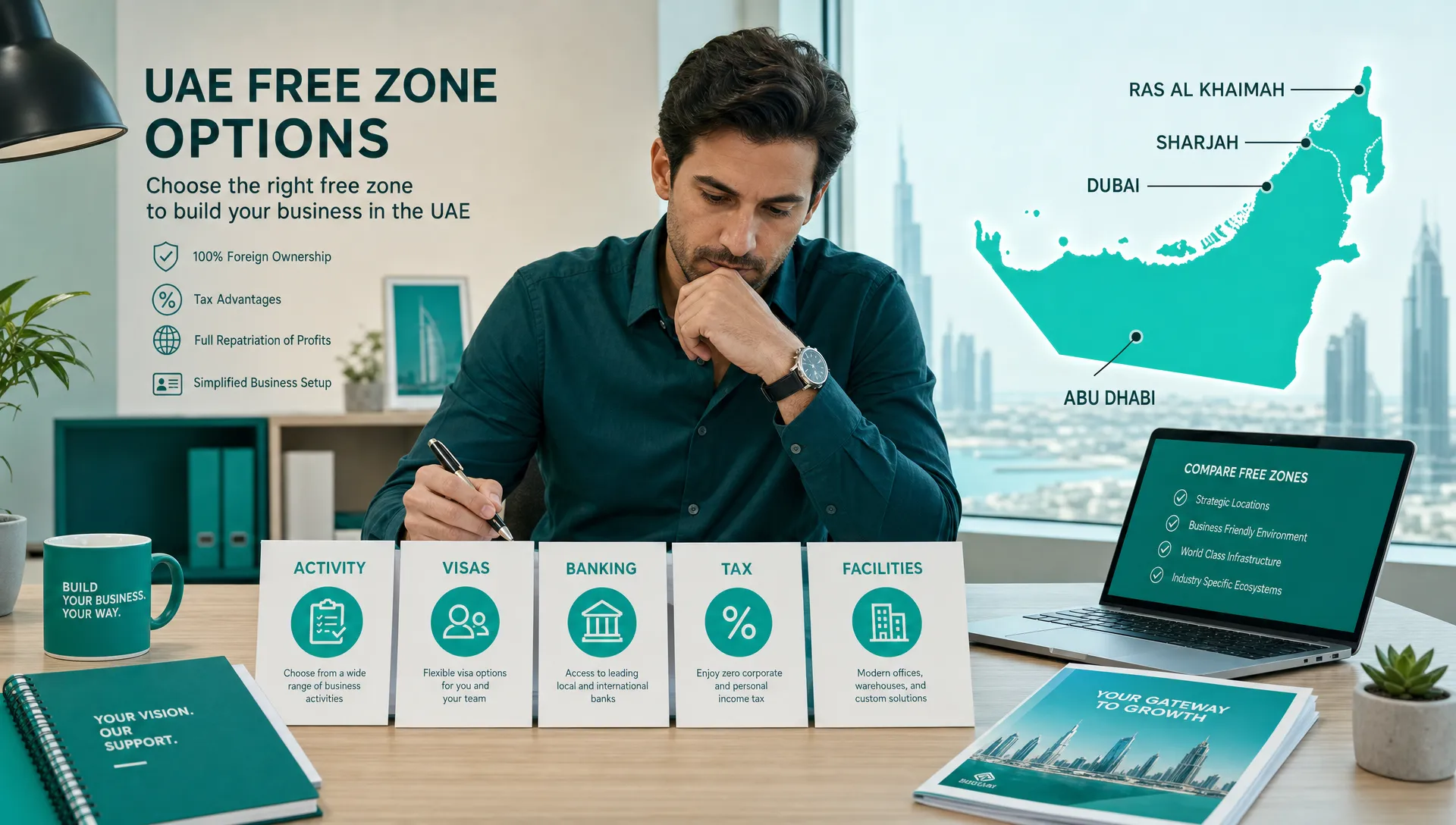
This guide compares RAKEZ Ras Al Khaimah Economic Zone vs other free zones through the lens that matters most to founders: business fit.
The quick answer: when RAKEZ is strongest
RAKEZ is often strongest for founders who want a UAE company that balances cost control with real operating capability. It can be a good fit for professional services, consulting, trading, e-commerce, light industrial activity, and businesses that need a combination of licensing, visas, and physical facilities without the premium positioning of certain Dubai or Abu Dhabi zones.
It is particularly worth considering when your priorities are practical rather than prestige-led. If you need a workable UAE base, predictable setup planning, the option to scale from a small office to larger premises, and a free zone authority familiar with SMEs, RAKEZ deserves a serious look.
Other free zones may be better if your business depends on a specific sector ecosystem, such as commodities, financial services, aviation, media, advanced technology, or deep logistics infrastructure. They may also be better if your clients expect a Dubai or Abu Dhabi address, or if your activity is regulated in a way that RAKEZ does not cover.
For a RAKEZ-specific setup checklist, Alldren’s RAKEZ Free Zone Ras Al Khaimah guide for founders explains how to think through activity selection, legal form, facility choice, banking preparation, and ongoing compliance.
What makes RAKEZ different from many UAE free zones
The UAE has dozens of free zones, and each one has its own activity list, licensing rules, facilities, sector focus, and authority processes. The UAE Government’s official portal notes that free zones are designed to support foreign ownership and business establishment within designated jurisdictions, but the practical details vary significantly by zone.
RAKEZ’s main distinction is that it is broad and operational. It is not only a sector-branded zone for one narrow industry. It is also not only a prestige jurisdiction for highly regulated financial services. Instead, it serves a wide mix of business models, including commercial, service, industrial, and trading activities, subject to the specific activity approvals available at the time of application.
That broad positioning matters because many founders do not simply need a license. They need a structure that can survive real-world scrutiny. Banks will want to understand what the company does, who owns it, where revenue comes from, and why the chosen jurisdiction makes sense. Visa authorities, tax advisers, auditors, and counterparties may also ask whether the company has enough substance for its activity.
RAKEZ can be attractive because it often provides a clear route for founders who need a license, visas, and facility options in one ecosystem. The decision, however, should still be based on your actual activity and future operating plan, not on a generic claim that one free zone is always better than another.
RAKEZ vs other free zones: practical comparison table
The table below is intentionally strategic rather than price-based. Published fees change, packages differ, and the cheapest setup can become expensive if the wrong activity, facility, or visa allocation is selected.
| Decision factor | RAKEZ | Dubai generalist free zones | Specialist and premium free zones | Other northern emirates free zones |
|---|---|---|---|---|
| Typical founder fit | SMEs, trading, e-commerce, consulting, light industrial, and operational companies seeking cost discipline | Founders who value a Dubai address, client proximity, networking, or broad market recognition | Businesses needing sector depth, regulatory infrastructure, or premium positioning | Cost-led service, creative, freelance, or simpler trading structures |
| Cost profile | Often positioned as competitive, especially for SMEs, but final cost depends on activity, facility, visas, and renewals | Very broad range, from startup-friendly packages to more expensive business districts | Often higher because of location, infrastructure, regulation, or sector ecosystem | Often competitive, though activity and facility flexibility may be narrower |
| Facilities and substance | Can support flexi-desk, office, warehouse, land, or industrial needs depending on package and approval | Good variety in many zones, but availability and cost vary widely | Strong where facilities align with the sector, such as logistics, finance, media, or industrial infrastructure | May suit basic office or license needs, but complex operations require careful review |
| Market perception | Practical UAE base, especially for cost-conscious founders and operational SMEs | Stronger brand recognition for some clients because of Dubai location | Strongest where counterparties expect a specific jurisdiction, such as ADGM, DIFC, DMCC, JAFZA, or DAFZ | Useful for simple structures, but may require more explanation to banks or counterparties |
| Banking narrative | Can be strong if activity, ownership, source of funds, and expected transactions are well documented | Often familiar to banks, although documentation standards still apply | Usually strong when the business genuinely fits the zone’s sector logic | Depends heavily on activity, profile, and preparation |
| Best avoided when | You need a highly specialized regulated ecosystem, a prestige location, or a specific Dubai/Abu Dhabi address | You do not need the address premium or the cost structure does not match your margins | Your business does not need the specialist ecosystem and would be over-structured | Your business needs more facilities, visibility, or sector-specific credibility than the zone can provide |
How RAKEZ compares for common founder profiles
Service companies and consultants
For consultants, agencies, professional service providers, and remote-first founders, RAKEZ can be a sensible option if the licensed activity matches the actual work performed. The main comparison point is usually not whether RAKEZ can issue a license, but whether the license description, facility, and visa plan support your commercial reality.
Dubai free zones may win when client perception is central. If you pitch to enterprise clients in Dubai every week, attend local events, or rely on proximity to a specific business district, a Dubai free zone might support your positioning. If your clients are international and the UAE company mainly provides a stable incorporation, invoicing, and residency platform, RAKEZ may be more efficient.
Trading and e-commerce businesses
Trading and e-commerce founders should compare free zones by activity scope, import and export requirements, customs needs, warehousing, and banking. A low-cost license that does not support the right trading activity, storage model, or payment flow can create problems later.
RAKEZ can be relevant for trading businesses that need a practical UAE base and may require facility options beyond a simple desk. However, businesses heavily dependent on a specific port, airport, fulfillment hub, or Dubai-based marketplace presence should compare zones linked to those operations.
Industrial and manufacturing businesses
RAKEZ is often more compelling for industrial, manufacturing, assembly, and light production models than many founder-oriented free zones that focus primarily on virtual offices or small professional licenses. If your business needs land, warehouses, or industrial facilities, the comparison changes entirely.
In this category, you should compare RAKEZ not only with startup-friendly free zones, but also with industrial and logistics zones in Dubai, Abu Dhabi, Sharjah, and other emirates. The right answer depends on utilities, labor accommodation, logistics routes, lease terms, approvals, and the nature of goods handled.
Regulated finance, fintech, and investment activity
RAKEZ is not usually the natural first choice for regulated financial services. If your business involves regulated investment management, brokerage, banking, fund structures, or financial promotion, you should examine specialist jurisdictions such as DIFC in Dubai or ADGM in Abu Dhabi, depending on your exact activity and regulatory requirements.
That does not mean every finance-adjacent company needs DIFC or ADGM. A software company serving financial clients, for example, may have a different licensing route from a company giving regulated investment advice. The key is to distinguish between technology, consulting, administration, and regulated financial activity before choosing a zone.
Asset holding and private wealth structures
If your main goal is holding shares, real estate, family assets, or international investments, a standard free zone operating company may not be the most efficient structure. In Ras Al Khaimah, founders and private clients often compare RAKEZ with RAK ICC, which is an offshore company registry rather than a free zone operating license.
This distinction is important. A RAKEZ company is generally considered when you need an active licensed business, visas, facilities, and UAE operational presence. A RAK ICC company may be considered for certain holding, succession, or asset ownership objectives where no UAE operational license or visa platform is required. Alldren’s guide to RAK ICC company vs free zone structures explains this choice in more detail.
The seven criteria that matter more than headline price
1. Licensed activity fit
Every UAE free zone has its own activity list. A business activity that sounds similar across zones may have different implications for banking, tax, visas, and customer contracts. Your license should describe what you actually do, not merely what is cheapest to obtain.
Before selecting RAKEZ or any other free zone, map your revenue streams. If you sell products, identify whether you import, export, store, dropship, distribute, or sell only online. If you provide services, clarify whether they are management consulting, marketing, software development, technical services, education, recruitment, or another regulated area.
2. Facility and substance requirements
A facility is not just an address. It can affect visa quota, economic substance, bank comfort, renewal cost, and operational credibility. Some businesses can operate from a flexi-desk. Others need a dedicated office, warehouse, workshop, or industrial plot.
RAKEZ can be competitive when a founder wants room to scale facilities over time. Some other free zones are excellent for simple service companies but less suitable for storage, production, or on-the-ground operations. The right question is not “What is the cheapest office?” It is “What facility supports the business model I will actually run?”
3. Visa strategy
Many founders choose a UAE free zone because they also need UAE residency visas for shareholders, employees, or family planning. Visa eligibility is tied to the company structure, facility, quota, and authority rules.
When comparing RAKEZ with other free zones, check whether the package supports the number of visas you realistically need. Do not choose a zero-visa or minimal package if your actual goal is relocation, hiring, or long-term UAE presence.
4. Bank account opening
A UAE company does not automatically receive a UAE bank account. Banks review ownership, nationality and residency profile, business activity, source of funds, expected counterparties, transaction volumes, website or contracts, and the logic of the chosen free zone.
RAKEZ can work well from a banking perspective when the story is coherent and documents are prepared properly. The same is true for other free zones. Problems usually arise when the company is incorporated quickly with a generic activity, no clear business plan, weak proof of source of funds, or no explanation of expected transactions.
5. Client and supplier perception
A free zone is also a signal. A Dubai free zone may help if your brand depends on a Dubai presence. DMCC may be helpful for commodities-related credibility. JAFZA or DAFZ may be relevant for logistics. ADGM or DIFC may be expected for certain financial and investment activities.
RAKEZ’s signal is different. It often communicates practicality, operational flexibility, and cost-conscious UAE establishment. For many SMEs and international founders, that is exactly the right signal. For some premium, regulated, or location-sensitive businesses, it may not be.
6. Tax and compliance implications
Free zone incorporation should not be treated as a shortcut around tax compliance. The UAE Corporate Tax regime applies to businesses, and free zone companies must assess their position carefully. The UAE Ministry of Finance explains that the standard Corporate Tax rate is 9% on taxable income above AED 375,000, while qualifying free zone treatment may apply only where specific conditions are met.
In practice, this means you should consider accounting, transfer pricing where relevant, qualifying income, substance, related-party transactions, and filing obligations. A company that is cheap to form but poorly documented can become expensive at tax registration, audit, renewal, or bank review stage.
7. Renewal and future changes
Founders often focus on setup and forget about year two. Renewal costs, lease changes, visa renewals, activity amendments, shareholder changes, and accounting requirements all matter.
RAKEZ and other free zones can be straightforward when the structure is chosen properly at the start. But if you select the wrong activity, understate your visa needs, or use the company for transactions outside its licensed scope, restructuring later can be more painful than setting up correctly from day one.
RAKEZ vs Dubai, Abu Dhabi, Sharjah, and northern emirates free zones
RAKEZ competes most directly with other cost-conscious and operationally flexible free zones. Compared with many Dubai options, it may offer a more practical cost base, especially where a Dubai address is not essential. Compared with some northern emirates zones, it may offer a stronger mix of activity breadth and facility options, particularly for businesses that may grow beyond a basic license.
Compared with Abu Dhabi specialist zones, RAKEZ is usually less about regulatory prestige and more about SME-friendly execution. If you need ADGM because of financial regulation, investor expectations, or common law structuring, RAKEZ is unlikely to replace it. If you simply need a UAE company for consulting, trading, or operations, ADGM may be unnecessarily complex or expensive.
Compared with sector-heavy Dubai zones, RAKEZ should be assessed by operational need. A company trading physical goods through specific logistics infrastructure may benefit from a zone linked to ports, airports, or warehouses. A manufacturing or assembly company, however, may find RAKEZ attractive if its facility, approval, and cost profile fit the business.
If you are comparing the broader emirate-level trade-offs, Alldren also provides a separate Ras Al Khaimah Economic Zone vs other Emirates comparison that looks at RAK against Dubai, Abu Dhabi, Sharjah, and other UAE locations.
Common mistakes when comparing RAKEZ with other free zones
Founders usually make the wrong choice for one of five reasons. They compare only the first-year license price. They choose a vague activity because it is easier. They ignore banking until after incorporation. They underestimate visas and facility requirements. Or they select a jurisdiction because a peer used it, even though the peer has a different activity, shareholder profile, and transaction pattern.
A better comparison starts with your business model. Who owns the company? What will it sell? Where are customers and suppliers located? Will it need UAE employees or only shareholder visas? Will it hold inventory? Will it receive international payments? Will it have related-party transactions? Will counterparties expect a particular jurisdiction?
Once those answers are clear, the free zone decision becomes much easier. RAKEZ may be the right choice, or another UAE free zone may be more appropriate. The goal is not to choose the most famous zone. The goal is to choose the zone that makes your company easier to operate, bank, renew, and defend from a compliance perspective.
Frequently Asked Questions
Is RAKEZ cheaper than Dubai free zones? RAKEZ is often positioned as a cost-conscious option, but the real comparison depends on license activity, facility, visa allocation, approvals, and renewal costs. A low first-year price is not enough to judge total cost.
Is RAKEZ better than IFZA, Meydan, DMCC, or Dubai South? It depends on the business. RAKEZ may suit founders seeking operational flexibility and cost discipline. A Dubai free zone may be better if you need a Dubai address, a specific sector ecosystem, logistics access, or stronger client recognition in Dubai.
Can a RAKEZ company open a UAE bank account? A RAKEZ company can apply for a UAE bank account, but approval depends on the bank’s due diligence. Banks review the business activity, ownership, source of funds, expected transactions, documents, and the commercial logic of the structure.
Does a RAKEZ company automatically get 0% UAE Corporate Tax? No. Free zone companies must assess whether they meet the conditions for qualifying free zone treatment. Corporate Tax registration, accounting, filing, and compliance should be planned properly.
Should I choose RAK ICC offshore instead of RAKEZ? RAK ICC may be relevant for certain holding or asset ownership goals where you do not need an active UAE operating license, visas, or facilities. RAKEZ is generally more relevant for active businesses that need licensing and operational presence.
Build the right UAE structure before you incorporate
The best free zone is the one that matches your activity, banking profile, visa needs, tax position, and long-term operating plan. RAKEZ can be an excellent fit for many founders, but it should be chosen as part of a complete UAE structuring decision, not as a standalone license purchase.
Alldren provides expert-led support for UAE company setup, structuring, compliance, governance, bank account opening support, visa processing, bookkeeping, and tax registration. If you want a transparent, senior-led assessment before choosing RAKEZ or another free zone, start with Alldren’s UAE corporate services team.